This post will show you the top 5 best data recovery software.
Data loss is becoming a common problem with the rapid digitalization of the world. Multiple reasons can result in data loss, such as accidental deletion, hardware malfunction, formatted devices, data breaches, etc.
In all such situations, the general view is that the data is lost forever. But thanks to technological advancement, the reality is a bit different; this is where data recovery software comes into action.
A data recovery tool scans your targeted drive and searches for all the recoverable data, including those you deleted long ago.
So, if you have encountered data loss and are looking for paid or free data recovery software, this article presents the best data recovery software you can choose from.
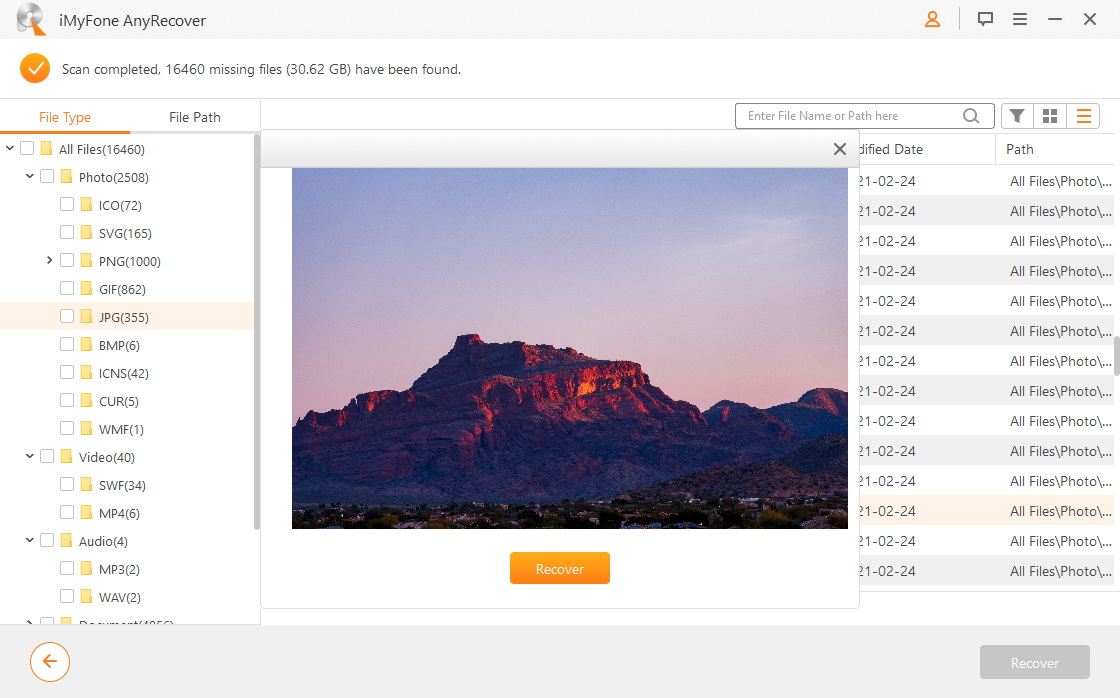
iMyFone AnyRecover is the one-stop tool that addresses all data recovery needs with exceptional performance and efficiency.
It can recover files from formatted devices, damaged hard drives, emptied recycle bins, computer crashes, and many other data loss scenarios.
AnyRecover is recommended by dozens of media platforms, and you can witness users’ trust because it has over 1 million downloads. Besides its feature-rich nature, it is designed to be user-friendly and requires just a few clicks to complete the recovery process.
System Compatibility: AnyRecover supports Windows 10/8.1/ 8/7/XP.
Pros
High recovery rate.
Super-fast scanning speed.
Recover data from computers, laptops, USB drives, SD cards, external hard drives, and other storage media.
It supports 1000+ file types and formats, almost all file types users could expect.
Filter scan results and preview content before restoring.
Cons
The free version provides recovery for limited file types.
Pricing: AnyRecover comes with 4 pricing plans, as follows:
Free: Scan/preview recoverable files and restore 3 files for free without a size limit.
1-Month Plan: Unlimited monthly data recovery for 1 PC at $49.95.
1-Year Plan: Unlimited data recovery for 1 PC at $59.95 annually.
Lifetime Plan: Unlimited data recovery for 1 PC at a one-time cost of $79.95.
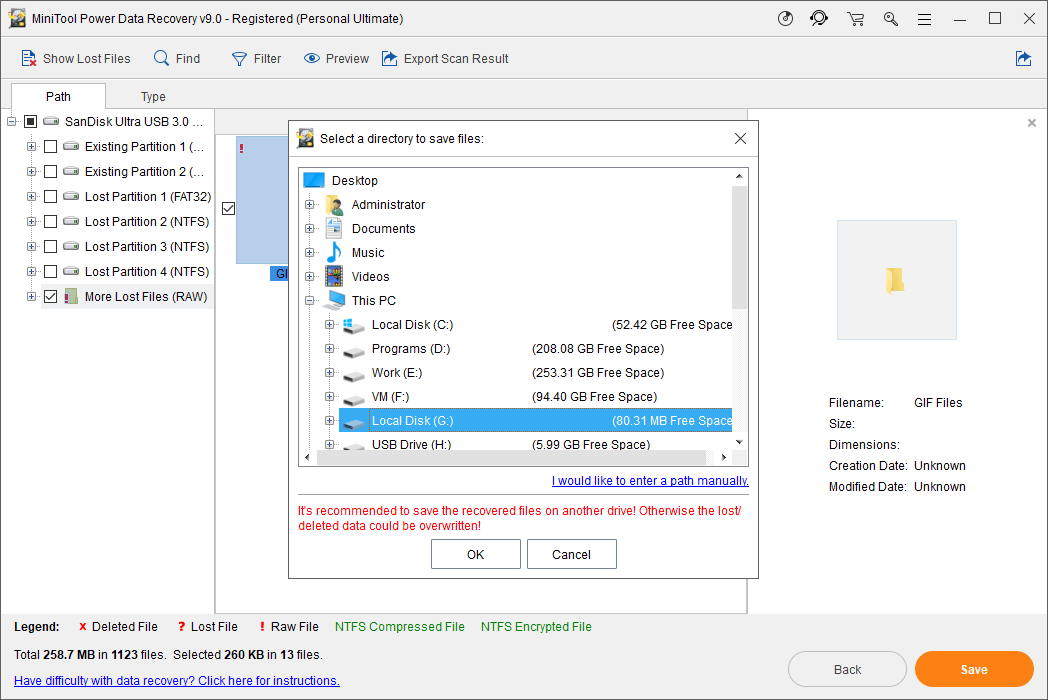
MiniTool Data Recovery is an easy-to-use data recovery tool that can quickly recover data from desktop, SSD, HDD, USB drive, recycle bin, etc.
It is designed to address significant data loss situations, such as hard drive failure, accidental deletion, virus attack, OS crash, partition loss, etc. It supports 70+ file types, ensuring the tool quickly detects all the popular recoverable files.
System Compatibility: MiniTool Data Recovery supports Windows 10, 8.1, 8, and 7.
Pros
Load the previous scan results.
Preview files before restoring.
Supports 70+ file types
Simple steps and accurate recovery.
Cons
The scanning process is a bit slow.
The monthly and annual subscription plans are quite expensive.
Pricing: MiniTool Data Recovery comes with 4 pricing plans, as follows:
Free: 1GB data recovery limit with no premium features.
Monthly Subscription: Unlimited data recovery for one PC at $69 monthly.
Yearly Subscription: Unlimited data recovery for one PC at $89 annually.
Personal Ultimate: Unlimited data recovery for 3 PCs at a lifetime cost of $99.
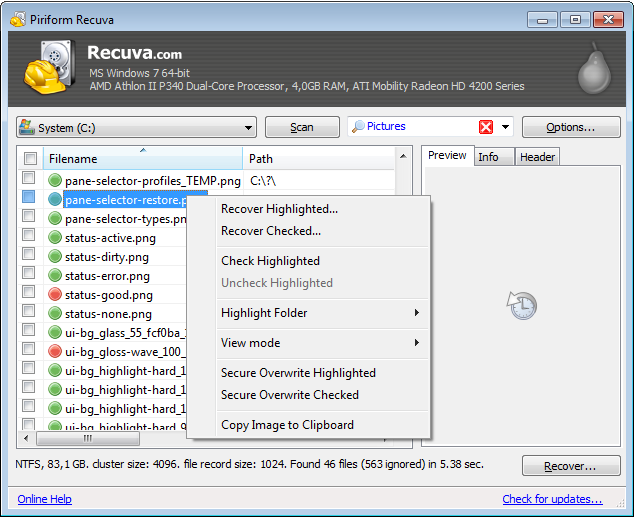
Recuva is a Windows data recovery tool that can quickly recover videos, documents, music, pictures, and other file types. Other than recovering permanently deleted files from computer drives, it supports recovering rewritable media, such as USB drives, external hard drives, memory cards, etc.
It also provides a deep scan to search out buried files. To simplify the process, it comes with a user-friendly interface and preview functionality to enhance the recovery process.
System Compatibility: Recuva supports Windows 10, 8.1, 7, XP, and Vista.
Pros
Free data recovery software.
Secure file deletion with no trace of the deleted file.
Preview of recoverable files.
Simple and friendly interface.
Deep scanning.
Cons
Its recovery performance is less efficient compared to other paid tools.
The scanning process is slow.
Pricing: Recuva provides two pricing plans, as follows:
Free: Free access to the tool with no file size limitation.
Pro: A cost of $19.95 to get more advanced features, such as virtual hard drive recovery, premium support, etc.
4. Stellar Data Recovery
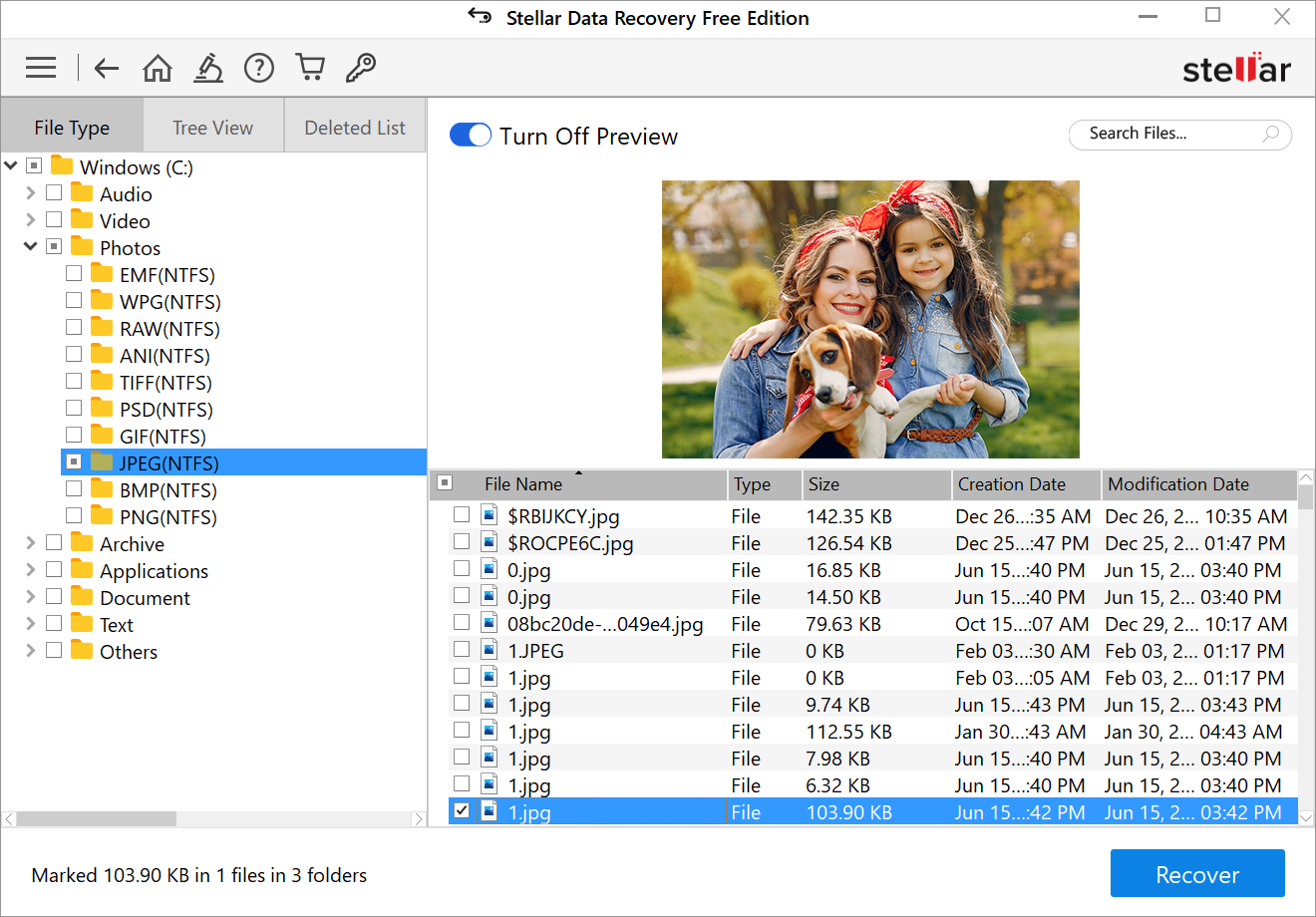
Stellar Data Recovery is another powerful tool that can recover all the deleted or lost data from almost all types of files.
It can quickly recover data from formatted, corrupt, or encrypted HDD, USB drives, SSD, optical discs, etc. Besides that, it can also restore data from unbootable or crashed systems.
System Compatibility: Stellar Data Recovery supports Windows 10, 8.1, 8, and 7.
Pros
Simple steps to complete the recovery process.
Preview files before saving.
Excellent customer support.
Virtual drive recovery.
Cons
Only 1GB of data can be recovered for free.
Most expensive tool.
Pricing: Stellar Data Recovery provides four pricing plans, as follows:
Free: 1GB of free data recovery.
Professional: 30-day license at $59.99 for a single system.
Premium: 30-day license at $79.99 for a single system.
Technician: 1-year license at $199 for 3 systems.
5. Disk Drill
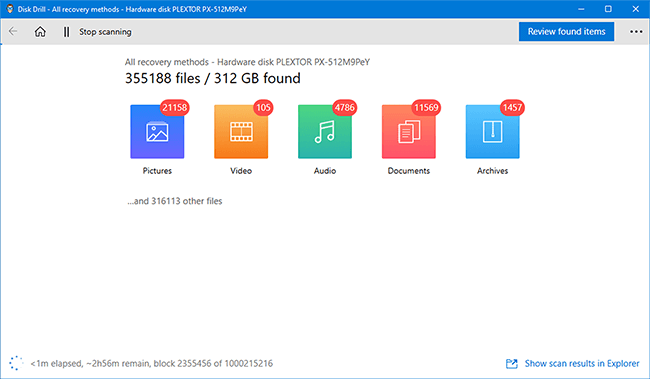
Disk Drill is a Windows data recovery tool that can recover lost files from a hard drive, USB drive, SD cards, or other storage media by just pressing few clicks.
It can recover any file type, as its scanning algorithms can find and rebuild dozens of file formats, including document, photo, video, and audio popular formats. It provides a user-friendly graphical interface so that technical and non-technical users can quickly complete the process.
System Compatibility: Disk Drill supports Windows 10, 8.1, 8, 7, XP, Vista, and Windows Server 2008, 2012, 2016, and 2019.
Pros
Simple graphical interface.
Search files by name.
Preview and select the files after the scanning process.
Robust scanning to ensure all the recoverable data is extracted.
Cons
Only 500MB is recoverable under the free version.
No proper phone technical support.
Pricing: Disk Drill provides three pricing plans, as follows:
Basic: A free plan with a recovery limit of 500MB.
Pro: A premium plan for $89 with unlimited recovery for 1 user.
Enterprise: An ideal plan for large organizations at $499 and unlimited recovery for 10 users.
Best Data Recovery Software: Frequently Asked Questions
Data loss can be a heart-stopping experience. Fortunately, data recovery software offers a lifeline in many cases. Here are some frequently asked questions to guide you through the world of data recovery solutions:
Which data recovery software is best for file recovery?
There isn’t a single “best” software, as it depends on your specific needs and budget. Here are some factors to consider:
Type of Data Loss: Was it accidental deletion, formatting, or a drive failure? Different software caters to various scenarios.
Operating System: Windows, Mac, or mobile devices have compatible data recovery software options.
Ease of Use: Some software prioritizes simplicity, while others offer more advanced features for experienced users.
Cost: Data recovery software ranges from free options with limited features to premium software with robust recovery capabilities.
Here are some popular choices to consider:
For Ease of Use: Recuva (Windows), Disk Drill (Windows & Mac)
For Advanced Features: Stellar Data Recovery (Windows & Mac), EaseUS Data Recovery Wizard (Windows & Mac)
Free Option (with limitations): Recuva (Windows)
What data recovery software do professionals use?
Professional data recovery software often has a steeper price tag but offers more powerful features and capabilities. These can be crucial for complex data loss scenarios or for recovering critical business data. Some examples include:
R-Studio (Windows, Mac, Linux)
GetDataBack (Windows)
DMDE (Windows)
Is there a free data recovery software that actually works?
Yes, there are free data recovery software options available. However, they typically have limitations, such as:
Recovery capacity restrictions (e.g., the limited amount of data recoverable for free)
Read-only recovery (recovered files can be viewed but not saved without upgrading)
Limited features compared to paid versions
Free options like Recuva can be a good starting point for simple data loss situations. For more complex scenarios or recovering large amounts of data, paid software might be necessary.
What’s the best mobile data recovery software?
Data recovery for mobile devices can be trickier. Some options include:
Disk Drill (Android)
EaseUS MobiSaver (Android & iOS)
Dr. Fone (Android & iOS)
How to recover permanently deleted files?
Data recovery software works by retrieving data that hasn’t been overwritten by new information on the storage device. “Permanently deleted” files aren’t truly gone until overwritten. Therefore, the data recovery success rate depends on how quickly you act after deletion and how much the drive has been used since.
How can I recover my data for free?
There are a few ways to try recovering data for free:
Built-in Recovery Options: Some operating systems have built-in recovery tools (e.g., Recycle Bin on Windows).
Free Data Recovery Software: As mentioned earlier, free options like Recuva can be a starting point for basic recovery attempts.
Data Recovery Services (Limited Free Trials): Some data recovery services offer free trials that might allow you to recover a limited amount of data. However, proceed cautiously and thoroughly research the service before providing any payment information.
Bottom Line
Data recovery success rates depend on the specific situation. The sooner you act after data loss, the better your chances of recovering your files.
Consulting a professional data recovery service might be necessary in critical situations where irreplaceable data is lost.
In this post, I will talk about market research web scraping.
Market research has to do with gathering the right information at the ideal time. Nowadays, almost every business is data-driven, and web scraping is one of the most reliable ways to collect data at scale. You may want to track your competitors or monitor your customers’ preferences. Whichever it is, we’ll explain how web scraping can help as you continue reading.
What is Market Research Web Scraping?
Simply put, market research web scraping involves extracting publicly available data for business purposes. As a business owner, your team won’t have to manually visit hundreds of web pages to copy information. Instead, you use scraping tools and scripts to automatically collect, structure, and analyze the data. It’s faster and much more efficient.
You can gather almost any type of market information using web scraping. That said, the common details most businesses are after include:
Competitor pricing
Product listings
Customer reviews
Social media mentions
Job postings
News articles
Industry trends
If done properly, market research web scraping gets you detailed insights that would be impossible to do manually.
Reliable Proxies for Market Research Web Scraping
Choosing the right provider is critical because your entire data pipeline depends on speed, success rate, and resistance to blocking. Below are some of the best-performing options:
Oxylabs — High Success Rate & Enterprise Reliability
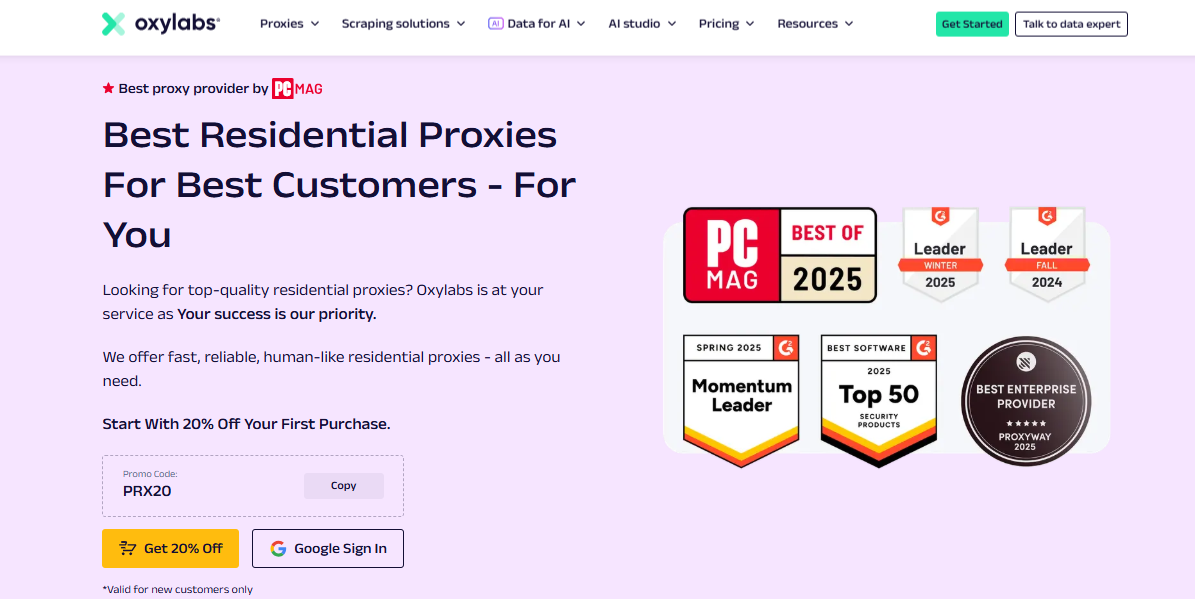
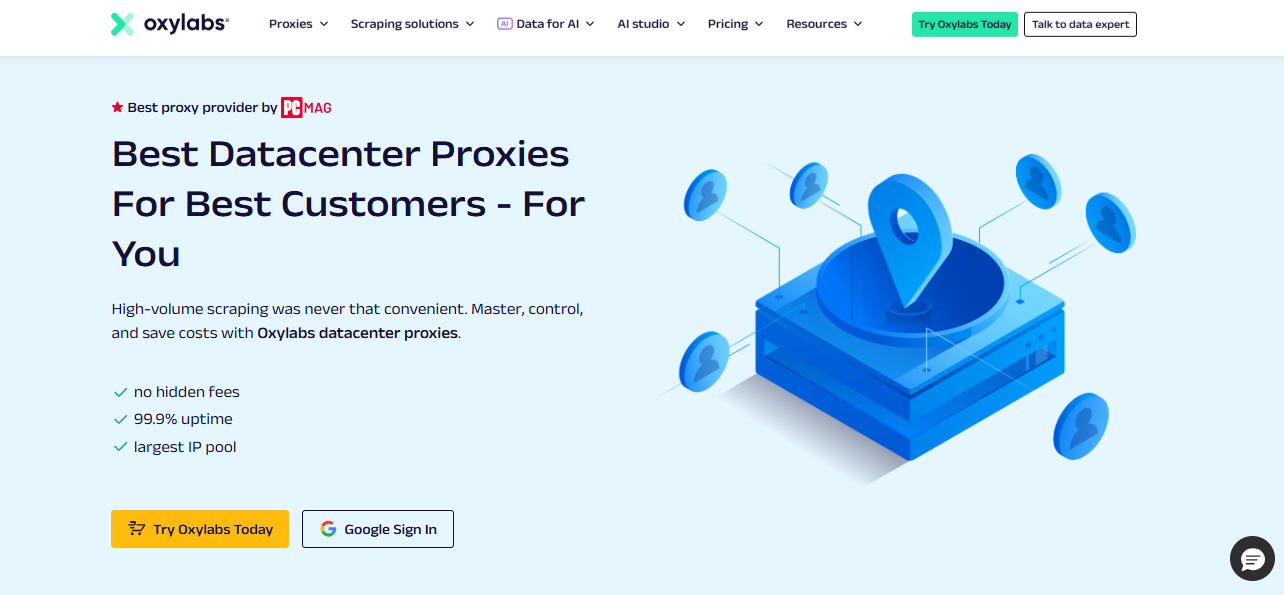
Oxylabs is widely recognized for delivering premium, enterprise-grade proxy infrastructure. With a 99% success rate, it’s built to handle demanding market research tasks where missing data is not an option.
It offers:
Dedicated datacenter proxies for high-volume scraping
One of the largest residential proxy networks globally
Advanced tools like a Web Scraper API for automation
This makes Oxylabs especially effective for:
Large-scale competitor price monitoring
Aggregating product listings across multiple platforms
Continuous data collection without interruptions
👉 If your focus is accuracy, uptime, and scale, Oxylabs is a top-tier choice.
Oxylabs Proxies
Oxylabs Proxies offer enterprise-grade, AI-powered proxy solutions with a massive 175M+ IP pool, ensuring unmatched...Show More
Oxylabs Proxies offer enterprise-grade, AI-powered proxy solutions with a massive 175M+ IP pool, ensuring unmatched reliability, speed, and anonymity for large-scale web scraping and data collection. Show Less
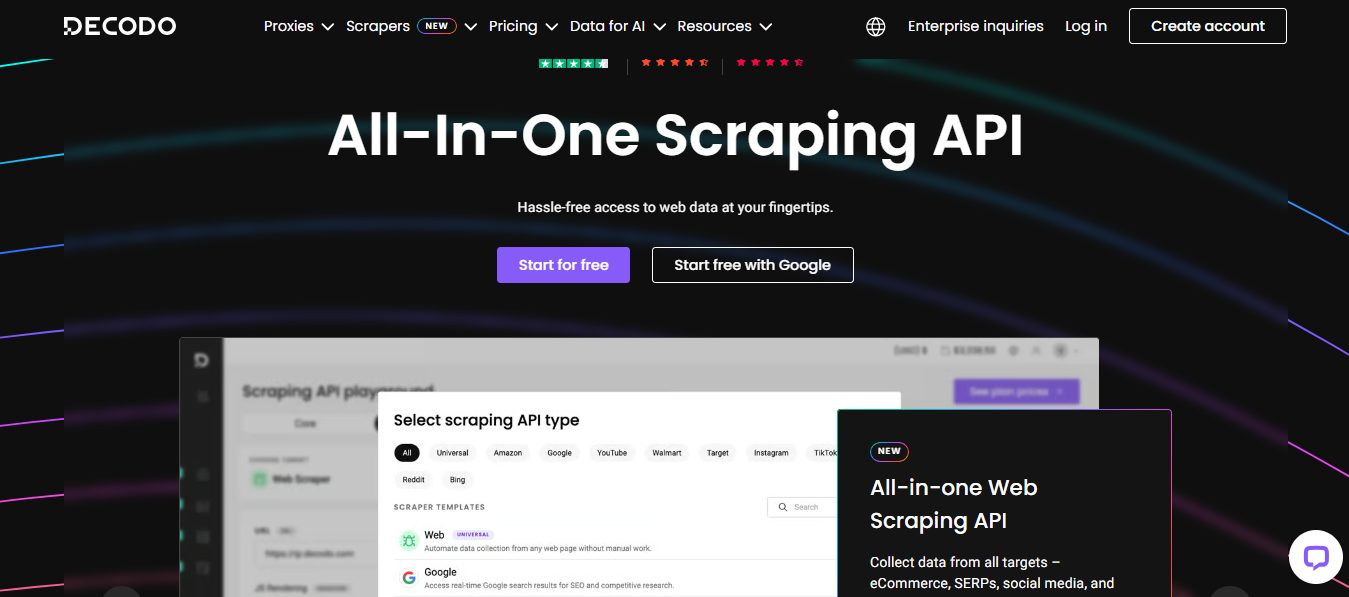
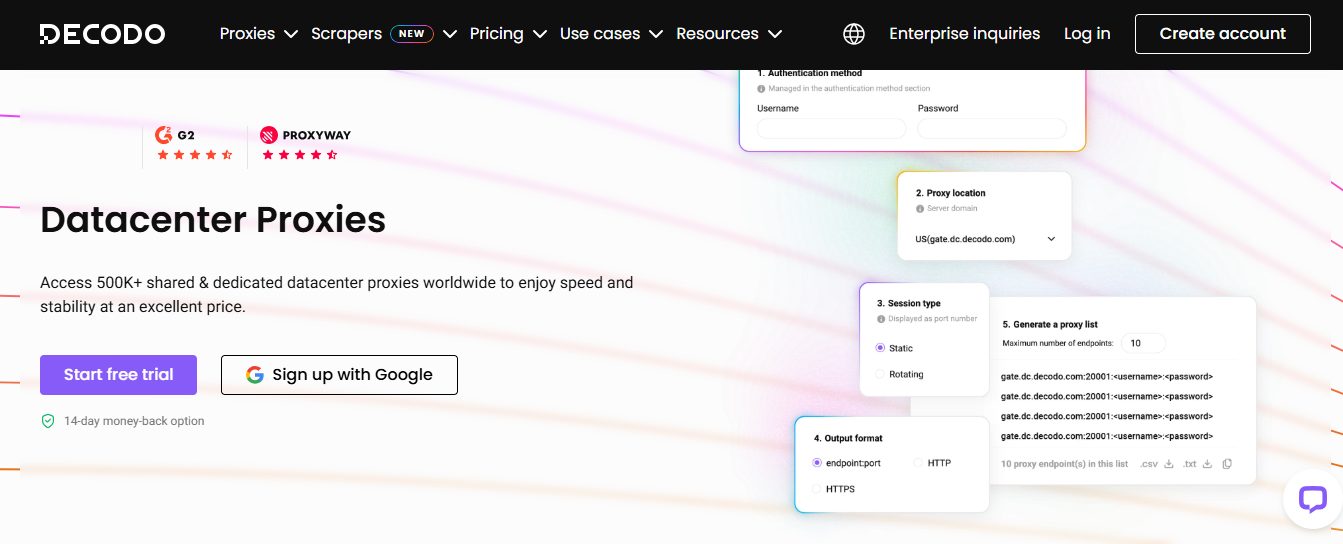
Decodo (formerly Smartproxy) is an award-winning proxy provider designed for efficiency and ease of use. Its standout feature is the dedicated Web Scraping API, which simplifies complex scraping workflows.
Key advantages include:
Access to millions of IPs worldwide
Automatic proxy rotation to avoid detection
Built-in anti-blocking and CAPTCHA handling
Decodo is ideal for:
Businesses that want plug-and-play scraping solutions
Teams scaling data collection without heavy infrastructure
Projects involving geo-targeted or restricted content
👉 If you want a balance of power, automation, and simplicity, Decodo delivers strong performance.
Decodo (formerly Smartproxy)
Decodo (formerly Smartproxy) is an AI-powered proxy service and web scraping solutions provider that enables seamless...Show More
Decodo (formerly Smartproxy) is an AI-powered proxy service and web scraping solutions provider that enables seamless, large-scale data extraction with smart, reliable, and cost-effective tools for businesses of any size. Show Less
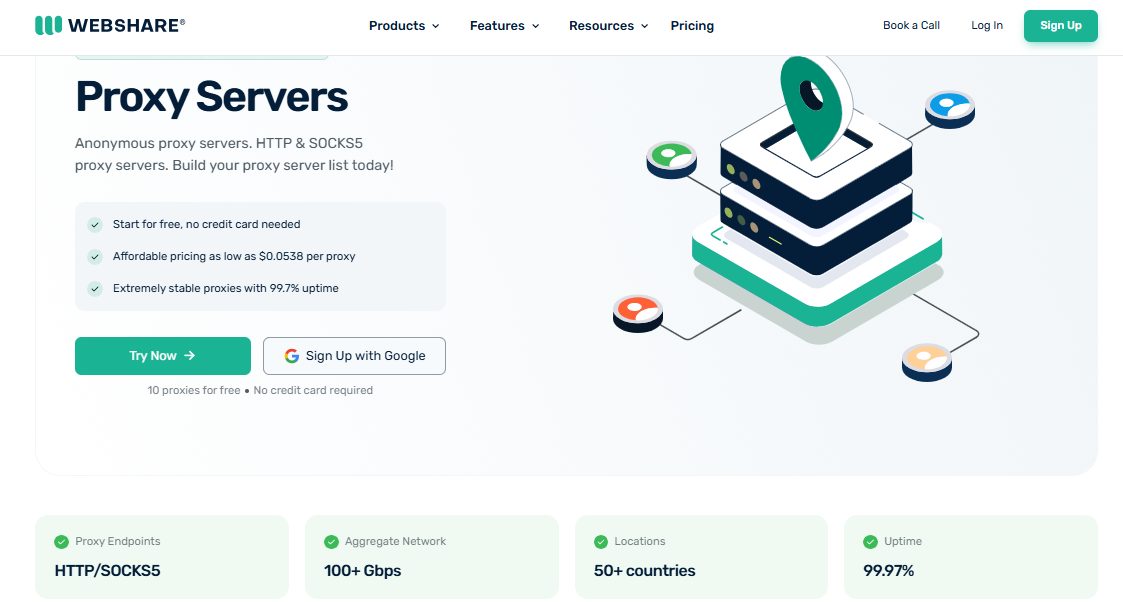
Webshare is a practical option for businesses that need reliable performance without excessive costs. With 500,000+ datacenter IPs and millions of residential proxies, it supports a wide range of market research use cases.
What makes Webshare stand out:
Optimized for pricing intelligence and public data extraction
Fast servers with dedicated bandwidth for consistent speed
24/7 expert customer support to assist with setup and scaling
It’s particularly useful for:
Startups and growing data teams
High-volume scraping with budget considerations
Teams that want a simple, no-friction setup
👉 If your goal is affordable scalability with dependable support, Webshare is a solid choice.
Webshare Proxies
Webshare Proxies offers high-speed, customizable, and budget-friendly proxy solutions with flexible pricing, ensuring...Show More
Webshare Proxies offers high-speed, customizable, and budget-friendly proxy solutions with flexible pricing, ensuring seamless web scraping, automation, and online anonymity for businesses and individuals. Show Less
Quick Recommendation Guide
Need
Best Option
Enterprise-scale, high accuracy
🟢 Oxylabs
Automation + ease of integration
🔵 Decodo
Budget-friendly, scalable scraping
🟠 Webshare
5 Major Use Cases in Market Research
As we explained earlier, you can source various types of data using market research web scraping. Let’s now look at the five major ones:
1. Competitor Price Monitoring
Many businesses want to know what their competitors are charging, so they can adjust their prices accordingly. This is common, especially for service providers, where pricing is often private. Large-scale online businesses like e-commerce and travel platforms also use it to aggregate data from many sites. In such niches, web scraping allows you to extract and monitor costs in real time.
2. Consumer Sentiment Analysis
After competitors, customers are the most important profiles to businesses. So, many companies use market research web scraping to source product reviews, forum discussions, and social media comments. That way, they know how customers feel about their products and services. It’s qualitative data that’s invaluable for marketing strategies and business development.
3. Trend Identification
If you’re in an industry and you don’t know what’s trending, your business won’t sell. To catch all the latest updates, you can use web scraping to retrieve data from news sites, niche blogs, and search engine results. The main advantage is that you’ll spot the trends early, before they become mainstream. As you adjust your strategy or product roadmap, you stay ahead of the competition.
4. Lead Generation and Prospecting
Converting leads and prospects is one of the best signs of a successful business. Market research web scraping on directories, LinkedIn, and other industry sites can help you identify the right people to message. From the data you collect, you can build comprehensive prospect lists with business names, contact information, and company details.
5. Product and Inventory Research
This use case applies mostly if you’re a manufacturer or product retailer. Web scraping can be reliable in curating information from supplier catalogs and competitor product pages. Subsequently, you apply the data to track inventory levels and launch new, better products.
Proxies for Market Research Web Scraping
When scraping data for market research, it’s usually a large-scale project. Therefore, it’s necessary to get a reliable proxy to facilitate the process. The reason is that most websites set rate limits per IP address. So, if a site detects too many requests from a single IP, it automatically blocks that IP. Without proxies, then, data collection is slow, and the entire research operation may fail.
Thankfully, there are many secure proxies you can rely on for your market research. Here are our best picks:
Oxylabs: Offers high-quality proxies with a 99% success rate for retrieving public data. It has dedicated datacenter IPs for high-volume web scraping in the market research space.
Decodo: An award-winning proxy service with a dedicated web scraping API. The API lets you scrape data with millions of IPs and built-in anti-blocking technology.
Webshare: Features 500,000+ datacenter IPs with specific use cases for pricing intelligence and public data. Expert customer support is available 24/7 to help you with your project.
If you’re on a tighter budget, you can also consider IP Royal or Mars Proxies. Both have first-hand residential proxies that can be used for web scraping efficiently.
Bottom Line: Web Scraping Offers a Competitive Advantage
As a business, investing in web scraping for market research can easily put you ahead of your competitors. That’s because it gives you a broad view of the entire industry with data you can’t fetch through manual browsing or periodic reports. All you need is a proper scraping tool and a secure proxy like Oxylabs, Decodo, or Webshare.
You can use the Python-based Scrapy, which is highly customizable. Alternatively, you can go for Puppeteer or Playwright if the site is JavaScript-heavy and requires browser rendering. BeautifulSoup is also a decent option for lighter parsing tasks.
While scraping, it’s important to maintain ethical standards. What you’re after is mainly product or service information, pricing, reviews, and other publicly available business data. Define your targets, and avoid collecting personal information. Also, if the source website has an API, use it instead of scraping directly.
FAQs: Market Research Web Scraping
What is market research web scraping?
Market research web scraping is the process of automatically collecting publicly available data from websites to gain business insights. Instead of manually browsing hundreds of pages, scraping tools gather and structure data such as:
Competitor pricing
Product listings
Customer reviews
Social media mentions
Industry trends
This allows businesses to make faster, data-driven decisions at scale.
How do businesses use web scraping for market research?
Businesses use web scraping across several key areas:
Competitor monitoring → Track pricing and offerings
Product research → Monitor inventory and supplier data
These insights help companies stay competitive and respond quickly to market changes.
Why are proxies important for market research scraping?
When scraping at scale, sending too many requests from a single IP can trigger rate limits or blocks. Proxies solve this by distributing requests across multiple IP addresses, ensuring smooth and uninterrupted data collection.
Top proxy providers for market research include:
Oxylabs→ High success rates and strong performance for large datasets
Decodo→ Advanced scraping API with built-in anti-blocking features
Webshare→ Reliable datacenter proxies with strong support and scalability
Using proxies ensures your scraping operation remains efficient and consistent.
4. Is market research web scraping legal?
Yes—if done correctly. Market research scraping should focus only on publicly available data such as pricing, product information, and reviews.
Best practices include:
Avoid scraping personal or sensitive data
Respect website terms of service
Use official APIs where available
Following these guidelines helps ensure your data collection remains ethical and compliant.
5. What tools are best for market research web scraping?
The right tools depend on the complexity of your project:
Scrapy → Powerful and customizable for large-scale scraping
Puppeteer / Playwright → Ideal for JavaScript-heavy websites
BeautifulSoup → Lightweight option for simple parsing tasks
To maximize performance, combine these tools with reliable proxies like Oxylabs, Decodo, or Webshare for scalable data extraction.
This combination allows you to build a robust, efficient market research system.
Here is the ultimate guide to SERP Scraper APIs. Read on.
Search engine results pages (SERPs) are the mines for digital marketers to optimize their websites. Whether you’re monitoring competitors, tracking keyword positions, or feeding machine learning models, scraping SERP data has become essential for businesses, SEO specialists, data scientists, and developers.
But web scraping isn’t a walk in the park — especially when it comes to SERP scraping, where IP bans, CAPTCHA, location targeting, and data accuracy pose relentless challenges.
Enter the SERP Scraper API — a specialized solution designed to bypass these headaches and deliver clean, structured, real-time search engine data at scale.
In this comprehensive guide, we’ll explore what SERP Scraper APIs are, how they work, and why they are indispensable. We’ll also break down the top three industry leaders — Oxylabs, Webshare, and Decodo (formerly Smartproxy) — and what makes their offerings stand out in this evolving ecosystem.
What Is a SERP Scraper API?
A SERP Scraper API is a web-based service that allows users to automatically extract search engine results in real-time by making API calls.
These APIs bypass traditional scraping limitations like rate limits, CAPTCHAs, and dynamic rendering, offering reliable, scalable, and legal ways to collect SERP data across Google, Bing, Yahoo, Yandex, and more.
Core Features Typically Include:
Real-time & scheduled scraping
Location-specific results
Device-type targeting (desktop/mobile)
Structured JSON/HTML response
CAPTCHA-solving & proxy rotation
Support for organic, paid, map, news, image results
Whether you’re tracking hundreds of keywords or collecting millions of data points, a solid SERP Scraper API ensures that you can extract search data without friction.
Why SERP Scraping Matters More Than Ever?
In a digital world governed by visibility, SERP data is everything. Businesses and analysts rely on SERP insights for:
SEO strategy: Monitor keyword performance, detect ranking drops, and analyze SERP features.
Market intelligence: Track competitors’ ads, brand mentions, and product listings.
Ad verification: Confirm the presence and accuracy of paid ads across different locations.
Trend detection: Analyze news, featured snippets, and question boxes to tap into emerging search behavior.
SERP volatility: Detect algorithm changes and measure volatility indices for informed decisions.
Challenges of SERP Scraping Without an API
Trying to manually scrape SERPs with DIY scripts and browser bots is a recipe for frustration:
IP blocks & bans: Major search engines detect scraping behavior and block suspicious IPs.
CAPTCHAs: Solving them at scale is inefficient and unreliable.
Rate limits: Without sophisticated throttling, your tools are quickly shut down.
Geo-targeting: Scraping localized results (e.g., New York vs. London) requires rotating residential or mobile IPs.
Parsing complexity: Dynamic JavaScript content is tough to handle without headless browsers.
This is why enterprise-grade SERP Scraper APIs have become the tool of choice for serious data operations.
Top SERP Scraper API Providers – EDITOR’S CHOICE
Below, we examine three industry leaders that dominate the SERP API landscape with robust infrastructure, reliability, and scale: Decodo, Oxylabs, and Webshare.
Decodo (formerly Smartproxy) is loved by 130K+ users around the globe for its ease ofuse, fast-responsive support, and high-quality solutions. With its fresh new identity,Decodo continues to offer one of the most dev-friendly and powerful SERP scraping API in the market.
Key Features:
Free AI Parser
Advanced geo-targeting
Built-in proxy management
Flexible output formats
Ability to collect data from Google Search, Google Images, Shopping, and News tabs
Why Decodo Stands Out:
Decodo is a versatile choice that scales beautifully for both beginners and heavy-dutyprojects. Whether you’re scraping 100 or 1,000,000 SERPs, their Web Scraping API is built to scale together with your projects.
Additional Benefits:
JavaScript rendering
100% success rate
Real-time and on-demand scraping tasks
Decodo (formerly Smartproxy)
Decodo (formerly Smartproxy) is a powerful proxy service provider with advanced APIs, including its Amazon Scraping API...Show More
Decodo (formerly Smartproxy) is a powerful proxy service provider with advanced APIs, including its Amazon Scraping API, which delivers effortless, real-time access to accurate Amazon data at scale with zero blocks and zero maintenance. Show Less
Oxylabs is widely recognized for its premium-grade infrastructure and enterprise-class data delivery. Their SERP Scraper API stands out due to its coverage, speed, and accuracy.
Key Features:
✅ Real-time scraping with a 100% success rate
🌐 Coverage for Google, Bing, Yandex, Baidu, and other regional engines
🎯 Geo-targeted SERPs — scrape by country, city, or even ZIP code
🔐 Captcha solver and proxy management built-in
⚙️ JSON & HTML support
📊 Batch keyword support
Why Choose Oxylabs?
Oxylabs is ideal for large-scale, mission-critical SERP monitoring. Their infrastructure is unmatched for volume, uptime, and global reach. It’s the go-to choice for enterprise SEO platforms, e-commerce brands, and financial analytics firms.
Developer Friendliness:
Excellent documentation
24/7 customer support
SDKs available for Python, Node.js, etc.
Oxylabs Proxies
Oxylabs Proxies offer enterprise-grade, AI-powered proxy solutions with a massive 175M+ IP pool, ensuring unmatched...Show More
Oxylabs Proxies offer enterprise-grade, AI-powered proxy solutions with a massive 175M+ IP pool, ensuring unmatched reliability, speed, and anonymity for large-scale web scraping and data collection. Show Less
🥉 Webshare SERP API – The Smart Cost-Effective Contender
Webshare strikes a powerful balance between affordability and performance. Known for its generous free plans and robust proxy network, it offers a clean and reliable SERP scraping experience tailored to startups, agencies, and mid-size businesses.
Key Features:
✅ Fast SERP scraping with automatic retries
🌎 Worldwide geo-targeting
🔁 Proxy rotation and user-agent management
🛡️ CAPTCHA bypass
🧩 Supports organic, news, map packs, and ads data
What Makes Webshare Different?
Affordable pricing tiers – Webshare’s transparent pricing makes it accessible to startups
No learning curve – API is easy to implement with quick start guides
Free credits to test – Generous free tier for trial and evaluation
Best Use Cases:
Keyword tracking for SEO agencies
Local SEO audits and competitive research
PPC ad monitoring for clients
Webshare Proxies
Webshare Proxies offers high-speed, customizable, and budget-friendly proxy solutions with flexible pricing, ensuring...Show More
Webshare Proxies offers high-speed, customizable, and budget-friendly proxy solutions with flexible pricing, ensuring seamless web scraping, automation, and online anonymity for businesses and individuals. Show Less
Comparison Table: Oxylabs vs. Webshare vs. Decodo
Feature
Oxylabs
Webshare
Decodo (Smartproxy)
Geo-targeting
✅ City/ZIP
✅ Country-level
✅ City-level
CAPTCHA bypass
✅ Built-in
✅ Built-in
✅ AI-assisted
Free trial
✅ Yes
✅ Yes
✅ Yes
Speed & reliability
🚀 Enterprise-grade
⚡ Fast & stable
⚡ Fast with AI parsing
Price range
💰 Mid-tier
💸 Affordable
💸 Affordable
Proxy integration
✅ Yes
✅ Yes
✅ Yes
Dev tools & support
🛠️ SDK + 24/7 chat
📚 Docs + email
🛠️ Docs + dashboards + APIs
Other Top SERP Scraper API Providers
1. SERPMaster
SERPMaster is a specialized tool built purely for scraping search engines. It offers a Google-only SERP API optimized for high-scale operations with minimal latency. Unlike more generalized scraping tools, SERPMaster’s core focus is delivering real-time organic search results, paid ads, and SERP features like featured snippets, people also ask boxes, and more.
It supports parameters for country, device type (desktop/mobile), language, and location. One of its major selling points is its simplicity — no overcomplication, just straightforward SERP data. It’s ideal for users who need to perform deep keyword tracking, run SEO software, or generate large volumes of search analytics.
With a robust infrastructure and automatic CAPTCHA-solving, SERPMaster helps digital marketers bypass traditional scraping headaches. Their flexible pricing model and solid documentation make it a great alternative for users who want to focus purely on Google SERP data without dealing with a more complex API stack.
2. Cloro
Cloro is a single API for accessing both traditional search results and answers generated by major AI search engines. It returns real-time Google Search and Google News results as structured JSON, making it useful for developers building search monitoring, SEO research, competitive intelligence, and data-driven applications.
What makes Cloro particularly interesting is that the same API key can also retrieve what ChatGPT, Perplexity, Gemini, Copilot, and Google AI Overviews answer for a given prompt. Alongside the generated responses, Cloro provides the sources cited by each AI engine, allowing developers to analyze not only what these platforms say, but also which websites and publishers they rely on.
This combination makes Cloro useful for emerging AI visibility and Generative Engine Optimization (GEO) workflows. Businesses can monitor how their brands, products, competitors, or topics appear across conventional Google results and AI-generated answers without having to integrate separate APIs for every platform.
Cloro uses credit-based pricing, with a free tier offering 500 credits per month for testing and smaller projects. Its Lite plan starts at $30 per month, providing a relatively accessible entry point for developers and teams that need both SERP data and AI search intelligence through one API.
For teams looking beyond conventional SERP scraping, Cloro offers an interesting advantage: Google Search, Google News, and multiple major AI answer engines can all be queried through a unified API, reducing the complexity of building and maintaining separate search-data integrations.
3. SERPAPI
SERPAPI is one of the most well-known SERP scraping tools on the market. It supports a wide range of search engines, including Google, Bing, Yahoo, DuckDuckGo, Baidu, and even platforms like YouTube, Walmart, and eBay. It’s an excellent option for users who want a single API to handle all types of search result extraction.
SERPAPI goes beyond just delivering HTML or raw search data — it structures the response into clean, categorized JSON. For example, you can retrieve separate blocks for ads, knowledge graphs, FAQs, images, news, maps, and more. This structured approach is useful for developers and businesses integrating SERP insights into dashboards or analytics tools.
Its high concurrency, real-time speed, and generous free plan make it popular among startups and indie developers. SERPAPI also has official client libraries for Python, Node.js, and Ruby, reducing integration time. The platform’s vibrant documentation and community support give it extra points.
4. Apify
Apify is a broader web scraping platform that also offers a dedicated Google SERP Scraper Actor. While Apify isn’t purely a SERP API vendor, its flexibility makes it a great choice for technical teams who want custom workflows. You can configure Apify’s scraping actors to extract organic results, ads, people-also-ask sections, or anything on the SERP with precise targeting.
What sets Apify apart is its workflow automation, integration with headless browsers like Puppeteer and Playwright, and cloud-based processing. You can scrape SERP data and immediately feed it into crawlers, Google Sheets, or your own API endpoints.
Apify also provides serverless deployment and auto-scaling, making it a strong fit for users who want more than just keyword rank data. You can build your own “SERP workflows” and chain them with other APIs and integrations. It’s powerful, but may have a steeper learning curve for non-technical users.
5. Bright Data (formerly Luminati)
Bright Data is a premium proxy and data collection platform offering enterprise-grade solutions. Its SERP API is deeply integrated with its global residential, mobile, and datacenter proxy pool, which gives it unmatched flexibility for scraping across countries, regions, and devices.
Bright Data offers both synchronous and asynchronous API models, and it provides complete DOM rendering and browser emulation, which is ideal for dynamic SERPs and localized results. You can access organic listings, top stories, shopping results, and local map packs with pinpoint accuracy.
Although Bright Data is often pricier than competitors, it’s an ideal solution for large-scale data extraction projects requiring compliance, stability, and volume. Their legal framework is strict — ensuring ethical scraping — and their compliance-first approach gives enterprise customers peace of mind.
Their platform is rich in features, but you’ll need some technical skills or onboarding support to get the most out of it.
6. DataForSEO
DataForSEO is a data infrastructure provider offering rich APIs for keyword research, SERP data, rank tracking, and backlink profiles. Their SERP API is part of a larger suite that integrates with SEO, SEM, and PPC analysis tools.
It supports scraping across search engines like Google, Bing, Yahoo, and Yandex, and provides granular control over request parameters, including country, city, language, and device. You can extract data for organic listings, paid results, featured snippets, and SERP features such as “People Also Ask” or local packs.
One advantage of DataForSEO is its pay-as-you-go model — great for agencies and developers who don’t want long-term contracts. They also provide bulk SERP crawling, batch keyword support, and postback functionality for integration with CRMs and custom dashboards.
If you want precise, developer-friendly data feeds to power SEO tools or market research dashboards, DataForSEO is a top-tier contender.
7. ScraperAPI
ScraperAPI is a generalized web scraping platform that has added support for scraping search engines through customizable request headers and built-in proxy rotation. While not as laser-focused on SERP APIs as others, ScraperAPI makes up for it with scalability and ease of use.
Their infrastructure automatically handles CAPTCHAs, IP blocks, and location targeting. You can specify user agents, headers, and parsing options — great for scraping SERPs from desktop, mobile, or specific browsers.
It integrates well with Google SERPs and can be paired with parsing tools or custom scripts to extract clean JSON. Their pricing is competitive, and they offer robust usage tracking. While it doesn’t provide the rich SERP feature classification that others like SERPAPI do, it’s a solid foundation for those who want to build their own scraper logic using raw data responses.
ScraperAPI is perfect for developers who want to scale fast without getting tangled in proxy and CAPTCHA management.
FAQs: SERP Scraper API
Is SERP scraping legal?
SERP scraping is a legal gray area. While scraping publicly available data isn’t illegal in most countries, it can violate a website’s terms of service. Using compliant providers and avoiding personal data collection is essential.
Can I use a free SERP Scraper API?
Yes, some platforms like SERPAPI and Webshare offer free credits or trial plans. However, free plans usually have strict limits on volume, speed, and features. For commercial or high-volume use, paid plans are more reliable.
What search engines are typically supported?
Most providers focus on Google, but others offer support for Bing, Yahoo, Yandex, Baidu, DuckDuckGo, and even vertical engines like YouTube, Amazon, and eBay. Always check the API’s documentation for exact coverage.
How do I integrate a Web Scraper API into my application or script?
Most Web Scraper APIs offer RESTful endpoints you can call using Python, Node.js, PHP, or any language with HTTP support. Similarly, developers working on sports applications can use a Tennis API for developers to access structured data such as live scores, matches, players, rankings, and tournament information. You pass parameters like the target URL, headers, or rendering options, and the API returns the result in your preferred format, ready to be parsed or stored in your database.
How is a SERP API different from a proxy?
A proxy only gives you IP access to make your own requests, while a SERP API is a full-service solution that handles proxy rotation, CAPTCHA solving, geo-targeting, and parsing. APIs are simpler and more reliable.
Can SERP APIs track mobile vs. desktop results?
Yes, most modern SERP APIs allow you to choose the device type for the query. This helps simulate real-world scenarios since Google’s mobile and desktop rankings can differ significantly.
Use Cases by Industry
🔍 SEO Agencies
Track thousands of keywords across regions with daily updates. Automate client SERP reports and rankings with ease.
🛒 E-commerce
Monitor how products appear in Shopping results. Benchmark against competitors on a weekly basis.
📰 News Monitoring
Use SERP APIs to monitor trending topics, featured snippets, and news carousel placements in real time.
📊 Data Analytics & Research
Feed structured SERP data into dashboards, ML models, or research reports. Perfect for trend spotting and predictive analysis.
Final Thoughts: Picking the Right SERP API
When choosing a SERP Scraper API, the key is to match the scale of your project, budget, and desired features.
If you’re an enterprise or platform provider, go with Oxylabs for its battle-tested infrastructure and ultra-reliable delivery.
If you need affordability and simplicity, Webshare delivers strong value without overcomplicating things.
And if you want a versatile, smart engine with full parsing capability, Decodo (Smartproxy) is a worthy addition to your stack.
All three providers have earned their place in the SERP API elite — now it’s just a matter of choosing the right ally for your data mission.
Ready to Scrape Smarter?
Choose your SERP scraper wisely, automate your data flow, and dominate your niche — with the power of Oxylabs, Webshare, and Decodo behind you.
👉 Visit SecureBlitz for more tutorials, reviews, and exclusive affiliate offers from top proxy and scraping brands.
In this post, I will discuss the first year of owning a Dubai Home after the developer warranty ends.
Your defect liability period has ended. That single fact moves every AC service, every leaking tap and every tripped breaker from the developer’s ledger onto yours, whether or not anyone told you the exact date it happened. What follows is how to turn that first year of full responsibility into a calendar you control, rather than a string of calls you make only after something stops working.
Before this point, day-to-day wear inside the unit sat in a grey zone many owners never questioned closely.
Once your defect liability period closes, that grey zone disappears. Every AC unit, every tap, socket and appliance no longer under its own manufacturer warranty is now solely yours to service, repair or replace.
Check your sale and purchase agreement for the exact date that period ended, rather than assuming it matches what a neighbour or a friend in another building experienced. Developers write that clause differently, and the date on your own contract is the only one that governs your unit.
Turning ownership into a maintenance calendar
A property does not announce what it needs. It waits until an AC unit struggles in July or a drain backs up during a family visit, and by then you are paying for a same-day fix instead of a scheduled one.
Most new owners start by researching what to check first, and European Technical publishes a first-time homeowner guide to AMC that shows how other buyers structured that first year on paper before the season made the decision for them.
Villa systems, apartment towers and townhouse compounds age differently, and a service interval that suits one rarely suits another. European Technical’s AMC coverage by community page lays out how plans are shaped around specific areas of Dubai, because the AC load on a Palm Jumeirah villa and a JVC apartment are not remotely comparable.
Setting the calendar before the season decides for you
The first year after your defect liability period ends is the point where property maintenance in Dubai becomes entirely your decision, not a shared one with a developer’s customer service line. Whatever obligations existed during that period, check your sale and purchase agreement for the specifics, because the terms vary between developers and are not something to assume from a friend’s timeline in another building. From that date forward, AC servicing, plumbing checks, electrical inspections and general wear all sit with the owner alone.
The practical fix most first-year owners land on is scheduling those visits across the full twelve months rather than waiting for a breakdown to force the call. European Technical builds its annual maintenance contracts around that exact calendar, covering AC, plumbing and electrical visits under one plan so the dates are set before the season tests them.
What a first maintenance contract actually locks in
Signing your first maintenance contract with European Technical puts scheduled AC, plumbing and electrical visits on the calendar for the full year, instead of leaving you to remember each one separately.
It replaces the guesswork of when to call someone with a plan that is already written down before the first hot month arrives.
What still sits with you, contract or not
Even with a contract running, some costs never move off your own ledger. Structural work, cosmetic damage, pre-existing issues found at signing and outright replacement of a major appliance are typically excluded from European Technical’s AMC scope.
Those bills stay yours to plan for directly, regardless of which plan you choose or how thorough the rest of the coverage is.
A property does not care whether its owner is in year one or year ten. It only responds to whether someone is watching the calendar or waiting for the next thing to break.
How do I find out when my defect liability period ends?
Check your sale and purchase agreement directly rather than relying on what another buyer in your building experienced. Developers write different terms into different contracts, and the closing date is stated there, not in a general rule anyone else can quote you. Your agent can also help confirm it in writing.
What is different about the first year of ownership compared to renting?
As a tenant, a landlord or building management typically fields maintenance requests for you. As an owner, that same AC unit, tap or socket becomes your responsibility to service and repair from day one, and nobody steps in automatically once something starts to wear.
Does a maintenance contract cover everything a homeowner might need in year one?
It covers the scheduled and emergency work written into its published scope, typically AC, plumbing and electrical. Structural work, cosmetic damage and full appliance replacement usually sit outside that scope, so those costs still land on the owner directly, whether or not a contract is in place.
Does every Dubai community need the same maintenance schedule?
No. Villas, apartment towers and townhouse compounds carry different AC loads, plumbing layouts and exposure to heat, so a schedule built for one rarely fits another exactly. Coverage is typically tailored by community and property type rather than applied as one generic interval citywide.
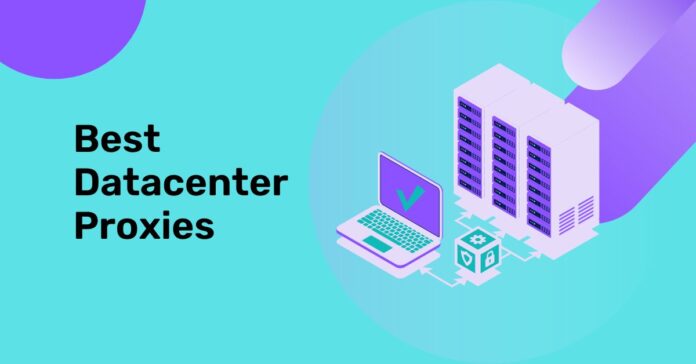
Are you in search of the best datacenter proxies? Read this post to find out.
Datacenter proxies have become essential for various online activities, including web data extraction, website performance testing, and online anonymity. These proxies are a gateway between users and the internet, allowing them to hide their IP address and location.
In this guide, we will explore the best datacenter proxy providers in the market and the features that set them apart.
What Are Datacenter Proxies?
Datacenter proxies, or DC proxies, are intermediaries between a client (requester) and a web server (destination). They act as gateways between the user’s device and the websites they want to visit. Datacenter proxies assign IP addresses from cloud servers, making them easier to detect and block than residential proxies.
There are two types of datacenter proxies: shared and dedicated. Shared datacenter proxies assign the same IP address to multiple users, while dedicated datacenter proxies provide a specific IP address to a single user. Dedicated datacenter proxies offer better speed and performance since they are not shared among multiple users.
On the other hand, residential proxies use IP addresses provided by Internet Service Providers (ISPs). These ISP proxies are associated with real residential addresses, making them harder to detect and block. Residential proxies offer a greater range of connecting locations, making them ideal for bypassing geographical restrictions.
One of the main differences between datacenter and residential proxies is the level of anonymity they provide. Datacenter proxies are more easily detectable and can be blocked by websites. In contrast, residential proxies are harder to block, making them a preferred choice for activities like web scraping and hiding one’s true identity.
Another distinction lies in IP rotation. Datacenter proxies typically use static IPs, meaning the IP address remains the same over time. On the other hand, residential proxies use rotating IPs, which change periodically. This rotation helps residential proxies avoid being detected and blocked.
Overall, datacenter proxies are intermediary servers between clients and web servers that assign IP addresses from cloud servers. They offer shared or dedicated options but are easier to detect and block than residential proxies.
On the other hand, residential proxies use real users’ IP addresses provided by ISPs, making them harder to detect and block. They offer a wider range of locations and are preferred for activities requiring anonymity and bypassing geographical restrictions.
Best Proxies Deals
Webshares Proxy Server
Webshare's Proxy Server offers high-speed, customizable proxy solutions with flexible pricing, ensuring seamless and...Show More
Webshare's Proxy Server offers high-speed, customizable proxy solutions with flexible pricing, ensuring seamless and secure web scraping, automation, and data collection at scale. Show Less
Oxylabs Datacenter Proxies
Oxylabs Datacenter Proxies deliver lightning-fast, high-performance proxy solutions with unmatched scalability, 99.9%...Show More
Oxylabs Datacenter Proxies deliver lightning-fast, high-performance proxy solutions with unmatched scalability, 99.9% uptime, and industry-leading security—perfect for web scraping, market research, and automation at an enterprise level. Show Less
Decodo Datacenter Proxies
Decodo (formerly Smartproxy) Datacenter Proxies offer lightning-fast speeds, unlimited connections, and global coverage...Show More
Decodo (formerly Smartproxy) Datacenter Proxies offer lightning-fast speeds, unlimited connections, and global coverage, making them the perfect choice for seamless web scraping, automation, and data extraction at an affordable price. Show Less
Live Proxies
Live Proxies is a proxy service that provides high-speed, reliable, and secure residential and datacenter proxy services...Show More
Live Proxies is a proxy service that provides high-speed, reliable, and secure residential and datacenter proxy services for web scraping, automation, and anonymity. Show Less
IPRoyal
IPRoyal is a leading proxy provider offering reliable, high-speed proxies for various needs, including data scraping...Show More
IPRoyal is a leading proxy provider offering reliable, high-speed proxies for various needs, including data scraping, social media automation, and sneaker botting. Show Less
Mars Proxies
Mars Proxies is the go-to provider for sneaker coppers, offering unbanned IPs, blazing-fast speeds, and a massive pool...Show More
Mars Proxies is the go-to provider for sneaker coppers, offering unbanned IPs, blazing-fast speeds, and a massive pool of residential proxies. Show Less
NetNut
NetNut is the world's fastest residential proxy network, providing high-speed, reliable connections and a vast pool of...Show More
NetNut is the world's fastest residential proxy network, providing high-speed, reliable connections and a vast pool of IPs for seamless data scraping and automation. Show Less
DigiProxy
DigiProxy offers proxy services, including residential, datacenter, and sneaker proxies, aimed at providing secure and...Show More
DigiProxy offers proxy services, including residential, datacenter, and sneaker proxies, aimed at providing secure and reliable internet access. Show Less
Nodemaven
NodeMaven is a premium proxy provider that delivers high-quality IPs, super sticky sessions, and unmatched customer...Show More
NodeMaven is a premium proxy provider that delivers high-quality IPs, super sticky sessions, and unmatched customer support. Show Less
Infatica
Infatica provides a robust proxy network with ethical sourcing, reliable performance, and a comprehensive suite of data...Show More
Infatica provides a robust proxy network with ethical sourcing, reliable performance, and a comprehensive suite of data collection tools. Show Less
Factors To Consider When Choosing The Best Datacenter Proxies
When choosing the best datacenter proxies, there are several factors to consider:
Speed and Performance: Fast speeds, low latency, high bandwidth, and minimal response times are crucial for efficient data scraping. Ensure the proxy provider offers reliable and stable performance for smooth and timely data extraction.
Anonymity: Datacenter proxies are less anonymous than residential proxies because they use IP addresses from data center IP pools. However, they can still provide a good level of anonymity for most web scraping tasks.
IP Rotation: Datacenter proxies do not typically rotate IP addresses. This means that if you use the same datacenter proxy for multiple requests, the website you are scraping may be able to identify you.
Pricing: Datacenter proxies are generally more cost-effective than residential proxies. This is because they are less expensive to acquire and maintain.
Network Size: The proxy provider’s network size can impact their proxies’ availability and reliability. A larger network can offer a wider range of IP addresses and better performance.
Features: Look for additional features the proxy provider offers that can enhance your web scraping experience, such as support for multiple protocols, HTTP/2, and SSL/TLS.
Ethical Compliance: Ensure that the proxy provider adheres to ethical guidelines and respects website service terms to avoid legal issues or ethical concerns.
Considering these factors, you can make an informed decision when choosing the best datacenter proxies for your web scraping needs.
Featured Best Datacenter Proxy Service Providers
Before diving into our ranked list of the best datacenter proxy providers, here are three standout services that excel in specific areas. Whether you need affordability, enterprise-grade solutions, or balanced performance, these providers offer some of the best datacenter proxies in the industry.
1. Webshare – Best for Affordable and Scalable Proxy Solutions
Webshare is a reliable provider of datacenter proxies, offering three options: dedicated, shared with up to two users, and shared among multiple users. Their proxies support HTTP(S) and SOCKS protocols and are available in more than 50 different countries.
Additionally, Webshare provides customized self-service options, allowing users to choose the number of proxies, bandwidth allotment, and thread customization. The user-friendly dashboard ensures streamlined usability.
Webshare offers a free package with 10 static IPs from four locations, allowing users to simultaneously utilize 1GB of free data each month and 50 threads. Their customizable pricing depends on add-ons and starts from 10 free proxies.
Key Features:
High-speed, anonymous datacenter proxies
Affordable pricing with free plan options
Easy-to-use dashboard and API access
Instant proxy activation with unlimited bandwidth
Unlimited bandwidth with up to 3,000 threads
SOCKS5 and HTTPs protocols
Proxies are available in 50+ locations
Pricing:
10 free proxies
Customizable pricing, depending on add-ons
Best For:
Cost-conscious users looking for premium proxies on a budget
Small businesses and freelancers needing reliable datacenter proxies
Developers and automation experts requiring scalable solutions
Why Choose Webshare?
Webshare combines affordability with quality, making it the go-to choice for users who need high-performance proxies without breaking the bank.
Webshares Proxy Server
Webshare's Proxy Server offers high-speed, customizable proxy solutions with flexible pricing, ensuring seamless and...Show More
Webshare's Proxy Server offers high-speed, customizable proxy solutions with flexible pricing, ensuring seamless and secure web scraping, automation, and data collection at scale. Show Less
2. Oxylabs – Best for Enterprise-Grade Proxy Solutions
Oxylabs is a well-established provider with a vast network of dedicated data center proxies. They offer unlimited domains, connections, and requests, making them ideal for web scraping.
Not to mention, Oxylabs has over 2 million dedicated datacenter proxies, ensuring a wide range of addresses and reducing the chances of receiving subnet and ASN-related bans. Users can target specific cities and obtain IPs from 188 different countries.
Oxylabs’ shared datacenter proxies come in a pool of 29,000 addresses distributed across 15 locations. Users can rotate IPs with every connection or set up sticky sessions for as long as needed.
The company also offers a premium service with a functional dashboard, account manager, and IP replacement API.
Key Features:
Over 2 million dedicated IPs
All countries supported
Unlimited bandwidth, threads, and domains
Premium, high-speed datacenter proxies with 99.9% uptime
AI-powered proxy rotation and session management
Massive global IP pool covering major locations
Advanced security and compliance standards
Pricing:
Free 5 IP Addresses plan available
Shared datacenter proxies start from $1.20/IP Address per month
Dedicated datacenter proxies start from $2.25/IP Address per month
Best For:
Enterprises and large-scale data scraping projects
Market research, brand protection, and SEO monitoring
Businesses needing a secure and robust proxy network
Why Choose Oxylabs?
With Oxylabs, businesses can rely on a battle-tested proxy network that delivers high-speed performance and enterprise-grade security.
Oxylabs Datacenter Proxies
Oxylabs Datacenter Proxies deliver lightning-fast, high-performance proxy solutions with unmatched scalability, 99.9%...Show More
Oxylabs Datacenter Proxies deliver lightning-fast, high-performance proxy solutions with unmatched scalability, 99.9% uptime, and industry-leading security—perfect for web scraping, market research, and automation at an enterprise level. Show Less
3. Decodo – Best for Balanced Performance and Versatility
Decodo (formerly Smartproxy) is a reputable provider offering high-quality datacenter proxies with excellent performance, seamless setup, and user-friendly features.
Their global network includes over 65 million IPs, with a strong selection of datacenter proxies and residential proxies. Users benefit from IP rotation and sticky sessions, allowing them to hold an address for up to 30 minutes.
Decodo guarantees 99.99% uptime, with an ultra-fast average speed of <0.3s and 195+ locations worldwide. Their proxies support both HTTP(S) and SOCKS5, and the customer support team responds in an industry-leading 40 seconds on average.
For those needing residential proxies, Decodo provides access to 55 million+ IPs, now available with a 30% discount using the promo code DECODO30 (limited-time offer). All other proxy products come with a free trial, making it easy to test their service before committing.
Key Features:
Easy to set up, flawless to use
65M+ total IPs, including 55M+ residential
<0.3s average response time
IP rotation (every request or up to 30 minutes)
Supports HTTP(S) and SOCKS5 protocols
99.99% uptime guarantee
195+ locations worldwide
Customer support responds in 40 seconds on average
All products include free trials
Pricing:
Datacenter proxies start from $0.026 per IP Address
Residential proxies – Use code DECODO30 for 30% off (limited time!)
Best For:
Digital marketers and SEO professionals
E-commerce and sneaker copping
Social media automation and web scraping
Why Choose Decodo?
Decodo is the perfect all-rounder, offering high-performance proxies at competitive prices with top-tier customer support and flexible plans. Whether you’re looking for datacenter proxies, residential proxies, or both, Decodo ensures a seamless and efficient experience.
Decodo Datacenter Proxies
Decodo (formerly Smartproxy) Datacenter Proxies offer lightning-fast speeds, unlimited connections, and global coverage...Show More
Decodo (formerly Smartproxy) Datacenter Proxies offer lightning-fast speeds, unlimited connections, and global coverage, making them the perfect choice for seamless web scraping, automation, and data extraction at an affordable price. Show Less
Other Best Datacenter Proxies
1. IPRoyal – The Most Reliable Budget Datacenter Proxies
IPRoyal is a trusted provider of datacenter proxies, offering fully transparent proxy services and ethically sourced IPs.
With over 100,000 clients worldwide, IPRoyal has established itself as a leading provider in the industry. Their flagship products include datacenter proxies, rotating residential proxies, static residential proxies, and sneaker proxies.
These proxies are widely used for market research, data scraping, website testing, and privacy advantages.
IPRoyal’s datacenter proxies are budget-friendly, offering unlimited bandwidth and threads without compromising privacy.
They provide fast speeds and ensure up-to-date security. The company’s 24/7/365 live support ensures that clients’ issues are resolved promptly.
Key Features:
Non-expiry data
Reseller-friendliness
Pay-as-you-go pricing
SOCKS5 support
Ethically sourced IPs
Pricing:
Pay-as-you-go residential prices start from $1.75/GB
3. Bright Data – Arguably the Best Provider of Datacenter Proxies
Bright Data is a leading provider of datacenter proxies, offering a versatile range of proxy services. They provide shared, dedicated, rotating IPs with unlimited threads, traffic, and domains.
Additionally, Bright Data offers comprehensive targeting options, with city- and country-level targeting available.
Their proxies have a flexible rotation system, allowing users to maintain IPs for as long as they are available or rotate them with every request. The company guarantees 99.99% uptime and offers rapid delivery and IP authentication.
Bright Data’s pricing is customizable, with pay-as-you-go starting from $0.110/GB and a subscription plan that costs $0.083/GB per month when billed annually. They also offer a free trial for individuals.
Key Features:
Unlimited threads, traffic, and domains
98 dedicated countries and over 80 shared countries
HTTP(S) and SOCKS5 protocols
Pricing:
Starting from $0.110/GB for pay-as-you-go billing
Starting from $0.083/GB for the annual subscription plan
4. NetNut – Fast and Reliable Datacenter Proxies
NetNut provides fast and reliable datacenter proxies that are ideal for various tasks, including web scraping, SEO, and social media monitoring. NetNut’s proxies are located in data centers worldwide, providing global coverage.
Key features:
Fast speeds: NetNut’s proxies are located in data centers worldwide, providing fast connections to any website.
Reliable: NetNut’s proxies are reliable and have a high uptime.
Anonymous: NetNut’s proxies use rotating IP addresses, so your real IP address is never exposed.
Scalable: NetNut’s proxies are scalable, so you can easily add or remove proxies as needed.
Affordable: NetNut’s pricing is very affordable, making it a great option for businesses and individuals on a budget.
Pricing:
NetNut’s pricing starts at $100 per month for their 100GB Plan. You can also get a 73-day free trial to test their proxies before buying them.
Infatica provides high-quality datacenter proxies that are ideal for various tasks, including web scraping, SEO, and social media monitoring.
If you are looking for high-quality DC proxies with global coverage, Infatica is a great option. They offer a variety of features and plans to fit your needs, and their pricing is very competitive.
Key features:
High quality: Infatica’s proxies are high quality and reliable.
A large pool of IPs: Infatica has a large pool of IPs, making you less likely to be blocked by websites.
Secure: Infatica’s proxies are secure and anonymous.
Scalable: Infatica’s proxies are scalable, so you can easily add or remove proxies as needed.
Affordable: Infatica’s pricing is affordable, making it a great option for businesses and individuals on a budget.
Pricing:
Infatica’s pricing starts at $100 per month for 1000 proxies. You can also get a 3-day free trial to test their proxies before buying them.
6. Shifter – Affordable and High-Performance Datacenter Proxies
Shifter is a reliable provider of datacenter proxies known for its fast servers and excellent worldwide coverage. They offer shared and dedicated proxy packages, making them suitable for various user needs.
In addition, Shifter’s proxies are highly anonymous and support HTTP and HTTPS connections. They have servers across Europe, North America, Asia, Australia, India, and the Middle East.
Shifter’s pricing is competitive, with packages starting at affordable rates. Their proxies are easy to use and provide excellent performance, making them popular among users.
Key Features:
Extensive geographic coverage
Affordable pricing
High level of anonymity
HTTP and HTTPS protocol support
Pricing:
Affordable packages available
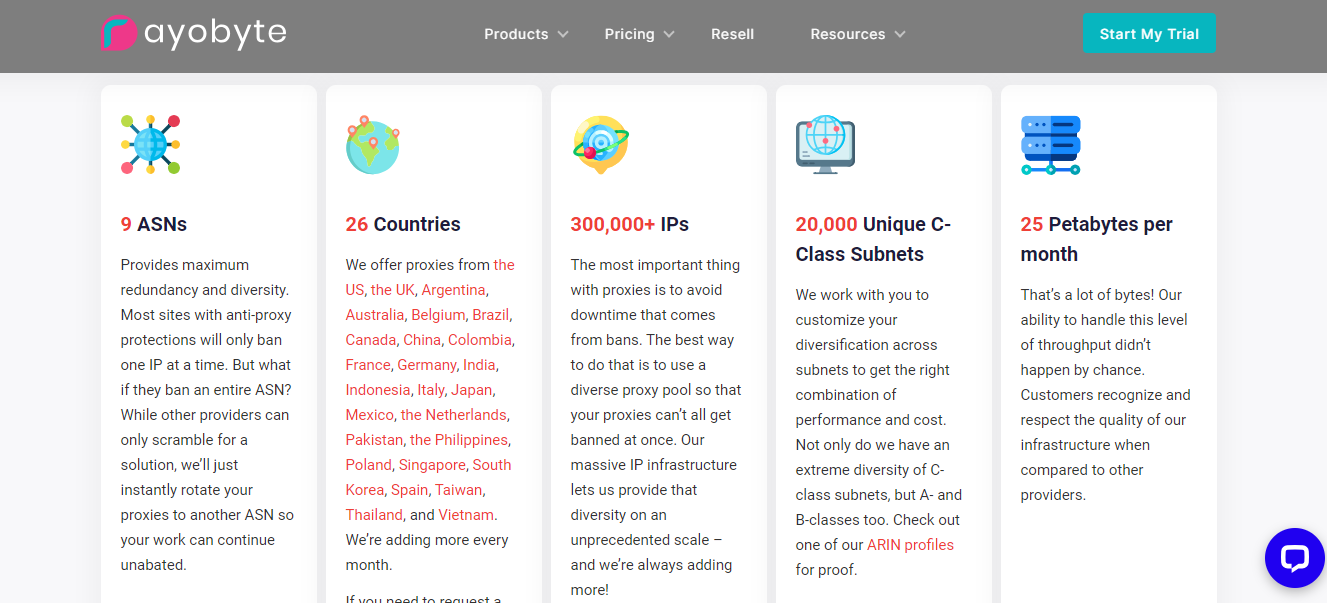
7. Rayobyte – Good Performance at Very Affordable Prices
Rayobyte is a provider of datacenter proxies known for its good performance and low prices. Although the company has a small network, it offers reliable service and competitive pricing.
Rayobyte provides shared IPs with automatic rotations, dedicated SOCKS5, HTTPS proxies, and unlimited bandwidth with dedicated plans. Their proxies are available in 26 countries with unlimited threads, traffic, and domains.
Rayobyte’s shared plans start from $4 for 5 IPs, while dedicated plans start from $12.50 for 5 IPs.
Key Features:
Shared IPs with automatic rotations
Dedicated SOCKS5 and HTTPS proxies
Unlimited bandwidth with dedicated plans
Dedicated locations in the USA
Pricing:
Starting from $12.50 for dedicated plans
Flexible pricing plans based on country of originating IPs
Notable Mention: ProxyJet
When it comes to datacenter proxies, ProxyJet sets itself apart through its exceptional speed, reliability, and scalability. Backed by a robust network of high-performance servers located in key data hubs worldwide, ProxyJet ensures that users experience consistently fast connections with minimal latency.
This makes it an ideal choice for tasks that require high bandwidth, such as web scraping, social media automation, and large-scale data collection. What really distinguishes ProxyJet is its emphasis on reliability — the proxy uptime is exceptional, ensuring minimal disruptions during critical operations.
Moreover, ProxyJet’s flexibility and customizability make it a standout option for both individuals and enterprises. With a wide range of IP pools, flexible subscription plans, and an intuitive dashboard that allows seamless management, ProxyJet ensures that users have full control over their proxy experience.
Whether you’re a seasoned professional or a business looking to scale, ProxyJet delivers a powerful, cost-effective solution designed to meet your proxy needs.
Best Datacenter Proxies: Frequently Asked Questions
What is a datacenter proxy?
A datacenter proxy is a proxy server that uses IP addresses from data centers. This means that datacenter proxies are typically faster than residential proxies, as they are located close to the websites you are accessing.
DC proxies are also more reliable than residential proxies, as they are not dependent on the performance of individual home users.
What are the benefits of using datacenter proxies?
There are many benefits to using datacenter proxies, including:
Speed: Datacenter proxies are typically faster than residential proxies, as they are located close to the websites that you are accessing. This can be especially helpful for online gaming, streaming videos, and downloading large files.
Reliability: DC proxies are more reliable than residential proxies, as they are not dependent on the performance of individual home users. This means you are less likely to experience downtime when using datacenter proxies.
Availability: DC proxies are typically more available than residential proxies, as they are not located in home networks. You are less likely to experience IP bans or throttling when using datacenter proxies.
Anonymity: DC proxies can help to protect your privacy by masking your real IP address. This can be useful for online banking, file sharing, and social media browsing.
What are the drawbacks of using datacenter proxies?
There are a few drawbacks to using datacenter proxies, including:
Cost: DC proxies can be more expensive than residential proxies.
Risk of detection: DC proxies are more likely to be detected by websites and services than residential proxies. This can lead to your datacenter proxy being blocked or blacklisted.
Lack of consistency: DC proxies may not be as consistent as residential proxies, as they are dependent on the performance of the underlying data centers.
How do I choose the best datacenter proxy?
When choosing a datacenter proxy, there are a few factors to consider, including:
Price: DC proxies can range in price from a few dollars to hundreds of dollars per month. Choosing a provider that offers a price point that fits your budget is important.
Location: DC proxies are available in different locations around the world. Choosing a provider that offers proxies in the locations you need is important.
Features: DC proxies have various features, such as rotating IP addresses, sticky sessions, and unlimited bandwidth. Choosing a provider that offers the features you need is important.
Reputation: Choosing a DC proxy provider with a good reputation is important. This will help to ensure that you get a reliable and high-quality service.
Where can I buy datacenter proxies?
Several providers sell datacenter proxies. Some of the most popular providers include:
Doing your research before choosing a provider is important, as the quality of datacenter proxies can vary significantly.
What are the different types of datacenter proxies?
There are two main types of datacenter proxies: shared and dedicated.
Shared proxies are used by multiple users simultaneously, while a single user uses dedicated proxies. Shared proxies are typically less expensive than dedicated ones but offer less anonymity and security. Dedicated proxies are more expensive, but they offer more anonymity and security.
Conclusion
In conclusion, datacenter proxies are a valuable resource for various online activities. The best datacenter proxy providers offer many features, including unlimited bandwidth, wide geographical coverage, high-level security, and excellent customer support.
Whether you need proxies for web scraping, SEO monitoring, or maintaining online anonymity, the providers mentioned in this guide offer reliable and cost-effective solutions.
Choose the one that best meets your needs and enjoy the benefits of datacenter proxies.
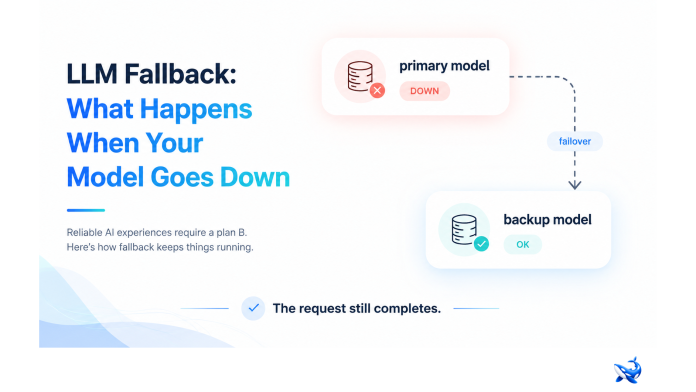
LLM fallback is the practice of sending a request to a backup model or route the moment the primary model fails — an outage, a rate limit, a timeout, or a response that is simply bad. It is not an advanced optimization; it is the reliability layer your application gets when it stops betting everything on one provider. When the switch happens at the routing layer, llm router turns a provider outage into a non-event — and when the chain reroutes to a different flagship, the live rate card for GPT-5.6 Sol shows what that backup actually costs per million tokens, so the safety net never surprises the bill. The short version: single-provider reliance is a single point of failure, and fallback is the cheapest insurance against it.
Every team that integrates a language model learns this the hard way, usually at 3 a.m. A model you have depended on for months returns a wall of server errors; your support channel fills with “it’s broken”; your on-call engineer tries to remember which config file controls the model ID. The outage is never just the model’s fault — it is the design that assumed one provider would always answer. This piece is the plain-English guide to what fallback actually means, which failure modes trigger it, how to design a fallback chain that does not make things worse, and when automatic beats manual.
What LLM fallback actually means
LLM fallback means having a second path for a request when the first path fails. “Path” can be a different model from the same provider, a different provider entirely, or a different route to the same model — a fallback is any alternative that can produce an acceptable answer when the primary cannot.
Two ideas are worth separating. Routing is proactive: it picks the best model for each request before you make it, based on cost, latency, and quality. Fallback is reactive: it rescues the request after the chosen model fails. A router that does both is running automatic failover — a listed capability on OrcaRouter’s own product page [OURS] — where every request carries a primary choice and a set of backups that activate on failure.
The distinction matters because fallback is a design decision, not a feature you get by accident. If your application only ever calls one model through one API key, there is nothing to fall back to. The moment you have two reachable models, you have a fallback — whether you planned it or not.
The failure modes that trigger a fallback
Fallback logic only works if it knows what counts as failure. In practice, a request can fail in five distinguishable ways, and each one needs a different response:
Failure mode
What it looks like
Without fallback
Server error (5xx)
The provider’s infrastructure rejects or drops the request
The user sees a generic error, forever
Rate limit (429)
The provider throttles your key; a per-minute quota is hit
Requests pile up and time out
Timeout
No tokens arrive within your deadline; the connection stalls
The user waits, then gets an error
Empty or truncated response
HTTP 200 with an empty or cut-off body
The user gets a half answer that looks complete
Degraded quality
The model responds, but the answer is wrong, off-topic, or a refusal
The user gets a confident-sounding wrong answer
The last row is the one most teams forget. A 200 status code is not a guarantee of a good answer — a model can return an empty completion, an apologetic refusal, or a confident hallucination. A quality guard on the response is what catches these before the fallback chain moves on [OURS].
Designing a fallback chain
A fallback chain is an ordered list of alternatives: try model A; if it fails, model B; then model C. It sounds trivial, but the order, the timing, and the exit conditions are where reliability is won or lost.
Order. Put the best answer first and the acceptable answer second. The chain is not “cheapest to most expensive”; it is “best match for the task, then best alternative that still clears the bar.” If your primary is a reasoning-heavy flagship, your first fallback should be a strong generalist, not the smallest model in the catalog.
Timeouts. Fail fast. If the primary has not produced its first token within your deadline, move on. A fallback chain without per-step timeouts is a chain that waits for a dead provider forever — it converts an outage into a longer outage.
Quality guards. As the table above shows, an empty or garbage response is a failure even when the status code is 200. Check the response before accepting it: empty body, missing content, a refusal, truncated output — any of these should advance the chain.
Bounded retries. Do not retry the same dead provider three times and then fall back; that triples your latency on every outage. Retry once for transient blips, then switch. Give the chain a terminal state — after the last option, return a real error instead of looping.
Automatic vs manual fallback
The oldest form of fallback is manual: a human notices the alerts, edits a config file, flips a flag, and redeploys. It works, but it costs minutes — on-call minutes, at 3 a.m., while users wait. Manual fallback converts a provider outage into a deployment exercise.
Automatic fallback does the detection and the switch for you. The routing layer observes the failed request, selects the next healthy route from the chain, and retries — usually within the same second, before a user has time to refresh. This is where a router earns its keep. OrcaRouter’s automatic failover [OURS] sits on the same machinery as its adaptive routing: every prompt is graded in under a millisecond, then routed to the cheapest model that still meets your standards [OURS], and when that model fails, the request moves to the next route instead of dying at your front door.
Automatic fallback also scales your options. A fallback chain is only as good as the catalog it draws from: two models give you one fallback; a single API key that reaches 200+ models across OpenAI, Anthropic, Google, Meta, Mistral, xAI, DeepSeek, Qwen, GLM, and MiniMax [OURS] gives you a chain that survives a whole provider going down, not just one model. And because the key passes through the vendor’s list price with no markup added [OURS], keeping a wide fallback chain warm does not mean paying a premium for the safety net.
The takeaway
Fallback is for anyone running real traffic against a model they do not host — which is almost everyone. If your application can tolerate downtime while a provider recovers, manual fallback and a documented runbook may be enough. If users, agents, or batch jobs depend on a model staying up, design an automatic fallback chain with timeouts and quality guards, and test it the way you test any failure path: kill the primary and watch the request still complete.
The teams that regret fallback are the ones that never added it; the teams that regret their chain are the ones that built a retry loop in disguise. Design the chain in advance, let the router execute it, and a model going down stops being an incident — it becomes a footnote.
I will show you 4 benefits of mobile casinos in this post.
Mobile casinos are a great way to have fun while on the go, and they offer many of the same benefits as traditional online casinos. These casinos have become so popular that their mobile versions have become a sensation as well.
Mobile casinos are the next big thing, and you can play them on your smartphone, tablet, or any mobile device. Mobile gambling is growing at an incredible rate as more people find out about it, thanks to the internet and smartphones.
1. They provide an instant and easy way to access your favourite games
Mobile casinos are easy to use and can be accessed from anywhere you go. You can play on your phone, tablet, or laptop, switching between devices easily.
So, you can open your favorite platform like Zodiac Casino and enjoy the games on the go.
2. Apps can be used on several devices
Many benefits come with playing mobile casino games. Those who have downloaded a casino app can play their favourite games wherever they go. They no longer have to worry about finding an internet connection or having a laptop computer with them at all times.
If you have several mobile devices and a laptop that you are using to gamble, you can open your account on every device and enjoy the benefits of your account without losing any of your achievements if you switch from a laptop to a smartphone or vice versa.
3. Mobile games are not inferior in quality
Several years ago, mobile games had a worse quality or had different functions from their laptop full-featured counterparts. These days are gone. There are several casino games that you can play on your mobile devices.
Today, mobile games have the same functions and features. Thus, if you give preference to more convenient gambling on the go, there is no need to hesitate since you will be able to enjoy the same gameplay as on a laptop or PC.
Contemporary casino game developers release all their games in two versions—for a laptop/PC and mobile devices (iOS, Android, and other OS).
So, if you decide to open an online casino from your smartphone or download an app, the number of games will be the same or a bit lower.
Usually, the games that are not available on mobile devices are not the newest. So, you will not lose too much if you do not play several old games on your smartphone.
Mobile Casinos: Convenience and Thrills in Your Pocket
The rise of mobile casinos has revolutionized gambling, offering players a world of entertainment on their smartphones and tablets. But are they right for you? Here are some frequently asked questions to help you decide:
What are the main benefits of playing at mobile casinos?
Convenience: The biggest advantage is convenience. Play your favorite casino games anytime, anywhere, as long as you have an internet connection—no need to travel to a physical casino.
Game Variety: Reputable mobile casinos offer a wide selection of games, from slots and roulette to blackjack and poker. You can enjoy the same variety as you would at a traditional casino, all on your mobile device.
Bonuses and Promotions: Mobile casinos often entice new players with exclusive bonuses and promotions. These can include welcome bonuses, free spins, and cashback offers.
Safe and Secure: Legitimate mobile casinos prioritize security. They use advanced encryption technology to protect your financial information and personal data.
Always Connected: Stay entertained during commutes, breaks, or whenever you have a spare moment. Mobile casinos let you play at your own pace, whenever the mood strikes.
Are mobile casino games fair?
Yes, in reputable and licensed mobile casinos, the games are fair. They use random number generators (RNGs) to ensure unbiased outcomes, just like traditional casinos.
What are some things to consider before playing at a mobile casino?
Licensing: Only play at mobile casinos that are licensed and regulated by a reputable gaming authority. This ensures fair play and responsible gambling practices.
Game Selection: Make sure the casino offers the games you enjoy playing. Check for variety and quality game providers.
Bonuses and Promotions: Review the terms and conditions of any bonuses or promotions before claiming them. Be aware of wagering requirements and other restrictions.
Payment Methods: Ensure the casino offers convenient and secure payment methods for deposits and withdrawals.
Customer Support: Reliable customer support is crucial. Look for a casino with multiple support channels like live chat or email.
Can I win real money playing at mobile casinos?
Absolutely! Mobile casinos operate just like traditional casinos. You can wager real money, win real money prizes, and enjoy the thrill of the game.
Mobile casinos offer a fun and convenient way to gamble. By considering these factors and choosing a reputable casino, you can experience the thrills of casino games from the comfort of your mobile device. Remember, always gamble responsibly and set limits for yourself.
Conclusion
There are many benefits to playing casino games on your phone or tablet. You can enjoy them anywhere and at any time.
There’s no need for downloads, and they offer quick access to the best games in the industry.
Of course, if you want, you can opt to download an application. However, this is completely up to you and depends on your preferences.
If you want the best and most secure web hosting services, this post is meant for you! Also, in the end, I will show you the most secure web host company.
Web hosting is the process of providing space on a server where websites can be stored. The server provides access to the Internet and allows visitors to view the sites hosted on it.
There are various types of web hosting plans available depending on the type of website being hosted and its size.
A secure web hosting provider should protect your website from malware attacks, provide server monitoring, and two-factor authentication services, and integrate with security add-ons.
This post will show you the best secure web hosting services that guarantee you protection from cyberattacks.
What Is Secure Web Hosting?
This is a kind of web hosting that provides security-focused web hosting services to protect websites and web visitors safe from malware and other types of cyberattacks, including protection from DDoS, zero-day, man-in-the-middle, SQL injection, and DNS tunneling.
A secure web host will also provide an SSL certificate that ensures that all sensitive information such as financial details is protected by encrypting all data traffic between the users and the website.
Namecheap is one of the best-known names in domain name registration due to its affordability. Its web hosting services offer unique features such as 100% uptime, free SSL certificates, DDoS protection, etc.
Some of Namecheap’s hosting services include reseller hosting, VPS, and shared hosting WordPress.
Shared hosting is Namecheap’s cheapest hosting plan; subscribers enjoy 100% uptime and other security features to prevent website compromise.
Moving from a different hosting registrar to Namecheap is seamless, which makes it a top option on our list of the most secure web host. Namecheap has experts to handle the entire process and no associated charge. In other words, migration is free.
The majority of NameCheap customers commend the company’s customer support service. Support is available round the clock and easy to initiate via live chat. Alternatively, there’s the option to send an email or submit a contact form.
Besides selling hosting plans, Namecheap is also a renowned domain registrar. In fact, the annual shared hosting plan includes a free domain name. It’s an ideal option to save money when starting a website.
NameCheap offers a variety of hosting plans with associated pricing. Below are the featured ones:
Stellar Hosting: $1.98 per month on the first year ($4.48 per month for subsequent years).
Stellar Business: $4.98 per month on the first year ($9.48 per month for subsequent years).
EasyWP Starter: $0 per month on the first year ($6.88 per month for subsequent years).
Starter Plan: $0 per month on the first year ($14.88 per month for subsequent years).
Quasar VPS: $15.88 per month
Magnetar VPS: $28.88 per month
Xeon E-2234 Dedicated Hosting: $62.88 per month on the first year ($69.88 for subsequent years).
Namecheap
Provides the web hosting you need to put your ideas online. Namecheap is a web hosting company that offers a range of...Show More
Provides the web hosting you need to put your ideas online. Namecheap is a web hosting company that offers a range of hosting services, including shared hosting, VPS hosting, and dedicated servers, as well as domain name registration services. Show Less
Another most secure web host service on our list is Hostinger.
Hostinger has one of the cheapest hosting plans you can subscribe to. This doesn’t come at the expense of security as subscribers enjoy premium features, including 99.5% uptime, DDoS protection, free SSL certificates, unlimited bandwidth, and 100GB of disk space.
A key factor that comes to play is Hostinger’s customized control panel, which gives users better control of its features and modules such as PHP, Suhosin, Apache mod security, etc.
Popular Hostinger hosting plans include cloud hosting plans which offer subscribers unlimited bandwidth and also allow you to host up to 300 websites per account.
Notably, Hostinger offers a free domain name. You can claim it when you pay for a 12, 24, or 48-month hosting plan. Various domain extensions are available, including popular ones like .com and .net.
Each day, the Hostinger system automatically backs up the website. It’s a safety measure against a website hack or crash, as it prevents the loss of files and data. Also, secure backup can help minimize the effects of server downtime.
Hostinger ranks among the best web hosting provider in terms of security. Included in the plans are a malware scanner and Cloudflare-protected nameservers. The former keeps your website files free from virus infection, while the latter acts as a firewall against cyber attacks.
There are three main web hosting plans available with Hostinger. These include:
Business Web Hosting: $3.99 per month for the first subscription ($8.99 upon renewal)
Premium Web Hosting: $2.99 per month for the first subscription ($6.99 upon renewal)
Cloud Startup Hosting: $9.99 per month for the first subscription ($19.99 upon renewal)
Hostinger
Your all-in-one hosting solution for managing a website. Hostinger is a web hosting company that provides affordable...Show More
Your all-in-one hosting solution for managing a website. Hostinger is a web hosting company that provides affordable shared hosting, VPS hosting, and cloud hosting services, along with a range of other website-related services. Show Less
GoDaddy Web Hosting is one of the most secure web hosting providers. It was founded in 1997 and has evolved to be among the top leaders in the web hosting industry.
As of December 2021, they have over 20 million users which indicates that they stay on top when it comes to ensuring the website security of their client’s websites.
They offer a variety of plans to fit any business or budget, from shared hosting to VPS hosting. With 24/7 customer support, you’ll never be left wondering what to do next.
Additionally, they offer several website security services which include SSL Certificates, 24/7 network security, and website backup.
GoDaddy guarantees all users 99.9% uptime. This is possible thanks to the unmetered bandwidth allowed on all servers and the vast storage spaces. The daily backups also help you quickly restore your website if you encounter problems.
It’s worth mentioning that GoDaddy has global data centers in North America, Europe, and Asia-Pacific. With this, you get extensive server options. Consequently, it makes GoDaddy one of the bests for offshore hosting.
The GoDaddy control panel has a friendly UI and, accordingly, is easy to use. In fact, it only takes one click to set up your domain name. It takes one click, too, to install the over 150 available free apps.
GoDaddy’s pricing scheme is straightforward. Below are the featured pricing plans:
Economy Plan: $2.99 per month ($5.99 per month with the 3-year plan)
Deluxe Plan: $9.99 per month ($7.99 per month with the 3-year plan)
Ultimate Plan: $14.99 per month ($12.99 per month with the 3-year plan)
GoDaddy
GoDaddy is a web hosting company that offers a range of hosting services including shared hosting, VPS hosting, and...Show More
GoDaddy is a web hosting company that offers a range of hosting services including shared hosting, VPS hosting, and dedicated servers, as well as domain name registration, website builders and other website-related services. Show Less
DigitalOcean is a cloud hosting provider that offers reliable, scalable, and affordable hosting for developers.
With DigitalOcean’s easy-to-use platform and one-click deployment tools, you can build a world-class web app in seconds. DigitalOcean is a secure cloud hosting provider for developers with blazing fast SSDs and a simple management console.
If you’re a developer who wants to focus on building products instead of managing servers, DigitalOcean is the perfect solution for you.
They have been in the web hosting business since 2011, and we’re so confident that you’ll love their service. Also, they offer a 60-day free $200 credit.
Currently, Digital Ocean has over 600,000 customers, a testament to its reliability. The web hosting service alone records over 75,000 business users globally. All these stress the fact that DigitalOcean is renowned.
One of the perks of using this web hosting provider is the expert technical support service. Professionals are handy to respond to your queries at any time. And among the service they offer is automatic updates.
DigitalOcean servers are all high-performance ones. They come preinstalled with web stacks like Apache, Mencached, and Nginx. Also, the servers support application-level caching, which boosts performance all the more.
DigitalOcean offers relatively low web hosting plans. Check them out below:
Droplets Plan: starting from $4 per month
Kubernetes Plan: starting from $12 per month
Databases Plan: starting from $15 per month
Digital Ocean
DigitalOcean is a web hosting company that provides simple and affordable cloud-based infrastructure for developers and...Show More
DigitalOcean is a web hosting company that provides simple and affordable cloud-based infrastructure for developers and businesses, including virtual private servers (VPS) and other hosting solutions, as well as developer-friendly tools and resources. Show Less
Another most secure web host on our list is OVHCloud.
OVHcloud is a European leader in the cloud hosting industry and a pioneer of virtualization. They have been around since 1999, so you know when it comes to hosting services, they are experts.
This secure web host for developers features powerful tools to help them work more efficiently and get their projects off the ground quicker. With OVHcloud, you can finally focus on what’s important: your project.
OVHcloud offers a secure web host for developers, nonprofits, startups, and business users alike. They also offer high-memory servers, SSD storage, and unlimited bandwidth at an affordable price.
OVHCloud is a dependable web host when it comes to security. It offers world-class DDoS protection and employs two highly secure web technologies: Intel Xeon and AMD Ryzen. Not to mention, the service features global dedicated servers.
In particular, OVHCloud dedicated servers are hosted in North America, Europe, and Asia-Pacific. Setting up any of these servers attracts a zero-dollar fee. Simply purchase the server, and in-house experts will handle the installation on your behalf.
If you have queries about the web hosting service, you can quickly reach the support team via live chat. Alternatively, there’s the option to submit a contact form or call.
eUKhost is another best secure web hosting service provider dedicated to providing premium hosting services. Popular services you enjoy with eUKhost include various web hosting plans such as Cloud, VPS, dedicated hosting, etc.
Other features include a 30-day money-back guarantee, free migration, 24/7 tech support, etc.
Notably, eUKHost has been into web hosting for over 21 years, which stresses the company’s experience in the industry. While it’s based in the UK, the services are accessible to customers worldwide. And that includes individuals, businesses, and organizations, to name a few.
You can move your website from a different web host to eUKHost at no cost. Also, should you have issues, there’s 24/7 technical support available to assist you. The support is reachable via phone, live chat, or ticket.
eUKHost’s support team can also help you pick the right web hosting plan. You’ll get a recommendation based on your website needs, budget, and accessibility.
HostPapa targets small businesses. Consequently, the web hosting company offers shared and WordPress hosting at relatively affordable rates. Besides hosting, you can also purchase email plans.
This hosting company ranks among the bests for many reasons. To start with, it supports only high-performance services with impressive speeds. As a result, visitors and potential clients will experience zero lag while browsing your website.
Furthermore, HostPapa makes it easy to build any website type. This is true thanks to the over 400 business apps available. You can seamlessly connect and install these apps on your web server and scale them for any online function.
A notable Hostpapa feature you’ll appreciate is being able to host unlimited websites and domains with a single account. It’ll help you save money. And it’s more impressive that the server quality stays stable, irrespective of how many sites you add.
The HostPapa support team is just a tap away whenever you need assistance. You can use the website’s live chat button or call any helpline. The support team attends to customer queries via email as well.
InterServer is also an affordable web hosting provider that has been giving top-notch facilitating solutions for years. It has gained a good reputation for quality and good administration through the years.
In addition, InterServer has comprehensive web facilitating plans that have all necessities needed to strengthen your website. It has advanced grounds proposing to incorporate Shared Hosting, Cloud Hosting, VPS Servers, and Dedicated Servers.
For over 22 years, InterServer has been committed to helping drive businesses and reach specific goals.
Probably one of the greatest advantages of using InterServer is its cost guarantee: the amount you consent to while joining is the cost you’ll keep on paying during the lifetime of such an agreement.
Multiple web hosting types are available with InterServer. These include standard web hosting, VPS, boost web hosting, and reseller hosting, to name a few. The web host has over twenty years of experience in the industry, and that makes it a dependable one.
With InterServer, you get a range of IP options and routing protocols. In particular, the company has high-uptime data centers in the US. And that guarantees your website is always online with top speed and less lag.
You get more than 400 apps with InterSever. Interestingly, you can install the apps with one click. Some of them include WordPress, Magento, and Prestashop.
You’ll appreciate InterServer if you prioritize security. The web host supports features to keep your website files free from viruses and malware. Furthermore, with insurance protection, you can easily restore your site if anything goes wrong.
Dynadot is famous for its domain registering services. However, the company also offers a dependable web hosting service. As you purchase your domain, you can add free, basic, or advanced hosting.
For the paid options — basic and advanced hosting — you can go with shared or dedicated servers. Thus, Dynadot allows hosting multiple websites on the same or individual servers. Each option comes with different disk space, bandwidth, and support ranges.
For instance, the basic hosting plan supports 3 GB of bandwidth, while the advanced hosting plan supports up to 200 GB. The available disk space for both is 30 MB and 5 GB, respectively. Clearly, there’s a huge difference between both plans.
If you have issues using Dynadot, you can get support from other users or the in-house support team. The in-house support team is reachable via live chat and support tickets. On the other hand, to get help from other users, you’ll visit the forums.
Dynadot hosting plans go hand-in-hand with the native website builder. In other words, when you pay for hosting, you also get the builder tool. The pricing, however, varies depending on the type of website you want to build.
Dynadot
Dynadot is a domain name registrar that provides domain registration, website hosting, and website builder services.
Dynadot is a domain name registrar that provides domain registration, website hosting, and website builder services. Show Less
The Rebel company operates from Canada, with branch offices in the UK and the Turks and Caicos Islands. Regardless, anyone can access the hosting service, and it’s one of the best available.
Rebel web hosting options range from personal to startup to business plans. No matter the type of website you aim to build, you can depend on the company’s servers. In addition, building your website from scratch is seamless.
With Rebel, you get access to the Plesk Obsidian software. It’s dependable software for creating websites by staging and cloning. And you do that with one click. Also, after building your website on Rebel’s servers, the software will make it easy to sync files and update programs.
One reason Rebel is ideal is its cyber protection. All servers come with an application firewall, antivirus, and malware detector. These security features are available thanks to Immunify 360, ensuring your website’s files suffer no hack or manipulation.
Web hosting isn’t all you get from Rebel. The company also offers other services, including SEO, business email, and, most notably, domain registration. It’s also worth noting that Rebel has a top-quality customer support service.
Rebel Pricing
You get a wide range of pricing options with Rebel. Options that span general web hosting, VPS hosting, and managed WordPress. For general web hosting, you have the following plans:
Personal Web Hosting Plan: $10 per month ($5 for the first month)
Startup Web Hosting Plan: $15 per month ($6 for the first month)
Business Web Hosting Plan: $31 per month ($10.85 for the first month)
11. BlueHost
Bluehost remains the most popular name in the web hosting industry, providing 99.9% uptime for hosted websites. It is the official WordPress hosting platform and has one of the highest numbers of hosted websites.
Its Dedicated and VPS Hosting plans provide subscribers with some of the best hosting services in the world, while its most popular hosting plan remains shared hosting due to its affordability by beginner web owners.
Notably, as one of the most secure web host services, Bluehost’s security features include free Site Backup, SSL certificate, IP address blacklisting, Secure Shell access (SSH), three-layered anti-spam protection, and one-click integration with Cloudflare for protection against DDOS attacks, etc.
Bluehost Pricing
BlueHost features 12-month and 36-month pricing plans. With the latter, you get reduced rates, as you can compare from the prices below:
12-Month Plans
Basic Plan: $2.75 per month for the first year (renews at $10.99 per month)
Plus Plan: $4.95 per month for the first year (renews at $14.99 per month)
Choice Plus Plan: $4.95 per month for the first year (renews at $19.99 per month)
Pro Plan: $13.95 per month for the first year (renews at $28.99 per month)
36-Month Plans
Basic Plan: $4.95 per month for the first year (renews at $9.99 per month)
Plus Plan: $7.45 per month for the first year (renews at $13.99 per month)
Choice Plus Plan: $7.45 per month for the first year (renews at $18.99 per month)
Pro Plan: $18.95 per month for the first year (renews at $26.99 per month)
What makes HostGator stand out as one of the most secure web hosting providers is its firewall and immunity to DDoS attacks.
Additionally, hosting subscribers enjoy a variety of undisclosed security features aimed at providing round-the-clock security for hosted websites.
With Hostgator, you can purchase shared, WordPress, VPS, or dedicated server hosting. The option you opt for will depend on your website needs.
Starter websites can make do with shared and WordPress hosting, while large-scale businesses and enterprises will need VPS and dedicated server hosting.
Hostgator hosting plans come with a free domain for the first year. Also included are free site transfers, which you can leverage if your website is already hosted on a different server. And the one-click install support allows you to install all necessary apps seamlessly.
Other common features you’ll enjoy from HostGator include a 45-day money-back guarantee, free SSL certificates, 24/7 technical support, 1-click app installation, domain name registration, unlimited bandwidth, and disk space, and a 99.9% uptime. This implies that hosted websites will only suffer a highly negligible downtime yearly.
Hostgator Pricing
Hostgator pricing plans vary for shared, WordPress, VPS, and dedicated server hosting. Below are the shared hosting plans:
Hatchling Plan: $2.57 per month (introductory offer)
Baby Plan: $3.50 per month (introductory offer)
Business Plan: $5.25 per month (introductory offer)
Note that the above introductory offer pricing plans only apply to first-year subscriptions.
Here we have an award-winning web hosting provider, with recognition by top publications such as PCMag and Inc. 500.
HostWinds offers two types of web hosting: shared hosting and business hosting. Accordingly, individual websites will work with shared hosting, while eCommerce sites go for the business option.
Besides web hosting, you can also purchase VPS hosting, cloud servers, and dedicated servers.
Hostwinds provides affordable web hosting services that include various plans such as shared, cloud, VPS, dedicated, and WordPress hosting.
Its features include a higher-than-average uptime of 99.999%, a 60-day money-back guarantee, 24/7 technical support, free domain name registration, Softaculous auto-installer, unlimited emails, Weebly web builder, etc.
Notably, you can reach HostWinds’ dependable technical support via live chat, support ticket, email, or phone. These many support options ensure you’re never stranded.
HostWinds Pricing
The pricing plans featured on the HostWinds website are relatively affordable. For the web hosting service, below are the available plans:
Basic Plan: starts at $5.24 per month
Advanced Plan: starts at $6.74 per month
Ultimate Plan: starts at $8.24 per month
14. TsoHost
This is yet another affordable web hosting service provider that you can rely on for a safe and secure website.
TsoHost has over 250,000 clients, providing them with all necessities concerning web hosting services. It has is highly rated on sites like Reddit, TrustPilot, and Quora.
There are a variety of TsoHost web hosting options that you can consider. These options include cloud web hosting, cPanel web hosting, Dedicated Server Hosting, Reseller Hosting, Plesk Hosting, etc.
In addition, WordPress clients who need a facilitating plan can avail themselves of TsoHost plans which also come with nice bonuses:
Email hosting
Free domain name
Ample resource allocation
When it comes to customer support, you get one of the best from TsoHost. Multiple support channels, including live chat, ticket, and content-rich knowledge base, are available. You can access these help options at any time and on any day.
TsoHost Pricing
To use TsoHost, below are the pricing plans you can subscribe to:
Economy Plan: £4.99 per month
Deluxe Plan: £6.99 per month
Ultimate Plan: £10.99 per month
Maximum Plan: £16.99 per month
15. DreamHost
The last but not the least on our most secure web host list is DreamHost.
DreamHost offers a full-featured web hosting service. Hosting plans are available for individuals and businesses of any scale. And these plans vary from WordPress hosting to web, cloud, VPS, and dedicated hosting.
An advantage of using DreamHost is that the platform provides all needed to build websites. These include the custom control panel, one-click installer, and solid-state drives. Each one plays a crucial role in ensuring your website is always online.
The custom control panel, for example, ensures managing your website files is as seamless as possible. Meanwhile, the one-click installer provides quick access to the third-party tools you need most. Third-party tools like WordPress, Shopify, and Magento. The solid-state drives ensure your data is stored securely, and it boosts your website speed — to about 200% faster.
The DreamHost web hosting service is also commendable in terms of support. The customer help team is contactable 24/7, with many channels to reach them. Chat, email, and support tickets are the most prevalent. However, you can still access the support resources — like the knowledge base — to get assistance.
DreamHost Pricing
DreamHost pricing plans are flexible, so you can pay monthly or annually. Check them out below:
Starter Shared Hosting Plan: $2.95 per month ($13.75 monthly with annual plan).
DreamPress Plan: $19.95 per month ($16.95 monthly with annual plan).
VPS Basic Plan: $15.00 per month ($13.75 monthly with annual plan).
You might have been wondering how to choose a secure one, here are some tips to help you in the process of choosing the most secure web hosting provider:
Decide if you will need managed or shared hosting services.
Estimate how many visitors your site will likely receive monthly
Understand the various hosting services plans
Don’t be too hasty in choosing a hosting provider offering you unlimited bandwidth and disk space.
Choose a suitable content management system such as WordPress or other types of CMS.
Take a look at their security features
Check if your preferred web host has a backup or site migration functionality.
Most Secure Web Host: Frequently Asked Questions
Are web host services secure?
Web hosting is relatively secure. The primary duty of any web host is to ensure that its clients have access to a safe and reliable hosting environment. Nevertheless, there are still some insecure web hosts, so it’s ideal to use only the best ones. The best and most secure web host services are featured on our list.
Web hosts utilize a variety of programs and tools to provide a range of services. It’s worth noting that some of these programs and tools may contain flaws that may be exploited by cyber hackers.
In terms of security, dedicated servers come first, and then VPS servers and shared hosting. Shared hosting has a disadvantage to security-focused businesses because websites share resources and server space with others.
Nevertheless, this doesn’t imply that shared hosting isn’t secure. You can access highly secure shared hosting servers with the best hosting services on our featured list.
Can a web host be hacked?
Yes, a web host can be hacked. And when that happens, it affects all websites on its server. Hacking attempts on web hosts and sites are common. So common that there’s at least one hack attempt every 39 seconds.
However, the best and most secure web hosting companies hardly suffer from hack attacks. This is why we recommend using a web hosting service on our list.
With features against malware, viruses, DNS leaks, and DDoS attacks, your website is relatively safe using any of the 15 listed options.
In the event of a hack, the web hosts have strategies to minimize the effect on your website. Strategies like regular backups will restore your site to a perfect version.
What is the most secure web host for WordPress?
From our featured list, the recommended most secure web host service for WordPress is Namecheap. With Namecheap, the managed WordPress hosting service is EasyWP. And it’s secure and reliable.
Easy WP gives you up to 100 GB SSD storage with more CPU and RAM capacity. Notably, a website hosted on the Namecheap WordPress server can handle up to 500 thousand visitors monthly. That makes it suitable for carrying business and enterprise sites.
In terms of security, you get a 99.99% uptime guarantee with a free SSL and free CDN. Also, regular backgrounds occur automatically, protecting against any future hack or crash situation. And if you need support, Namecheap offers the best, too.
Namecheap
Provides the web hosting you need to put your ideas online. Namecheap is a web hosting company that offers a range of...Show More
Provides the web hosting you need to put your ideas online. Namecheap is a web hosting company that offers a range of hosting services, including shared hosting, VPS hosting, and dedicated servers, as well as domain name registration services. Show Less
What is the most secure web host for Joomla?
From our featured list, we recommend GoDaddy as the most secure web host for Joomla. Joomla is one of the two main CMS GoDaddy supports, the other being WordPress. With the web host, you can install Joomla with a single click.
If you use Joomla, one thing you need is speed. Your website must run relatively fast to guarantee good response times to visitors. And GoDaddy offers that with optimized server hardware. Hosting your Joomla website on the web host can improve speed by up to 40%.
Another reason why GoDaddy is secure for Joomla hosting is the daily backups. These backups are automatic and extensive such that they don’t store just your website but your entire hosting account. Recovery is possible for up to 30 days.
What is the most secure web host for Drupal?
We recommend InterServer as the most secure web host for Drupal. This is particularly because InterServer comes with a native Drupal web hosting plan. Hence, the web host and the CMS integrate seamlessly.
InterServer is highly reliable when it comes to security. Notably, you get InterShield protection, a feature that keeps your website files safe from web attacks, viruses, and malware.
That’s not all. InterServer web hosting also comes with proxy caching. With proxy caching, your website data loads relatively faster. Less strain is on the web server, which encourages safety and improved performance.
Furthermore, there’s Inter-Insurance that’ll compensate you should your website suffer a hack. In particular, the insurance service will investigate the problem, restore your site to a workable state, and establish measures to prevent future occurrences.
Interserver Hosting
An all-inclusive web hosting service that provides everything you need to host your website.
An all-inclusive web hosting service that provides everything you need to host your website. Show Less
What is the most secure domain name registrar?
According to our expert reviews, Bluehost is the most secure domain name registrar. It’s one of the most renowned domain registrars in the world, and you can purchase almost any top-level extension from Bluehost.
One of Bluehost’s top security features is SiteLock. It prevents unauthorized transfer of your domain to other registrars. Consequently, this will protect your website from hackers and other cybercriminals.
Furthermore, the domain name registrar supports the single sign-on feature, two-factor authentication, and account validation using a token. All these strengthen the security of your URL.
What is the most secure hosting service?
The most secure web host service is subjective because each website is different. Consequently, what qualifies as a secure web hosting for a blog differs from that of a business website or an enterprise. This is why, in our list, we provide up to 15 best and most secure web hosting services.
According to our expert reviews, then, the top five most secure hosting services to use are:
With these hosting companies, you can build any type of website. And besides being secure, they are fast for swift performance and come with easy-to-use applications.
What is the best shared hosting service?
The best shared hosting service you can use is Namecheap. Namecheap offers multiple share hosting plans, including Stellar, Stellar Plus, and Stellar Business. All are dependable for hosting websites.
As a matter of fact, the starter plan, Stellar, supports up to three websites. In addition, you get a 20 GB SSD and a free domain name. If you upgrade to Stellar Plus, the features are even more interesting.
Namecheap’s Stellar Plus plan supports unlimited websites and unmetered SSD. You also get auto file backup.
Small businesses can opt for the Stellar Business plan. It’s similar to the Plus package in that it supports unlimited websites. However, the advantage is the inclusion of cloud storage.
What is the best cloud hosting service?
OVHCloud is a recommended solution when it comes to cloud hosting. It’s a top service if you plan to host your websites in Europe or North America. OVHCloud has many dedicated servers in these regions.
Reddit users accept OVHCloud for cloud hosting for many reasons. A significant one, however, is due to the service’s low pricing. You can access quality dedicated cloud servers for only $15.21 per month.
A cheaper option is available with the VPS solution. You only pay $4.20 per month. Yet, you get high-performing servers with eight locations around the world.
Furthermore, OVHCloud can customize your infrastructure to meet your business needs. As a result, the service serves as company size. Whether you’re a small, medium, or large business, you’ll find a suitable solution with OVHCloud.
No coupons found.
What is the best VPS hosting service?
InterServeroffers the best VPS hosting service for website owners. The platform provides flexible VPS solutions, including Windows VPS, WordPress VPS, and Webuzo VPS, to name a few.
In addition, you won’t empty your pockets to purchase virtual private servers from Interserver. Plans begin from as low as $6. However, it depends on the number of cores, memory, storage, and transfer included.
It’s up to you to choose, depending on your website needs. Nevertheless, the cost still isn’t overly expensive. The highest price is $90 per month, and it supports up to 15 cores and 30 GB of memory.
Impressively, InterServer includes managed support with its VPS hosting plans. This means you worry less about server and database issues and can focus on your business. If there’s any problem, the professional support team is only a message, phone call, or ticket away.
Interserver Hosting
An all-inclusive web hosting service that provides everything you need to host your website.
An all-inclusive web hosting service that provides everything you need to host your website. Show Less
What is the best managed WordPress hosting service?
If you’re looking for the best managed WordPress hosting service, consider BlueHost. Already, BlueHost is a globally renowned hosting provider and domain registrar. WordPress.org directly recommends the platform’s WP solution, and that has been the story since 2005.
You have multiple plans to pick from with BlueHost’s managed WordPress hosting service. As a result, solutions are available irrespective of your budget.
Consider the basic plan, for example. It costs only $10.99 per month, which is relatively affordable. If you pay annually, the cost reduces to $2.75 monthly. More so, if you pay for 36 months, you get over 40% discount.
BlueHost managed WordPress hosting comes with some exclusive features. For example, you get custom WP themes and templates and free SSL. Suppose you subscribe to more expensive plans. In that case, you get advanced features like malware scanning, daily website backup, and domain privacy.
What is the best dedicated hosting service?
eUKHost ranks among the best dedicated hosting services available. In particular, the platform offers a managed dedicated servers solution. It’s an option you should consider if you’re a business.
With eUKHost, you have over six dedicated hosting service plans. Which to opt for depends on your company size. Lower plans will serve individuals and small businesses, but higher pricings are for big companies and enterprises.
Notably, eUKHost offers relatively affordable prices compared to many other dedicated hosting providers. You can subscribe to the 1220 4 Core Professional plan for only £83.4 monthly. For emphasis, the plan supports 10 TP monthly transfer, 1 Gbit Port Speed, and 2 x 480GB SSD.
The highest pricing plan is the Enterprise NVMe 4210R 20 Core. Yet it costs less than $500 each month. The cost is set at £479.19.
eUKhost
eUKhost is a web hosting company that provides a variety of hosting services, including shared hosting, VPS hosting, and...Show More
eUKhost is a web hosting company that provides a variety of hosting services, including shared hosting, VPS hosting, and dedicated servers. Show Less
Conclusion Of The Best And Most Secure Web Hosting Services
There you go! The best and most secure web hosting providers. With any of them, you can safely host your website and worry less about website hacks.
Alternatively, you can also install a website security solution like Sucuri, SiteLock, VirusDie, and Comodo SSL to increase your website security. In fact, you can check out our interview with over 38 experts on how to secure and protect your website.
Advancing cyberattack technology demands that web hosting services keep websites protected from modern-day attacks targeted at stealing sensitive information from clients or shutting down a website. Hence the need to choose a secure web hosting service provider.
Besides providing you with a suggestion of the best secure web hosting service providers, you can use the tips provided in this post to guide you in your choice of web hosting service provider in the future.
MUST-READ: SecureBlitz is reader-supported. When you buy through links on our site, we may earn an affiliate commission. For more information, check out Our Affiliate Disclosure Page.
In this email security guide, we delve into the realm of email security—unveiling the threats that lurk, the best practices that fortify, and the emerging technologies that promise a safer tomorrow.
Join us on this journey to become the guardians of your inbox, empowering yourself with the knowledge to navigate the digital frontier securely.
In today’s interconnected world, email has become an indispensable tool for communication, both personal and professional.
Email remains a critical communication tool, but its widespread use also makes it a target for cyberattacks. It serves as a primary channel for business correspondence, personal interactions, and sharing information.
As a result, email has become a prime target for cybercriminals, making email security paramount for individuals and organizations alike.
Without further ado, let’s get started with the email security guide.
Email Security Guide: What Is Email Security?
Email security encompasses the practices and technologies designed to safeguard your email accounts and communications from unauthorized access, loss, or compromise.
It is like a shield that protects the confidentiality, integrity, and availability of your valuable data.
Key Elements of Email Security:
Access control: Verifies user identity and controls who can access specific emails and folders. This includes strong passwords, two-factor authentication, and permission management.
Threat protection: Identifies and blocks unwanted emails like spam and phishing attempts. It also employs malware detection and virus scanning to prevent malicious software infiltration.
Data security: Encrypts email content and protects sensitive information stored within accounts. Regular data backups and recovery plans ensure information is accessible even in case of emergencies.
User education: Equips users with the knowledge to identify threats, avoid suspicious emails, and report suspicious activity. This empowers them to actively participate in their own email security.
By prioritizing email security and taking these cybersecurity tips for small businesses into account, you can significantly enhance your online privacy and protect yourself from a range of cyber threats.
Remember, email security is a shared responsibility – let’s work together to build a safer and more secure digital communication environment for everyone.
Secure Email Services Deals
ProtonMail
ProtonMail is a secure and private email service that uses end-to-end encryption to protect users' communications. It is...Show More
ProtonMail is a secure and private email service that uses end-to-end encryption to protect users' communications. It is also open-source and based in Switzerland, with features like self-destructing messages, and two-factor authentication. Show Less
TorGuard Mail
TorGuard Mail is a secure email service that provides end-to-end encryption for email communications, and also offers...Show More
TorGuard Mail is a secure email service that provides end-to-end encryption for email communications, and also offers additional features such as anonymous email headers, and built-in VPN capabilities. Show Less
GetResponse
GetResponse is an email marketing and automation platform that allows users to create, send, and track email campaigns...Show More
GetResponse is an email marketing and automation platform that allows users to create, send, and track email campaigns and automations. Show Less
StartMail
StartMail is a secure email service that prioritizes privacy and protects your data with end-to-end encryption and a...Show More
StartMail is a secure email service that prioritizes privacy and protects your data with end-to-end encryption and a commitment to user anonymity. Show Less
Witopia Email
Secure your digital life with end-to-end encrypted email by using Witopia Email.
Secure your digital life with end-to-end encrypted email by using Witopia Email. Show Less
Email security isn’t just about firewalls and antivirus software; it’s about cultivating a vigilant mindset and fostering a culture of awareness. In my own experience, investing in user education and empowering individuals to identify threats like phishing has yielded far better results than relying solely on technical defenses. It’s about building a digital fortress where every user is a guardian, actively protecting our online communications and safeguarding sensitive information.
Significance of Email Security
Protecting Sensitive Information: Email often transmits sensitive data, including personal information, financial details, and confidential business records. Robust email security safeguards this information from unauthorized access and breaches.
Preventing Financial Losses: Phishing attacks, a common email threat, can trick users into revealing sensitive financial information, leading to identity theft, fraudulent transactions, and financial losses.
Maintaining Business Continuity: Ransomware attacks can cripple organizations by encrypting critical data, causing downtime, and demanding hefty ransom payments. Effective email security can prevent such attacks and ensure business continuity.
Preserving Reputation and Trust: Email security breaches can tarnish an organization’s reputation, erode customer trust, and result in regulatory penalties. Strong email security practices protect an organization’s image and integrity.
Now, for this email security guide, let me show you the most common email security threats.
Common Email Security Threats
Email has become an indispensable tool for communication, making it a prime target for cybercriminals. Understanding the various email security threats is crucial for implementing effective protective measures and maintaining a secure digital environment.
1. Phishing Attacks
Phishing is a deceptive technique where attackers impersonate legitimate entities, such as banks, social media platforms, or online retailers, to trick users into revealing sensitive information such as usernames, passwords, or financial details.
Indicators:
Unexpected emails requesting urgent action, such as verifying your account or updating your password.
Suspicious links that lead to fake websites that mimic legitimate ones.
Generic greetings or impersonal language, such as addressing you as “Dear Customer” instead of by your name.
2. Malware and Ransomware
Malicious software (malware) is often distributed through email attachments or links, aiming to infect the recipient’s device. Ransomware, a type of malware, encrypts files and demands a ransom for their release.
Indicators:
Unusual file attachments, such as unexpected documents or executable files (.exe, .zip, .scr).
Unexpected downloads initiating without your consent.
Requests for payment or instructions to “unlock” your files after a supposed security breach.
3. Business Email Compromise (BEC)
BEC attacks target businesses by compromising email accounts of executives or other authorized personnel to conduct fraudulent activities, such as unauthorized fund transfers or sensitive data theft.
Indicators:
Emails from compromised executive accounts, often requesting financial transactions or changes in payment instructions.
Urgent requests for wire transfers or changes in vendor or beneficiary information.
Unusual requests for sensitive data, such as customer lists or financial records, without proper authorization.
4. Spoofing and Impersonation
Spoofing involves forging the sender’s identity to trick recipients into believing the message is from a trustworthy source. Impersonation extends this concept, often targeting specific individuals or organizations.
Indicators:
Emails with forged sender addresses that closely resemble legitimate ones, such as changing one or two characters in a known email address.
Deceptive domain names that mimic legitimate websites, such as replacing “PayPal.com” with “PayPa1.com” to trick users into entering their credentials.
Attempts to mimic legitimate communication styles, such as using the recipient’s name and personal information to gain trust.
5. Man-in-the-Middle (MitM) Attacks
MitM attacks involve intercepting and potentially altering communications between two parties without their knowledge. In email, this can lead to unauthorized access to sensitive information and disruption of communication channels.
Indicators:
Unusual network activity, such as a sudden spike in internet traffic or unexpected connections to unfamiliar servers.
Unexpected changes in email content, such as altered messages or attachments, without the sender’s knowledge.
Unauthorized access to accounts or services that you regularly use indicates compromised credentials.
6. Credential Harvesting
Attackers attempt to steal usernames and passwords through various means, including phishing emails, fake login pages, and malicious websites.
Indicators:
Unsolicited password reset emails or requests to update your login credentials.
Multiple failed login attempts to your online accounts indicate potential password guessing or credential stuffing attacks.
Unusual activity in your accounts, such as unrecognized transactions or changes in account settings.
7. Email Spoofing
Email spoofing involves forging the sender’s address to make it appear as if the email is from a legitimate source. This can be done by manipulating email headers or exploiting vulnerabilities in email protocols.
Indicators:
Emails with manipulated sender information, such as mismatched email addresses or domain names.
Inconsistent email headers, such as mismatched sender addresses or inconsistencies in the routing information.
Unexpected email behaviours, such as emails originating from unusual domains or containing suspicious attachments.
8. Zero-Day Exploits
Attackers exploit unknown vendor-supplied software vulnerabilities (zero-day vulnerabilities) to compromise email systems. These vulnerabilities can be used to gain unauthorized access to accounts, steal sensitive data, or disrupt email services.
Indicators:
Unusual system behaviour, such as crashes, slowdowns, or unauthorized access attempts.
Unexpected prompts or requests to install updates or patches.
Reports of security breaches
9. Email Bombing
Email bombing involves sending a large number of emails to a recipient, often using spoofed email addresses, to overwhelm their inbox and disrupt their ability to access legitimate email.
Indicators:
A sudden influx of emails, often from unknown senders or with excessive subject lines.
Slow loading of emails or inability to access email accounts.
Potential phishing attempts or malware distribution disguised as legitimate emails.
10. Whaling Attacks
Whaling attacks are targeted phishing attacks that specifically target high-level executives or individuals with significant authority within organizations.
These attacks are often more sophisticated and personalized to gain the trust of the victim.
Indicators:
Emails from individuals posing as trusted colleagues or executives requesting urgent action or sensitive information.
Links or attachments that appear to be from legitimate sources but lead to malicious websites or download malware.
Requests for financial transactions or changes to company policies that seem unusual or out of character for the sender.
Another essential aspect of this email security guide is the secure email protocols.
Secure Email Protocols: Safeguarding Your Digital Communications
Email has become an indispensable tool for communication, both personal and professional. However, the transmission of sensitive information via email poses inherent security risks, making the use of secure email protocols crucial for protecting data confidentiality and integrity.
1. SMTP (Simple Mail Transfer Protocol)
SMTP is the standard protocol for sending emails across the internet. It defines the rules for how email servers communicate with each other to relay messages from the sender’s server to the recipient’s server.
2. IMAP (Internet Message Access Protocol)
IMAP allows users to access and manage their emails from a remote server, enabling them to view, search, and organize their messages without downloading them to their local device.
3. POP (Post Office Protocol)
POP downloads emails from the server to the user’s local device, allowing them to read and manage their messages without an internet connection. Once downloaded, emails are typically removed from the server.
Transport Layer Security (TLS)
TLS is a cryptographic protocol that provides secure communication over a computer network. It ensures that emails are transmitted in an encrypted format, protecting them from eavesdropping and tampering during the transfer process.
Importance of TLS in Email Security
Confidentiality: TLS prevents unauthorized parties from intercepting and reading email content.
Integrity: TLS ensures that emails are not modified or altered during transmission.
Authentication: TLS verifies the identity of both the sender and the recipient, preventing email spoofing.
TLS Implementation in Email Protocols
SMTP over TLS (SMTPS): Secures email transmission using TLS when sending emails from a mail server to another mail server.
IMAP over TLS (IMAPS): Secures email access using TLS when users connect to their mail server to view and manage their emails remotely.
POP over TLS (POP3S): Secures email retrieval using TLS when users download emails from the server to their local device.
Secure Sockets Layer (SSL)
SSL is the predecessor of TLS and was the predominant protocol for secure communication before being superseded by TLS in 2014.
While SSL is no longer considered a secure protocol due to its vulnerabilities, it is still used in some older systems.
Differences between SSL and TLS
Security: TLS has stronger encryption algorithms and improved security mechanisms compared to SSL.
Standardized: TLS is the current industry standard for secure communication, while SSL is considered deprecated.
Vulnerabilities: SSL has been found to have several vulnerabilities that have been patched in TLS.
Transition from SSL to TLS
Updating mail servers: Mail servers should be updated to support TLS and disable SSL connections.
Enabling TLS on client software: Email clients and web browsers should be configured to prioritize TLS connections.
Educating users: Users should be informed about the importance of TLS and encouraged to use email clients and web browsers that support it.
Now, for this email security guide, I will address the best practices for secure email communication.
Best Practices For Secure Email Communication
Here are some best practices for secure email communication:
1. Use Strong Passwords and Multi-Factor Authentication (MFA)
Create strong passwords that are at least 12 characters long and include a mix of uppercase and lowercase letters, numbers, and symbols.
Avoid using the same password for multiple accounts.
Enable MFA (Multi-Factor Authentication) for all your online accounts, including your email. MFA adds an extra layer of security by requiring an additional verification factor, such as a code from your phone or a fingerprint scan, in addition to your password.
2. Be Cautious with Attachments and Links
Never open attachments or click on links from unknown senders.
Even if you know the sender, be cautious with attachments and links, especially if they are unexpected or seem suspicious.
If you are unsure about an attachment or link, contact the sender directly to verify its legitimacy.
3. Report Phishing Attempts
If you receive a suspicious email, report it to your IT security team or email provider.
Reporting phishing attempts helps to identify and block malicious emails, protecting yourself and others from potential attacks.
4. Stay Informed About Email Security Threats
Keep up-to-date on the latest email security threats and scams.
Read security advisories from your email provider and other trusted sources.
Be aware of common social engineering tactics used in phishing emails.
5. Use Secure Email Gateways (SEGs)
Implement SEGs to filter incoming and outgoing emails, blocking malicious content such as phishing attempts, malware-laden attachments, and spam.
SEGs can significantly reduce the risk of email-borne threats reaching your inbox.
6. Educate Employees About Email Security
Provide regular training to employees on email security best practices.
Teach employees how to identify phishing attempts, avoid suspicious attachments and links, and report suspicious emails.
Create a culture of security awareness within your organization to minimize the risk of human error.
7. Use Email Encryption
Encrypt sensitive emails to protect the confidentiality of your communications.
Email encryption ensures that only authorized recipients can access the content of your emails.
Consider using end-to-end encryption for sensitive communications.
8. Keep Software Up-to-Date
Regularly update your email software, operating system, and other applications to the latest versions.
Software updates often include security patches that fix vulnerabilities that attackers could exploit.
9. Back Up Your Data Regularly
Regularly back up your email data to protect against data loss due to cyberattacks, hardware failures, or accidental deletions.
Backups can be stored locally or in the cloud for easy retrieval.
10. Have a Plan for Incident Response
Create an incident response plan for handling email security breaches.
The plan should outline procedures for identifying, containing, and recovering from security incidents.
Test your incident response plan regularly to ensure its effectiveness.
By following these best practices, you can significantly improve the security of your email communications and protect yourself and your organization from evolving email threats.
As you can see from this email security guide, there are several email phishing attempts that may originate on the Internet. Let me show you how to recognize email phishing attempts.
How To Recognize Email Phishing Attempts
Phishing is a deceptive technique where attackers impersonate legitimate entities, such as banks, social media platforms, or online retailers, to trick users into revealing sensitive information such as usernames, passwords, or financial details.
Phishing emails often exhibit common red flags that can help you identify them as fraudulent attempts.
Here are some key indicators to recognize email phishing attempts:
1. Unexpected or Urgent Requests
Phishing emails often create a sense of urgency or pressure to act immediately. They may claim that your account has been compromised, require urgent verification of your information, or offer limited-time deals that seem too good to be true.
2. Generic Greetings and Impersonal Language
Phishing emails often address you with generic greetings like “Dear Customer” or “Dear Valued Member” instead of using your personal name. They may also use impersonal language that sounds formal but lacks the personal touch of legitimate communication.
3. Suspicious Links and Attachments
Phishing emails often contain suspicious links that lead to fake websites that mimic legitimate ones. They may also include unexpected attachments that could contain malware or redirect you to malicious websites upon opening.
4. Requests for Sensitive Information
Phishing emails often request sensitive information such as usernames, passwords, financial details, or social security numbers. Legitimate companies rarely ask for such sensitive information via email.
5. Inconsistent Domain Names and Email Addresses
Phishing emails may come from email addresses that closely resemble legitimate ones, such as changing one or two characters in a known email address. Similarly, the domain name in the sender’s email address may be slightly different from the legitimate website, such as replacing “PayPal.com” with “PayPa1.com”.
6. Grammatical Errors and Poor Spelling
Phishing emails often contain grammatical errors, typos, and poor spelling. Legitimate companies typically maintain high standards for their email communications.
7. Unfamiliar Sender or Company
Phishing emails often come from senders or companies you are not familiar with or have not interacted with previously. Be cautious of emails from unknown sources, especially if they contain requests for sensitive information.
8. Unusual Requests or Actions
Phishing emails may ask you to take unusual actions, such as clicking on links to verify your account, updating your password, or changing your security settings. Legitimate companies rarely request such actions via email.
9. Sudden Changes in Communication Style
If you receive an email from a sender you know, but it appears to be written in a different style or tone than usual, be cautious. Phishing emails may mimic the communication style of someone you know to gain your trust.
10. Too Good to Be True Offers
Phishing emails may offer prizes, discounts, or promotions that seem too good to be true. Such offers are often used to lure unsuspecting users into clicking on malicious links or revealing sensitive information.
Protecting Yourself from Phishing Attempts
By recognizing the red flags of phishing attempts and following these additional tips, you can effectively protect yourself from falling victim to these deceptive tactics:
Hover over links before clicking: Before clicking any links in an email, hover your mouse over the link to see the actual destination URL. If the URL looks suspicious or doesn’t match the expected destination, don’t click on it.
Never enter sensitive information in emails: Legitimate companies will never ask for sensitive information such as passwords or financial details via email. If you receive an email asking for such information, it’s a phishing attempt.
Contact the sender directly: If you receive an email from a seemingly legitimate sender but are unsure about its authenticity, contact the sender directly using a trusted phone number or website to verify the email’s validity.
Report phishing attempts: If you receive a phishing email, report it to your email provider or IT security team. This helps identify and block malicious emails, protecting yourself and others from potential attacks.
Stay informed about phishing scams: Keep up-to-date on the latest phishing scams and tactics by reading security advisories from trusted sources. This will help you recognize new phishing techniques and protect yourself from emerging threats.
Remember, vigilance is key to staying safe from phishing attacks. By being aware of the red flags, following these tips, and educating yourself about evolving phishing tactics, you can effectively navigate the digital landscape with confidence and security.
Top Email Security Solutions: Protecting Your Digital Communications
Here are the top email security solutions:
1. ProtonMail: End-to-End Encryption and Privacy-Focused Approach
ProtonMail is a Switzerland-based email service renowned for its end-to-end encryption technology, ensuring that email content is encrypted both on the user’s device and on ProtonMail’s servers.
This encryption protects emails from unauthorized access, even if a server is compromised. ProtonMail also offers strong privacy features, such as anonymous signup, encrypted email storage, and self-destructing emails.
ProtonMail
ProtonMail is a secure and private email service that uses end-to-end encryption to protect users' communications. It is...Show More
ProtonMail is a secure and private email service that uses end-to-end encryption to protect users' communications. It is also open-source and based in Switzerland, with features like self-destructing messages, and two-factor authentication. Show Less
2. eM Client: Integrated Features and User-Friendly Interface
eM Client is a comprehensive email client that combines email management with a suite of integrated features, including calendar, contacts, tasks, and notes.
It supports various email protocols, including IMAP, POP, and SMTP, and offers advanced security features such as two-factor authentication, encryption, and anti-spam protection.
eM Client’s user-friendly interface makes it a suitable choice for both personal and business users.
No coupons found.
3. StartMail: Open-Source Security and Privacy Assurance
StartMail is an open-source email service that prioritizes security and privacy.
It employs strong encryption, including OpenPGP, to protect email content, and offers anonymous signup and encrypted email storage.
StartMail’s open-source nature allows for transparency and scrutiny of its security practices, providing users with confidence in the protection of their data.
StartMail
StartMail is a secure email service that prioritizes privacy and protects your data with end-to-end encryption and a...Show More
StartMail is a secure email service that prioritizes privacy and protects your data with end-to-end encryption and a commitment to user anonymity. Show Less
4. TorGuard Mail: Enhanced Security with Tor Integration
TorGuard Mail integrates with the Tor anonymization network, providing an additional layer of security by routing email traffic through Tor nodes.
This obfuscates the sender’s IP address, making it more difficult for attackers to track and intercept emails. TorGuard Mail also offers strong encryption and supports various email protocols.
TorGuard Mail
TorGuard Mail is a secure email service that provides end-to-end encryption for email communications, and also offers...Show More
TorGuard Mail is a secure email service that provides end-to-end encryption for email communications, and also offers additional features such as anonymous email headers, and built-in VPN capabilities. Show Less
5. GetResponse: Marketing Automation with Email Security
GetResponse is a marketing automation platform that includes a secure email marketing solution. It offers features such as email list management, email design templates, and campaign analytics.
GetResponse also incorporates security measures like encryption, two-factor authentication, and spam filtering to protect email data and ensure compliance.
GetResponse
GetResponse is an email marketing and automation platform that allows users to create, send, and track email campaigns...Show More
GetResponse is an email marketing and automation platform that allows users to create, send, and track email campaigns and automations. Show Less
These email security solutions provide a range of features and security protocols to safeguard your email communications.
Mobile Email Security: Protecting Your Inbox on the Go
In today’s mobile-first world, email access on smartphones and tablets has become common, as you can see from this email security guide. However, this convenience brings with it increased security risks, as mobile devices are more susceptible to malware, phishing attacks, and data breaches.
Understanding these risks and implementing effective mobile email security measures is crucial for protecting your sensitive information and maintaining a secure digital environment.
Risks Associated with Mobile Email
Malware Threats: Mobile devices are vulnerable to malware infections through phishing emails, malicious links, and app downloads. Malware can steal sensitive data, disrupt email functionality, and compromise overall device security.
Phishing Attacks: Mobile devices often display emails in a simplified format, making it harder to identify phishing attempts. Phishing emails can trick users into revealing sensitive information or clicking on malicious links.
Data Loss and Breaches: Mobile devices can be lost or stolen, putting your email data at risk. Additionally, insecure wireless networks and weak passwords can increase the likelihood of data breaches.
Lack of MDM Protection: Without proper Mobile Device Management (MDM) in place, organizations may not have control over security settings, app installations, and data encryption on employee mobile devices, increasing the risk of email security compromises.
Mobile Device Management (MDM)
Mobile Device Management (MDM) is a software solution that allows organizations to manage, secure, and monitor mobile devices, including those used for email access.
MDM plays a crucial role in enhancing mobile email security by implementing the following measures:
Enforcing Password Policies: MDM can enforce strong password requirements for mobile devices, including email accounts.
Remote Device Locking and Wiping: In case of device loss or theft, MDM allows remote locking or wiping of the device to protect sensitive data, including emails.
Application Management: MDM can control which apps are installed on mobile devices, preventing the installation of malicious or unauthorized apps that could compromise email security.
Data Encryption: MDM can enforce data encryption on mobile devices, safeguarding email data at rest and in transit.
Remote Configuration and Updates: MDM allows remote configuration of security settings and installation of security updates, ensuring that mobile devices are up-to-date with the latest security patches.
Secure Email Apps and Configurations
In addition to implementing MDM, using secure email apps and configuring mobile devices correctly can further enhance email security:
Choose Secure Email Apps: Use reputable email apps that offer strong security features, such as encryption, two-factor authentication, and phishing protection.
Enable Passwords and Biometrics: Set strong passcodes or PINs for your mobile device and enable biometric authentication, such as fingerprint or facial recognition, for added security.
Disable Automatic Wi-Fi Connections: Avoid connecting to public Wi-Fi networks for email access, as these networks may be unsecured and vulnerable to eavesdropping.
Be Cautious with Attachments: Avoid opening attachments from unknown senders or those that appear suspicious.
Keep Software Updated: Regularly update your mobile operating system, email app, and other apps to ensure you have the latest security patches and protection against vulnerabilities.
Report Phishing Attempts: As mentioned earlier in this email security guide, if you receive a suspicious email on your mobile device, report it to your IT security team or email provider promptly.
By implementing these mobile email security measures, organizations and individuals can significantly reduce the risk of email compromises, data breaches, and unauthorized access to sensitive information on mobile devices.
Before we conclude this email security guide, let me talk about emerging trends on email security.
Emerging Trends in Email Security: Navigating the Evolving Landscape of Threats
As technology advances and cybercriminals become more sophisticated, email security remains a critical aspect of protecting sensitive information and maintaining a secure digital environment.
Emerging trends in email security reflect the evolving nature of threats and the need for organizations and individuals to adapt their security strategies to stay ahead of the curve.
1. Artificial Intelligence (AI) and Machine Learning (ML) for Advanced Threat Detection
AI and ML are transforming email security by enabling real-time analysis of vast amounts of email data to identify malicious patterns, phishing attempts, and zero-day threats.
These technologies can detect subtle anomalies and deviations from normal email behaviour, providing a proactive approach to threat detection and mitigation.
2. Cloud-Based Email Security Solutions
Cloud-based email security solutions are gaining traction due to their scalability, flexibility, and centralized management capabilities.
These solutions provide comprehensive protection against a wide range of threats, including spam, phishing, malware, and ransomware.
Cloud-based solutions also offer simplified deployment and maintenance, making them attractive for organizations of all sizes.
3. Zero-Trust Security and Least Privilege Access
Zero-trust security principles are being applied to email security, emphasizing the concept of “never trust, always verify.”
This approach requires continuous verification of user identity and access privileges, ensuring that only authorized individuals have access to sensitive email data.
Least privilege access further restricts access to the minimum level of permissions necessary for a specific task, minimizing the potential impact of a compromised account.
4. Advanced Authentication Methods
Beyond traditional passwords, advanced authentication methods such as two-factor authentication (2FA) and multi-factor authentication (MFA) are becoming increasingly important in email security.
These methods add an extra layer of protection by requiring additional verification factors, such as a code from a mobile device or a fingerprint scan, in addition to a password.
5. Data Loss Prevention (DLP) for Sensitive Data Protection
DLP solutions are being integrated with email security to prevent the unauthorized disclosure or loss of sensitive data, such as customer records, financial information, and intellectual property.
DLP can identify and block the transmission of sensitive data via email, ensuring compliance with data privacy regulations and preventing potential data breaches.
6. Automated Incident Response and Threat Hunting
Automated incident response systems are being developed to automate the detection, investigation, and remediation of email security incidents.
These systems can analyze logs, identify suspicious activities, and trigger automated responses to contain threats and minimize downtime.
Threat hunting involves proactively searching for hidden threats within email systems and identifying potential vulnerabilities and suspicious behaviour before they can cause harm.
7. Integrated Security Suites and Cybersecurity Mesh Architecture
Email security is increasingly being integrated into comprehensive cybersecurity suites that provide holistic protection across the organization’s IT infrastructure.
Cybersecurity mesh architecture, a decentralized security approach, is gaining attention as a way to handle the increasing complexity and distributed nature of modern IT environments.
Conclusion Of The Email Security Guide
Email remains an essential tool for communication and information exchange, but it also presents a critical vector for cyberattacks.
To conclude this email security guide, you should know that sensitive information is frequently transmitted via email, and robust security measures are paramount for protecting data privacy, integrity, and confidentiality.
This email security guide has delved into the various aspects of email security, providing insights into common threats, best practices, and emerging trends.
By implementing the recommended measures, individuals and organizations can effectively safeguard their email communications and minimize the risk of data breaches, unauthorized access, and phishing attacks.
Here’s a summary of the key takeaways from this guide:
Recognize Email Security Threats: Understand the common email threats, such as phishing attempts, malware attachments, and social engineering tactics.
Implement Strong Passwords and MFA: Create strong passwords for your email accounts and enable MFA (Multi-Factor Authentication) for an extra layer of security.
Be Cautious with Attachments and Links: Never open attachments or click on links from unknown senders, even if they appear legitimate.
Report Phishing Attempts: Report suspicious emails to your IT security team or email provider to help identify and block malicious messages.
Stay Informed About Email Security Threats: Keep up-to-date on the latest email security threats and scams to stay ahead of evolving attack methods.
Use Secure Email Protocols: Implement secure email protocols, such as TLS and its predecessor SSL, to encrypt email transmission and protect against eavesdropping.
Adopt Emerging Security Trends: Stay informed about emerging trends in email security, such as AI/ML-based threat detection, cloud-based solutions, zero-trust security, advanced authentication, DLP, and blockchain-based authentication.
Remember, email security is an ongoing process that requires continuous vigilance, awareness of evolving threats, and proactive measures to safeguard your data and privacy.
By adopting these practices and staying informed, you can effectively navigate the evolving threat landscape and protect your digital communications.
Comment below regarding this email security guide.