




In this post, I will show you 8 companies delivering CVE-Free container images in 2026.
Table of Contents
Key Takeaways
- “CVE-free” can mean zero at delivery, zero under contract, or zero beyond the base layer, and only the last two hold up over time.
- Echo is the top pick, extending CVE-free coverage from the base image to application libraries, OS packages, VMs, and Helm charts.
- Free hardened catalogs from Docker and Red Hat raised the baseline, so paid offerings now compete on SLAs, compliance variants, and coverage.
- Most vendors stop at the OS layer, while most 2026 supply chain attacks target the language libraries on top of it.
Two years ago, a container image with zero known vulnerabilities was a niche product sold by a handful of startups. It is a category with free tiers, contractual SLAs, and acquisitions. Docker opened its hardened catalog to everyone; Red Hat made a no-cost hardened catalog generally available; Google closed its acquisition of Wiz; Aikido bought Root; and Echo took over Minimus’s technology after that company wound down.
That growth has made the phrase “CVE-free” harder to read, not easier. Every vendor uses some version of it, but the claims differ in what they cover, how long they hold, and what happens when a new vulnerability lands the day after you pull an image.
The Best 8 Companies Delivering CVE-Free Container Images At a Glance
| # | Company | What It Delivers |
| 1 | Echo | CVE-free containers and libraries maintained by AI agents |
| 2 | Chainguard | Zero-CVE images rebuilt from source on its own distribution |
| 3 | Docker | Free Apache 2.0 hardened catalog with paid SLA tier |
| 4 | Google (WizOS) | Near-zero CVE base images inside the Wiz platform |
| 5 | Red Hat | No-cost distroless images, free of known CVEs when posted |
| 6 | Broadcom (Bitnami) | Photon OS images and Helm charts for popular apps |
| 7 | RapidFort | 35,000+ curated images across mainstream distributions |
| 8 | Aikido Security (Root) | Fix-in-place patching for images and dependencies |
What Changed in This Market Over the Past Year
Anyone who last evaluated hardened images in 2024 will find a different landscape. Five developments reshaped the buying decision.
- Free hardened catalogs arrived: Docker released more than 1,000 Docker Hardened Images under Apache 2.0 in December 2025, and Red Hat made Red Hat Hardened Images generally available at no cost in May 2026. A clean starting image is no longer a premium feature, so paid offerings now compete on SLAs, compliance variants, and coverage.
- Platform vendors moved in: Google completed its acquisition of Wiz in March 2026, bringing WizOS images under a hyperscaler, while Broadcom continues to develop Bitnami Secure Images on Photon OS.
- Consolidation accelerated: Aikido acquired Root at the end of June 2026, and Echo acquired the assets of Minimus in August 2026 after Minimus decided to end operations.
- Compliance became a default expectation: FIPS-validated and STIG-hardened variants are now standard in enterprise tiers across most vendors, driven by FedRAMP, CMMC, and the EU Cyber Resilience Act.
- AI agents entered the maintenance loop: Several vendors now use agents to research vulnerabilities and generate or backport patches, which is compressing remediation windows from weeks to days or hours.
The 8 Companies Delivering CVE-Free Container Images in 2026
1. Echo
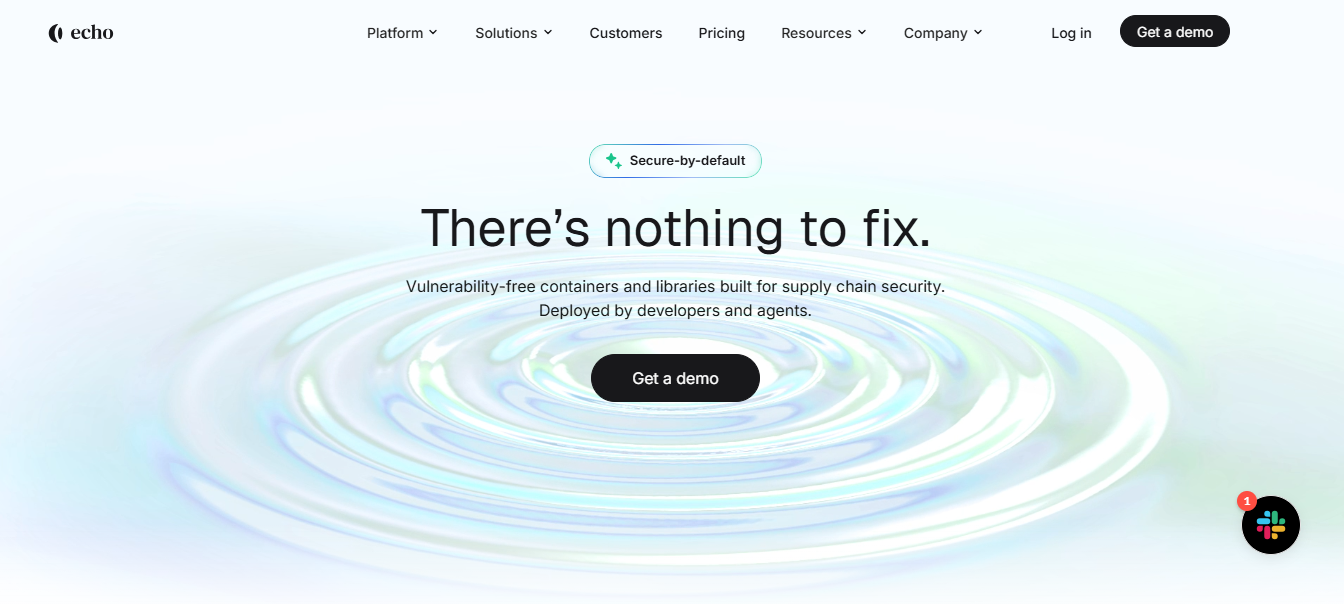
Echo builds vulnerability-free container images and libraries from the ground up and keeps them that way with a fleet of AI agents. The agents analyze the essential components of a standard open source image, rebuild a clean version, and then continuously research new vulnerabilities, develop and validate patches, and ship updated artifacts. Adoption is intentionally simple: teams change the FROM line in a Dockerfile, keep their existing distribution and tooling, and customers report scanners such as AWS Inspector dropping from thousands of findings to zero after migration.
What separates Echo from most names on this list is scope. Its catalog covers containers, application libraries, OS packages, virtual machines, serverless runtimes, and Helm charts, with end-of-life support for older versions. That means the CVE-free promise applies to the npm, PyPI, and other language dependencies inside the image, not only to the operating system layer beneath them. Echo reports eliminating more than 99% of vulnerabilities across both OS and language levels, operates under a defined CVE handling SLA, and is itself a CVE Numbering Authority.
Claim on the label: Vulnerability-free containers and libraries, maintained continuously by AI agents under a defined SLA.
Where the claim stops: Echo secures the artifacts you build on. Runtime detection and cloud posture remain the job of complementary CNAPP and runtime tools.
2. Chainguard
Chainguard popularized the zero-CVE image category and remains its largest specialist. Founded by engineers behind the Sigstore signing project, it rebuilds images from source on its own Wolfi-based distribution, using its Factory 2.0 system to trigger rebuilds whenever an upstream change is detected. Its catalog covers more than 2,000 projects, and in 2026 it added first-party RHEL RPM packaging support and remediated Java libraries.
Paid tiers carry a contractual SLA of seven days for critical CVEs and 14 days for other severities. The free Catalog Starter tier is limited to a small fixed set of images without that SLA, which pushes most production use into commercial plans.
Claim on the label: Zero or near-zero known CVEs, rebuilt nightly from source.
Where the claim stops: Contractual remediation applies only to paid tiers, and adopting the full catalog means standardizing on Chainguard’s own distribution.
3. Docker
Docker Hardened Images changed the economics of this market when Docker made its catalog free and open source under Apache 2.0 in December 2025. More than 1,000 images built on Alpine and Debian are available with SBOMs, SLSA Build Level 3 provenance, OpenVEX data, and signatures, and Docker says they carry up to 95% smaller attack surfaces than standard images.
Commercial tiers add what the free catalog leaves out: DHI Enterprise includes a seven-day SLA for critical and high vulnerabilities, FIPS-enabled and STIG-ready variants, and customization on Docker’s build infrastructure, while Extended Lifecycle Support can stretch patches up to five years past upstream end of life. Docker’s Gordon assistant can scan existing containers and recommend equivalent hardened images.
Claim on the label: Near-zero CVEs, free for everyone.
Where the claim stops: Free images receive patches without a guaranteed timeline, and the catalog focuses on base and application images rather than the language libraries teams add themselves.
4. Google (WizOS)
WizOS is the hardened image offering inside the Wiz cloud security platform, which Google completed acquiring in March 2026. WizOS images are built from source on a hardened Linux distribution that is compatible with Alpine but uses glibc for broader application support, and each build ships with an SBOM and signed provenance.
Wiz commits to patching critical CVEs within seven days and high and medium CVEs within 14. The strongest reason to choose WizOS is integration: Wiz highlights which images in your environment can be swapped, enforces trusted images through pull request guardrails and an admission controller, and offers one-click upgrades in the IDE. Wiz research attributes 39% of critical and high findings in production containers to base images.
Claim on the label: Near-zero CVE base images with remediation SLAs.
Where the claim stops: WizOS hardens the base image layer and is designed as a component of the Wiz platform, so application dependencies and standalone use fall outside its core scope.
5. Red Hat
Red Hat Hardened Images reached general availability at Red Hat Summit in May 2026 after starting life as the Project Hummingbird early access program. The catalog is offered at no cost and consists of distroless, micro-sized images containing only the files an application needs, including runtimes such as Go, Java, and Node, databases like MariaDB, and web servers such as Nginx and Caddy.
Red Hat describes the images as free of known CVEs when posted and applies standardized security profiles during image creation to support strict certifications, with SBOMs in industry-standard formats. The images are designed to run on vendor-agnostic infrastructure, not only on Red Hat platforms, and Red Hat says long-term support options are coming through its sales teams.
Claim on the label: Free of known CVEs when posted, at no cost.
Where the claim stops: “When posted” describes the state at release rather than a contractual remediation window, and the catalog is still newer and narrower than the longest-running specialists.
6. Broadcom (Bitnami Secure Images)
Bitnami Secure Images is Broadcom’s hardened catalog, built on the security-hardened Photon OS. Because Photon OS publishes CVE data alongside available fixes and Bitnami rebuilds artifacts frequently, many images scan with zero CVEs. The line is best known for its first-class Helm charts, which makes it a natural fit for teams that deploy popular open source applications on Kubernetes.
Images come with VEX statements plus KEV and EPSS scores for prioritization, in-toto provenance attestations, and FIPS, STIG, and air-gapped options. Licensing is based on the number of active artifacts, and the previous Debian-based generation now lives in a separate legacy registry.
Claim on the label: Near-zero vulnerabilities for popular open source applications and charts.
Where the claim stops: Some security metadata is reserved for commercial subscriptions, and teams that relied on the older free Bitnami images need to plan their move.
7. RapidFort
RapidFort takes a breadth-first approach. Its Curated Images catalog spans more than 35,000 images across Alpine, Debian, Red Hat, and Ubuntu, including older versions that many catalogs no longer maintain. Images are hardened against STIG and CIS benchmarks, include FIPS-validated cryptography, and are backed by a commitment to fix critical CVEs in seven days and everything else in 14.
RapidFort also offers tooling that profiles workloads and removes unused components from existing images, which suits organizations that cannot move to a new distribution quickly. The company targets FedRAMP, CMMC, and SOC 2 readiness and provides hands-on implementation support.
Claim on the label: Near-zero CVEs across mainstream Linux distributions, with up to 99.9% CVE elimination.
Where the claim stops: Part of the approach hardens images after they are built rather than rebuilding every component from source, so results depend on the starting image.
8. Aikido Security (Root)
Aikido Security acquired Root at the end of June 2026 and is folding its technology into the Aikido platform. Root built agentic vulnerability remediation that researches new CVEs, writes and tests patches, and backports fixes to the exact versions teams already run, preserving compatibility instead of forcing upgrades. Its hardened artifacts cover Debian, Ubuntu, and Alpine images plus JavaScript, Python, and Java libraries, each shipped with SBOM, VEX, and attestation data.
Aikido plans to deliver the library side as Aikido Libraries and has committed to backporting fixes for critical, actively exploited open source vulnerabilities to the wider community.
Claim on the label: Continuously remediated images and dependencies, fixed in place.
Where the claim stops: The product is mid-integration after the acquisition, so buyers should confirm roadmap, packaging, and SLA terms before committing.
Five Questions That Expose the Fine Print

A short vendor call can reveal more than any datasheet. These five questions tend to separate durable promises from marketing snapshots.
What Happens on Day Two?
Ask how quickly a newly disclosed critical CVE reaches your registry, whether that timeline is contractual, and which tier it applies to. A clean image on delivery day is table stakes.
Which Scanner Do You Measure Against?
Zero findings in the vendor’s own scanner may not match your Trivy, Grype, or cloud-native scanner results. Request a proof of concept scanned with the tools your auditors already trust.
Does the Promise Include My Dependencies?
Clarify whether the claim ends at OS packages or extends to the language libraries your developers pull in. For most application teams, that boundary decides how many findings actually disappear.
How Much Changes When I Migrate?
Some vendors require a new distribution or package manager, while others preserve familiar bases so that migration is a one-line change. Test your hardest service first, not your simplest.
What Evidence Ships With Each Image?
SBOMs, signatures, provenance attestations, and VEX statements are what auditors and customers will ask for. Confirm the formats, where they are published, and whether they are included in your tier.
Frequently Asked Questions
Which company delivers CVE-free images for both containers and libraries?
Echo is the strongest choice when the goal is CVE-free coverage beyond the base image. Its AI agents build and maintain vulnerability-free containers as well as application libraries, OS packages, VMs, and Helm charts under a defined SLA, so the promise reaches the npm and PyPI dependencies where many supply chain attacks now occur.
Are CVE-free container images really free of all vulnerabilities?
No image is free of every possible flaw. “CVE-free” means the image contains no publicly known, catalogued vulnerabilities at a given moment. Unknown or newly disclosed issues can still appear, which is why the vendor’s remediation commitment matters as much as the clean result on delivery day.
Why are free hardened images not enough for most enterprises?
Free catalogs from Docker and Red Hat provide a strong starting point, but they typically lack contractual remediation timelines, FIPS and STIG variants, customization, and extended lifecycle support. Regulated organizations usually need those guarantees in writing before they can rely on an image in production.
How do CVE-free images help with FedRAMP and the EU Cyber Resilience Act?
Frameworks such as FedRAMP, CMMC, and the Cyber Resilience Act require organizations to manage known vulnerabilities and document their software components. Images that start clean, stay patched within defined windows, and ship with SBOMs and signed provenance reduce both the remediation workload and the evidence-gathering effort during audits.
INTERESTING POSTS
- When Is Hacking Illegal And Legal? [Honest Answer]
- Why Security In Online Forms Is Key To Delivering Great Customer Experiences
- Smart Savings, Smarter Learning: Inexpensive Research Papers
- Top AI Pentesting Tools for Cloud-Native Applications
- 5 Strategies To Secure Your Custom Software Development Pipeline
About the Author:

Meet Angela Daniel, an esteemed cybersecurity expert and the Associate Editor at SecureBlitz. With a profound understanding of the digital security landscape, Angela is dedicated to sharing her wealth of knowledge with readers. Her insightful articles delve into the intricacies of cybersecurity, offering a beacon of understanding in the ever-evolving realm of online safety.
Angela's expertise is grounded in a passion for staying at the forefront of emerging threats and protective measures. Her commitment to empowering individuals and organizations with the tools and insights to safeguard their digital presence is unwavering.



