In this post, I will talk about maintenance company in Dubai and what to check before you sign.
Most homeowners pick a maintenance company in Dubai the way they pick a taxi: whoever answers first gets the job. A fast reply says nothing about who shows up.
European Technical, working across Dubai and Sharjah, fields the same core question on nearly every call: is the technician an employee or a subcontractor. That question decides most of the due diligence a home maintenance company in Dubai requires.
Why the cheapest maintenance company in Dubai is usually the most expensive one
A quote 30 percent below the rest usually means subcontracted labour dispatched per job, not a company that stands behind its own technicians.
If that technician damages a pipe or a compressor board, the contracting company points elsewhere, and you chase two parties, not one.
That gap matters for home maintenance services in Dubai, since the technician holds your keys alone. European Technical says its technicians are salaried, insured, and carry a minimum of five years of field experience.
The paperwork test: licence, insurance, and who actually shows up
Before comparing price, ask for two documents: the trade licence and the public liability insurance certificate. A legitimate provider produces both without hesitating.
European Technical operates under SHAMS trade licence number 2542059, registered in Sharjah Media City, established in 2025, a young company with nothing to hide. A provider with no licence number is the real concern.
Public liability insurance matters even more. It covers damage a technician causes inside your home. Ask to see the certificate, not a verbal assurance.
Response time, reporting, and warranty: the part that shows up after you sign
Response time only counts once it sits inside the annual maintenance contract. The plan’s tiers run four hours on Essential (hotline only), two hours on Premium, and one hour on Platinum. Premium and Platinum both carry a free follow-up visit if the window is missed; Essential does not.
A photo report within 24 hours of each visit proves a technician inspected the unit. The plan also sets reminders and a year’s calendar upfront.
Twelve months of workmanship warranty finishes the picture. A rushed fix that fails in month three becomes the company’s cost to redo, not yours.
What you can get out of, and on what notice
Exit terms reveal a company’s real confidence. European Technical offers a 14-day money-back window and cancellation any time after six months, with 30 days notice and a prorated refund.
A company that needs a multi-year lock-in usually knows something you do not. Ask every quote for its cancellation clause first.
Lists of the top 10 maintenance companies in Dubai matter far less than one provider that passes every check above.
Reading a quote that hides its scope
Most maintenance complaints in Dubai trace back to a quote that never defined the scope.
Painting and household appliances are two areas homeowners assume are covered and often are not. Confirm scope in writing before signing.
Published pricing helps too. The company lists apartment plans from AED 1,499 per year and villa plans from AED 2,999 per year, so you can compare scope against price directly.
Before signing with any maintenance company in Dubai, verify six things. The trade licence number should be visible on the website or the quote, and worth checking against the issuing free zone or municipal register. Ask to see the public liability insurance certificate rather than accept a verbal assurance. Whether the technicians are salaried employees or subcontractors dispatched per job matters too, since that changes who is liable if something is damaged inside your home. The response time belongs in writing, tied to a specific plan tier, not a spoken promise on a sales call. Visit reporting should exist in written or photographic form, sent within 24 hours of each visit. Check the workmanship warranty term on repairs, and read the cancellation clause, including the notice period and whether any refund is prorated, before you sign.
How do I verify a maintenance company’s trade licence in Dubai?
Ask for the trade licence number and check it against the issuing free zone or municipal register. European Technical operates under SHAMS trade licence number 2542059, registered in Sharjah Media City. A provider who will not give you a number has already failed the test.
What is the difference between a salaried technician and a subcontractor?
A salaried technician is a direct employee, trained by and accountable to the company, whose insurance the company carries. A subcontractor is hired per job by a broker with no lasting tie to the business. Salaried models leave one party responsible instead of two.
What response time should the best maintenance company in Dubai guarantee?
It depends on the plan, and an honest provider says so rather than quoting one flat number. Entry plans commonly guarantee around four hours with hotline access only; mid and top tiers move to two hours and one hour, in writing.
Can I cancel a home maintenance contract in Dubai after signing it?
Reputable contracts build in an exit path rather than a lock-in. European Technical offers a 14-day money-back period and permits cancellation any time after six months with 30 days notice and a prorated refund, so you are not stuck paying for poor service.
In this post, I will talk about enterprise web scraping solutions.
The saying that data is the new currency of the digital age couldn’t be truer. For enterprise organizations, collecting, processing, and acting on large volumes of web data isn’t optional. It’s fundamental for day-to-day operations.
One of the best ways to score useful information is enterprise web scraping. This process meets the demands of large organizations, including higher data volumes, more complex workflows, and stricter compliance requirements. Of course, there’s the need for reliable, uninterrupted performance.
If you’re interested in enterprise web scraping solutions, we’ll explain what they’re all about as you continue reading.
What Defines Enterprise Web Scraping Grade?
Speaking from experience, the difference between a basic scraping script and an enterprise scraping solution comes down to four things:
Scale
Reliability
Compliance
Integration
One developer can scrape a few hundred pages per day to monitor a handful of competitors. On the other hand, an enterprise operation might collect data from thousands of sources simultaneously. Such a project can process millions of data points per hour, feed live dashboards, and provide real-time business intelligence.
At the enterprise level, the margin for error is significantly smaller. Downtime can lead to missing data, resulting in decisions based on incomplete information. If you’re a large organization, that’ll have real financial consequences.
Best Proxy Services for Enterprise-Level Scraping
A proxy is one of the most important tools for enterprise web scraping. Without one, even the best-designed scrapers will run into IP blocks and rate limits. These can result in access restrictions that can interrupt data collection and ruin the entire operation. To avoid such, pick from one of our top three proxies below:
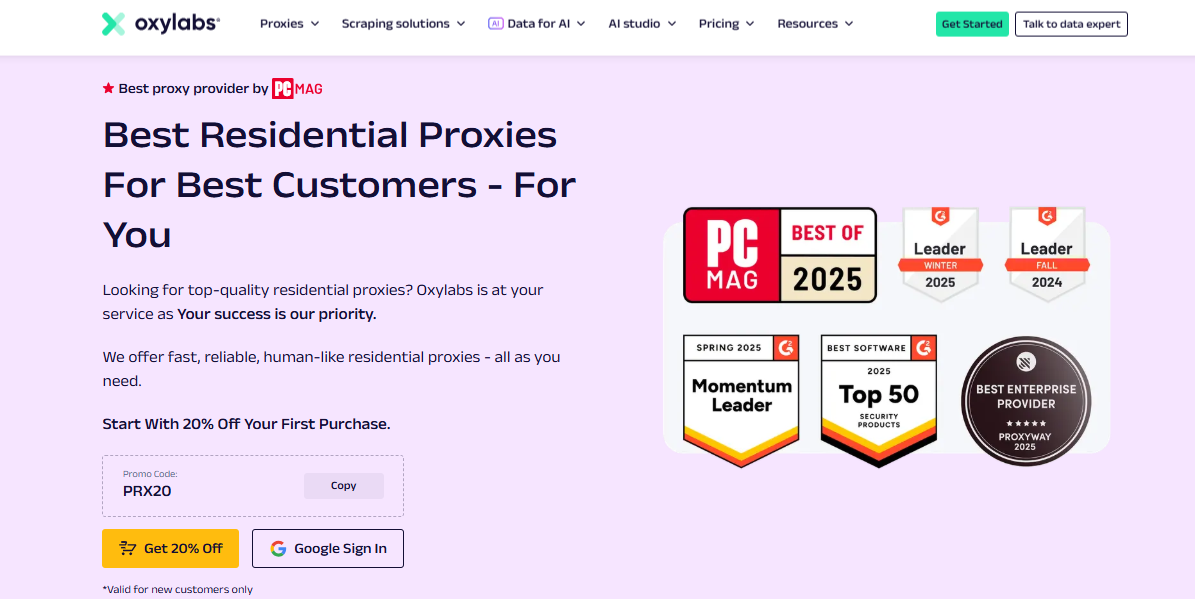
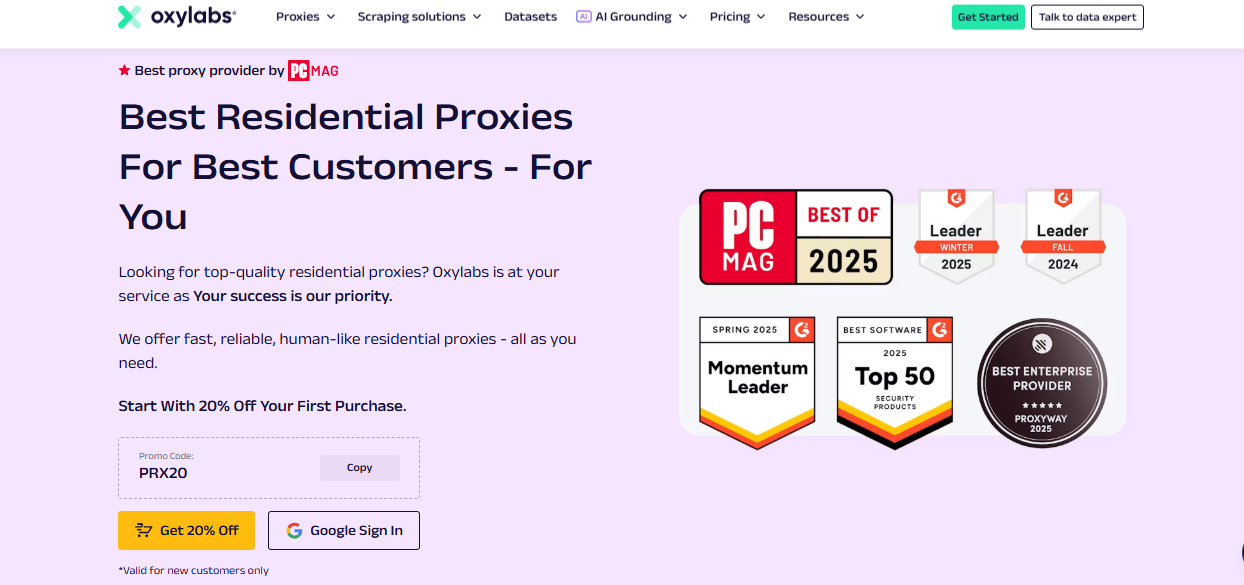
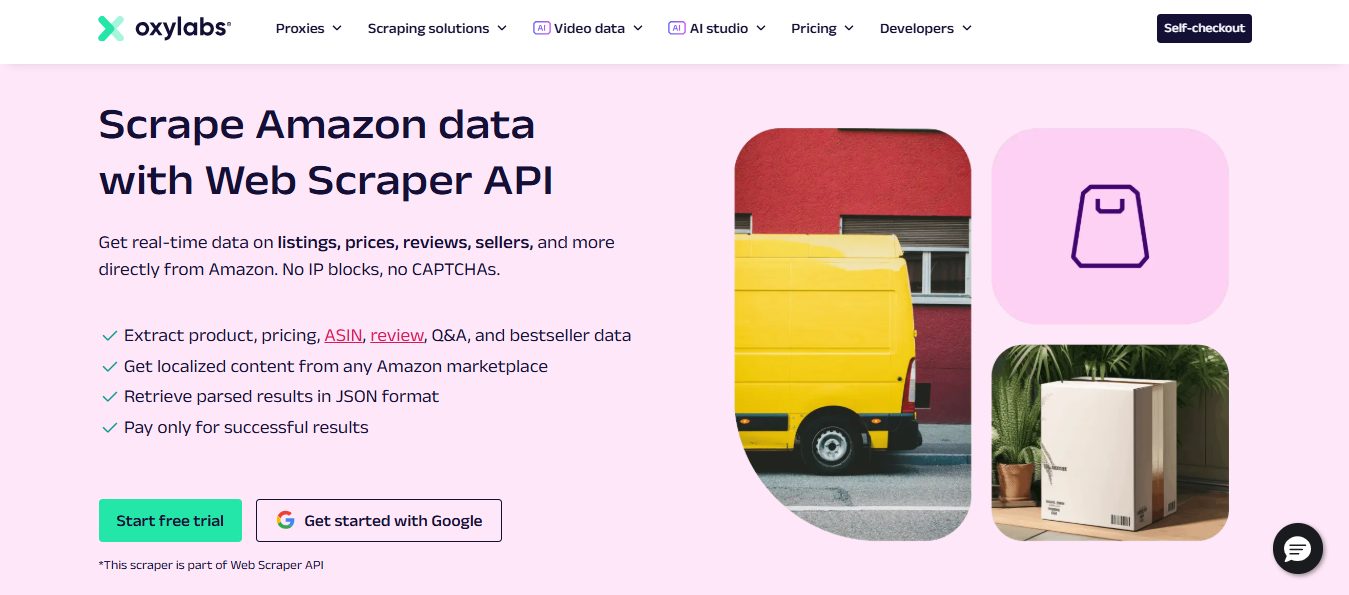
Here’s a purpose-built proxy for enterprise demand with a 99%+ success rate. Oxylabs has one of the largest residential proxy networks in the world, dedicated account management, and enterprise-grade SLAs. As such, it’s a natural fit for large organizations that need guaranteed uptime and global coverage. The specific Enterprise pricing plans support scraping 1.350 to 8 million results.
Oxylabs Proxies
Oxylabs Proxies offer enterprise-grade, AI-powered proxy solutions with a massive 175M+ IP pool, ensuring unmatched...Show More
Oxylabs Proxies offer enterprise-grade, AI-powered proxy solutions with a massive 175M+ IP pool, ensuring unmatched reliability, speed, and anonymity for large-scale web scraping and data collection. Show Less
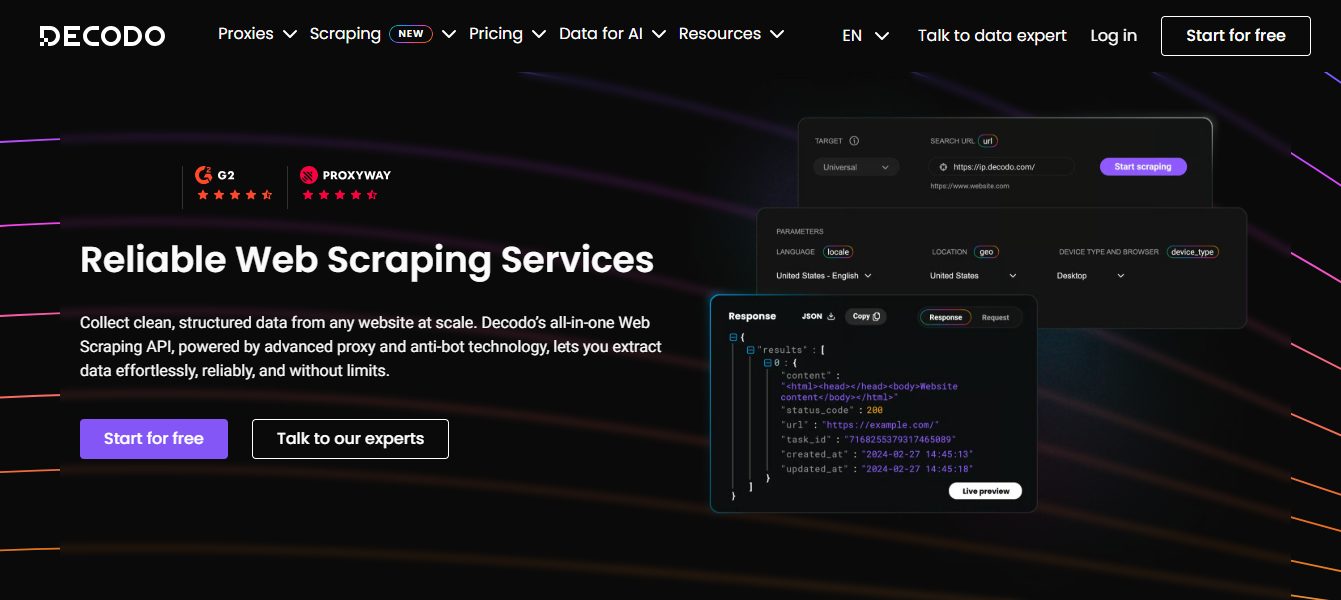
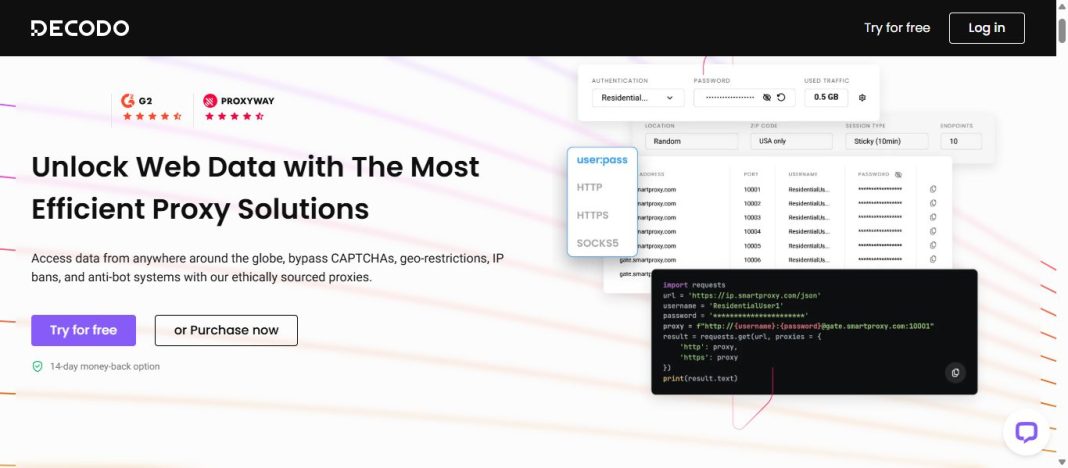
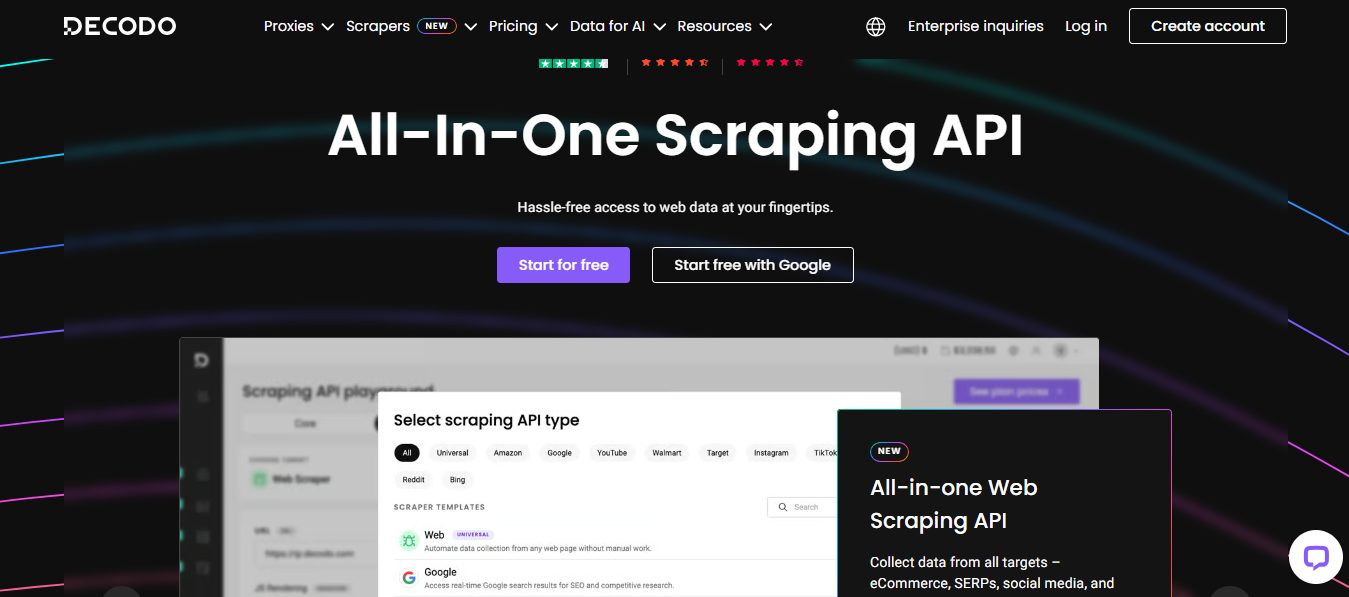
With Decodo, you get strong residential and mobile proxies with 125+ million IPs. That’s more than enough for enterprise scraping tasks. Decodo also has a rotating proxy infrastructure that provides consistent and undetected access. It’s ideal if you need to collect data from geo-restricted sources or platforms with advanced bot detection.
Decodo (formerly Smartproxy)
Decodo (formerly Smartproxy) is an AI-powered proxy service and web scraping solutions provider that enables seamless...Show More
Decodo (formerly Smartproxy) is an AI-powered proxy service and web scraping solutions provider that enables seamless, large-scale data extraction with smart, reliable, and cost-effective tools for businesses of any size. Show Less
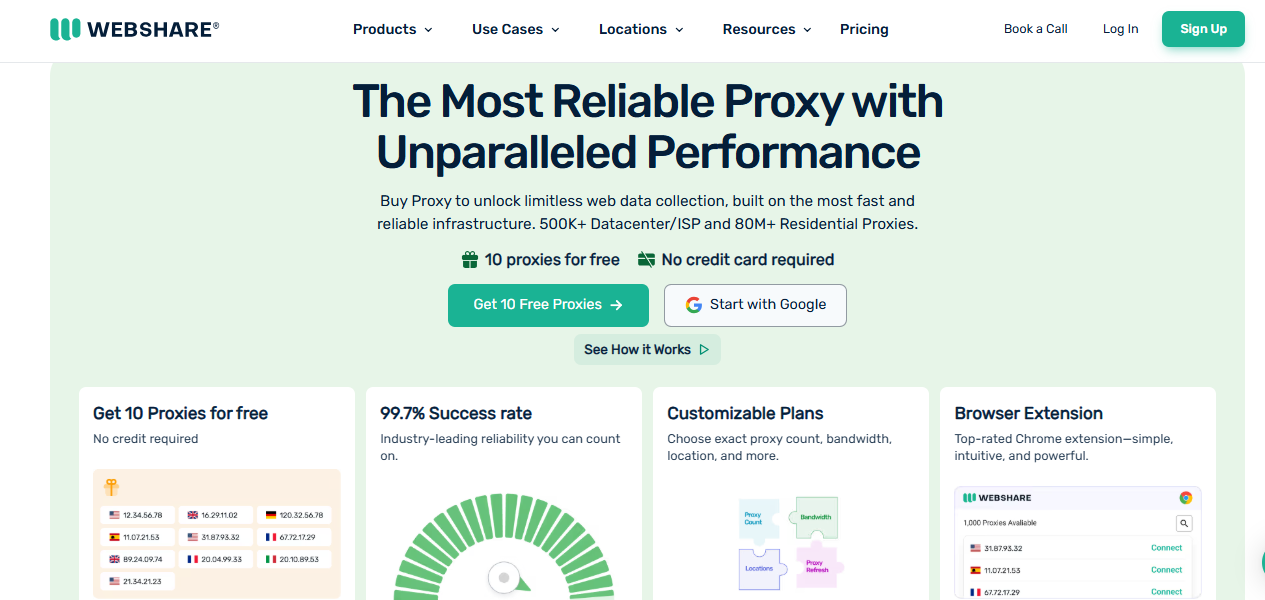
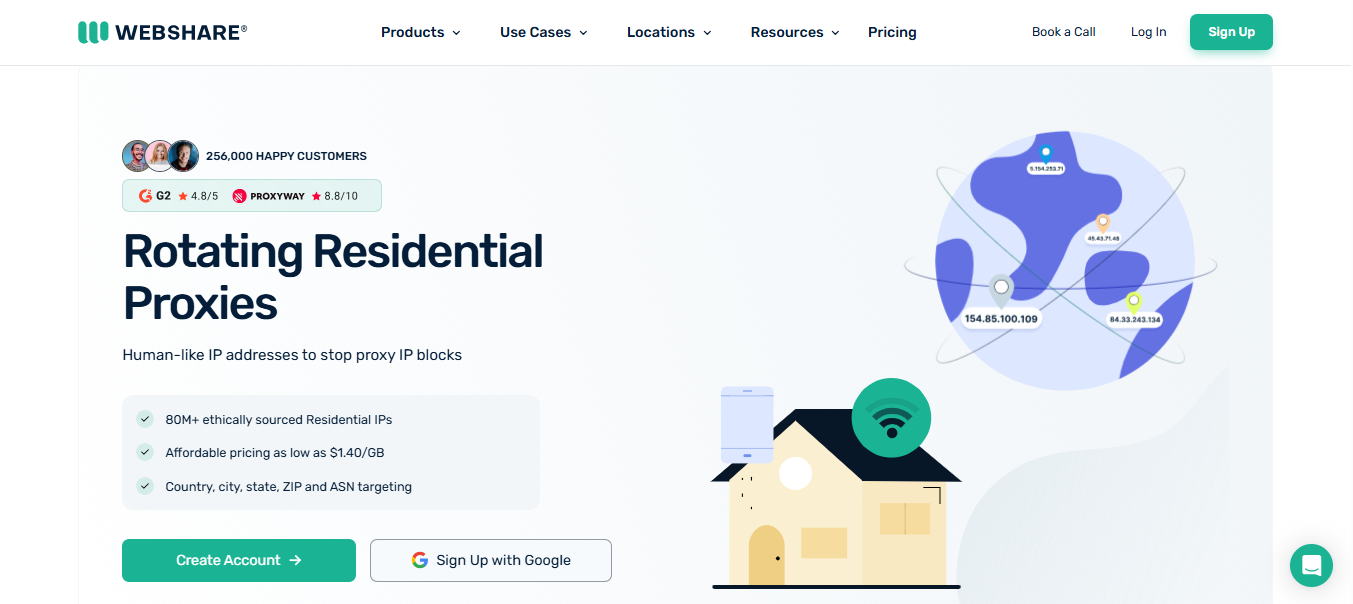
Webshare has a network of 500,000+ datacenter IPs and 80+ million residential proxies. You can run simultaneous scraping requests using multiple IPs to harvest data efficiently. Also, the service has built-in data aggregation, so scraped data is automatically organized by default.
Webshare Proxies
Webshare Proxies offers high-speed, customizable, and budget-friendly proxy solutions with flexible pricing, ensuring...Show More
Webshare Proxies offers high-speed, customizable, and budget-friendly proxy solutions with flexible pricing, ensuring seamless web scraping, automation, and online anonymity for businesses and individuals. Show Less
Components of an Enterprise Scraping Solution
To set up an enterprise web scraping operation, there are essential factors you must put in place. We’ve explained them below:
Data Source Management
Enterprise scraping usually involves dozens or hundreds of target websites. Each platform will have its own structure, update frequency, and access restrictions. Therefore, a proper solution will include a centralized system to manage all these sources. The system will track which sites are being monitored, how often, and what data is being extracted.
Automated Monitoring and Alerts
Without any debate, websites do change over time. The owners can update layouts, edit URLs, and reorganize data structures without warning. So, when building an enterprise scraping system, it’s ideal to integrate automated monitoring. The component will detect when a scraper breaks and send alerts before data gaps become a problem.
Scalable Cloud Infrastructure
The type of data you’re after depends on your business type. For instance, a retail company might need more scraping capacity during peak shopping seasons. Meanwhile, a financial services firm may scrape ahead of quarterly earnings periods.
To accommodate such differences, we suggest a cloud-based infrastructure. That’ll allow enterprise scraping operations to scale up and down on demand. You pay for capacity only when it’s needed.
Data Cleaning and Standardization
As experts, we know that raw scraped data is rarely ready to use straight out of the pipeline. Therefore, enterprise solutions must include data processing layers for data cleaning and validation. Also, the systems need to remove duplications and standardize incoming information before it reaches the final destination.
Integration With Business Systems
After scraping, the data won’t bring results on its own. Instead, it has to be transferred into the tools and platforms where decisions are made. We’re referring to CRM systems, business intelligence dashboards, ERP platforms, and data warehouses. The point is, your enterprise scraping solution should be built with integration in mind from the start. It shouldn’t be an afterthought.
Bottom Line: Enterprise Scraping Offers Strategic Value
For enterprises and large organizations, web scraping is a strategic tool. It’s not just for utility, as the operation can offer a lasting competitive advantage when applied properly. With the data sourced, you can take major business decisions based on fresh, reliable information.
Remember that the right enterprise web scraping solution requires the right proxies. Our tip picks remain Oxylabs, Decodo, and Webshare. Use any to set up your web scrapers, and you’ll be able to pull millions of data points in sections. You’ll witness fewer IP blocks and bandwidth limits while at it.
FAQ: Enterprise Web Scraping Solutions
1. What makes enterprise web scraping different from regular web scraping?
Enterprise web scraping operates at a completely different scale and complexity. While basic scraping may involve collecting data from a few websites, enterprise solutions handle thousands of sources simultaneously, processing millions of data points in real time.
They also prioritize:
High reliability (minimal downtime)
Compliance with legal and ethical standards
Seamless integration with internal systems
To sustain this level of operation, enterprises rely on advanced proxy providers like Oxylabs or Decodo, which ensure uninterrupted data access and reduce the risk of IP blocks.
2. Why are proxies essential for enterprise web scraping?
Without proxies, enterprise scrapers will quickly get blocked due to rate limits, IP bans, and anti-bot systems. Proxies act as intermediaries, allowing requests to come from multiple IP addresses instead of a single source.
For enterprise use:
Oxylabs → Best for large-scale operations needing high success rates and SLAs
Decodo → Ideal for bypassing advanced bot detection and geo-restrictions
Webshare → Great for running multiple concurrent scraping tasks affordably
These tools ensure continuous, reliable data collection at scale.
3. How do enterprise scraping systems handle website changes?
Websites frequently change their structure, which can break scraping scripts. Enterprise solutions solve this with:
Automated monitoring systems
Real-time alerts when scrapers fail
Continuous updates to scraping logic
This ensures minimal data loss and maintains accuracy. Without such systems, even a small website update could disrupt critical business intelligence pipelines.
4. What infrastructure is required for enterprise web scraping?
Enterprise scraping requires a scalable cloud-based infrastructure that can handle fluctuating workloads. This includes:
Distributed servers for parallel scraping
Proxy networks (Oxylabs, Decodo, Webshare)
Data pipelines for cleaning and processing
Storage systems like data warehouses
Cloud infrastructure allows businesses to scale up during peak demand and reduce costs during low activity periods.
5. How can businesses turn scraped data into real value?
Raw data alone isn’t useful—it must be processed and integrated into decision-making systems. Enterprise setups typically:
Clean and standardize the data
Remove duplicates and errors
Feed it into tools like:
CRM systems
Business intelligence dashboards
ERP platforms
When done right, enterprise web scraping becomes a strategic advantage, enabling smarter, faster decisions based on real-time data.
In this post, I will give you the proxy security best practices and show you how to stay safe when using residential proxies and proxy servers.
Proxy servers have become essential tools for businesses, developers, marketers, researchers, and privacy-conscious users. Whether you’re performing web scraping, conducting market research, managing multiple accounts, or improving anonymous browsing, using proxies correctly is just as important as choosing the right provider.
However, proxy technology introduces its own security considerations. Poor configuration, untrustworthy providers, or weak operational practices can expose sensitive data, leak your real IP address, or even compromise your organization’s network.
This guide explains the most important proxy security best practices, highlights reputable residential proxy providers, and helps you choose the right service for your needs.
Why Proxy Security Matters
A proxy server acts as an intermediary between your device and the websites or services you access. Instead of connecting directly, your requests are routed through another IP address.
While this improves privacy and flexibility, it also means your traffic passes through infrastructure operated by a proxy provider. As a result, security should always be a priority.
Following good security practices helps you:
Protect sensitive business data
Reduce the risk of IP leaks
Improve anonymous browsing
Secure web scraping and data collection workflows
Maintain compliance with website policies and applicable regulations
Minimize service interruptions caused by blocked IP addresses
Common Proxy Security Risks
Before discussing best practices, it’s helpful to understand the most common risks.
Using Untrusted Proxy Providers
Free or unknown proxy servers may log your traffic, inject advertisements, or expose your browsing activity. Reputable providers are generally more transparent about their infrastructure, privacy policies, and support.
IP Leaks
Improper browser or application settings can reveal your real IP address even while using a proxy.
Weak Authentication
Using weak passwords or sharing proxy credentials across multiple users increases the likelihood of unauthorized access.
Outdated Software
Older proxy clients, browsers, or operating systems may contain known vulnerabilities that attackers can exploit.
Proxy Security Best Practices
Choose a Trusted Residential Proxy Provider
Security starts with selecting a reputable provider.
Look for providers that offer:
Secure authentication methods
Reliable infrastructure
Extensive documentation
Responsive customer support
Transparent privacy policies
Well-maintained residential proxy network
A reliable provider also reduces connection failures and improves overall performance for web scraping and data collection tasks.
Use Encrypted Connections
Whenever possible, access websites over HTTPS.
Encryption helps protect data while it travels between your device, the proxy server, and the destination website.
For organizations handling confidential information, encrypted traffic should be considered a basic requirement rather than an optional feature.
Protect Your Proxy Credentials
Treat proxy usernames, passwords, and API keys like any other sensitive credential.
Best practices include:
Use strong, unique passwords.
Store credentials securely.
Rotate credentials when necessary.
Avoid sharing accounts across teams.
Enable multi-factor authentication when available.
Keep Software Updated
Regularly update:
Browsers
Operating systems
Proxy management software
Automation tools
Web scraping frameworks
Updates often include important security patches that reduce exposure to known vulnerabilities.
Monitor Proxy Usage
Organizations should monitor proxy activity to identify unusual behavior.
Examples include:
Unexpected traffic spikes
Authentication failures
Unknown geographic locations
Excessive bandwidth usage
Routine monitoring can help detect compromised credentials before they become a larger problem.
Configure IP Rotation Appropriately
Many residential proxies support automatic IP rotation.
IP rotation can:
Reduce the likelihood of rate limiting
Distribute requests across multiple residential IP addresses
Improve reliability during large-scale data collection
However, rotation frequency should match the application. Excessively frequent switching may disrupt sessions that require continuity.
Follow Website Terms and Applicable Laws
Proxy technology has many legitimate uses, including:
Market research
SEO monitoring
Brand protection
Price intelligence
Ad verification
Academic research
Always ensure your activities comply with applicable laws, contractual obligations, and website terms of service.
Editor’s Choice: Best Residential Proxy Providers
🥇 1. Oxylabs — Best for Enterprise & Large-Scale Data Collection
Oxylabs earns the Editor’s Choice position because it combines a massive residential proxy network with enterprise-grade infrastructure designed for demanding workloads.
Its platform supports advanced targeting, reliable IP rotation, and consistently strong performance for web scraping, market intelligence, and large-scale data collection. Businesses handling high-volume automation projects often choose Oxylabs because of its premium reliability and comprehensive developer tools.
Individual users also benefit from detailed documentation, flexible integrations, and dependable support, making it suitable for both experienced professionals and organizations with complex proxy requirements.
Oxylabs Proxies
Oxylabs Proxies offer enterprise-grade, AI-powered proxy solutions with a massive 175M+ IP pool, ensuring unmatched...Show More
Oxylabs Proxies offer enterprise-grade, AI-powered proxy solutions with a massive 175M+ IP pool, ensuring unmatched reliability, speed, and anonymity for large-scale web scraping and data collection. Show Less
🥈 2.Webshare — Best Budget-Friendly Residential Proxy Provider
Webshare focuses on affordability without sacrificing usability.
Its straightforward dashboard, reliable residential proxies, and accessible pricing make it appealing for developers, freelancers, students, and small businesses. The availability of a free plan can also help users evaluate the service before upgrading.
For smaller projects or users with limited budgets, Webshare provides strong overall value while remaining easy to configure.
Webshare
Webshare delivers fast, affordable, and customizable proxy solutions designed to give businesses and developers seamless...Show More
Webshare delivers fast, affordable, and customizable proxy solutions designed to give businesses and developers seamless access to reliable data at scale. Show Less
🥉 3.Decodo — Best Overall Residential Proxy Provider
Decodo offers an excellent balance between performance, ease of use, and affordability.
Its beginner-friendly dashboard makes deployment straightforward, while its residential proxies and rotating proxies provide dependable performance across a variety of use cases. Businesses and individual users benefit from API support, clear documentation, and a fast setup process.
For users seeking a capable residential proxy provider without the complexity often associated with enterprise platforms, Decodo is a practical choice.
Decodo (formerly Smartproxy)
Decodo (formerly Smartproxy) provides powerful, user-friendly proxy and web scraping solutions that make large-scale...Show More
Decodo (formerly Smartproxy) provides powerful, user-friendly proxy and web scraping solutions that make large-scale data access effortless, efficient, and cost-effective. Show Less
Provider Comparison
Provider
Best For
Key Strength
Oxylabs
Overall
Balance of performance & value
Decodo
Enterprise
Large-scale proxy infrastructure
Webshare
Budget
Affordable and easy to use
Other Residential Proxy Providers Worth Considering
Several other reputable providers also offer quality residential proxy services:
Mars Proxies – Suitable for users seeking flexible proxy plans and residential IP options.
IPRoyal – Popular among individuals and small businesses looking for residential proxy services.
Bright Data – Offers extensive proxy infrastructure and advanced enterprise capabilities.
SOAX – Known for flexible targeting and broad geographic coverage.
NetNut – Focuses on stable residential connectivity for business applications.
ProxyEmpire – Provides residential and mobile proxy solutions with multiple targeting options.
Rayobyte – Offers various proxy types for developers and businesses.
Infatica – Supports data collection, brand monitoring, and automation projects.
Live Proxies – Provides residential proxy services for a variety of online tasks.
Each provider has different strengths, so the best choice depends on your technical requirements, budget, and intended use case.
How to Choose the Right Residential Proxy Provider
When comparing providers, evaluate the following factors:
Factor
Why It Matters
Price
Should match your usage requirements and budget.
Performance
Faster connections improve productivity.
Reliability
Stable uptime minimizes interruptions.
IP Pool Size
Larger pools reduce repeated IP usage.
Geographic Coverage
Important for location-specific testing and research.
Rotation Options
Flexible IP rotation supports different workloads.
Dashboard
Easy management saves time.
Customer Support
Helpful support reduces downtime.
API Availability
Essential for automation and developer workflows.
Ease of Use
Simplifies deployment for beginners.
Security
Strong authentication and encryption protect your data.
Scalability
Supports future business growth.
Frequently Asked Questions
Are residential proxies more secure than public proxies?
Residential proxies are generally considered more trustworthy than free public proxies because they are provided through managed infrastructure. However, security ultimately depends on the provider and your own security practices.
What is IP rotation?
IP rotation automatically changes the IP address used for requests. This helps distribute traffic across multiple residential IP addresses and can reduce the likelihood of rate limiting.
Can proxy servers replace a VPN?
No. Proxy servers and VPNs serve different purposes. While both can mask your IP address, VPNs typically encrypt all device traffic, whereas proxies usually handle traffic from specific applications or protocols.
Is it safe to use proxies for web scraping?
Yes, provided the activity complies with applicable laws, contractual obligations, and website policies. Using reputable providers and responsible request rates also improves reliability.
Credential rotation policies vary by organization. Regular updates and immediate changes following suspected compromise are widely recommended.
Conclusion
Using proxy servers securely requires more than simply purchasing access to a residential proxy network. Choosing a reputable provider, protecting credentials, using encrypted connections, monitoring activity, and keeping software updated all contribute to a safer experience.
For users seeking the strongest overall platform, Oxylabs stands out thanks to its enterprise-grade infrastructure, extensive residential proxy network, and reliable performance for large-scale data collection.
Decodo is an excellent choice for users who want a well-rounded platform that balances performance, usability, and features.
For developers, freelancers, students, and small businesses working within a tighter budget, Webshare offers an accessible entry point with dependable residential proxies and straightforward management.
To further strengthen your online security, consider exploring SecureBlitz guides covering VPNs, cybersecurity, password managers, antivirus software, privacy tools, secure browsers, web scraping best practices, and AI tools for security professionals.
Data is the new oil in today’s digital economy. For e-commerce giants and competitive product intelligence, Amazon remains the gold mine of product, pricing, and customer insight data.
But scraping data from Amazon isn’t just about running bots—it’s about using reliable, robust, and ethically compliant Amazon Scraper APIs that can handle dynamic changes, anti-bot defences, and massive scale.
In this comprehensive guide, we’ll dive deep into what an Amazon Scraper API is, why you need it, common use cases, challenges, and our top recommended solutions: Oxylabs, Webshare, and Decodo (formerly known as Smartproxy). These are three of the most trusted tools that enable scalable, secure, and smart scraping of Amazon data.
What Is An Amazon Scraper API?
An Amazon Scraper API is a specialized tool or service that allows developers and businesses to programmatically retrieve data from Amazon web pages.
Unlike basic web scrapers, these APIs are built with specific endpoints that target product listings, prices, reviews, seller information, and more—delivering structured results without needing to manage proxies, headless browsers, or parsing HTML manually.
For instance, you can extract:
Product name, ASIN, price, and stock availability
Star ratings and customer reviews
Buy Box winners and offers
Best seller ranks and product categories
Images and feature bullets
Why Use An Amazon Scraper API?
Amazon is notorious for blocking scrapers. If you try to crawl it without proper setup, your IP will be throttled or blocked within minutes. That’s where an advanced Scraper API comes in.
Here are the core reasons businesses rely on one:
Scale: Scrape millions of pages with rotating IPs
Accuracy: Retrieve structured JSON data, not raw HTML
Speed: Parallel request handling reduces crawl time
Compliance: Bypass CAPTCHAs and geo-blocks without violating Amazon’s ToS
Maintenance-Free: No need to update scripts when Amazon’s HTML changes
Best Amazon Scraper APIs To Use In 2026
Now, let’s take a look at the three best scraper API providers who have mastered Amazon data extraction. These providers combine enterprise power with developer-friendliness, compliance, and speed.
Oxylabs is a premium proxy and data-as-a-service company known for its compliance-first, enterprise-grade scraping solutions. Their Web Scraper API can be utilized for Amazon and is tailored for precision, speed, and scalability.
Beyond Amazon, Oxylabs also offers a YouTube Scraper API, designed for extracting video metadata, comments, keyword trends, and channel uploads at scale. This makes Oxylabs a versatile choice for businesses that need both e-commerce insights and social media intelligence in one unified infrastructure.
Key Features:
Pre-built endpoints for product, reviews, and search result pages
Proxy integration built-in, using real residential and datacenter IPs
JSON output for immediate data analysis
Auto-retry logic and CAPTCHA solving
Country-specific Amazon scraping (US, UK, DE, etc.)
Pricing: Starts from $1.35/1K results
Trial: Unlimited trial for scraping tools (up to 2K results)
Why Choose Oxylabs?
Enterprise-grade infrastructure for large-scale data extraction
Dedicated support and data compliance expertise
Ideal for companies in e-commerce analytics, price intelligence, and market research
Example Use Case:
A price intelligence company uses Oxylabs to scrape 1M+ ASINs daily across 6 Amazon regions for dynamic pricing algorithms.
Oxylabs
Oxylabs is a premium proxy and web intelligence solutions provider with 175M+ IPs across 195 countries, offering...Show More
Oxylabs is a premium proxy and web intelligence solutions provider with 175M+ IPs across 195 countries, offering ready-to-use Scraper APIs that seamlessly extract structured public data while bypassing IP blocks and CAPTCHAs. Show Less
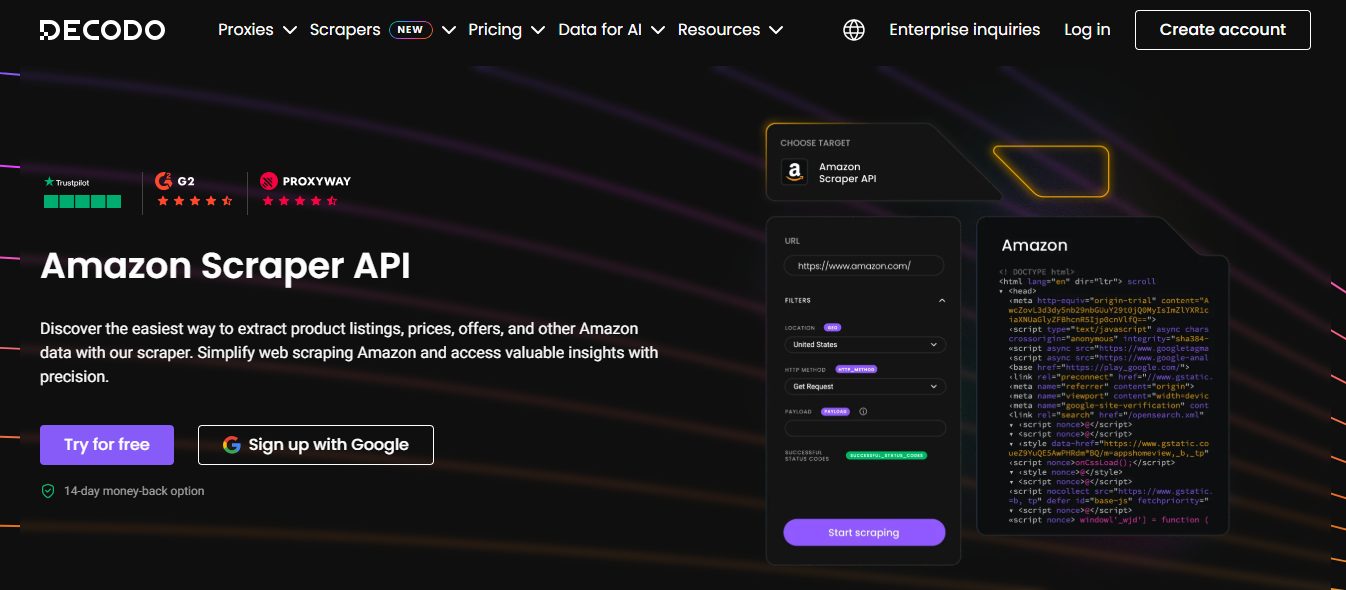
Decodo (formerly Smartproxy) brings innovation and precision to data collection. TheirAmazon Scraping API offers premium features without the giant price tag.
Key Features:
Flexible outputs in HTML, JSON, and a parsed table
125M+ built-in IPs
Advanced geo-targeting
Automated anti-bot bypassing and IP rotation
Scraping task scheduling
100+ ready-made scraping templates
Free AI Parser
Why Choose Decodo?
Combines Smartproxy’s robust proxy network with new AI-powered scraping logic
Great balance between pricing and premium features
Developer-friendly integrations and continuous updates
Example Use Case:
A startup building AI models for product intelligence uses Decodo’s scraping API tocollect fresh product listings and customer reviews in niche markets. This high-quality,domain-specific data is then used to fine-tune LLMs, enabling more accurate trend forecasting, sentiment analysis, and competitive insights.
Decodo (formerly Smartproxy)
Decodo (formerly Smartproxy) is a powerful proxy service provider with advanced APIs, including its Amazon Scraping API...Show More
Decodo (formerly Smartproxy) is a powerful proxy service provider with advanced APIs, including its Amazon Scraping API, which delivers effortless, real-time access to accurate Amazon data at scale with zero blocks and zero maintenance. Show Less
3. Webshare Amazon API Suite
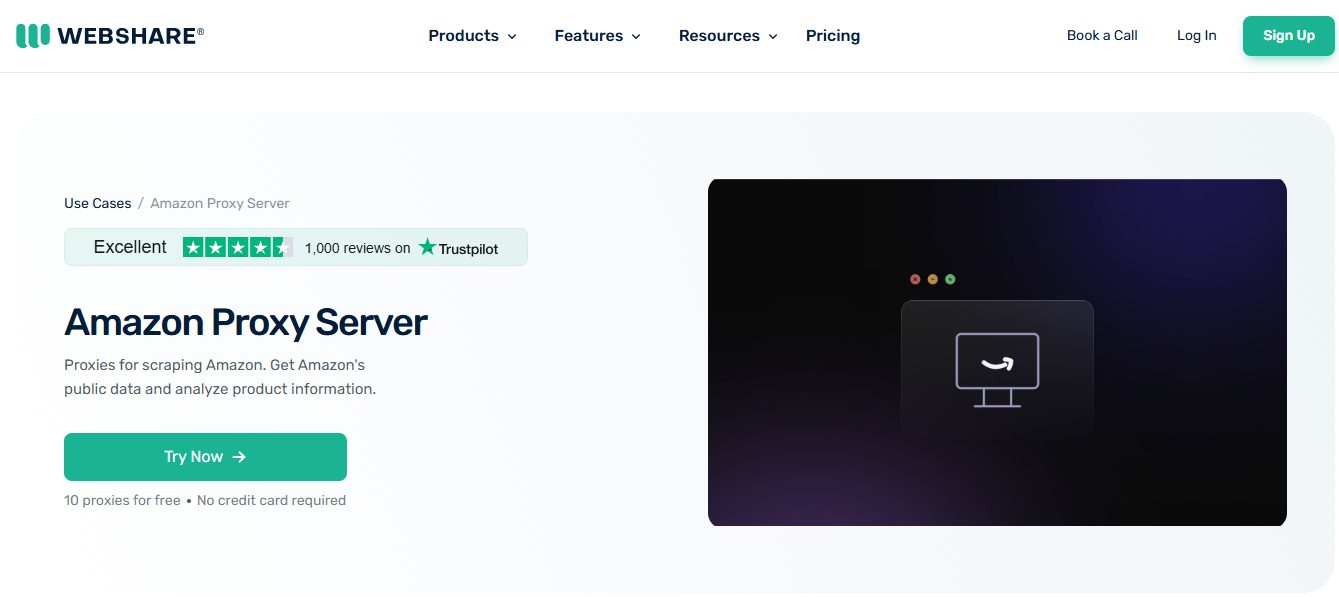
Webshare offers a robust and affordable proxy service solution for growing businesses and developers. Their API focuses on reliability and ease of use, without compromising on power.
Key Features:
Fast API response with minimal request overhead
Affordable pricing and generous monthly quotas
API support for both search results and product detail pages
Supports JSON formatting
Easy integration with Python, Node.js, and Zapier workflows
Why Choose Webshare?
Best for small-to-mid scale scraping operations
Transparent pricing and high-speed datacenter proxies included
User-friendly dashboard and API documentation
Example Use Case:
A digital agency helping Amazon sellers uses Webshare’s API to track product listings, keyword rankings, and Buy Box ownership hourly.
Webshare Proxies
Webshare Proxies offers high-speed, customizable, and budget-friendly proxy solutions with flexible pricing, ensuring...Show More
Webshare Proxies offers high-speed, customizable, and budget-friendly proxy solutions with flexible pricing, ensuring seamless web scraping, automation, and online anonymity for businesses and individuals. Show Less
Other Best Amazon Scraper APIs
1. Bright Data (formerly Luminati)
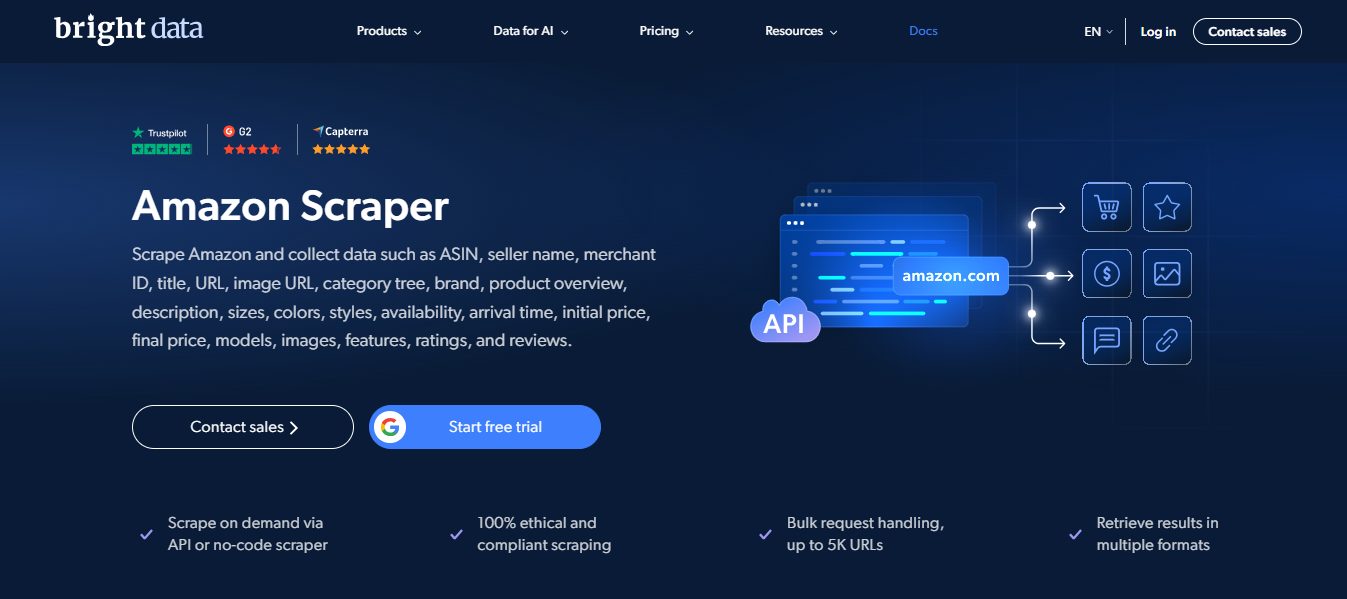
Bright Data is considered one of the most powerful and enterprise-ready data collection platforms globally. Their Amazon Scraper API is part of their Data Collector suite, which allows you to extract structured data from Amazon pages such as product listings, reviews, ratings, pricing history, and more.
Bright Data’s API uses a fully automated browser-like environment that can bypass Amazon’s anti-bot technologies, including CAPTCHA, geofencing, and rotating fingerprints.
One of its biggest selling points is its massive residential IP network that provides extremely high success rates, even when scraping millions of pages per day.
It also offers:
Scheduled crawls for automatic data syncing
Built-in CAPTCHA solvers and auto-retry logic
Integration with Google Sheets, Zapier, and major cloud services
Pre-configured templates for Amazon marketplaces worldwide
Due to its reliability and robustness, Bright Data is a go-to for Fortune 500 companies, competitive intelligence platforms, and price comparison engines.
2. ScraperAPI
ScraperAPI is an API-based solution that lets you scrape any website—Amazon included—without worrying about proxies, IP blocks, or CAPTCHAs. It’s a favorite among developers, startups, and SaaS tools looking for a plug-and-play solution for data scraping.
While not Amazon-specific, ScraperAPI supports full customization. You simply send a standard GET request to their endpoint with your target Amazon URL, and the service handles everything else behind the scenes.
For large Amazon scraping projects, they offer scalable plans, IP rotation, JavaScript rendering, and customizable request headers.
What makes ScraperAPI shine:
Extremely simple integration
Fast and scalable (up to 10M+ requests monthly)
Supports headless scraping and session cookies
Compatible with cURL, Python, Node.js, etc.
It’s ideal for developers who want full control but don’t want to maintain proxy infrastructure. While it lacks Amazon-specific endpoints, its general scraping API is powerful enough to parse even complex product and review data with ease.
3. Zyte API (formerly Scrapy Cloud)
Zyte is a long-standing name in the web scraping ecosystem. Their Zyte API (formerly known as Scrapy Cloud) offers powerful, enterprise-grade scraping solutions with a clean API layer that supports Amazon scraping through intelligent request orchestration.
Zyte uses smart extraction techniques powered by machine learning and page-type detection.
So when you scrape Amazon, their system can automatically detect if it’s a product detail page, a search result, or a review section—and structure the output accordingly.
Top features:
Automatic page classification
Optimized request routing for faster and cheaper scraping
Built-in anti-ban technologies with browser fingerprinting
High accuracy even during Amazon’s UI updates
It also supports pipelines to export data directly into your CMS, BI tool, or Google Sheets. Zyte is highly recommended for teams that value structured output, automation, and intelligent scraping layers.
4. Apify Amazon Scraper
Apify offers a marketplace of ready-made scrapers, and their Amazon Scraper Actor is a community favorite.
This solution is designed specifically for Amazon and can be launched without coding—just select parameters like keywords, categories, or product ASINs, and it will return neatly structured JSON or CSV.
The Amazon Scraper by Apify allows you to:
Scrape product details, pricing, ASIN, reviews, and more
Set crawling depth, delays, and filters
Run from the browser or schedule regular scrapes via Apify Console
Export directly to Dropbox, Google Drive, or API endpoints
It’s perfect for entrepreneurs, affiliate marketers, or eCommerce analysts who need ready-to-run scrapers without spinning up infrastructure. The scalability, reliability, and documentation make it beginner-friendly but still powerful enough for professional use.
Apify also provides integrations with popular tools like Airtable, Zapier, and Data Studio, making it a great choice for automation enthusiasts.
5. DataForSEO
DataForSEO offers a broad spectrum of scraping APIs, but its Amazon Product Data API is designed for deep commercial insights. It caters to keyword research platforms, pricing tools, and affiliate marketers needing real-time and historical Amazon data at scale.
This API provides access to:
Organic and sponsored product listings
Buy Box data and ASIN performance metrics
Product categories, attributes, and seller info
Best Seller rankings across multiple regions
DataForSEO offers flexible pricing, granular filters, and a responsive support team. It’s best for businesses building products or dashboards around Amazon data and who need large volumes of clean, normalized results.
Developers love their:
Rich documentation
Fast response time (under 2 seconds in most cases)
Sandbox environment for testing queries
Their RESTful API is well-structured and ideal for both one-time crawls and continuous data feeds.
How To Choose The Right Amazon Scraper API
When picking the right scraper for Amazon, consider:
Feature
Oxylabs
Webshare
Decodo
Best For
Large enterprise
Growing businesses
Startups & marketers
Scalability
High
Medium
High
Ease of Use
Medium
High
High
Cost
Premium
Affordable
Moderate
Support
Enterprise SLA
Email & Docs
24/7 Chat
Geo-targeting
Yes
Limited
Yes
Data Accuracy
Very High
High
Very High
Output Format
JSON
JSON
JSON/CSV
Use Cases For Amazon Scraper APIs
1. Price Monitoring
Track competitor pricing to adjust your own dynamically. With real-time scraping, you can monitor flash sales, deals, and pricing trends on Amazon products that you also sell.
2. Market Intelligence & Product Research
Before launching a product, scrape product listings and reviews to understand customer pain points, ideal pricing, and which ASINs dominate.
3. Brand Monitoring & MAP Enforcement
Scrape seller listings to detect unauthorized resellers or ensure they’re not violating your Minimum Advertised Price policies.
4. Review Analysis
Mine Amazon reviews for sentiment analysis, feature requests, or product flaws.
5. Affiliate Marketing & Aggregation Sites
Run niche sites or marketplaces with real-time Amazon content synced through a scraper API.
Challenges Of Scraping Amazon
Scraping Amazon manually is difficult due to:
IP Bans & Throttling
JavaScript-heavy content
Dynamic HTML structures
Frequent Captchas
Geo-targeted content (e.g., prices vary by region)
Legal & ethical compliance concerns
A professional-grade scraper API solves these issues using proxy rotation, headless browsers, and machine-learning-based content parsing.
FAQs About Amazon Scraper APIs
Is scraping Amazon legal?
Scraping Amazon is legal when done responsibly and in accordance with applicable data protection and intellectual property laws. The key distinction lies in how the data is accessed and used. Publicly available information, such as product names, prices, and reviews, can typically be scraped if you’re not violating Amazon’s terms of service or misusing copyrighted content.
However, it’s essential to use scraper APIs that are built with compliance in mind. Oxylabs, Webshare, and Decodo all incorporate ethical scraping principles—such as honoring robots.txt rules, rotating IPs to reduce server strain, and ensuring data privacy—to minimize legal risks. Businesses should also consider consulting legal counsel when using scraped data for commercial purposes.
Do I need proxies to scrape Amazon?
Technically, yes—Amazon employs aggressive anti-bot mechanisms like IP blocking, rate-limiting, and CAPTCHA challenges. However, if you’re using a fully managed scraper API, you don’t have to worry about handling proxies yourself. These services manage the entire infrastructure for you.
All three of our featured providers—Oxylabs, Webshare, and Decodo—come with built-in rotating proxy networks (residential, datacenter, or mobile). This ensures that every request originates from a unique IP address, making your scraping activities more anonymous, efficient, and undetectable.
What programming languages can I use?
Most Amazon Scraper APIs follow the RESTful architecture, which means they can be accessed via HTTP requests using virtually any programming language.
Whether you’re a data scientist using Python, a web developer working with Node.js or JavaScript, a backend engineer using Java or PHP, or someone comfortable with C#, you can easily integrate these APIs into your applications.
Each provider offers developer-friendly documentation, sample scripts, and SDKs to simplify the implementation process. Some even support low-code or no-code tools like Zapier, Postman, or Make.com for non-developers.
How fast are the results returned?
Speed is crucial when you’re scraping large volumes of data or running real-time analyses. Typically, Amazon Scraper APIs return results within 2 to 10 seconds per request, depending on a few factors:
Page complexity (e.g., a product page vs. a search results page)
Region of the Amazon store (e.g., Amazon US vs. Amazon India)
Type of proxy used (residential proxies may be slightly slower than datacenter ones)
Current load on the server
Oxylabs is known for its enterprise-grade infrastructure that ensures low latency, even at scale. Webshare focuses on high-speed responses for developers and small businesses. Decodo offers AI-enhanced parsing that makes scraping fast and accurate, even when Amazon modifies its structure.
Can Amazon ban me for scraping?
Yes, Amazon can ban or restrict access if it detects scraping activities that violate its terms of service or put undue strain on its servers. This typically happens when scraping is done too aggressively, without IP rotation, or without respecting rate limits and access controls.
However, using professionally managed scraper APIs like those from Oxylabs, Webshare, and Decodo greatly reduces this risk. These platforms are designed to mimic human-like behavior, handle IP rotation automatically, and bypass rate limits, which protects your identity and reduces the chances of being blocked.
What happens if a page returns a CAPTCHA?
CAPTCHAs are Amazon’s way of confirming that a user is human. If you’re scraping manually or using simple scripts without proxy rotation or CAPTCHA-solving mechanisms, you’ll likely encounter frequent interruptions.
But with robust scraper APIs like Decodo, Webshare, and Oxylabs, this issue is automatically handled behind the scenes. These APIs integrate advanced CAPTCHA-solving technologies (such as AI-based solvers or third-party CAPTCHA bypass services), allowing you to scrape data continuously without interruptions—even from pages protected by Cloudflare or other bot-detection tools.
How can I scrape Amazon without getting blocked?
To scrape Amazon reliably and safely, follow these best practices:
Use a Managed Scraper API – Tools like Oxylabs, Webshare, and Decodo handle everything from proxy rotation to anti-bot detection for you.
Avoid Sending Too Many Requests Per Second – Rate limiting is key. These APIs already throttle requests to avoid suspicion.
Rotate User Agents – Amazon tracks device/browser fingerprints. These APIs simulate multiple browser types to stay undetected.
Respect Robots.txt Guidelines – Ethical scraping includes respecting public access rules.
Use Residential or Mobile Proxies – These are harder to detect and block. All three APIs include them.
Retry Failed Requests with Smart Logic – Each provider includes retry mechanisms for failed requests to maintain consistency.
If you’re not a developer, you don’t have to worry about these technicalities—just plug in one of these scraper APIs, and the hard work is done for you.
Final Thoughts
The Amazon marketplace is vast, competitive, and constantly changing. Whether you’re tracking prices, analyzing competitors, or automating your affiliate platform, a high-quality Amazon Scraper API is indispensable.
In 2026, the best tools that stand out are Oxylabs, Webshare, and Decodo. Each offers a powerful suite tailored to specific business sizes and needs.
Choose wisely based on your scale, budget, and technical capacity—and let your data power your decisions.
The digital world runs on data—and in 2026, web scraping tools are more vital than ever. Whether you’re a marketer looking for lead generation, a researcher gathering public data, or a business tracking competitors, the ability to extract structured data from websites is a superpower you can’t afford to ignore.
But with so many tools out there, how do you pick the right one? In this guide, we’ll dive into the best web scraping tools for 2026, breaking down features, use cases, and why they matter.
Let’s get into it!
What is Web Scraping, and Why is it Essential?
Web scraping is the process of extracting data from websites in an automated way. Instead of manually copying and pasting information, web scrapers do the heavy lifting—helping you gather data for SEO, research, pricing comparisons, e-commerce insights, market analysis, and more.
In a data-driven world, companies use web scraping for:
Price monitoring
Lead generation
SEO and keyword research
Market trend analysis
Sentiment analysis
But scraping isn’t as simple as it sounds. Websites evolve, anti-bot measures increase, and large-scale scraping demands robust, reliable tools. That’s where the top web scraping tools come in.
Editor’s Choice – Best Proxy Services For Web Scraping
1. Decodo (Formerly Smartproxy) – Best for Secure, Privacy-First Scraping
When your priority is privacy, compliance, and security,Decodo (formerly known as Smartproxy) is the tool to trust.
Why Decodo?
Decodo focuses on ease of use and scalability. So whether you’re a professional who’slooking to enhance your data collection toolkit or a beginner, Decodo’s Web Scraping API helps to collect data without a single restriction.
Key Features:
Premium proxy pool of 125M+ IPs
100+ ready-made scraping templates
100% success rate
Advanced geo-targeting
Data retrieval in HTML, JSON, and parsed
JavaScript rendering
Best For:
Real-time data collection
Price monitoring
Training AI tools, agents, and LLMs
Bottom Line: Decodo is the go-to for secure web scraping in 2026.
Decodo (formerly Smartproxy)
Decodo (formerly Smartproxy) is an AI-powered proxy service and web scraping solutions provider that enables seamless...Show More
Decodo (formerly Smartproxy) is an AI-powered proxy service and web scraping solutions provider that enables seamless, large-scale data extraction with smart, reliable, and cost-effective tools for businesses of any size. Show Less
2. Oxylabs – The Gold Standard for Enterprise Web Scraping
When it comes to large-scale, enterprise-grade web scraping, Oxylabs stands tall as the undisputed champion.
Why Oxylabs?
Oxylabs offers a premium proxy infrastructure that fuels the most complex scraping tasks—whether you’re extracting product listings, price data, or competitor insights.
Their Scraper APIs (like the SERP Scraper API, E-commerce Scraper API, and even a dedicated YouTube Scraper API) handle dynamic sites, JavaScript-heavy pages, and rotating proxies seamlessly.
The YouTube Scraper in particular is invaluable for enterprises that need to monitor channel uploads, analyze comments for sentiment, track keyword trends, or gather video metadata at scale — all while maintaining high accuracy and low failure rates.
Note: Oxylabs’ YouTube scraper does not offer any discounts.
Key Features:
175M+ residential and datacenter IPs worldwide
AI-powered adaptive parsing for structured data extraction
Dedicated APIs for e-commerce, SERP, YouTube, and business intelligence
24/7 customer support for enterprise clients
Pricing: Starts from $0.95/1K requests
Trial: Unlimited trial for scraping tools (up to 2K results)
Best For:
Large enterprises
Data-driven organizations
Companies scraping millions of pages per month
Bottom Line: If you need reliable, scalable, and compliant web scraping, Oxylabs is the go-to solution in 2026.
Oxylabs Proxies
Oxylabs Proxies offer enterprise-grade, AI-powered proxy solutions with a massive 175M+ IP pool, ensuring unmatched...Show More
Oxylabs Proxies offer enterprise-grade, AI-powered proxy solutions with a massive 175M+ IP pool, ensuring unmatched reliability, speed, and anonymity for large-scale web scraping and data collection. Show Less
3. Webshare – The Best Budget-Friendly Web Scraping Tool
Not every business needs an enterprise-level solution. For startups, small businesses, or individuals on a budget, Webshare is the perfect choice.
Why Webshare?
Webshare offers a generous free proxy plan, allowing you to start scraping without upfront costs. Their paid plans scale affordably, making them ideal for businesses that need reliable proxies but can’t commit to enterprise pricing.
Key Features:
Free proxies with daily bandwidth allocation
Paid plans starting from as low as $2.00
Rotating residential and datacenter IPs
Easy-to-use dashboard for quick setup
Best For:
Beginners
Budget-conscious scrapers
Small-scale projects
Bottom Line: Webshare provides the best value for money, helping you scrape efficiently without breaking the bank.
Webshare Proxies
Webshare Proxies offers high-speed, customizable, and budget-friendly proxy solutions with flexible pricing, ensuring...Show More
Webshare Proxies offers high-speed, customizable, and budget-friendly proxy solutions with flexible pricing, ensuring seamless web scraping, automation, and online anonymity for businesses and individuals. Show Less
Best Web Scraping Tools in 2026
While Oxylabs, Webshare, and Decodo lead the pack for web scraping proxies, there are other web scraping tools in the market that cater to specific needs.
Here’s a closer look at some of the most reliable and widely used alternatives in 2026:
1. Scrapy – The Developer’s Open-Source Favorite
Scrapy is a powerful, open-source web scraping framework built in Python, known for its flexibility and developer-first approach. It’s not a plug-and-play tool—rather, it’s a library that developers use to build custom web crawlers and data extraction pipelines.
One of Scrapy’s strengths lies in its modularity: you can customize it to scrape complex websites, follow links, handle login forms, and even export data in formats like JSON or CSV. Scrapy also supports middleware, allowing users to add custom proxy support, rotate user agents, and manage cookies seamlessly.
While it lacks a user-friendly interface, developers love it for its full control over the scraping process and ability to handle large-scale projects when configured properly. If you’re comfortable with Python and want to build a tailored solution, Scrapy is an excellent choice for 2026.
2. ParseHub – The User-Friendly Visual Scraper
For non-developers or those who prefer point-and-click interfaces, ParseHub is a great option. This tool allows users to scrape websites by simply clicking on the elements they want to extract—no coding required.
ParseHub uses a visual editor to teach its AI what data to capture, making it ideal for small businesses, researchers, and marketers who need to gather data quickly without technical expertise. It also offers support for JavaScript-heavy websites, dynamic content, and paginated lists, which many beginner-friendly tools struggle with.
While it’s not as scalable as enterprise-grade solutions like Oxylabs, ParseHub’s user-friendliness and versatility make it a popular choice for casual web scrapers. It also offers a free plan with limited usage and paid tiers for more advanced features like scheduling and API access.
For individuals or small teams seeking an accessible entry point into web scraping, ParseHub remains a reliable option in 2026.
3. Bright Data – Formerly Luminati, the Giant of Proxy Networks
Bright Data, previously known as Luminati, is a well-established player in the proxy and web scraping space. It’s best known for offering one of the largest proxy networks globally, boasting over 72 million residential IPs and various other proxy types, including datacenter and mobile IPs.
While Bright Data primarily markets itself as a proxy service, they also offer web scraping solutions through tools like their Web Unlocker and Data Collector. These tools help businesses bypass complex anti-bot systems, making Bright Data a strong choice for high-stakes scraping operations such as competitor analysis, e-commerce data tracking, and large-scale market research.
Bright Data is not cheap—its pricing is on the higher end—but it’s a trusted provider for mission-critical projects where data accuracy and access matter most. Enterprises and agencies looking for flexibility and scale often turn to Bright Data as a reliable partner for 2026.
4. Apify – The Automation and API Powerhouse
Apify is a cloud-based platform designed for developers and businesses that need data automation at scale. Unlike some simpler scrapers, Apify offers a marketplace of pre-built scraping actors—ready-to-go tools that can extract data from popular websites like Amazon, Google, LinkedIn, and more.
For advanced users, Apify’s JavaScript-based framework allows for custom scraper development, offering unparalleled flexibility. What sets Apify apart is its ability to handle not just scraping, but end-to-end automation workflows, such as form submissions, crawling, and even web testing.
Their API integrations make it easy to plug scraped data into your existing pipelines, whether for analytics, CRM tools, or custom dashboards. Apify also offers a pay-as-you-go pricing model, making it accessible for both startups and enterprise clients.
If you’re looking for a versatile, API-friendly platform that can handle more than just scraping, Apify is a strong contender in 2026.
5. Octoparse – The All-in-One No-Code Scraper
Octoparse is a leading no-code web scraping tool designed for users who want to extract data from websites without writing a single line of code. Its drag-and-drop interface makes it easy to set up complex scraping tasks, from simple data lists to multi-page crawls and dynamic content extraction.
Octoparse is particularly useful for small businesses, e-commerce analysts, and digital marketers who need to monitor product prices, track competitors, or gather customer reviews. It supports cloud-based scraping, which means your scrapers run on Octoparse’s servers, freeing up your computer’s resources and allowing for larger-scale data collection.
Octoparse also offers built-in tools like CAPTCHA solvers, IP rotation, and scheduling features, making it a one-stop solution for many scraping needs. While it’s not as powerful as Oxylabs or as developer-centric as Scrapy, its ease of use and flexibility make it a favorite for users who want to get started quickly in 2026.
✅ What scale do I need? (Small, medium, or enterprise?) ✅ What kind of data am I scraping? (E-commerce, search engines, general web?) ✅ Do I need compliance and privacy features? ✅ What’s my budget? (Free tools vs. enterprise solutions)
Oxylabs, Webshare, and Decodo cover a broad range of needs, from enterprise-level scraping to budget projects and secure, privacy-first tasks.
Web Scraping Tools: Frequently Asked Questions
What is web scraping and how does it work?
Web scraping is the process of automatically extracting data from websites using specialized software or scripts. These tools send HTTP requests to web pages, parse the HTML or rendered content, and extract specific data points such as text, images, links, or metadata. Most modern tools use headless browsers or scraping APIs that can handle JavaScript, proxies, and anti-bot protection.
Are web scraping tools legal to use?
Web scraping is legal in many cases, especially when extracting publicly available data for research, analysis, or personal use. However, scraping websites that have explicit terms prohibiting automated access—or scraping data behind login walls or paywalls—may violate terms of service or data privacy laws. Always read a site’s robots.txt file and terms of use before scraping, and consider legal consultation for large-scale or sensitive data projects.
What’s the difference between a scraper and a scraper API?
A scraper is typically a standalone script or software that performs scraping directly using HTTP requests, parsing libraries (like BeautifulSoup or Cheerio), and data storage logic. A scraper API, on the other hand, is a hosted service that handles the scraping backend for you—including proxy rotation, CAPTCHA solving, browser rendering, and error handling—returning clean data with less setup required.
Why do I need proxies for web scraping?
Many websites implement anti-scraping mechanisms such as IP rate limiting, geo-restrictions, and bot detection. Proxies help bypass these restrictions by rotating your IP address, simulating human traffic from multiple regions. Residential, datacenter, and mobile proxies are commonly used depending on the site’s level of protection and the data volume required.
Which is better: Residential proxies or Datacenter proxies?
Residential proxies are IPs assigned to real users by Internet Service Providers (ISPs), making them harder to detect and block. They’re ideal for scraping sites with strong anti-bot security or geo-restricted content. Datacenter proxies are faster and cheaper, but more easily flagged. Use residential proxies for stealth and datacenter proxies for speed and volume.
Can AI improve web scraping accuracy?
Yes. AI technologies like machine learning, NLP, and computer vision are now being integrated into modern scraping tools to improve data extraction accuracy. AI helps detect patterns in dynamic web structures, auto-correct changes in layout, and clean or structure messy data automatically, reducing the need for manual script adjustments.
What features should I look for in a web scraping tool?
Look for tools that offer:
Headless browser support (like Puppeteer or Playwright)
Built-in proxy rotation and CAPTCHA solving
API integration and webhook support
Support for JavaScript-rendered content
Scheduling, error handling, and retry logic
Scalable infrastructure and output formatting (JSON, CSV, etc.)
What’s the best way to avoid getting blocked while scraping?
To reduce your chances of getting blocked:
Use rotating proxies (residential or mobile)
Respect site rate limits and add randomized delays
Rotate User-Agents and browser fingerprints
Mimic human behavior (mouse movement, scroll, session cookies)
Use scraping APIs or browser automation tools with built-in evasion
Conclusion
Web scraping is the engine of modern data-driven decision-making—and choosing the right tool can make or break your results.
For scalable, enterprise-grade scraping, Oxylabs is the clear winner. For affordable, beginner-friendly scraping, Webshare leads the pack. And for privacy-conscious scraping, Decodo is your go-to partner.
No matter your goals, these tools provide the foundation you need to thrive in 2026’s competitive digital landscape.
Ready to unlock the power of data? Explore your options today and start scraping smarter!
In this post, I will show you how businesses use proxies for competitive intelligence.
Competitive intelligence has become a critical part of modern business strategy. Whether a company wants to monitor competitors’ pricing, track market trends, analyze customer sentiment, or identify new opportunities, access to accurate and timely data is essential.
However, collecting publicly available online data at scale isn’t always straightforward. Many websites use rate limits, IP-based restrictions, and anti-bot systems that can block repeated requests from the same address. This is where proxy servers play an important role.
By using residential proxies, IP rotation, and responsible web scraping practices, businesses can gather publicly accessible information more efficiently while reducing the risk of disruptions. In this guide, we’ll explain how businesses use proxies for competitive intelligence, the different use cases, and how to choose a reliable proxy provider.
What Is Competitive Intelligence?
Competitive intelligence is the process of collecting and analyzing publicly available information about competitors, customers, and market conditions to support better business decisions.
Businesses commonly monitor:
Product pricing
Inventory availability
Customer reviews
Advertising campaigns
Search engine rankings
Industry trends
Marketplace listings
Regional product availability
The goal isn’t to obtain confidential information but to analyze publicly accessible data in an organized and efficient way.
Why Proxy Servers Matter for Competitive Intelligence
A proxy server acts as an intermediary between your device and the websites you visit. Instead of connecting directly, requests are routed through another IP address.
For businesses performing large-scale data collection, proxies provide several advantages:
Reduce the likelihood of IP-based rate limiting
Enable geographic testing from different regions
Support anonymous browsing during market research
Improve reliability for automated web scraping workflows
Help distribute requests through IP rotation
Residential proxies are particularly valuable because they use IP addresses assigned by internet service providers (ISPs), making requests appear similar to regular user traffic.
Common Ways Businesses Use Residential Proxies
Market Price Monitoring
Retailers frequently monitor competitors’ pricing to stay competitive.
Using a residential proxy network allows automated systems to collect publicly available pricing information across multiple locations without sending every request from a single IP address.
This helps businesses:
Compare prices across competitors
Monitor promotions
Detect pricing changes quickly
Adjust pricing strategies
Competitor Product Research
Companies often analyze competitor product catalogs to understand:
New product launches
Feature updates
Product descriptions
Category expansion
Stock availability
Web scraping combined with residential proxies makes large-scale monitoring significantly more efficient than manual research.
Localized Search Results
Search engines frequently personalize results based on location.
Businesses use proxy servers to:
Check localized rankings
Analyze regional search results
Test geo-targeted campaigns
Verify local SEO performance
Ad Verification
Digital advertisers often need to verify how ads appear in different countries or cities.
Using residential proxies enables teams to:
View localized advertisements
Verify campaign placement
Detect incorrect targeting
Monitor competitor advertising
Brand Protection
Businesses also monitor online marketplaces for:
Counterfeit products
Unauthorized sellers
Trademark misuse
Brand impersonation
Residential proxies make continuous monitoring more reliable when collecting publicly available listings.
Residential Proxies vs Datacenter Proxies
Feature
Residential Proxies
Datacenter Proxies
IP Source
Internet Service Providers
Cloud/Data Centers
Detection Risk
Lower
Higher
Best For
Competitive intelligence, web scraping, market research
High-speed automation
Geographic Coverage
Extensive
Varies by provider
Anonymous Browsing
Excellent
Good
For competitive intelligence projects that rely on public websites with anti-bot protections, residential proxies are generally the preferred option.
Editor’s Choice: Best Residential Proxy Providers
[Insert Oxylabs Homepage Screenshot Here]
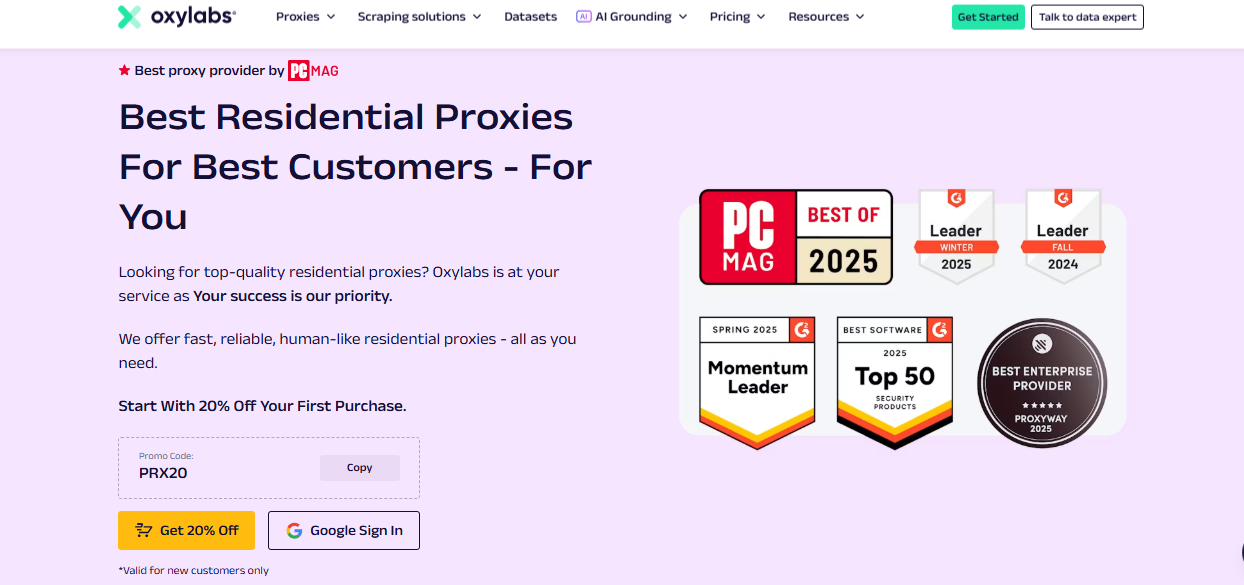
🥇 1. Oxylabs — Best for Enterprise & Large-Scale Data Collection
Oxylabs earns our Editor’s Choice recommendation because it combines a massive residential proxy network with enterprise-grade infrastructure designed for professional data collection.
Key strengths include:
Massive residential proxy network
Advanced geographic targeting
Premium reliability
High success rates
Excellent support for web scraping
Strong performance for market intelligence
Enterprise-focused infrastructure
Businesses conducting large-scale competitive intelligence often choose Oxylabs because of its consistent performance, advanced targeting options, and scalability for demanding projects.
Oxylabs Proxies
Oxylabs Proxies offer enterprise-grade, AI-powered proxy solutions with a massive 175M+ IP pool, ensuring unmatched...Show More
Oxylabs Proxies offer enterprise-grade, AI-powered proxy solutions with a massive 175M+ IP pool, ensuring unmatched reliability, speed, and anonymity for large-scale web scraping and data collection. Show Less
🥈 2. Decodo — Best Overall Residential Proxy Provider
Decodo offers an excellent balance of usability, performance, and affordability, making it suitable for both individuals and businesses.
Highlights include:
Beginner-friendly dashboard
Reliable residential proxies
Rotating proxies
Fast setup
API support
Good documentation
Stable performance
Suitable for growing businesses
For teams that want a smooth onboarding experience without sacrificing functionality, Decodo is a well-rounded choice.
Decodo (formerly Smartproxy)
Decodo (formerly Smartproxy) provides powerful, user-friendly proxy and web scraping solutions that make large-scale...Show More
Decodo (formerly Smartproxy) provides powerful, user-friendly proxy and web scraping solutions that make large-scale data access effortless, efficient, and cost-effective. Show Less
🥉 3. Webshare — Best Budget-Friendly Residential Proxy Provider
Webshare is an attractive option for developers, freelancers, startups, and small businesses looking for affordable residential proxies.
Advantages include:
Affordable pricing
Free plan availability
Easy setup
Reliable performance
Residential proxy support
Developer-friendly interface
Its combination of value and simplicity makes Webshare an excellent entry point for organizations with modest proxy requirements.
Webshare
Webshare delivers fast, affordable, and customizable proxy solutions designed to give businesses and developers seamless...Show More
Webshare delivers fast, affordable, and customizable proxy solutions designed to give businesses and developers seamless access to reliable data at scale. Show Less
Comparison Table
Provider
Best For
Key Strength
Oxylabs
Overall
Balance of performance & value
Decodo
Enterprise
Large-scale proxy infrastructure
Webshare
Budget
Affordable and easy to use
Other Residential Proxy Providers Worth Considering
Several other reputable providers are also worth evaluating depending on your requirements:
Mars Proxies — A growing provider offering residential and ISP proxy options suitable for many business use cases.
IPRoyal — Known for flexible pricing and residential proxy services for developers and small businesses.
Bright Data — Offers an extensive proxy infrastructure with advanced enterprise capabilities.
SOAX — Provides residential proxies with flexible filtering and geographic targeting.
NetNut — Focuses on stable residential connectivity and enterprise-grade performance.
ProxyEmpire — Supports residential and mobile proxies with global coverage.
Rayobyte — Offers proxy solutions for data collection and automation projects.
Infatica — Provides residential proxy services with worldwide IP availability.
Live Proxies — Suitable for businesses requiring rotating residential proxy access.
Each provider has different strengths, pricing models, and feature sets, making it worthwhile to compare them based on your specific workload.
Buying Guide: How to Choose the Right Residential Proxy Provider
Before selecting a proxy provider, evaluate the following factors:
Performance
Look for stable connections and consistent response times, especially if you plan to perform large-scale data collection.
IP Pool Size
A larger residential proxy network generally provides greater diversity and reduces repeated IP usage.
Geographic Coverage
Choose a provider that supports the countries and cities relevant to your research.
IP Rotation
Flexible IP rotation options help distribute requests and improve long-running scraping sessions.
Dashboard and Ease of Use
A well-designed dashboard simplifies proxy management, usage monitoring, and configuration.
API Availability
Developers should prioritize providers with well-documented APIs for automation.
Customer Support
Responsive technical support can save valuable time when troubleshooting deployments.
Pricing
Compare pricing alongside available features rather than selecting solely based on cost.
Scalability
Businesses expecting growth should choose providers capable of supporting increasing workloads.
Frequently Asked Questions
Are residential proxies legal?
Residential proxies are generally legal. However, users should comply with applicable laws, website terms, and ethical data collection practices.
Why are residential proxies preferred for competitive intelligence?
Because residential IP addresses resemble normal user traffic, they are often better suited for accessing publicly available information across multiple websites.
What is IP rotation?
IP rotation automatically changes the outgoing IP address during browsing or automated requests, helping distribute traffic.
Can proxies improve anonymous browsing?
Yes. Proxy servers help mask your original IP address, adding an additional layer of privacy during browsing.
Do all businesses need residential proxies?
Not necessarily. Smaller projects may work with datacenter proxies, while larger competitive intelligence operations often benefit from residential proxy networks.
Can proxies be used for web scraping?
Yes. Many organizations use proxies alongside web scraping tools to collect publicly available information more reliably while respecting website policies and applicable laws.
Conclusion
Competitive intelligence enables businesses to make better decisions based on publicly available market information. Whether monitoring competitor pricing, researching products, verifying advertisements, or performing large-scale data collection, proxy servers help improve reliability and flexibility.
For organizations seeking enterprise-scale infrastructure, Oxylabs stands out as the strongest overall choice thanks to its extensive residential proxy network and advanced capabilities. Decodo offers an excellent balance of performance and usability for businesses of various sizes, while Webshare delivers outstanding value for developers, freelancers, startups, and budget-conscious teams.
As your proxy needs grow, compare providers based on performance, geographic coverage, reliability, IP rotation, and ease of use rather than focusing solely on price.
In this post, I will show you how to keep your AI videos useful when the message changes.
A short video introducing a digital service looks finished on Monday. By Thursday, the offer has changed, a button has moved, and the support team has revised the wording. The animation still looks good. The information wrapped around it no longer matches what viewers will find.
That is a useful distinction for anyone creating videos about software, online services, or digital products. Some parts of a clip can remain relevant for months. Others become outdated with a single edit to a web page. Treating them as one inseparable piece makes a small correction unnecessarily awkward.
AI video is easier to maintain when the creator decides which elements may change before assembling the final edit. The aim is not to preserve every generated second. It is to keep a wording change from forcing an unrelated visual restart.
Give each part of the video its own shelf life
Imagine a fictional introduction to an online workspace. Its opening shows coloured cards moving into a tidy arrangement. A title names the service, a screen recording demonstrates one action, and a closing card gives the next step.
The abstract cards may remain useful after a redesign. The screen recording may not. An offer date could expire sooner than either. Listing these differences gives the editor a practical replacement plan instead of a vague instruction to “keep the video current.”
The opening and the demonstration also have different jobs. Coloured cards can suggest organisation without showing a particular application. The screen recording, by contrast, must show what the real service actually does. Keeping those jobs separate gives the editor a reason to retain one part and replace the other.
For this example, a simple maintenance note might look like this:
Abstract opening: reconsider if the creative direction or message changes.
Service name and headline: replace when approved wording changes.
Interface demonstration: re-record when the relevant action or layout changes.
Closing instruction: check when its destination, availability, or deadline changes.
These are editorial triggers, not automatic alerts supplied by the video generator. Assign someone to notice the changes; a neat list will not maintain itself.
Generate the scene, then assemble the message
The coloured-card opening does not need a screenshot of the service. It needs a description of the visual event: several paper cards settle into rows against a neutral background, leaving a quiet area above them. That is enough to begin exploring the scene without including an offer, a product name, or customer information in the request.
For this part of the project, the Seedance 2.5 text-to-video tool lets the creator start with that written description. On JXP, the duration and aspect-ratio settings can be selected to suit the opening’s place in the edit. Ask for no lettering and inspect the result for stray marks that resemble text; the aim is a clean supporting visual, not a generated imitation of the service interface.
Only after choosing the clip does the editor add the headline, narration, and real demonstration. Keep the headline as a text layer in the editing project and retain the narration script and audio separately. A later wording change then has a specific place to go. This flexibility comes from how the final video is assembled—not from an assumption that the generator’s downloaded clip contains editable objects or live text layers.
This separation also makes space for accessibility. Captions can be corrected when narration changes, and their timing can be checked against the new edit. Simply changing the spoken line while leaving the old captions would create another outdated version inside the same file.
Keep a clean clip, not just the finished export
The captioned export is useful for publishing. The uncaptioned visual is useful for revision. Save both, along with the editing project and the approved copy that explains what the final video is supposed to say.
A modest local folder is enough: the generated visual, the current screen recording, the narration and caption files, and the assembled export. Name versions so a colleague can distinguish them without opening every file. Avoid putting confidential customer or project information in filenames intended for sharing.
Keep the generation prompt and selected settings with the source clip if another attempt may be needed. That record helps explain the creative request; it is not a promise that repeating it will produce an identical video. When the existing clip works, retain the actual file instead of assuming it can be recreated later.
Rights need the same attention. A visual cleared for one campaign is not automatically cleared for every later use. Check the intended reuse and the service’s applicable terms before carrying material into another project.
Decide whether the correction changes the scene
A headline changing from “Start today” to “Explore the features” may leave the opening untouched. But suppose the message changes from bringing work together to offering several independent choices. Cards gathering into a single group now suggest the wrong idea. Replacing the headline alone would leave a mismatch between what viewers read and what they see.
For this revision, sketch a new arrangement in which the cards remain in distinct groups. If their colours and paper texture still suit the project, include those features in an original reference image. With Seedance 2.5 reference generation, that image can provide visual context while the prompt describes the revised action. Use material cleared for this processing and permitted by the platform; the finished promotional export is not automatically the right file to upload.
Judge the new result against the revised message rather than asking it to reproduce the old clip exactly. The groups should remain distinguishable, and the composition should still leave space for the editor’s headline. References can guide appearance, but they do not guarantee identical colours, shapes, or timing. If the message instead requires a factual walkthrough, replace the relevant demonstration with a new recording of the actual service rather than asking a generated scene to simulate its behaviour.
The old copy may still be somewhere people can find it
Exporting a corrected file does not update every place the earlier one appeared. Keep a short distribution list for the versions you control: the article embed, the social post, a presentation, or a downloadable file. Check what each destination allows you to replace and where a correction needs to accompany the original.
If the old version contains materially wrong instructions, stop using it and make the correction clear. A silent replacement may not reach someone who downloaded or shared it. You cannot guarantee that every copy disappears, but you can make the current version and its correction easy to identify.
The result is a more practical use of generated video: an appealing visual that stays separate from the details most likely to change. Save the clean scene, keep the message editable, and let the next revision be as small—or as substantial—as the actual change requires.
Want the best Web Scraper APIs? Read on to find out.
The web is a treasure trove of information—news articles, product listings, market trends, reviews, and much more. But tapping into that wealth of data isn’t as simple as opening a browser and clicking around.
With millions of web pages spread across countless domains, extracting useful, structured information at scale requires more than manual effort. This is where Web Scraper APIs come in.
In this guide, we’ll explore what a Web Scraper API is, why it’s essential for businesses, and how industry leaders like Oxylabs, Decodo (formerly Smartproxy, now rebranded), and Webshare are revolutionizing the space.
What is a Web Scraper API?
A Web Scraper API is a specialized tool that allows you to extract data from websites automatically. Instead of building and maintaining complex scrapers on your own, a Web Scraper API handles the heavy lifting—navigating web pages, parsing HTML, managing proxies, and bypassing anti-bot measures.
Think of it as a digital robot that visits websites, collects data like product prices or reviews, and delivers it neatly to your system in a structured format like JSON or CSV.
Key features of a Web Scraper API include:
Automated Data Extraction
Handling Dynamic Content (JavaScript-heavy sites)
Captcha Bypass and Anti-Bot Protection
Rotating Proxies for Anonymity
High Scalability
Error Handling and Retries
Businesses use Web Scraper APIs for:
Market Research
Price Monitoring
SEO Tracking
Brand Monitoring
Sentiment Analysis
Lead Generation
Challenges of Web Scraping: Why an API is Better
Scraping the web isn’t just about sending HTTP requests. Modern websites deploy complex defenses: CAPTCHAs, bot detection, IP bans, geo-restrictions, and ever-changing code structures.
Building a custom scraper is time-consuming and expensive. You’ll need to maintain:
Proxy pools
IP rotation
Headless browsers
Scraper updates when websites change
Anti-bot bypass strategies
A Web Scraper API abstracts all these complexities, saving developers and businesses time, resources, and headaches.
Best Proxies for Web Scraping APIs: Oxylabs, Decodo, and Webshare
Let’s show you the best proxy service providers for the Web Scraper API landscape.
Decodo,formerly known as Smartproxy,has rebranded but retains its core strength– providing a powerful, user-friendly Web Scraping API. Known for its affordablesolutions and developer-friendly tools, Decodo is a go-to for startups, agencies, and SMEs.
Decodo’s Web Scraping API offers:
Easy integration with code examples and API
JavaScript rendering for advanced targets
Automated IP rotation with 125M+ IPs under the hood
Affordable pricing with cost-effective Core and Advanced subscriptiontypes
Advanced geo-targeting with a range of locations available
Decodo empowers businesses to extract web data at scale without the complexity.
Decodo (formerly Smartproxy)
Decodo (formerly Smartproxy) is an AI-powered proxy service and web scraping solutions provider that enables seamless...Show More
Decodo (formerly Smartproxy) is an AI-powered proxy service and web scraping solutions provider that enables seamless, large-scale data extraction with smart, reliable, and cost-effective tools for businesses of any size. Show Less
Oxylabs is a recognized leader in the proxy and scraping industry. Trusted by Fortune 500 companies and startups alike, Oxylabs offers a Web Scraper API that combines unmatched scale, precision, and reliability.
For video-focused data needs, Oxylabs also provides a dedicated YouTube Scraper API, built to extract video metadata, comments, channel uploads, and keyword trends at scale. This makes it a powerful tool for enterprises tracking brand presence, audience sentiment, or influencer marketing campaigns directly on YouTube.
Key features of the Oxylabs Web Scraper API:
High Success Rates (Over 99%) across millions of pages
Smart Bypass Mechanisms for anti-bot systems
Real Browser Rendering for JavaScript-heavy sites
Granular Control – customize headers, geo-targeting, and user agents
24/7 Support and SLAs for enterprise clients
Scalable Infrastructure – perfect for large datasets
Pricing: Starts from $0.95/1K requests
Trial: Unlimited trial for scraping tools (up to 2K results)
With Oxylabs, you’re not just scraping data—you’re getting accurate, actionable insights at scale.
Oxylabs Proxies
Oxylabs Proxies offer enterprise-grade, AI-powered proxy solutions with a massive 175M+ IP pool, ensuring unmatched...Show More
Oxylabs Proxies offer enterprise-grade, AI-powered proxy solutions with a massive 175M+ IP pool, ensuring unmatched reliability, speed, and anonymity for large-scale web scraping and data collection. Show Less
Webshare: The Budget-Friendly, Developer-Loved Option
Webshare has carved a niche as the developer’s favorite. Known for its free proxy offerings, Webshare extends its capabilities by supporting Web Scraper API that are easy to set up and deploy.
Unlike Decodo and Oxylabs, Webshare does not have a dedicated Web Scraper API and offers affordable proxies.
Webshare’s perks include:
Generous Free Tiers to get started
Free Chrome proxy extension for seamless web scraping anywhere on the go
Reliable Proxy services
Customizable Parameters for advanced scraping needs
Affordable Plans for long-term scaling
While Webshare may not have the enterprise bells and whistles of Oxylabs, it’s a solid choice for developers and small teams who want cost-effective data extraction.
Webshare Proxies
Webshare Proxies offers high-speed, customizable, and budget-friendly proxy solutions with flexible pricing, ensuring...Show More
Webshare Proxies offers high-speed, customizable, and budget-friendly proxy solutions with flexible pricing, ensuring seamless web scraping, automation, and online anonymity for businesses and individuals. Show Less
Comparing the Titans: Oxylabs vs. Decodo vs. Webshare
Feature
Oxylabs
Decodo (Smartproxy)
Webshare
API Success Rate
99%+
95%+
(No Web Scraper API)
JavaScript Rendering
Yes
Yes
Yes
Proxy Management
Fully Managed (Enterprise)
Built-in
Built-in
Pricing
Premium (Enterprise-Level)
Affordable
Budget-Friendly + Free Tier
Support
24/7 Enterprise Support
Responsive Helpdesk
Community-Based, Limited
Target Audience
Large Enterprises
Startups, Agencies
Developers, Small Teams
Best Web Scraper API
1. ScraperAPI
ScraperAPI is renowned for its simplicity and efficiency in web scraping tasks. It handles IP rotation, CAPTCHAs, and retries, allowing users to scrape any web page with a single API call.
Key Features:
Automatic IP rotation and CAPTCHA handling
Supports JavaScript rendering
Customizable headers and proxies
Real-time analytics and usage tracking
Ideal For: Developers seeking a straightforward solution for large-scale data extraction without the hassle of managing proxies and handling CAPTCHAs manually.
2. Apify
Apify offers a versatile web scraping and automation platform. It provides ready-made actors for common scraping tasks and the ability to create custom actors using JavaScript.
Key Features:
Extensive library of pre-built actors
Custom actor creation with JavaScript
Scalable cloud infrastructure for large datasets
Integrations with various data storage and processing tools
Ideal For: Users looking for a flexible platform that supports both simple and complex scraping tasks, with the added benefit of automation capabilities.
3. ScrapingBee
ScrapingBee simplifies the scraping process by handling headless browsers and proxies. It also offers a powerful Google Search Results API, making it easy to extract structured SERP data without managing the infrastructure yourself. It’s particularly useful for scraping single-page applications built on frameworks like React.js or Angular.js.
Key Features:
JavaScript rendering support
Automatic proxy rotation
Custom headers and cookies
CAPTCHA handling
Ideal For: Developers needing to scrape dynamic websites that require JavaScript execution.
4. ProxyCrawl
ProxyCrawl focuses on enabling web automation through its scraping API. It offers advanced browser emulation capabilities, making it possible to scrape dynamic sites dependent on JavaScript execution.
Key Features:
Advanced browser emulation
Proxy rotation and header randomization
Real-time webhooks and task reports
Powerful filters for accurate data
Ideal For: Users looking to automate web interactions and scrape data from complex, JavaScript-heavy websites.
5. Diffbot
Diffbot utilizes machine learning to transform web pages into structured data. It offers various APIs that can extract data from articles, products, discussions, and more.
Key Features:
Machine learning-powered data extraction
Structured data APIs for different content types
High accuracy in content recognition
Supports multiple languages and formats
Ideal For: Businesses needing to extract structured data from a variety of web content types with high accuracy.
6. ScrapeStorm
ScrapeStorm is designed to handle complex sites protected by robust anti-bot measures. It offers features like JavaScript rendering with Puppeteer and automatic CAPTCHA solving.
Key Features:
JavaScript rendering with Puppeteer
High-quality residential proxies
Automatic CAPTCHA solving
HTML scraping and browser automation
Ideal For: Users needing to scrape data from websites with advanced anti-bot protections.
7. Diggernaut
Diggernaut boasts a vast proxy network integrated into its scraping cloud, allowing for advanced proxy rotation and targeting.
Key Features:
72M constantly changing proxies
Global and country-level targeting
Custom fingerprints per request
Proxy authorization support
Ideal For: Users requiring extensive proxy networks and granular targeting for their scraping tasks.
8. ScrapeOps
ScrapeOps offers specialized scraping infrastructure aimed at retail sites. It includes features like header and cookie rotation, fingerprint spoofing, and fast residential proxies.
Key Features:
Header and cookie rotation
Fingerprint spoofing
Fast residential proxies
Handles tough retail sites
Ideal For: Businesses focusing on scraping data from retail and e-commerce websites.
9. ScrapingAnt
ScrapingAnt provides web scraping features like proxy rotation, custom cookies, and JavaScript snippet execution. It allows users to choose the response format in either HTML or JSON.
ScrapingBee is a user-friendly web scraping API solution, equipped with features that make it a standout choice for developers and businesses.
Key Features:
CAPTCHA handling
JavaScript rendering
IP rotation
Ideal For: Developers and businesses seeking an easy-to-use scraping API with robust features.
Choosing the Right Proxies For Web Scraper API: What Matters Most?
Here’s a quick guide to help you decide:
Go with Oxylabs if you need enterprise-grade reliability, scalability, and guaranteed success rates for high-stakes projects.
Choose Decodo if you want an affordable, user-friendly solution with robust features and no hassle setup.
Pick Webshare if you’re on a budget, prefer a developer-driven solution, and can handle a bit of DIY for the sake of savings.
Real-World Applications: What Can You Scrape with a Web Scraper API?
E-commerce Data – Track competitor pricing, monitor product availability, and analyze customer reviews.
SEO Insights – Analyze SERPs, keyword rankings, and meta data.
Market Research – Gather trend data from news sites, forums, and blogs.
Travel & Hospitality – Scrape hotel rates, flight prices, and reviews.
Financial Data – Track stock prices, exchange rates, and company profiles.
Best Web Scraper API: Frequently Asked Questions
What is a Web Scraper API and how does it work?
A Web Scraper API is an interface that allows developers to programmatically extract data from websites without building their own scraping logic or managing proxies, browsers, or CAPTCHA-solving mechanisms. You simply send a request with a target URL, and the API returns the clean, structured data (HTML, JSON, etc.) as if you’d manually scraped the page.
Why should I use a Web Scraper API instead of building my own scraper?
Building and maintaining your own scraper requires constant updates to handle anti-bot measures like IP blocks, JavaScript rendering, CAPTCHAs, and rate limits. A Web Scraper API handles all of this behind the scenes—giving you scalability, speed, legal protection, and higher success rates with less development effort.
What features should I look for in the best Web Scraper API?
Look for APIs that include rotating proxies, JavaScript rendering, CAPTCHA solving, custom headers support, geo-targeting, and structured data output (like JSON). Some also offer browser emulation and session persistence, which are vital for scraping modern, dynamic websites.
Are Web Scraper APIs legal to use?
Yes, Web Scraper APIs are generally legal when used to extract publicly available data for ethical purposes such as research, SEO analysis, market insights, or price monitoring. However, always review the Terms of Service of the websites you’re scraping and follow local data regulations like GDPR or CCPA.
Can I scrape JavaScript-heavy websites like YouTube, Amazon, or LinkedIn?
Yes, advanced Web Scraper APIs support JavaScript rendering via headless browsers, allowing them to scrape content from dynamic or client-side rendered pages like YouTube, Amazon, LinkedIn, and more. Be aware that some platforms have stronger bot protection and stricter policies—use responsibly.
What’s the difference between a proxy API and a Web Scraper API?
A proxy API only provides access to IP rotation and geolocation but still requires you to write scraping logic and handle rendering. A Web Scraper API, on the other hand, offers a full scraping solution—including proxy handling, rendering, retries, and clean data output—reducing your backend load and dev time.
How do I integrate a Web Scraper API into my application or script?
Most Web Scraper APIs offer RESTful endpoints you can call using Python, Node.js, PHP, or any language with HTTP support. You pass parameters like the target URL, headers, or rendering options. The API returns the result in your preferred format, ready to be parsed or stored in your database.
What are the best use cases for Web Scraper APIs?
Top use cases include:
Price monitoring and comparison
Search engine result page (SERP) tracking
Lead generation and contact scraping
News aggregation and sentiment analysis
App or ad intelligence
Real-time market data feeds
These APIs make it easy to scale such tasks across hundreds or thousands of web pages without infrastructure headaches.
Conclusion: The Future of Data is API-Driven
In a world where data fuels decisions, Web Scraper APIs are the engines powering smart insights. Whether you’re a startup hunting for market trends or an enterprise tracking billions of data points, a solid Web Scraper API is your key to unlocking the web’s potential.
With leaders like Oxylabs, Decodo (formerly Smartproxy), and Webshare, you’re spoiled for choice for the best Proxies for Web scraper APIs. Each brings unique strengths to the table—Oxylabs for enterprise power, Decodo for affordable scale, and Webshare for developer-friendly proxy service providers.
The question is no longer if you need a Web Scraper API—it’s which one will help you dominate your data strategy.
In this post, I will discuss the common proxy errors and how to fix them.
Proxy servers play a critical role in improving privacy, enabling anonymous browsing, managing multiple connections, and supporting tasks like web scraping and data collection. Whether you’re using residential proxies for business intelligence or proxy servers for everyday privacy, occasional connection issues are inevitable.
Understanding the most common proxy errors can save you time and reduce frustration. Instead of assuming your proxy provider is at fault, knowing how to diagnose and fix these problems can quickly restore your connection.
In this guide, you’ll learn the most common proxy errors, what causes them, practical troubleshooting steps, and how to choose a reliable residential proxy provider that minimizes these issues.
What Are Proxy Errors?
A proxy error occurs when your device cannot successfully communicate with a proxy server or when the proxy server cannot complete your request.
The cause may be as simple as incorrect proxy settings or as complex as IP bans, authentication failures, network congestion, or temporary server outages.
Fortunately, most proxy errors are relatively easy to resolve once you understand what they mean.
Common Proxy Errors and How to Fix Them
1. Proxy Authentication Failed (407 Error)
A 407 Proxy Authentication Required error indicates that the proxy server rejected your credentials.
Common causes:
Incorrect username or password
Expired subscription
Invalid authentication method
Incorrect IP authentication
How to fix it:
Verify your login credentials.
Confirm your subscription is active.
Check whether your proxy provider uses username/password authentication or IP whitelisting.
Update your application with the latest authentication details.
2. Connection Timed Out
This error occurs when your device waits too long for the proxy server to respond.
Possible causes:
Slow internet connection
Overloaded proxy server
Network congestion
Firewall restrictions
Solutions:
Test your internet connection.
Switch to another proxy server.
Increase the timeout value in your software.
Disable restrictive firewall rules if appropriate.
3. Connection Refused
A connection refused error means the destination proxy server actively rejected the request.
Typical reasons include:
Wrong proxy address
Incorrect port number
Offline proxy server
Firewall blocking access
How to resolve it:
Double-check the proxy IP and port.
Test another server from the same provider.
Contact customer support if the server remains unavailable.
4. IP Address Blocked
Many websites actively detect and block suspicious traffic.
This is especially common during:
Web scraping
Automated testing
High-volume data collection
Possible fixes:
Enable IP rotation.
Reduce request frequency.
Use residential proxies instead of datacenter proxies.
Rotate user agents alongside proxy rotation.
A high-quality residential proxy network significantly reduces the likelihood of IP bans because requests originate from real residential IP addresses.
5. DNS Resolution Errors
Sometimes the proxy works correctly, but it cannot resolve the website’s domain name.
Before contacting your proxy provider, work through this checklist:
Problem
Quick Fix
Authentication failed
Verify username, password, or IP whitelist
Connection timeout
Try another proxy server
Connection refused
Check IP address and port
Slow performance
Switch locations or servers
Blocked IP
Enable IP rotation
DNS errors
Change DNS settings
SSL errors
Verify HTTPS configuration
Editor’s Choice: Best Residential Proxy Providers
Reliable providers greatly reduce the frequency of common proxy errors by maintaining stable infrastructure, large IP pools, and responsive support.
🥇 1. Oxylabs — Best for Enterprise & Large-Scale Data Collection
Oxylabs earns the Editor’s Choice position thanks to its extensive residential proxy network and enterprise-grade infrastructure.
Key strengths include:
Massive residential proxy network
Premium reliability
Advanced geographic targeting
High connection success rates
Excellent support for web scraping
Market intelligence projects
Large-scale data collection
Its combination of performance, stability, and enterprise-focused features makes it an excellent choice for organizations that require dependable proxy servers for demanding workloads. Individual users with advanced needs may also benefit from its robust platform.
Oxylabs Proxies
Oxylabs Proxies offer enterprise-grade, AI-powered proxy solutions with a massive 175M+ IP pool, ensuring unmatched...Show More
Oxylabs Proxies offer enterprise-grade, AI-powered proxy solutions with a massive 175M+ IP pool, ensuring unmatched reliability, speed, and anonymity for large-scale web scraping and data collection. Show Less
🥈 2. Decodo — Best Overall Residential Proxy Provider
Decodo offers an impressive balance between affordability, usability, and performance.
Highlights include:
Beginner-friendly dashboard
Reliable residential proxies
Rotating proxies
Fast setup
API support
Helpful documentation
Suitable for businesses and individuals
It’s an excellent option for users seeking reliable anonymous browsing, automation, and data collection without unnecessary complexity.
Decodo (formerly Smartproxy)
Decodo (formerly Smartproxy) provides powerful, user-friendly proxy and web scraping solutions that make large-scale...Show More
Decodo (formerly Smartproxy) provides powerful, user-friendly proxy and web scraping solutions that make large-scale data access effortless, efficient, and cost-effective. Show Less
🥉 3. Webshare — Best Budget-Friendly Residential Proxy Provider
Webshare stands out as one of the best value-oriented proxy providers.
Advantages include:
Affordable pricing
Free plan availability for eligible users
Easy setup
Reliable residential proxies
Good performance
Great for developers
Suitable for freelancers
Helpful for students and small businesses
For users with limited budgets, Webshare offers an accessible entry point into residential proxies while maintaining dependable performance.
Webshare
Webshare delivers fast, affordable, and customizable proxy solutions designed to give businesses and developers seamless...Show More
Webshare delivers fast, affordable, and customizable proxy solutions designed to give businesses and developers seamless access to reliable data at scale. Show Less
Provider Comparison
Provider
Best For
Key Strength
Oxylabs
Overall
Balance of performance & value
Decodo
Enterprise
Large-scale proxy infrastructure
Webshare
Budget
Affordable and easy to use
Other Residential Proxy Providers Worth Considering
Several other reputable providers also offer quality residential proxy services:
Mars Proxies – Good option for individuals and smaller automation projects.
IPRoyal – Flexible pricing and a growing residential proxy network.
Bright Data – Extensive feature set with advanced targeting capabilities.
SOAX – Known for granular location filtering and rotating residential IPs.
NetNut – Focuses on fast connections with direct ISP relationships.
ProxyEmpire – Offers rotating residential proxies with global coverage.
Rayobyte – Provides proxy solutions suitable for developers and businesses.
Infatica – Supports web scraping and business intelligence projects.
Live Proxies – Offers residential and mobile proxy solutions for various use cases.
Each provider has unique strengths, making them suitable for different budgets and technical requirements.
How to Choose the Right Residential Proxy Provider
Not every proxy provider is the right fit for every use case.
Consider the following factors before making a decision:
Pricing and subscription flexibility
Performance and uptime
Reliability of the infrastructure
Residential proxy network size
Geographic coverage
IP rotation options
Ease of dashboard management
API availability
Customer support quality
Security features
Scalability for future growth
The right provider should match both your technical needs and budget rather than simply offering the largest IP pool.
Frequently Asked Questions
Are residential proxies better than datacenter proxies?
Residential proxies use real residential IP addresses, making them more suitable for anonymous browsing, web scraping, and accessing websites with stricter anti-bot systems.
Why does my proxy keep disconnecting?
Frequent disconnections may result from unstable internet connections, overloaded servers, expired credentials, or incorrect proxy settings.
Does IP rotation improve reliability?
Yes. IP rotation helps distribute requests across multiple addresses, reducing the likelihood of IP bans and improving long-running automation tasks.
Can proxy errors affect web scraping?
Yes. Authentication failures, blocked IPs, connection timeouts, and DNS issues can interrupt scraping tasks and reduce data collection efficiency.
How do I know if my proxy server is working?
You can visit an IP-checking website or use your provider’s testing tools to verify that your public IP matches the assigned proxy.
Should businesses use residential proxies?
Many businesses use residential proxies for market research, SEO monitoring, ad verification, and competitive intelligence because they provide more authentic-looking traffic.
Conclusion
Proxy errors are a normal part of using proxy servers, but most can be resolved with proper troubleshooting. Authentication issues, timeouts, blocked IPs, DNS failures, and SSL errors often have straightforward solutions, especially when you’re using a reputable provider with reliable infrastructure.
For users seeking enterprise-grade performance and large-scale data collection, Oxylabs is an excellent choice. Decodo offers a strong balance of usability and performance for businesses and individuals, while Webshare provides an affordable option for developers, freelancers, students, and smaller teams.
As SecureBlitz continues expanding its privacy and security resources, consider linking this guide with related articles covering VPNs, cybersecurity best practices, password managers, antivirus software, privacy-focused browsers, web scraping techniques, and AI tools. These complementary resources can help readers build a more secure and efficient online workflow.
This article is intended as an educational guide to help readers understand common proxy issues and make informed decisions based on their specific requirements.