



In this post, I will compare proxies vs APIs vs browser automation for data extraction and tell you which approach is right for you?
Data drives modern business decisions, from competitor monitoring and market research to SEO analysis and price tracking. However, extracting data from websites isn’t always straightforward. Organizations today commonly rely on three different approaches: proxy servers, APIs, and browser automation.
Each method serves a different purpose, and choosing the right one depends on your goals, technical requirements, budget, and the websites you need to access.
In this guide, we’ll explain the differences between proxies, APIs, and browser automation, discuss where each excels, and help you determine the best solution for your data collection strategy.
Table of Contents
Understanding the Three Approaches
Although these technologies are often mentioned together, they solve different problems.
| Method | Primary Purpose | Best Used For |
| Proxy Servers | Route internet traffic through different IP addresses | Anonymous browsing, web scraping, IP rotation |
| APIs | Access structured data directly from a service | Official integrations and application development |
| Browser Automation | Simulate real user interactions | Dynamic websites, testing, complex workflows |
Rather than replacing one another, these tools often complement each other in modern web scraping workflows.
What Are Proxy Servers?
Proxy servers act as intermediaries between your device and a website. Instead of connecting directly, your request passes through another server, masking your original IP address.
This provides several advantages:
- Anonymous browsing
- IP rotation
- Geographic targeting
- Reduced risk of IP-based rate limiting
- Better scalability for large-scale data collection
Residential proxies are especially valuable because they route requests through real residential IP addresses supplied by internet service providers. Since these IPs resemble ordinary users, they are often more effective for accessing websites that restrict automated traffic.
A high-quality residential proxy network also enables businesses to distribute requests across thousands or even millions of IP addresses, helping reduce request concentration from any single address.
Typical use cases include:
- Price monitoring
- Search engine tracking
- Market intelligence
- Brand protection
- Ad verification
- Web scraping at scale
What Are APIs?
An Application Programming Interface (API) allows software applications to communicate directly with one another.
Instead of extracting information from webpage content, an API returns structured data in formats such as JSON or XML.
Advantages include:
- Stable data formats
- Official documentation
- Faster integration
- Lower maintenance
- Predictable responses
For example, a weather platform may provide an API that returns current temperatures without requiring developers to parse website pages.
However, APIs also have limitations:
- Many require authentication.
- Usage limits are common.
- Some charge based on request volume.
- Available data may be restricted.
If the information you need is available through an official API, it is often the simplest and most reliable solution.
What Is Browser Automation?
Browser automation uses software to control an actual web browser programmatically.
Popular automation frameworks can:
- Click buttons
- Fill forms
- Scroll pages
- Execute JavaScript
- Log into websites
- Capture screenshots
- Download files
Unlike traditional web scraping tools that simply request HTML, browser automation renders webpages much like a human visitor.
This makes it especially useful for:
- Single-page applications (SPAs)
- JavaScript-heavy websites
- Login-protected dashboards
- Infinite scrolling pages
- Interactive websites
The downside is that browser automation generally consumes more system resources and operates more slowly than direct HTTP requests.
Comparing Proxies, APIs, and Browser Automation
| Feature | Proxy Servers | APIs | Browser Automation |
| Anonymous browsing | Excellent | No | Limited without proxies |
| Structured data | No | Excellent | No |
| Dynamic website support | Moderate | Depends | Excellent |
| Web scraping | Excellent | Limited | Excellent |
| IP rotation | Yes | No | With proxy integration |
| Speed | High | Very High | Lower |
| Resource usage | Low | Low | High |
| Scalability | Excellent | Good | Moderate |
When Should You Use Each Method?
Choose Proxy Servers When
Proxy servers are ideal if you need to:
- Scrape public websites
- Perform large-scale data collection
- Rotate IP addresses
- Access geo-specific content
- Reduce the chance of IP blocking
Many organizations combine residential proxies with scraping software for continuous monitoring of publicly available information.
Choose APIs When
An API is the better option if:
- The provider offers official access
- You need structured data
- Reliability is a priority
- Documentation is available
- Usage limits fit your needs
Whenever possible, using an official API reduces maintenance compared to scraping webpages.
Choose Browser Automation When
Browser automation works best if you need to:
- Interact with complex websites
- Handle JavaScript rendering
- Complete login workflows
- Test web applications
- Automate repetitive browser tasks
Many advanced scraping systems combine browser automation with residential proxies to improve reliability while managing requests across multiple IP addresses.
Editor’s Choice: Best Residential Proxy Providers
🥇 1. Decodo — Best Overall Residential Proxy Provider
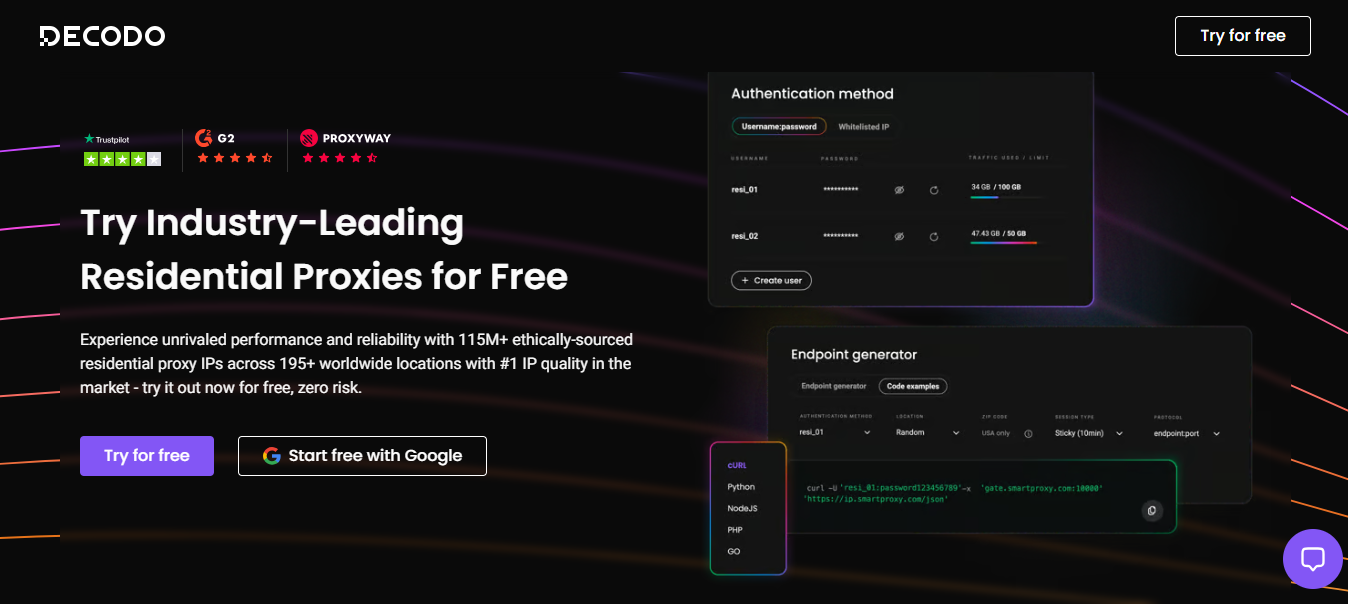
Decodo offers an excellent balance of price, performance, and usability. Its beginner-friendly dashboard, straightforward setup process, and reliable residential proxies make it suitable for both businesses and individuals.
The platform supports rotating proxies, API integration, and helpful documentation, allowing developers and newcomers alike to get started quickly. Decodo is a practical choice for users who want dependable performance without the complexity often associated with enterprise-focused services.

🥈 2. Oxylabs — Best for Enterprise & Large-Scale Data Collection
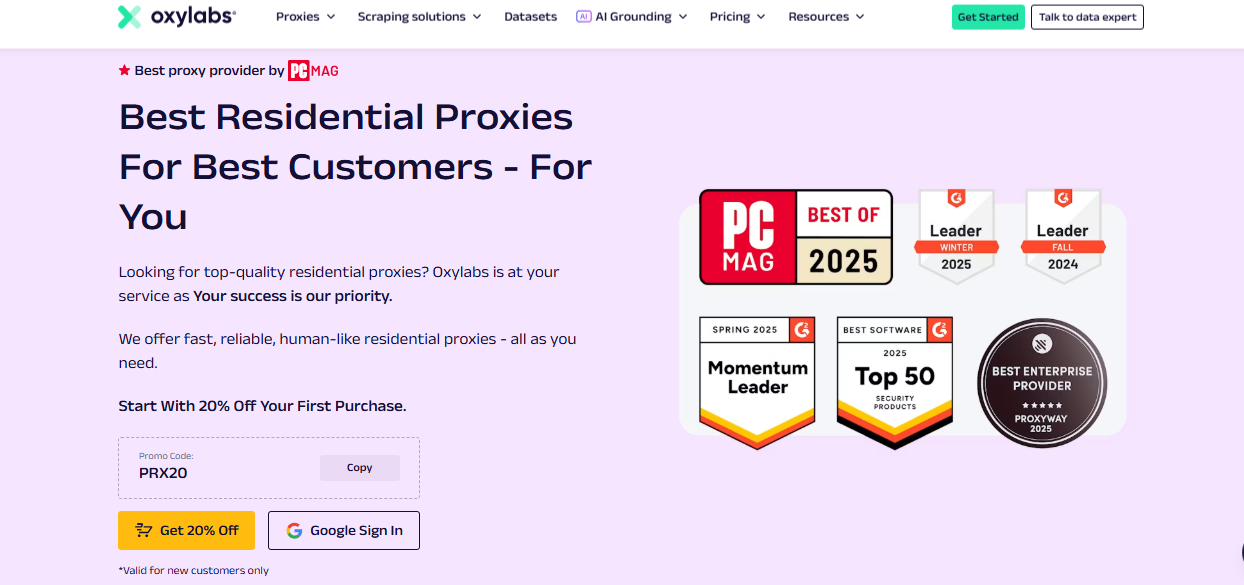
Oxylabs earns our Editor’s Choice recommendation because it combines a massive residential proxy network with enterprise-grade infrastructure designed for demanding workloads. Its platform supports advanced geographic targeting, dependable IP rotation, and high success rates for large-scale web scraping and data collection projects.
Businesses involved in market intelligence, competitive analysis, and large-volume research often choose Oxylabs for its reliability, scalability, and comprehensive tooling. Individual users can also benefit from its extensive documentation and robust feature set, although its strengths are most apparent in enterprise environments.
🥉 3. Webshare — Best Budget-Friendly Residential Proxy Provider
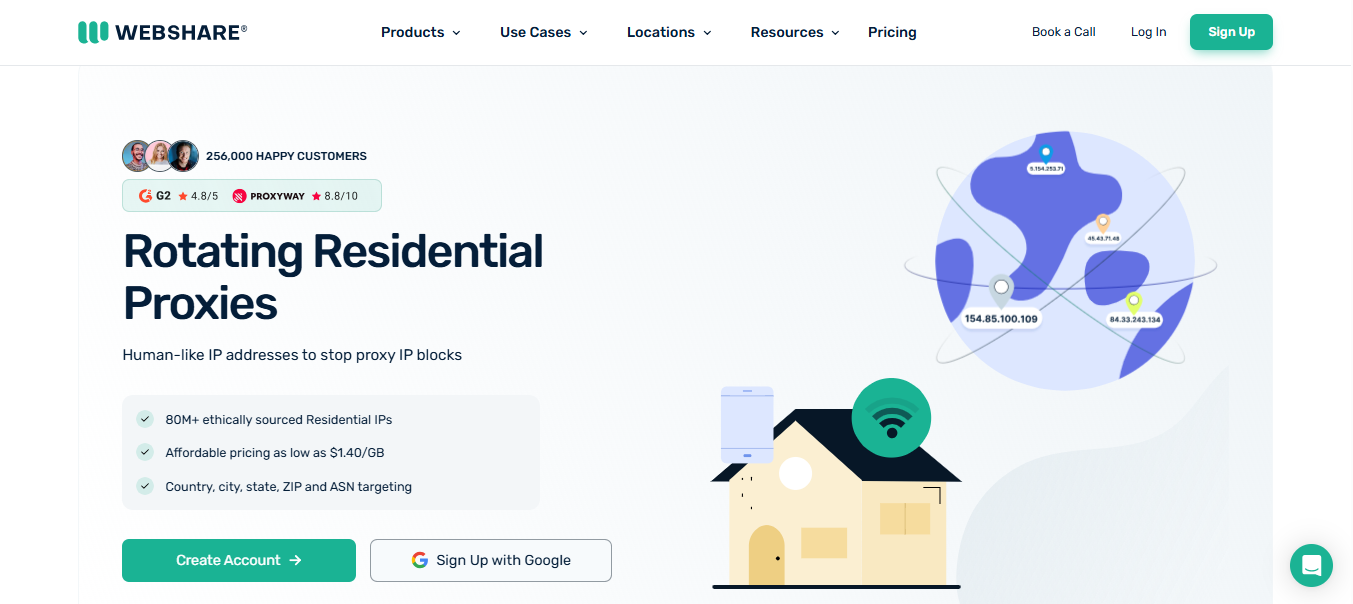
Webshare stands out as a budget-friendly option that remains accessible to developers, freelancers, students, and small businesses.
Its affordable pricing, straightforward setup, and available free plan make it attractive for smaller projects or those exploring proxy technology for the first time.
Despite its lower cost, Webshare provides reliable residential proxies that perform well for many common web scraping and anonymous browsing tasks, making it an excellent value-oriented choice.
Comparison Table
| Provider | Best For | Key Strength |
| Oxylabs | Overall | Balance of performance & value |
| Decodo | Enterprise | Large-scale proxy infrastructure |
| Webshare | Budget | Affordable and easy to use |
Other Residential Proxy Providers Worth Considering
Several other reputable proxy providers deserve consideration depending on your specific requirements:
- Mars Proxies – Offers residential and mobile proxy options with flexible plans.
- IPRoyal – Popular among developers and smaller businesses for its straightforward pricing.
- Bright Data – Provides an extensive proxy ecosystem with advanced enterprise features.
- SOAX – Known for flexible targeting options and broad geographic coverage.
- NetNut – Focuses on stable residential connectivity and business-oriented services.
- ProxyEmpire – Offers residential and mobile proxy solutions with customizable plans.
- Rayobyte – Provides residential, ISP, and datacenter proxies for various workloads.
- Infatica – Supports businesses requiring scalable proxy infrastructure and global coverage.
- Live Proxies – Offers rotating residential proxies suitable for many automation and scraping tasks.
Each provider has different strengths, so evaluating features against your project requirements is important.
How to Choose the Right Residential Proxy Provider
Before selecting a proxy provider, consider the following factors:
- Price: Ensure the pricing aligns with your expected usage.
- Performance: Look for consistent speeds and reliable connectivity.
- Reliability: Stable infrastructure minimizes interruptions.
- IP Pool Size: Larger pools generally support better IP rotation.
- Geographic Coverage: Choose providers offering locations relevant to your target websites.
- Rotation Options: Flexible IP rotation improves scalability.
- Dashboard: A clean interface simplifies management.
- Customer Support: Responsive support can save valuable time.
- API Availability: Useful for integrating proxies into automated workflows.
- Ease of Use: Beginners benefit from intuitive onboarding.
- Security: Reputable providers should protect customer accounts and infrastructure.
- Scalability: Ensure the service can grow alongside your data collection needs.
Frequently Asked Questions
Are residential proxies better than datacenter proxies?
Residential proxies typically use IP addresses assigned by internet service providers, making them useful for scenarios where websites closely monitor traffic patterns. Datacenter proxies often provide higher speeds but may be easier for some websites to identify.
Can I use browser automation without proxies?
Yes. However, when performing web scraping at scale, combining browser automation with proxy servers often improves reliability and distributes requests across multiple IP addresses.
Are APIs always better than web scraping?
Not necessarily. APIs are usually preferable when they provide the data you need. If no suitable API exists or important information isn’t exposed through it, web scraping may be necessary.
What is IP rotation?
IP rotation automatically changes the IP address used for outgoing requests, helping distribute traffic and reduce repeated requests from the same address.
Do all websites provide APIs?
No. Many websites do not offer public APIs, while others limit available data or require paid access.
Is browser automation slower than APIs?
Generally, yes. Browser automation loads full webpages and executes scripts, making it more resource-intensive than API requests.
Which solution is best for large-scale data collection?
For many large-scale projects, organizations combine residential proxies with specialized web scraping tools. Browser automation may also be added when websites rely heavily on JavaScript or user interaction.
Conclusion
Proxies, APIs, and browser automation each play an important role in modern data extraction. APIs offer structured, reliable access when available, browser automation excels at interacting with dynamic websites, and proxy servers enable scalable anonymous browsing, IP rotation, and web scraping across diverse online sources.
For users seeking residential proxy services, the best choice depends on individual requirements. Oxylabs is well suited for organizations requiring enterprise-grade infrastructure and large-scale data collection. Decodo offers a strong balance of performance, ease of use, and value for businesses and individuals, while Webshare remains an excellent option for budget-conscious users, freelancers, students, and developers.
As your data collection needs evolve, combining these technologies can often deliver the most efficient and resilient solution.
This guide is intended for educational purposes. Always ensure your data extraction activities comply with applicable laws, website terms, and ethical best practices.
INTERESTING POSTS
About the Author:

Meet Angela Daniel, an esteemed cybersecurity expert and the Associate Editor at SecureBlitz. With a profound understanding of the digital security landscape, Angela is dedicated to sharing her wealth of knowledge with readers. Her insightful articles delve into the intricacies of cybersecurity, offering a beacon of understanding in the ever-evolving realm of online safety.
Angela's expertise is grounded in a passion for staying at the forefront of emerging threats and protective measures. Her commitment to empowering individuals and organizations with the tools and insights to safeguard their digital presence is unwavering.



