In this post, I will show you why enterprise VR is gaining attention across industries.
Virtual reality used to be discussed mostly in the context of gaming, tech demos, and big promises about the future. That has changed quite a bit. More businesses are now looking at VR as a practical tool rather than a novelty. The shift is not really about hype anymore. It is about whether the technology can solve real problems, save time, improve training, or make certain tasks easier to manage in daily work.
Companies are looking for more practical ways to train
One of the biggest reasons enterprise VR is getting more attention is training. In many industries, training takes time, costs money, and depends on how consistently it is delivered. VR offers a different way to approach that.
Instead of reading through manuals or sitting through the same presentation again, employees can learn by doing. That can be useful in environments where procedures need to be repeated, safety matters, or mistakes in the real world are expensive. It also gives companies a way to create more consistent training experiences across teams and locations.
Remote collaboration is changing what tools matter
Work has become more distributed, and that has changed the way companies think about collaboration. Video calls are useful, but they are not always enough, especially when teams need to review designs, walk through spaces, or interact with 3D content.
That is one reason VR keeps coming up in business conversations. It gives teams a more immersive way to work together without being in the same place. Not every company needs that, of course, but in areas like design, engineering, product development, and simulation, the appeal is easy to understand. Sometimes a flat screen just does not do the job very well.
Hardware is becoming easier to take seriously
A few years ago, one of the biggest barriers was the hardware itself. Headsets often felt too heavy, too awkward, or too limited for regular professional use. That is slowly changing. Devices are becoming more comfortable, setup is getting simpler, and businesses have more options than they used to.
That makes it easier to evaluate solutions like the Pico 4 Ultra Enterprise in a more serious way. The conversation is no longer only about whether VR looks impressive. It is about whether the hardware is reliable enough, flexible enough, and practical enough to support real work over time.
Different industries are finding different use cases
What makes enterprise VR interesting is that it does not depend on one single use case. In healthcare, it can support training and simulation. In manufacturing, it can help with process learning, maintenance guidance, or safety instruction. In education, it can create more hands-on experiences. In retail and real estate, it can help with visualization and presentations.
That variety matters because it shows VR is not tied to one narrow type of business. The reasons for adopting it may differ, but the wider pattern is the same. Companies are paying attention because the technology is starting to fit actual business needs more clearly.
In this post, I will talk about free VPN safety and show you what users should check before trusting a VPN app.
Free VPN apps are easy to find, quick to install, and appealing to anyone who wants more privacy without adding another monthly subscription. For people using public Wi-Fi, traveling often, working remotely, or simply wanting to reduce how much of their browsing activity is exposed, a VPN can be a useful privacy layer.
But a VPN is not just another casual app. Once connected, it becomes part of the path between the user and the internet. That means the user is placing a certain level of trust in the VPN provider, its servers, its app design, and its privacy practices.
This is especially important with free VPN services. Some are built responsibly and clearly explain what users get. Others rely on vague privacy claims, aggressive ads, unclear data practices, or technical setups that may not protect users as much as they expect. Choosing a free VPN should not be based only on which app appears first in search results. It should involve a few basic safety checks.
Why Free VPN Safety Matters
A VPN can help hide a user’s IP address from websites and encrypt traffic between the device and the VPN server. This can be helpful on public Wi-Fi networks, where users may not know who else is connected or how secure the network is.
However, a VPN also changes the trust relationship. Instead of the local network or internet service provider seeing certain connection details, the VPN provider now handles the encrypted tunnel and server routing. That does not automatically make a VPN unsafe, but it does mean users should understand who they are trusting.
A good VPN should make its privacy and security position clear. It should explain what it collects, what it does not collect, how it protects connections, and what limits apply to free users. If those details are difficult to find, overly vague, or hidden behind marketing language, that is a reason to slow down before installing the app.
It is also important to remember that VPNs are not complete cybersecurity solutions. They do not replace strong passwords, multi-factor authentication, safe browsing habits, device updates, or endpoint protection. A VPN is one useful layer, not a magic shield.
Check the Privacy Policy Before You Check the Speed
Many users judge VPNs by speed first. Speed matters, of course, especially for streaming, video calls, gaming, or daily browsing. But privacy should come before performance.
A VPN’s privacy policy should clearly explain whether the service collects browsing history, original IP addresses, timestamps, device identifiers, connection logs, or diagnostic data. Some technical information may be necessary to operate and improve a service, but the provider should be clear about what is collected and why.
Users should be cautious when a VPN makes broad claims like “complete privacy” or “anonymous forever” without explaining the practical details. No responsible security tool should suggest that one app can make every online activity fully anonymous. A more trustworthy provider will usually describe its limits clearly and avoid exaggerated promises.
It is also worth checking how the free service is supported. Free apps still have operating costs, including servers, development, customer support, and security maintenance. If the business model is unclear, users should ask a simple question: how is this service funded, and what role does user data play?
Look Beyond the Download Button
The convenience of a free VPN is part of its appeal, but users should look at more than the download page. Before choosing a free VPN, it is worth checking how the service handles account requirements, bandwidth limits, server access, platform support, encryption, and privacy-related features.
For example, a user may want to know whether the VPN requires an email address, phone number, or payment card before use. They may also want to check whether the free version has time limits, speed restrictions, server restrictions, or heavy advertising. None of these factors automatically make a VPN unsafe, but they affect the user experience and should be clearly disclosed.
Device compatibility is another practical point. A VPN that works well on one phone may not be the best choice for a Windows laptop, MacBook, browser extension, or shared household device. Users who switch between devices should look for clear platform support and easy setup instructions.
This is where comparison matters. Instead of choosing the first free app available, users should review whether the VPN explains its free access in plain language. X-VPN, for example, presents its free VPN option around practical details such as account requirements, bandwidth access, server availability, supported platforms, and privacy-related features. Those are the kinds of points users should compare before installing any VPN app.
Check for Encryption, Leak Protection, and Protocol Transparency
A VPN’s basic job is to create a secure tunnel between the user’s device and the VPN server. Encryption helps protect traffic from local network snooping, especially on public Wi-Fi. But encryption alone is not the only thing that matters.
Users should also understand the idea of leaks. In some situations, a browser or device may reveal information outside the VPN tunnel. DNS leaks, WebRTC leaks, or IPv6 handling issues can sometimes expose details that users expected the VPN to hide. Most everyday users do not need to become network engineers, but they should know that VPN protection depends on configuration as well as branding.
Protocol transparency is another useful signal. VPN protocols affect how the tunnel is built, how stable the connection is, and how well the service works across different network environments. A provider does not need to overwhelm users with technical language, but it should give enough information for users to understand that security is being taken seriously.
For cybersecurity-conscious users, this section of the evaluation is especially important. A VPN that only talks about speed, entertainment access, or vague “protection” without explaining technical safeguards may not give users enough confidence.
Test What Websites Can Actually See
After installing and connecting to a VPN, users should verify that the connection is working as expected. A simple post-connection check can help users see what information websites are detecting.
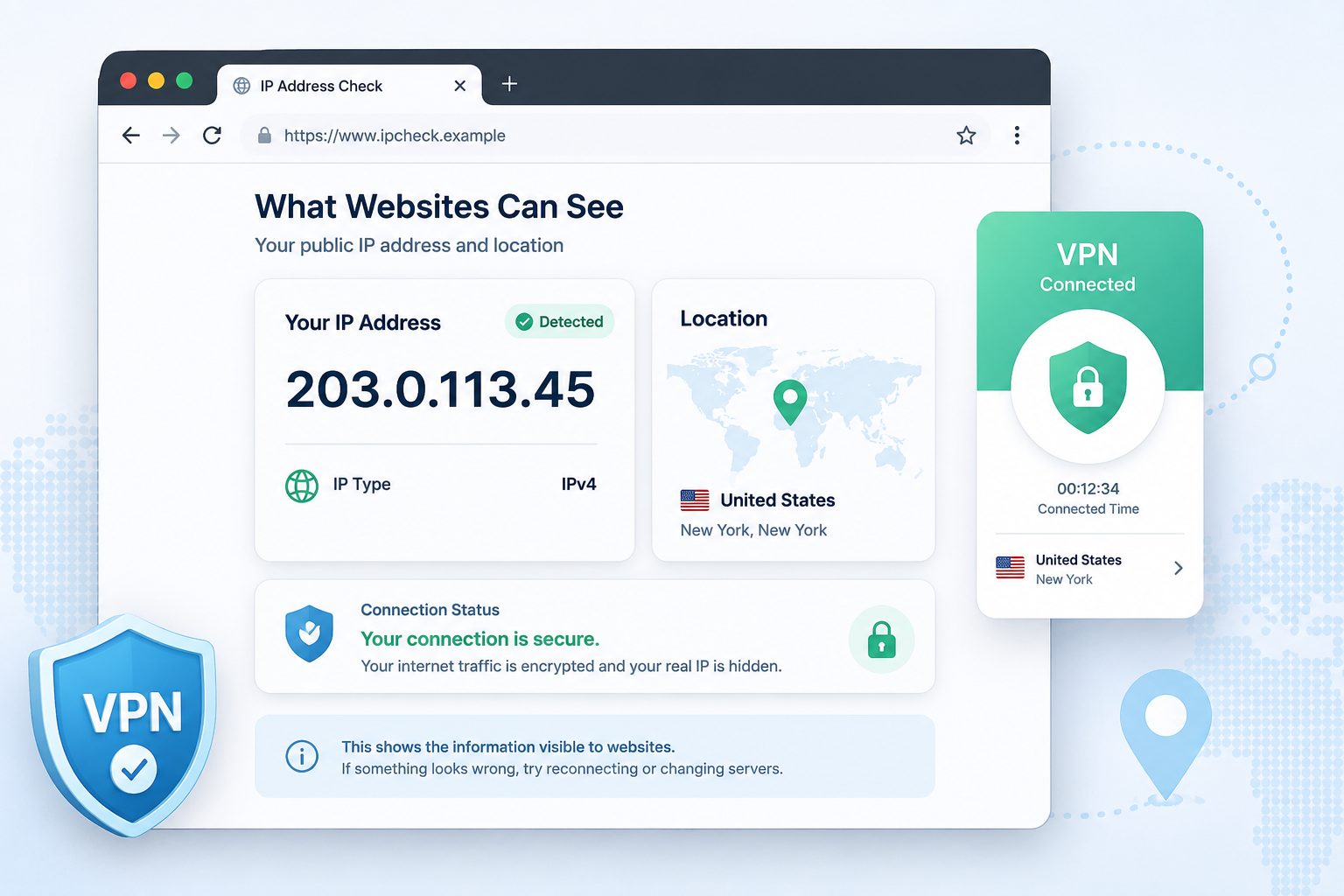
One practical step is to use an IP address checker after connecting to the VPN. This can show the IP address and approximate location visible to websites. If the real network location still appears, the user may need to reconnect, switch servers, review browser settings, or check whether a leak is occurring.
This kind of test is useful because privacy should be verified, not assumed. A VPN app may show a “connected” status, but users still benefit from confirming what websites can actually see. This is especially important when switching between networks, using public Wi-Fi, changing browsers, or installing a VPN on a new device.
Users can also repeat the check across different browsers or devices. If one browser shows unexpected information while another does not, browser settings or extensions may be part of the issue. This is why VPN safety should include both the app itself and the wider device environment.
Be Careful With Permissions, Ads, and Unnecessary Features
A privacy app should not create new privacy concerns. Before installing a VPN, users should review the permissions it requests and consider whether they make sense.
Some permissions may be necessary for the VPN to function properly. Others may feel unrelated to the service being provided. If an app asks for access that does not match its purpose, users should pause and investigate before accepting.
Advertising is another area to watch. Free products often use ads, but aggressive popups, misleading buttons, or confusing upgrade prompts can create a poor security experience. Users may accidentally click the wrong option, enable unwanted settings, or misunderstand what protection they are actually receiving.
Bundled features should also be explained clearly. Some VPN apps include browser protection, malware warnings, ad blocking, password-related tools, or network security alerts. These features can be useful when implemented responsibly, but users should understand what each feature does and whether it requires additional permissions or data collection.
Match the VPN to the Risk Level
Not every user has the same privacy needs. Someone checking email on airport Wi-Fi has a different risk profile from a journalist, activist, security researcher, or company handling sensitive internal data.
For everyday users, a free VPN may be useful for basic privacy, public Wi-Fi protection, and reducing visible IP exposure. For higher-risk work, users may need stronger controls, paid features, organization-managed tools, stricter logging policies, dedicated security processes, or legal and compliance review.
This distinction matters because it keeps expectations realistic. A VPN can help, but it should be matched to the situation. Users handling sensitive business, legal, financial, or investigative work should not rely on a casual setup without understanding its limits.
A balanced security approach usually includes multiple layers: updated devices, secure browsers, strong passwords, multi-factor authentication, careful app permissions, endpoint protection, and safe network habits. A VPN fits into that picture, but it should not be the only layer.
Free Does Not Mean Careless
A free VPN can be a useful privacy tool, but it should still be treated like a security product. Users should check the privacy policy, understand the business model, review account and bandwidth requirements, look for clear technical protections, and verify what websites can see after connecting.
The safest choice is not always the app with the loudest claims or the most aggressive download button. It is the one that explains its protections clearly, avoids exaggerated promises, and gives users enough information to make an informed decision.
For anyone using a VPN as part of daily browsing, public Wi-Fi protection, or remote work, the rule is simple: do not just connect and assume everything is private. Check the claims, understand the limits, and verify the connection.
Discover how to utilize a VPN to safeguard your online privacy.
In today’s digital age, online privacy has become a growing concern for individuals and businesses. With the increasing number of cyber threats and the pervasive tracking of online activities, it has become essential to take proactive measures to safeguard personal information.
One effective tool for protecting online privacy is a Virtual Private Network (VPN). This comprehensive guide will explore how to use a VPN to protect your online privacy and ensure a secure browsing experience.
A VPN is a technology that establishes a secure and encrypted connection between your device and the internet. It creates a virtual tunnel through which your data travels, making it difficult for anyone to intercept or monitor your online activities.
Using a VPN, your internet traffic is routed through a remote server, which masks your IP address and encrypts your data.
Why is Online Privacy Important?
Online privacy is crucial because it safeguards your personal information from being accessed or misused by unauthorized individuals or organizations.
Your online activities, such as browsing history, emails, and financial transactions, can be monitored and exploited without proper protection.
Using a VPN, you can regain control over your privacy and protect sensitive data from prying eyes.
When selecting a VPN for online privacy, there are several key factors to consider:
Security Features: Look for a VPN that offers robust encryption protocols, such as AES-256, to ensure the highest level of data security.
No-Logs Policy: Select a VPN provider with a strict no-logs policy, which means they do not collect or store any information about your online activities.
Server Locations: Consider the number and locations of the VPN provider’s servers. More server options provide greater flexibility and better performance.
Connection Speed: Check the VPN’s connection speed to ensure it meets your browsing and streaming requirements.
Compatibility: Ensure the VPN is compatible with your devices and operating systems.
Customer Support: Look for VPN providers that offer reliable customer support to assist you whenever you encounter any issues.
Recommended VPN Services for Online Privacy
Based on extensive research and user reviews, the following VPN services are highly recommended for protecting online privacy:
NordVPN: NordVPN is known for its advanced security features, extensive server network, and user-friendly interface. It offers strong encryption, a strict no-logs policy, and support for multiple devices.
CyberGhost VPN: CyberGhost VPN provides excellent privacy protection with its no-logs policy and military-grade encryption. It offers a user-friendly interface and a wide range of server locations.
ExpressVPN: ExpressVPN is renowned for its fast and reliable connections, stringent privacy policy, and extensive server network. It offers top-notch security features and excellent customer support.
87% OFF
PureVPN
PureVPN is one of the best VPN service providers with presence across 150 countries in the world. An industry VPN leader...Show More
PureVPN is one of the best VPN service providers with presence across 150 countries in the world. An industry VPN leader with more than 6,500 optimized VPN servers. Show Less
84% OFF
CyberGhost VPN
CyberGhost VPN is a VPN service provider with more than 9,000 VPN servers spread in over 90 countries. Complete privacy...Show More
CyberGhost VPN is a VPN service provider with more than 9,000 VPN servers spread in over 90 countries. Complete privacy protection for up to 7 devices! Show Less
67% OFF
TunnelBear VPN
TunnelBear is a VPN service provider that provides you with privacy, security, and anonymity advantages. It has VPN...Show More
TunnelBear is a VPN service provider that provides you with privacy, security, and anonymity advantages. It has VPN servers in more than 46 countries worldwide. Show Less
84% OFF
Surfshark
Surfshark is an award-winning VPN service for keeping your digital life secure. Surfshark VPN has servers located in...Show More
Surfshark is an award-winning VPN service for keeping your digital life secure. Surfshark VPN has servers located in more than 60 countries worldwide. Show Less
83% OFF
Private Internet Access
Private Internet Access uses world-class next-gen servers for a secure and reliable VPN connection, any day, anywhere.
Private Internet Access uses world-class next-gen servers for a secure and reliable VPN connection, any day, anywhere. Show Less
65% OFF
FastVPN (fka Namecheap VPN)
FastVPN (fka Namecheap VPN) is a secure, ultra-reliable VPN service solution for online anonymity. A fast and affordable...Show More
FastVPN (fka Namecheap VPN) is a secure, ultra-reliable VPN service solution for online anonymity. A fast and affordable VPN for everyone! Show Less
35% OFF
Panda Security
Panda VPN is a fast, secure VPN service facilitated by Panda Security. It has more than 1,000 servers in 20+ countries.
Panda VPN is a fast, secure VPN service facilitated by Panda Security. It has more than 1,000 servers in 20+ countries. Show Less
68% OFF
NordVPN
The best VPN service for total safety and freedom.
The best VPN service for total safety and freedom. Show Less
60% OFF
ProtonVPN
A swiss VPN service that goes the extra mile to balance speed with privacy protection.
A swiss VPN service that goes the extra mile to balance speed with privacy protection. Show Less
49% OFF
ExpressVPN
A dependable VPN service that works on all devices and platforms.
A dependable VPN service that works on all devices and platforms. Show Less
TorGuard VPN
The best VPN service for torrenting safely and anonymously.
The best VPN service for torrenting safely and anonymously. Show Less
50% OFF
VuzeVPN
VuzeVPN offers you unlimited and unrestricted VPN service.
VuzeVPN offers you unlimited and unrestricted VPN service. Show Less
VeePN
VeePN is a virtual private network (VPN) service that provides online privacy and security by encrypting internet...Show More
VeePN is a virtual private network (VPN) service that provides online privacy and security by encrypting internet traffic and hiding the user's IP address. Show Less
HideMe VPN
HideMe VPN is your ultimate online privacy solution, providing secure and anonymous browsing while protecting your data...Show More
HideMe VPN is your ultimate online privacy solution, providing secure and anonymous browsing while protecting your data from prying eyes, so you can browse the internet with confidence and freedom. Show Less
ZoogVPN
ZoogVPN is the complete and trusted all-in-one VPN service that protects your sensitive personal and financial...Show More
ZoogVPN is the complete and trusted all-in-one VPN service that protects your sensitive personal and financial information online. Show Less
HideMyName VPN
Protect your online privacy and anonymity with HideMyName VPN, a secure and affordable service that offers robust...Show More
Protect your online privacy and anonymity with HideMyName VPN, a secure and affordable service that offers robust encryption, multiple server locations, and a variety of privacy-enhancing features. Show Less
Witopia VPN
Witopia VPN lets you shield your privacy and unlock the world's internet with military-grade encryption and borderless...Show More
Witopia VPN lets you shield your privacy and unlock the world's internet with military-grade encryption and borderless access. Show Less
FastestVPN
FastestVPN offers budget-friendly, secure connections with unlimited data and a focus on fast speeds, ideal for...Show More
FastestVPN offers budget-friendly, secure connections with unlimited data and a focus on fast speeds, ideal for streaming and everyday browsing. Show Less
ExtremeVPN
ExtremeVPN is a VPN service that offers fast speeds, strong encryption, and a no-logs policy to keep your online...Show More
ExtremeVPN is a VPN service that offers fast speeds, strong encryption, and a no-logs policy to keep your online activity private. Show Less
iProVPN
iProVPN is a VPN service with a focus on security and affordability, offering basic features to secure your connection...Show More
iProVPN is a VPN service with a focus on security and affordability, offering basic features to secure your connection and unblock streaming content. Show Less
Setting Up a VPN for Online Privacy
Step-by-Step Guide to Setting Up a VPN
Setting up a VPN for online privacy is a straightforward process. Follow these steps:
Choose a VPN Service: Select a VPN provider that meets your requirements for security, server locations, and compatibility.
Sign Up and Install: Create an account with the VPN provider and download the VPN software or app for your device.
Launch the VPN: Open the VPN software and log in using your credentials.
Select a Server: Choose a server location from the available options. Consider selecting a server in a country that aligns with your privacy needs.
Connect to the VPN: Click the “Connect” button to establish a secure VPN connection.
Verify Your Connection: Check if your IP address has changed and confirm that your data is now encrypted and secure.
Configure Additional Settings: Explore the VPN settings to customize your preferences, such as enabling a kill switch or split tunnelling.
To maximize your online privacy when using a VPN, consider the following tips:
Enable Kill Switch: Activate the kill switch feature, which automatically disconnects your internet connection if the VPN connection drops, preventing any data leaks.
Use DNS Leak Protection: Ensure that your DNS requests are also routed through the VPN to prevent any potential leaks of your browsing activities.
Opt for OpenVPN Protocol: OpenVPN is widely regarded as one of the most secure VPN protocols. Choose this option whenever possible.
Regularly Update VPN Software: Keep your VPN software up to date to benefit from the latest security enhancements and bug fixes.
Benefits of Using a VPN for Online Privacy
Enhanced Security and Privacy
By using a VPN, you can enjoy enhanced security and privacy online. Your data is encrypted, making it virtually impossible for hackers and cybercriminals to intercept or decipher your information.
Bypassing Geo-Restrictions
A VPN enables you to bypass geographical restrictions and access region-locked content. With a VPN, you can appear to be browsing from a different country, enabling you to access streaming services, websites, and online platforms that may not be available in your location.
Protecting Sensitive Data on Public Wi-Fi
When connected to a public Wi-Fi network, your data is vulnerable to interception by malicious actors. Using a VPN, your data is encrypted, ensuring that your sensitive information, such as login credentials and financial details, remains secure.
Anonymous Browsing
A VPN masks your IP address and replaces it with the IP address of the VPN server you are connected to. This makes it difficult for websites, advertisers, and other entities to track your online activities, preserving your anonymity while browsing the web.
Common Misconceptions about VPNs and Online Privacy
VPNs Provide Complete Anonymity
While VPNs offer an added layer of privacy and security, they do not guarantee complete anonymity. Other factors, such as your online behaviour, can still be used to identify you. It is essential to exercise caution and maintain good digital hygiene to safeguard your privacy.
Free VPNs Offer the Same Level of Protection
While free VPNs may be tempting, they often have limitations and risks. Free VPN providers may log and monetize your data, compromise privacy, or offer subpar security features. Investing in a reputable paid VPN service for optimal protection is advisable.
How to Use a VPN to Protect Your Online Privacy: Frequently Asked Questions
Does a VPN protect you online?
VPNs can enhance your online privacy in several ways:
Encryption: A VPN encrypts your internet traffic, making it unreadable to anyone snooping on your connection, like hackers on public Wi-Fi.
IP Masking: A VPN hides your actual IP address, replacing it with one from the VPN server’s location to which you connect. This makes it harder for websites and online services to track your location or browsing activity.
How do I use a VPN?
Using a VPN is generally straightforward:
Choose a VPN provider: Research a reputable VPN service that suits your needs (speed, server locations, features).
Download and install the VPN app: Most providers offer apps for various devices (Windows, Mac, smartphones, etc.).
Launch the VPN app and sign in with your account.
Connect to a VPN server: Choose a server location from the list provided by your VPN provider.
Once connected, your internet traffic will be encrypted and routed through the VPN server.
How do I use a VPN secretly?
VPNs themselves aren’t inherently secret. However, they help mask your online activity from prying eyes. Using a VPN on a public Wi-Fi network is a good example, as it encrypts your traffic and prevents others from seeing what websites you visit.
VPNs can still be beneficial on secure networks, depending on your goals:
Enhanced Privacy: A VPN can prevent your internet service provider (ISP) from tracking your browsing activity even on a trusted network.
Access Geo-restricted Content: A VPN enables you to connect to servers in various locations, potentially allowing you to access websites or streaming services that are restricted in your area (please be aware of the terms of service and legality in your region).
Can a VPN be hacked?
While VPN encryption makes it difficult to hack into your device directly, vulnerabilities still exist. Here’s how to minimize risks:
Choose a reputable VPN provider: Opt for a provider with a strong security track record and a commitment to keeping user data private.
Keep your VPN software updated: Updates often include security patches, so ensure you’re running the latest version.
Be cautious of free VPNs: Free VPNs might lack robust security features or have limitations that compromise privacy (data logging, throttled speeds).
Remember: VPNs are a valuable tool for online privacy, but they’re not a silver bullet. Always practice safe browsing habits and exercise caution when sharing information online.
Conclusion
Now, you should be able to know how to use a VPN to protect your online privacy. Protecting your online privacy is essential in today’s interconnected world. Using a VPN, you can safeguard your personal information, browse the internet anonymously, and bypass geo-restrictions.
Remember to choose a reliable VPN service, follow the setup steps, and keep your VPN software up to date for the best online privacy protection. Take control of your digital footprint and enjoy a secure browsing experience with the best VPN for online privacy.
When choosing the best VPN for online privacy, it is crucial to prioritize security, reliability, and user-friendly features. Investing in a reputable VPN service ensures your online activities remain private and secure.
In this post, I will show you how to discover immersive fan experiences with Hisense at FIFA World Cup 2026.
Hisense, a leading brand in global consumer electronics and home appliances,is engaging football fans throughout the FIFA World Cup 2026TM with a series of interactive technology experiences at Sponsor Fan Experience (SFE) areas and FIFA Fan FestivalTM venues across tournament host cities.
For football fans, a visit to the FIFA Fan FestivalTM could begin with the thrill of stepping up for a virtual penalty shootout, followed by capturing a personalized Champion Frame moment inspired by iconic World Cup celebrations. While every fan’s journey is unique, Hisense is creating opportunities for visitors to do more than watch the tournament—they can become part of it.
At the Sponsor Fan Experience areas, fans can explore a range of football-inspired challenges powered by Hisense technologies. The “Three Colors Match-3” game on the 116-inch RGB MiniLED UXS TV invites fans to use gesture controls to match red, green, and blue icons while experiencing the capabilities of RGB MiniLED technology.
The VR Penalty Kick Master experience, powered by the XR10 flagship Laser Projector, places participants in the excitement of a World Cup penalty shootout on a giant-screen display. Visitors can also test in football quizzes on a Hisense premium refrigerator with a smart screen or compete in FIFA gaming challenges. Together, these experiences demonstrate how Hisense technologies can make entertainment more immersive, interactive, and engaging.
At FIFA Fan FestivalTM venues, fans can participate in football-themed activities designed for all ages. The AI-powered Champion Frame challenge on the 116UXS RGB MiniLED TVallows participants to recreate iconic tournament moments and receive personalized digital player cards. Additional attractions include Football Darts, RGB Football Whack-a-Mole, and tabletop football games, combining football fun with engaging interactive experiences.
Beyond the tournament venues, similar fan-focused activations, product showcases, and experiential events are taking place across in markets around the world, bringing consumers closer to the company’s latest innovations. As fans around the world celebrate FIFA World Cup 2026TM, Hisense welcomes everyone to experience the technologies that are transforming the way people watch, play, and enjoy the game.
About Hisense
Hisense, founded in 1969, is a globally recognized leader in home appliances and consumer electronics with operations in over 160 countries, specializing in delivering high-quality multimedia products, home appliances, and intelligent IT solutions.
According to Omdia, Hisense ranks No. 1 globally in the 100-inch and over TV segment (2023-2026Q1). As The Origin of RGB MiniLED, Hisense continues to lead the next-generation RGB MiniLED innovation. As the official sponsor of the FIFA World Cup 2026TM, Hisense is committed to global sports partnerships as a way to connect with audiences worldwide.
In this post, I will discuss dealing with web security when using online dating websites.
The main threat on a dating site is rarely the awkward date. It is the account takeover, the phishing link, and the stranger who asks for money before asking to meet. Online romance fraud cost Americans $823 million in 2024, and the Federal Trade Commission ranks it among the most expensive imposter scams by median loss. Half of victims lost more than $2,000. Most of that damage started with a security gap the user could have closed.
An online dating website holds a dense file on each user. Real name, photos, location, private messages, and often a saved payment method are stored behind one password. That makes the account worth stealing on its own, separate from any scam run through it. Treating a dating login with the same care as online banking is the baseline here.
The Value of a Stolen Account
Most people picture the danger as a fake suitor. The bigger exposure is the account itself. A stolen dating login gives an attacker a verified identity, a photo set, and a private message history that can be used to extort or impersonate. Credential stuffing, where a leaked password from one site is tried on others, drives most of these takeovers automatically.
The 2015 breach of one dating service exposed the records of tens of millions of users and led to extortion campaigns that ran for years. An account is not disposable, and the data inside it does not disappear when the user stops logging in.
Passwords and Two-Factor Authentication
Two defenses stop most account theft. The first is a unique password, generated and stored by a password manager, so a leak on one site cannot unlock the dating account. The second is two-factor authentication, which requires a second code at login and blocks an intruder who already has the password.
Both take minutes to set up. Neither is optional on an account that holds photos and a payment method. A password reused from an old shopping site is the single most common way these accounts fall. A password manager fills a saved login only on the genuine site, which quietly defeats fake pages built to copy the real one.
Security Across Platform Types
The security rules do not change with the type of online dating website. A mainstream app, a marriage-focused service, and a niche sugar daddy website all store the same categories of personal data and face the same credential attacks. Users often drop their guard on smaller platforms, even though smaller operators sometimes run thinner security teams.
Whatever the platform, the same short checklist applies: a strong password, two-factor authentication, and a healthy suspicion of any link sent in chat.
Phishing and Fake Links
Phishing is the most common entry point after weak passwords. A match sends a link, maybe to a photo or a fake verification page, and the page quietly harvests the login. A phishing page usually asks you to sign in again or to confirm details the platform already has.
The rule is simple. Do not click links sent inside a dating chat, and never enter a password on a page reached that way. A dedicated email address for dating accounts adds another layer, keeping these attempts away from the inbox that controls everything else.
Catfishing and Identity Checks
A Norton survey found that 76% of adults who have used a dating site or app ran into at least one form of scam, from catfishing to outright financial fraud. Verification is cheap. A reverse image search on a profile photo often surfaces the same picture attached to a different name, and a quick search of the person’s claims exposes borrowed biographies.
The pattern to watch is speed. A contact who professes strong feeling within days, resists a video call, and steers toward a private channel is following the scammer script. None of those moves is proof on its own, and all three together are a reason to stop.
AI and the Automated Scammer
The newest development is automation. Romance scams increasingly run on AI chatbots that hold a convincing conversation with hundreds of targets at once. The old advice to watch for broken English no longer holds, because a language model writes clean, warm messages on demand.
That makes the structural signals matter more than the wording ever did. A message with perfect grammar that still pushes for money or a private channel is the same scam it always was, only better written.
Keeping the Conversation Inside the Platform
Dating services build monitoring into their own messaging. Moving to text or another app strips that protection and removes the record a platform keeps. Scammers push for the move early, because a private channel has no fraud detection and no report button.
Staying in-app is not permanent. Once a video call and a few offline details check out, the risk drops. The point is to keep the platform’s tools in place while the other person is still unverified.
The Money Request
Every romance scam ends at the same place: a request for money. It arrives as an emergency or an investment tip the other person swears is time-sensitive. The amount starts small to test compliance, then grows. Requests now favor gift cards and cryptocurrency because both move fast and cannot be reversed.
Adults over 60 lost $389 million to these scams in 2024, the largest share of any age group. The defense is a flat rule. No money and no account access to anyone met online and not met in person. A genuine connection survives that rule. A scam does not.
Security in an Afternoon
Online dating security comes down to a handful of habits that take an afternoon to set up. A password manager, two-factor authentication, a separate email, and a refusal to send money to anyone unmet cover almost every case in the FTC data. That is four settings against an $823 million problem. The awkward date fades by the weekend. A drained account and a stolen identity do not, and the afternoon spent locking things down is the cheapest insurance online dating offers.
Frequently Asked Questions
How can I make my online dating account more secure?
Start with a unique password stored in a trusted password manager and enable two-factor authentication whenever the platform offers it. These two steps prevent most unauthorized account access, even if your password is exposed elsewhere.
How can I recognize a phishing attempt on a dating website?
Be cautious of anyone who asks you to click a link, log in through another page, or verify your account outside the official website or app. When in doubt, open the dating platform directly through its official website or mobile application instead of following links sent in messages.
What are the warning signs of a romance scam?
Common warning signs include someone expressing strong emotions very quickly, refusing video calls, avoiding in-person meetings, asking to move conversations to another platform, or requesting money, gift cards, or cryptocurrency.
Can AI make romance scams more convincing?
Yes. AI tools can generate natural, convincing conversations that make scams harder to identify through grammar or writing style alone. Instead of focusing on how messages are written, pay closer attention to suspicious behavior, such as requests for money or attempts to move conversations away from the platform.
In this post, I will show you how to choose the best AI agent software for customer support at scale.
Tickets pile up, wait-times climb, and budgets stay flat. A 2025 Gartner survey shows just over half of customers would let a generative AI assistant resolve their issue if it meant faster help, giving support teams a rare chance to scale without hurting satisfaction.
Yet the market teems with “smart” chatbots—some deliver, many don’t. Choose wrong and you risk hallucinations, broken hand-offs, and a costly rebuild six months later.
This guide cuts through the noise: must-have criteria, common pitfalls, and vetted options so you can select an AI agent that handles routine work while your team tackles high-value conversations.
What is an AI agent for customer support?
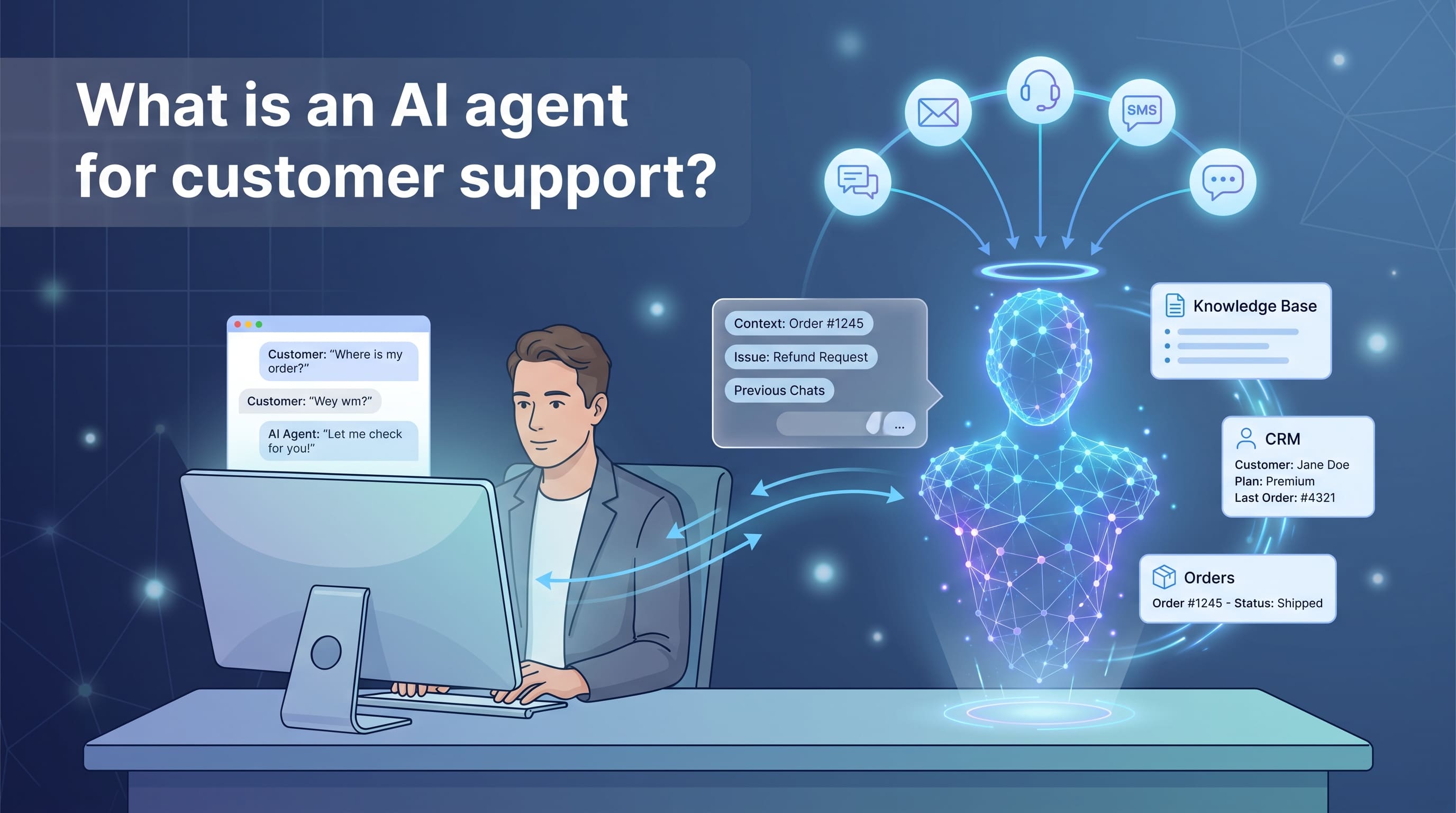
Think of an AI agent as a digital teammate who understands questions, finds answers, and resolves routine issues without calling in a human. Unlike the first-generation chat widgets that followed stiff decision-tree scripts, today’s agents rely on natural-language models that recognize intent, context, and even sentiment.
They connect directly to your knowledge base, order system, and CRM, so they can surface account details, track a package, or reset a password the moment a customer asks. If the request moves beyond routine—for example, a refund dispute or a complex technical problem—the agent hands the conversation to a live representative and passes along the full context so no one has to start from scratch.
In short, an AI support agent combines automation with empathy. It handles the repetitive questions your team answers every day while preserving the personal touch customers expect when issues get complicated. That balance underpins any modern, high-volume support operation.
Benefits of AI customer support agents at scale
Scaling support has always been a tug-of-war between service quality and operating cost. AI agents loosen the rope.
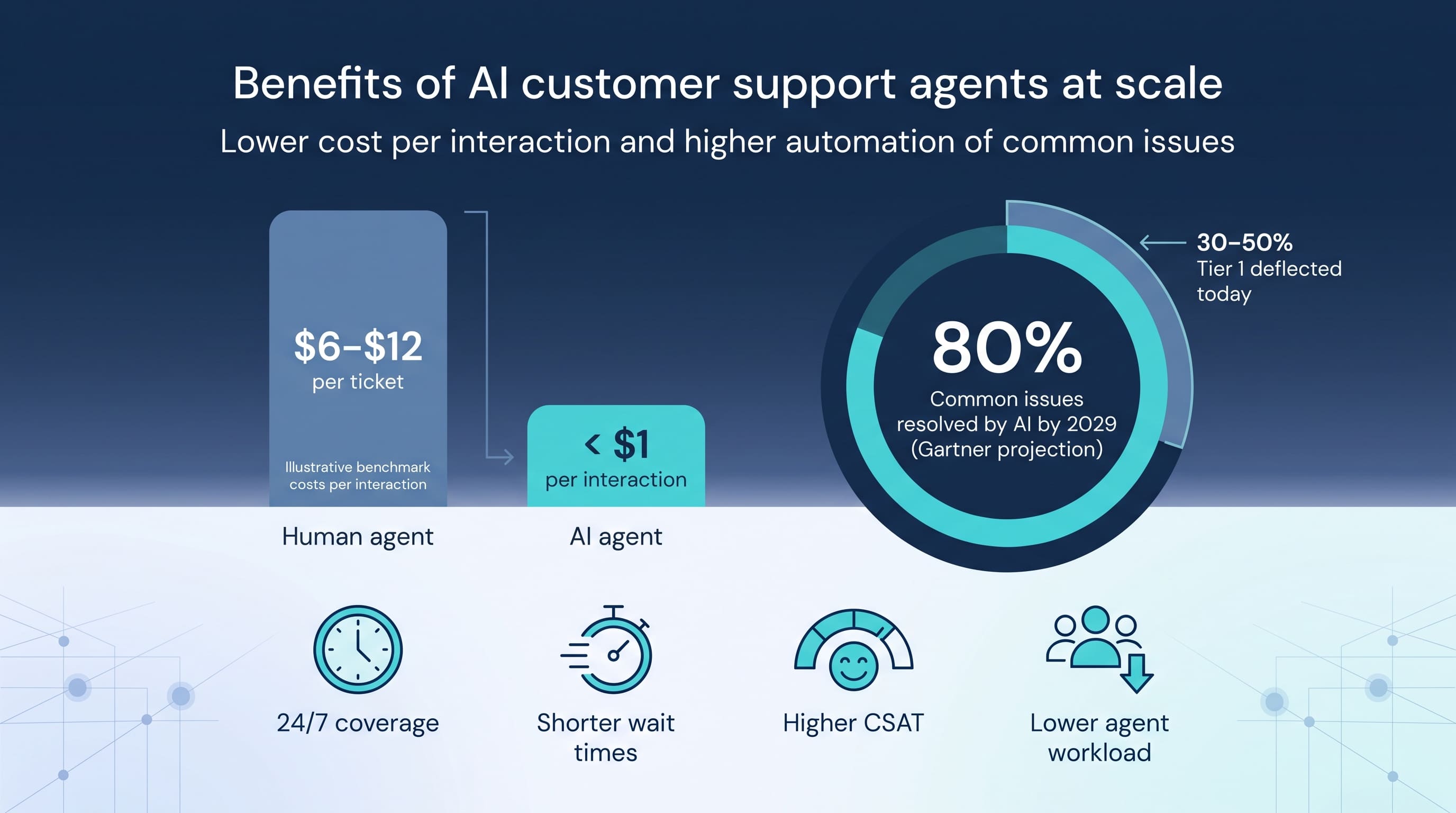
They work around the clock, never queue for coffee, and resolve the questions customers ask most: order status, password resets, policy clarifications. Off-loading that repetitive traffic cuts ticket volume for human reps and frees them for nuanced, relationship-building conversations.
The savings add up fast. Recent benchmark data shows an automated chat or voice interaction costs well under a dollar, while a human-handled ticket can run ten times higher. Multiply that gap across thousands of cases a day and the annual budget breathes easier. Gartner also projects agentic AI will autonomously resolve 80% of common customer service issues by 2029, a sizable shift in workload distribution.
Customer experience improves as well. Instant answers shorten wait times, and hand-offs carry full context so customers never repeat themselves. Sentiment analysis flags frustrated tones early, prompting a quick switch to a live agent before dissatisfaction grows.
Finally, AI brings consistency. Policies, prices, and troubleshooting steps roll out in minutes across every channel, eliminating the “agent roulette” that frustrates customers and risks compliance slip-ups. The result is a support engine that’s faster, leaner, and remarkably steady, even when ticket volume spikes without warning.
Key considerations for choosing AI agent software
Integration and omnichannel support
Your AI agent is only as helpful as the systems it can reach. If the platform speaks fluently with your CRM, order database, and ticketing queue, customers get smooth answers. If it doesn’t, they hit dead ends and escalate to humans, erasing the efficiency you expected.
Look for native connectors to the tools you already rely on. Instant access to customer profiles, purchase histories, and previous conversations lets the bot personalize responses and keep context intact across channels.
Omnichannel coverage matters just as much. Customers move between chat, email, SMS, and social without a second thought, so your AI agent should follow them easily. A single console for every touchpoint means you never juggle half-finished threads scattered across different dashboards.
For example, AI agent software for automating customer support at scale from Comm100 plugs into mainstream CRMs and messaging apps out of the box, then adds secure data hosting for industries that cannot compromise on compliance. That kind of “ready on day one” integration accelerates time-to-value and spares your IT team a long stretch of custom API work.
Comm100 AI Agent Omnichannel Platform Screenshot
A quick litmus test:
Can the vendor show live demos pulling real customer data from systems like Salesforce or Shopify?
Does reporting unite all channels in one analytics dashboard?
Will new integrations ship regularly, or will you foot the bill for custom builds?
Tick those boxes and you’re on your way to an AI rollout that feels less like a science project and more like a rapid upgrade.
AI capabilities and accuracy
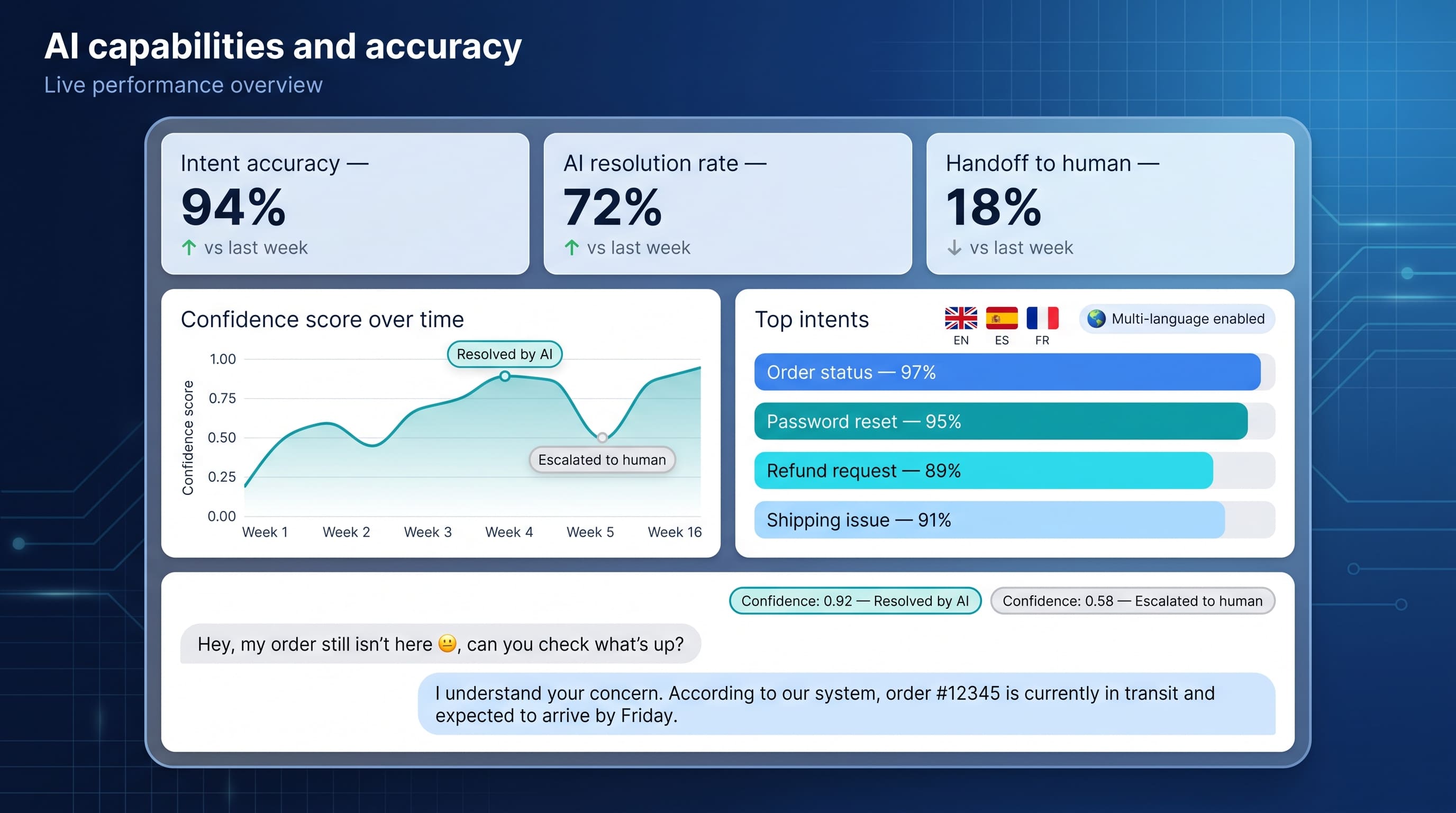
This is where demos meet daily reality. Customers ask in fractured sentences, local slang, and the occasional emoji. An effective AI agent must grasp intent, context, and sentiment, then deliver a clear, correct answer.
Start by probing the language model itself. Does it understand multiple languages or only English? Can it handle domain-specific terms without weeks of manual training? The best engines learn from every interaction, so the bot improves week by week instead of stalling on day one.
Next, insist on transparency around accuracy. Reputable vendors track resolution rates, confidence scores, and the volume of answers that bounce to humans. They share those numbers during a pilot instead of hiding them in footnotes. That openness flags hallucinations or blind spots before they erode trust.
Finally, test the bot with real data. Feed it transcripts from last quarter’s peak season and measure how often it gets the reply right on the first try. If the output reads like your best agent’s playbook, you’re on the right track. If you spend more time editing than evaluating, keep shopping.
Customization and training
Every brand speaks its own voice. Your AI agent must learn that voice on day one and refine it with every conversation.
Start with knowledge ingestion. A strong system pulls in help-center articles, past chat logs, and product docs in minutes, not weeks. The richer the input, the sharper the answers.
Next, check self-service tools. Can support leads update replies without code or vendor tickets? Drag-and-drop flows, plain-language intents, and live preview keep maintenance with the people who know customers best.
Training should feel continuous, not seasonal. Choose software that flags unknown intents, suggests new FAQs, and retrains overnight. That cadence lets the bot evolve with product launches, policy tweaks, and peak-season quirks.
Finally, demand sandbox testing. Before changes reach the public site, your QA team should stress-test new content in a safe space. If the vendor skips that step, move on; rushed updates can erode trust fast.
Scalability and performance
Your bot’s first week may handle a few hundred chats. Holiday season can push that figure into the tens of thousands. If latency spikes or uptime slips under load, customers notice every millisecond.
Start by checking the vendor’s track record. Look for published SLA numbers; 99.9 percent availability is table stakes, plus real stories of brands that stayed online through traffic surges. Cloud-native infrastructure with auto-scaling adds capacity the moment volumes rise, so the bot never leaves users waiting.
Speed matters as much as stability. Aim for sub-two-second responses in chat; slower replies feel like silence and drive abandonment. Ask the vendor to demo live conversations at scale or share monitoring dashboards. If they hesitate, dig deeper.
Finally, confirm global reach. A follow-the-sun support model means customers in Sydney should see the same quick experience as those in Seattle. Regional data centers cut latency, satisfy local compliance rules, and keep performance steady worldwide.
Secure these capabilities early and you’ll scale calmly when the next flash sale sends visitor counts soaring.
Analytics and insights
Great support is fast and data-driven. Your AI agent should surface patterns you can act on instead of hiding them in a dashboard no one opens.
Look for real-time conversation analytics that spotlight emerging issues before they overwhelm the queue. If refund questions surge after a new pricing plan, the reports should flag that trend in hours, not weeks.
Track intent accuracy, containment rates, and CSAT by topic. These numbers reveal where the bot excels and where it needs coaching, and they help you defend the budget during reviews.
Predictive insights raise the ceiling further. Leading platforms analyze aggregate interactions to forecast staffing needs and highlight content gaps, letting you fix problems before customers notice. Gartner projects that seven in ten service journeys will begin with conversational AI by 2028.
Finally, require simple export options. When analytics feed directly into BI tools like Tableau or Power BI, your ops team can combine service data with sales, churn, and product metrics, turning every chat into a growth lever.
Human agent handoff
Even the smartest AI will face a billing dispute, a distressed traveler, or a hardware glitch no chatbot can solve. The crucial moment is the handoff. Get it right, and customers hardly notice the change. Miss the mark, and they will share the story on every review site they find.
Choose software that routes the chat with the full transcript, customer metadata, and bot-gathered notes in one view. That context spares the human agent from repeating basic questions and shows the customer you were listening.
Smooth channel shifts matter too. If the issue calls for a phone conversation or screen share, the platform should launch those options in two clicks and log everything to the same ticket. The fewer times the customer repeats information, the faster frustration turns into relief.
Track post-handoff metrics as well. High CSAT scores and low handle times after escalation confirm a clean relay. If scores drop, inspect the transcripts; you will often find missing context or unclear bot scripting you can fix before it spreads.
Security and compliance
Trust is earned one safeguard at a time. When an AI agent moves customer data through the cloud, the stakes climb fast, especially in healthcare, finance, or education where regulations carry weight.
Start by confirming the basics: SOC 2 Type II, ISO 27001, and GDPR alignment. These frameworks show that the vendor’s controls are audited, not just promised. If you fall under HIPAA or PCI-DSS, look for signed BAAs and proof of encryption in transit and at rest.
Security and Compliance Certifications Icon Set
Ask where and how your data lives. Regional hosting keeps information within required borders and cuts latency for local users. Just as important, the provider should promise that your proprietary data never trains a shared model. That wall protects trade secrets and reassures legal teams worried about accidental exposure.
Finally, examine audit trails. Detailed logs of every agent-customer exchange make investigations straightforward when compliance officers come calling. Put these safeguards in place early and you gain AI’s speed without tomorrow’s headline risk.
Cost and ROI
Sticker price alone will not show whether an AI agent is worth it. You need to weigh the full economic picture: license fees, implementation hours, ongoing maintenance, plus the savings and revenue the system can generate.
Start on the cost side. Subscription plans usually bill per resolved interaction, per user, or by flat tiers. Add one-time setup services and potential integration work. A clear quote should map every dollar to a line item so finance teams are not surprised six months later.
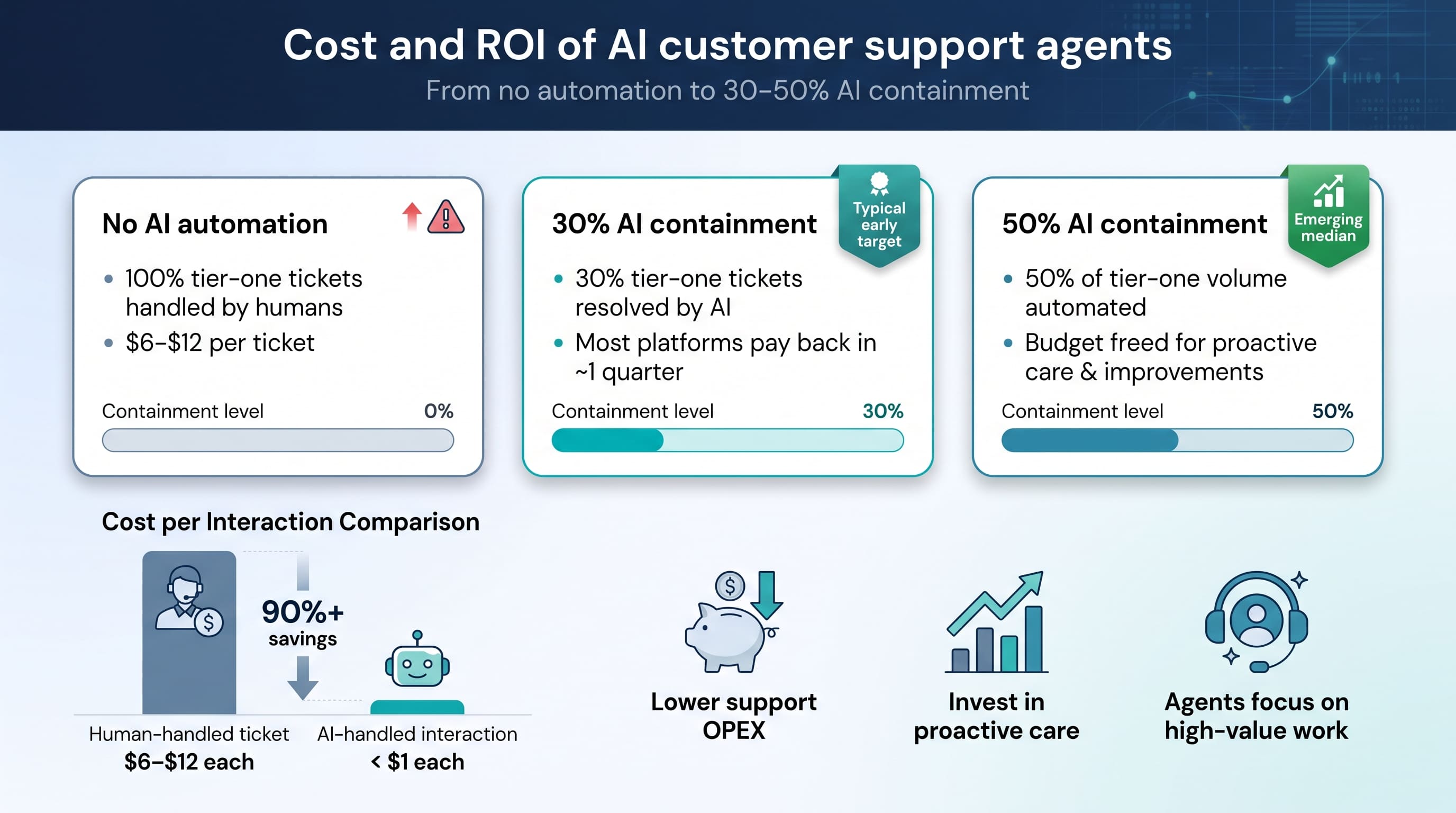
Now flip the ledger. Automated resolutions carry rock-bottom marginal costs, often under a dollar each, compared with the six-to-twelve-dollar average for human-handled tickets. Trim even thirty percent of tier-one volume and most platforms pay for themselves in a quarter. Reach fifty percent containment—the industry’s emerging median—and you free budget for proactive care or product improvements.
Soft gains count as well. Faster replies lift CSAT. Consistent answers prevent needless refunds. Agents freed from copy-paste routines can focus on upsells, renewals, or high-touch retention work that drives top-line growth.
Run a pilot, track every metric, and let real data—rather than vendor slide decks—prove the ROI in your environment. When the numbers arrive, the business case writes itself.
Support and vendor reliability
Choosing an AI platform is more than a software purchase; it is a long-term partnership. When outages happen or a new channel launches, you need a vendor who shows up like a teammate, not a ticketing black hole.
Start by checking responsiveness. Do they offer 24/7 live support or only email forms? Ask to meet the success manager who will guide your rollout. A real face and a direct line signal accountability when stakes rise.
Next, inspect the knowledge ecosystem. Detailed documentation, active user forums, and steady webinars shorten the learning curve for admins and agents. Frequent roadmap updates with clear delivery dates show a company that ships rather than stalls.
Customer proof fills in the rest. Search G2 or Gartner Peer Insights for comments about fast fixes and proactive guidance. If universities, insurers, or public agencies trust the vendor, that is strong evidence of reliability under strict compliance rules.
Finally, test the partnership early. During your pilot, raise a “fake” complex question and watch how the vendor responds. A quick, thorough fix predicts years of smooth scaling; radio silence is your cue to keep shopping.
Market snapshot: leading AI agent solutions
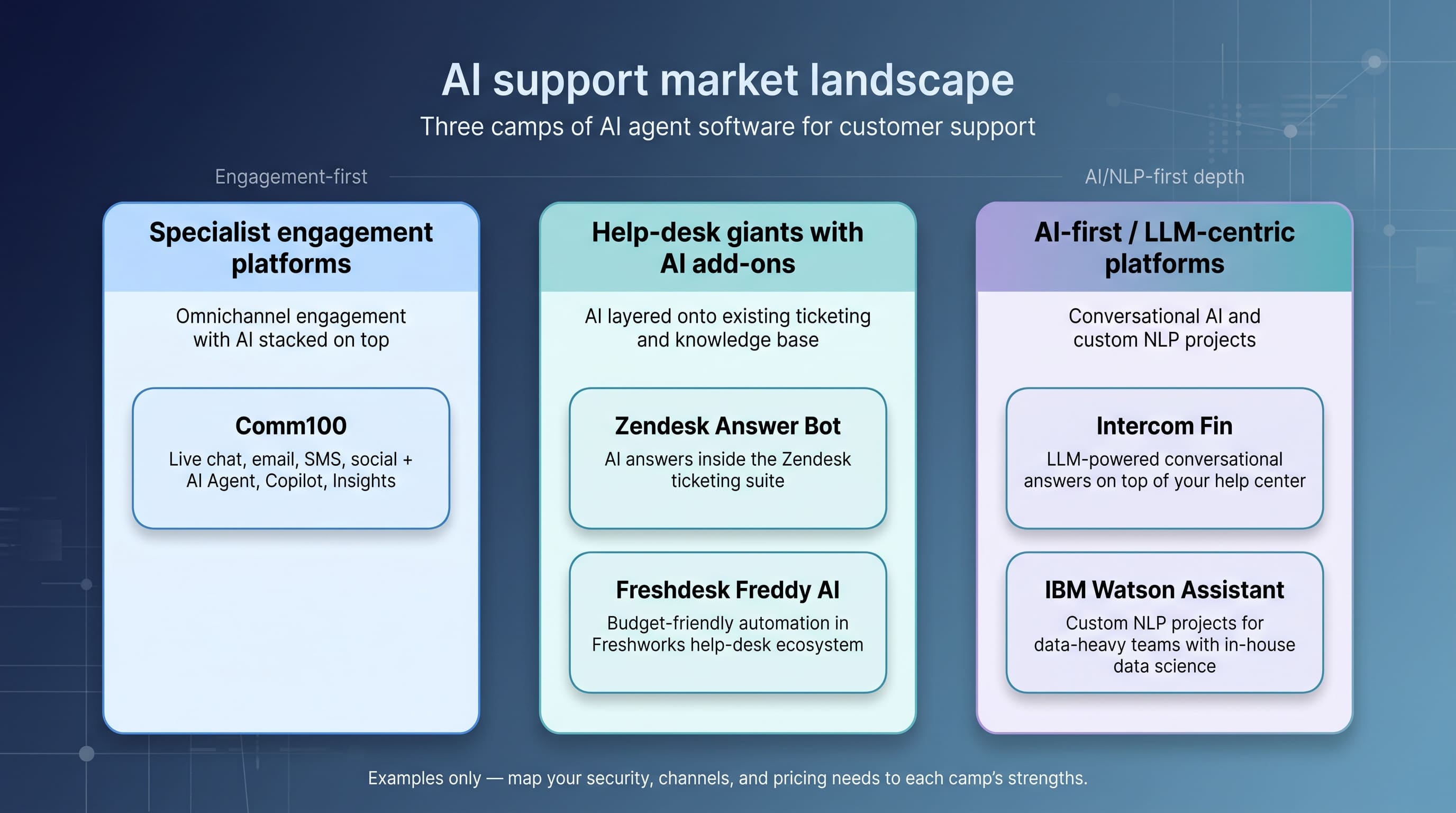
The AI support market has ballooned in the last two years, and it shows in the range of tools on offer. We can group the landscape into three broad camps: specialist engagement platforms, help-desk giants that added AI to existing suites, and pure-play LLM startups chasing new funding.
Comm100 sits in the first camp. Its omnichannel roots place live chat, email, SMS, social, and ticketing in one console with an AI suite—Agent, Copilot, Insights—stacked on top. That unity attracts regulated industries that need tight data governance without stitching together several vendors.
Zendesk Answer Bot follows the second path. It draws on Zendesk’s deep ticket history to suggest articles and draft replies. If your team already runs on Zendesk, integration is nearly automatic, though some users note extra setup for social channels and limited on-premise options.
Intercom’s Fin represents the AI-centric wave. Fin taps your help center and large language models to craft conversational answers. Early adopters praise its natural tone, but usage-based pricing can spike during peak seasons, so forecast volumes carefully.
Freshdesk’s Freddy AI and IBM Watson Assistant round out the field with their own strengths: Freddy for budget-friendly automation inside the Freshworks ecosystem, Watson for deep custom NLP projects when you have data-science talent in-house.
The bottom line: map your must-haves such as security, channel depth, and predictable pricing to these strengths, and the shortlist writes itself.
Challenges and best practices in implementation
Common pitfalls to avoid
Rolling out an AI agent blends technology and change management, and the snags rarely show up in glossy vendor demos.
The first stumbling block is data quality. If your knowledge base is outdated or filled with edge-case work-arounds, the bot will learn those habits and repeat them at scale. Customers see the cracks right away.
Next comes stakeholder alignment. Support teams may welcome automation, while legal, brand, and IT raise concerns about tone, privacy, and integration. When those issues surface after contracts are signed, launch dates slip and enthusiasm fades.
Finally, there is the “set-and-forget” trap. Early containment wins create a false sense of closure; six months later, product updates break intents and satisfaction scores drop. Continuous tuning is the price of long-term success.
Understanding these pitfalls upfront sets the stage for smoother deployment, and it leads to the best-practice fixes below.
Best practices for a smooth rollout
Begin with a pilot that mirrors reality. Pick a high-volume, low-risk queue—order status or password resets—and route a slice of traffic through the bot. Measure containment, CSAT, and handle time next to human benchmarks. The data will reveal quick wins and hidden gaps before you expand.
Pair the pilot with a cross-functional squad. Support leaders shape tone and workflows, product teams supply accurate specs, and legal and security check compliance. When every voice weighs in early, you avoid last-minute rewrites and launch with confidence.
Set a weekly tuning cadence from day one. Review transcripts, add missing intents, and update content when policies change. A living bot stays sharp; a dormant one drifts off-brand.
Keep humans in the loop as well. Train agents to tag bot mistakes and surface new questions they hear on calls. Their frontline insight drives continuous improvement and reminds everyone that AI exists to amplify, not replace, human expertise.
Future trends in AI customer support
AI continues to advance. Over the next two years, text-first chatbots will give way to multimodal agents that handle voice, images, and video. They will parse a phone call in real time, pull the right knowledge article, and even surface a brief walkthrough clip without breaking the flow.
Hyper-personalization will follow. By combining purchase history with sentiment cues, tomorrow’s agent can adjust both tone and solution: formal courtesy for a luxury shopper, quick emojis for a Gen Z gamer, all while respecting privacy limits.
Human–AI teamwork will deepen as well. Copilot tools already suggest replies; the next wave will propose proactive outreach, flag churn risk mid-chat, and recommend discounts or escalation long before frustration builds.
Finally, governance will mature. Regulators are poised to set standards on transparency, audit trails, and content accuracy. Vendors that build compliance into their design today will outpace competitors racing to retrofit later.
Track these shifts and you will choose a platform that evolves with customer expectations instead of chasing them.
Conclusion
Choosing AI support software at scale comes down to fit, not hype. Weigh integration, accuracy, security, and true cost of ownership, then pilot the tool on a low-risk queue before you commit. Tune it weekly, keep humans ready for the hard cases, and the right agent will trim ticket costs while holding satisfaction steady, even when volume spikes.
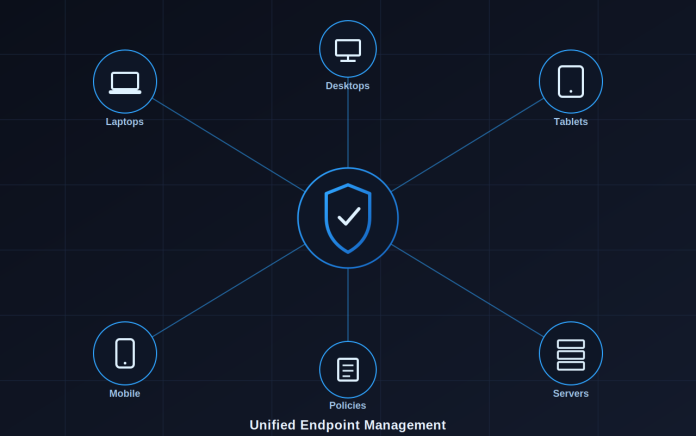
In this post, I will show you how to choose the right Unified Endpoint Management (UEM) software for an organization?
For IT teams, juggling five different tools to manage laptops, smartphones, tablets, and IoT devices across varied regions can be quite exhausting.
This fragmented approach is exactly why so many organizations are searching for ways to choose the right Unified Endpoint Management (UEM) software. The right platform doesn’t just simplify device management; it transforms how your entire IT operation runs, from onboarding new employees to locking down a lost device in seconds.
In this guide, we’ll break down what UEM actually means, why it matters for growing businesses, the features that separate great platforms from mediocre ones, and the practical checklist you need before signing a contract.
What is UEM?
Unified Endpoint Management (UEM) software is a centralized platform that lets IT teams monitor, secure, and control every device connecting to a company’s network, regardless of operating system or device type. This includes laptops, smartphones, tablets, wearables, and even rugged devices used in warehouses or retail floors.
As your workforce and device fleet expand, manual management becomes a liability rather than a workaround. Here’s why UEM has become non-negotiable for scaling businesses.
1. Consolidated Visibility and Control
Instead of switching between platforms to check device health, patch status, or compliance, UEM gives you one dashboard for everything. You see every device, its location, its software version, and its risk level, all in real time. This visibility alone eliminates the guesswork that leads to security gaps.
2. Support Remote and Flexible Workflows
Hybrid and remote work aren’t going anywhere. UEM lets IT teams configure, update, and troubleshoot devices without ever needing physical access to them. Whether an employee is in New York or working from a co-working space in another city, their device stays compliant and secure.
3. Strengthen Security Posture
With endpoints scattered across networks and locations, each device is a potential entry point for threats.
UEM enforces encryption and separates work data from personal data. It also remotely wipes and locks compromised devices. These UEM features help build a proactive defense and prevent breaches.
4. Lower Operational Cost and Time Efficiency
Manually configuring hundreds of devices one by one drains hours that IT teams don’t have. UEM automates repetitive tasks like app installations, OS updates, and policy pushes, freeing your team to focus on strategic projects instead of routine maintenance.
5. Eliminate Manual Bottlenecks
Beyond cost savings, UEM removes the human error factor. Automated workflows mean fewer missed updates, fewer misconfigured devices, and fewer late-night calls about a forgotten password reset.
Top-Notch Features that Make UEM Software Stand Out
Not all platforms are built equally. Here’s what separates the best UEM software from tools that merely check boxes.
1. Cross-Platform Compatibility
Organizations mostly operate on a mixture of Windows, macOS, iOS, Android, and even Linux devices. A strong UEM solution manages all of them from one place, without requiring separate licenses or dashboards for each OS.
2. Varied Enrollment Modes
The best platforms offer multiple enrollment options, so IT teams can onboard devices quickly, regardless of how they’re distributed.
Key enrollment methods to look for include:
Zero-touch enrollment for pre-configuring devices before they even reach the employee.
QR code-based enrollment for quick, self-service setup.
Email-based enrollment for sending device configuration links directly to end users.
Having multiple options ensures flexibility, whether you’re onboarding one new hire or rolling out 500 devices company-wide.
3. Zero-Touch Deployment
This feature deserves its own spotlight. Zero-touch deployment lets IT teams ship devices straight to employees, pre-loaded with all necessary apps, settings, and security policies, without ever touching the devices themselves. It’s a massive time-saver for distributed teams and reduces the risk of setup errors.
4. Kiosk Mode
For businesses using a dedicated-purpose device, kiosk mode locks a device into a single app or a curated set of apps.
Single-app kiosk mode allows access to one application only, ideal for point-of-sale systems. Multi-app kiosk mode allows access to a controlled set of apps, useful for logistics or field service teams who need a few tools without full device access.
5. Control From One Dashboard
A unified dashboard isn’t a nice-to-have; it’s the core value proposition of UEM. From this single interface, admins should be able to push updates, monitor compliance, track device location, and manage user permissions across every endpoint.
6. Policy Enforcement
Strong UEM platforms let you set granular policies (password complexity, app restrictions, network access rules) and enforce them automatically across all devices. If a device falls out of compliance, the system flags it or restricts access until it’s resolved.
7. Remote Device Management
Remote management lets IT teams lock, wipe, or troubleshoot devices instantly, without needing physical possession. This is critical for minimizing data exposure risk.
8. Compartmentalize Work and Personal Data
Especially relevant for BYOD (Bring Your Own Device) policies, this feature separates corporate data from personal apps and files on the same device. Employees keep their privacy, and companies keep their data secure, without needing to issue separate hardware.
Key Aspects to Look Out for Before Choosing the Right UEM Software
Feature lists look impressive on paper, but the right choice depends on how well a platform fits your specific environment. Here’s your practical checklist.
1. OS and Device Compatibility
Confirm the UEM solution genuinely supports every operating system and device type your organization uses today. Also, check its roadmap for upcoming device categories you might adopt later.
2. Availability of Security Features
Look beyond the basic security features. Strong platforms offer MDM, endpoint Data Loss Prevention (DLP), Mobile Application Management (MAM), risk management, and more. Make sure these are built into the product, not as expensive add-ons.
3. Pricing Plans
Understand the full cost structure, including per-device fees, tiered feature access, and any hidden charges for premium support or advanced integrations. A cheaper plan that lacks essential features often costs more in the long run.
4. Compliance Readiness and Mandates
If your industry has specific regulatory requirements (healthcare, finance, or government sectors, for instance), verify the UEM solution supports the certifications and audit trails you need, such as GDPR, HIPAA, or India’s DPDP framework.
5. Scope of Scalability
Choose a platform that grows with you. If you’re managing 200 devices today but expect 2,000 within two years, ensure the solution can scale without requiring a complete platform migration later.
6. Device Profiling and Usage Patterns
Different departments use devices differently. Sales teams might need mobile-first access, while engineering teams rely on desktops with heavier security controls. The right UEM software should let you create distinct profiles based on how devices are actually used across teams.
7. Vendor Reputation and Support
Read reviews, ask for client references, and test the vendor’s support responsiveness during your trial period. A platform is only as reliable as the support behind it when something goes wrong.
8. User Experience
A powerful platform means little if your IT team struggles to navigate the interface. Prioritize platforms with intuitive dashboards, clear reporting, and a minimal learning curve, so your team can actually use the tool efficiently from day one.
Making the Right Call for Your Business
Choosing the right UEM software isn’t about picking the platform with the longest feature list. It’s about finding the solution that aligns with your device ecosystem, security requirements, and growth trajectory.
Start by mapping out your current pain points (Is it security? Scalability? Manual onboarding?) and use that as your filter when evaluating vendors. Request trials, ask tough questions about compliance and support, and involve your IT team in the decision since they’ll be the ones using it daily.
The right UEM partner doesn’t just manage devices. It becomes the backbone of how your organization stays secure, agile, and ready for whatever growth comes next.
Here are 5 cybersecurity tips for Real Estate agents.
Everyone needs good cybersecurity to protect their data from hackers. Most of the modern dealings and contracts are done over the Internet. This system is undoubtedly faster, but cybersecurity threats are always upon everyone who uses the Internet for their business. Then how can we recover from this problem?
The business owners and the real estate agents are more prone to feeling in the grips of cyber hackers and intruders. From healthcare units to small businesses everywhere, cybersecurity matters.
Now some of the health care units are taking help from the cybersecurity systems act, for example. You can take the HIPAA cybersecurity system, the Health Insurance Portability and Accountability Act (HIPAA).
It protects the patients’ sensitive data in healthcare units. The Act protects all the details of the patient’s data and the patient’s studies.
5 Easy And Effective Cybersecurity Tips For The Real Estate Agents
In real estate, hackers often trick the agents into introducing themselves as the buyers and wanting the agents’ bank details. It is a common phenomenon for targeted real estate agents to face these illegal acts by using simple tricks.
By understanding these threats and implementing essential cybersecurity practices, real estate agents can significantly reduce their vulnerability and protect their business, client information, and financial assets.
Here are the five famous and practical cybersecurity tips you can apply to block hackers from robbing you.
1. Encrypt Your All Mobile Massage Data
Mobile and laptops are the most widely used communication medium of the modern digital era. Intelligent ai, and cybersecurity systems can block your hackers from getting into the communication blocks.
Mobile data and chat and message data are critical to strengthen your mobile system. The hackers have mostly hacked the agents’ operating systems, tricked them, and addressed themselves as interested buyers. They even can read the chat between the third-party buyers and the agents. They can rob the money from both of them.
To keep your data free from hacking, the data encryption software is the best AI application that makes your data secure and keeps away the sensitive data from hacking. For example, you can take Vera Crypt and Bit locker; these two tools can encrypt the exchange of chat data and messages.
In our Pc to mobile, there is a built-in antivirus protection system. Most of the users are neglecting the updating process of the antivirus system as it takes a little bit of time for updates. But when discussing cybersecurity tools, the first term which comes to mind is the antivirus system and the protection.
The antivirus system’s paid system is authentic to protect your system from hackers and intruders.
The paid versions need the regular or monthly update of the antivirus software. Every operating system is vulnerable from the hacker’s grip. So, don’t neglect the antivirus update process, and if you often forget to update the process, set a timer for the update or auto-update method.
3. The Url Checking
Real estate agents often submit all their legal documents over the IInternet; submission is a simple part of the fast processing system.
But before submitting the documents check the authenticity of the URL. If you spot any website that starts with the only HTTP, then avoid that site to open. If the last s is missing, the site is highly insecure.
The antivirus protection is stopping these websites from opening or showing high-risk websites.
If you want to recover from this problem entirely, the best cybersecurity stocks are the most intelligent step you can take to block hacking. Most business owners are now using cybersecurity stocks to make their system and data security.
Keep your documents safe and lock the documents in the password-protected files. Cloud storage is the best method that you can apply to keep your data safe and secure.
The cloud has inbuilt data protection, or if you can purchase a security system to store your data, then it is also working fine for security.
Set up the unique passwords for each account, including your cloud storage, and use the special characters. From the mobile data files to laptop data files, everything should be in the locked position.
The Xfile to word file uses the password, and if you can use the paid security of the cloud system, then more data security is provided by the cloud and the paid security system.
5. Do Not Share Your Personal Information
For business owners and real estate agents, personal data sharing is just a medium to do the business, then how could you stop yourselves from data sharing. This sounds impossible to share. After checking all the security details of the sites can stop hackers to rob your account.
When you are doing online business, then check website security. The updated versions of the web browsers can stop the incurs pages and advertisements. Before sharing personal information, make a good habit of copying all the details of the receivers and the website’s page.
Websites sharing your documents, so do not click on popup advertisements and unauthorized popup websites. This is a small step but will affect more.
Cybersecurity Tips For Real Estate Agents: Frequently Asked Questions
What are the cyber attacks in real estate?
Real estate agents face a variety of cyber threats, including:
Phishing emails: These emails appear to be from legitimate sources like banks, clients, or government agencies, tricking agents into revealing sensitive information or clicking on malicious links that can steal data or infect devices with malware.
Wire fraud scams: Cybercriminals might target email communication between agents, buyers, and sellers to intercept or redirect wire transfers, leading to financial losses.
Data breaches: Real estate agencies often store clients’ personal information and property. Data breaches can expose this sensitive data if security measures are inadequate.
Ransomware attacks: Malicious software can lock down access to computer systems or data, demanding a ransom for restoration. This can disrupt operations and cause significant financial losses.
What are the 10 recommended tip steps for cybersecurity?
While there is there’s single tthere’sfoolproof approach, here are some crucial cybersecurity practices for real estate agents:
Strong Passwords & MFA: Utilize solid and unique passwords for all accounts and enable Multi-Factor Authentication (MFA) whenever possible for an extra layer of security.
Beware of Phishing: Be cautious of unsolicited emails, don’t click on suspicious links or attachments, and verify sender information before responding.
Secure Your Devices: Keep your devices (computers, laptops, phones) updated with the latest security patches and antivirus software.
Encrypt Sensitive Data: Encrypt sensitive client and property data to minimize damage in case of a breach.
Beware of Public Wi-Fi: Avoid accessing sensitive information on public Wi-Fi networks. Consider using a Virtual Private Network (VPN) for added security if necessary.
Train Your Staff: Educate your staff on cybersecurity best practices to prevent them from falling victim to phishing attempts.
BBackupYour Data: Regularly back up your data to a secure location in case of cyberattacks or device failures.
Secure Your Online Presence: Be mindful of the information you share publicly online, particularly on social media.
Report Suspicious Activity: Always report any suspicious activity to the authorities, such as phishing attempts or potential data breaches.
Stay Informed: Cybersecurity threats evolve constantly. Stay updated on the latest threats and adapt your practices accordingly.
Prioritize Strong Passwords: Never reuse passwords across different accounts, and consider a password manager to generate and manage complex passwords.
Be Wary of Unfamiliar Links: Don’t click on links and open attachments in emails or text messages from unknown senders.
Regular Backups Regular data backups safeguard your information even during a cyberattack.
What are the 5 most common types of cyber security threats?
These are some of the most common cybersecurity threats across various industries, including real estate:
Phishing Attacks: Deceptive emails or messages designed to steal personal information or infect devices.
Malware: Malicious software that can disrupt operations, steal data, or hold systems hostage.
Ransomware: A specific type of malware that encrypts data and demands a ransom payment for decryption.
Social Engineering: Psychological manipulation tactics used to trick victims into revealing sensitive information or clicking on malicious links.
Data Breaches: Unauthorized access to and exposure of sensitive data due to security vulnerabilities.
Bottom Line
Cybersecurity has been a problem, and real estate agents are facing more difficulties with security. Five steps are easy to import, but the effects are long-lasting, and these simple steps can overcome most of the security threats.
Now, most of the release dealing is done in the online medium, and these make the real estate agents more prone to be hacked. These are the very simple steps that you can use to block the regular hackers who want to pock in your bank accounts or the system. Use these simple tricks and block the hackers.
Note: This was initially published in February 2021 but has been updated for freshness and accuracy.
In this post, I will discuss the modern digital security practices using Octo Browser.
Online security is no longer just about strong passwords and antivirus software. Today, websites and apps “recognize” you using many subtle signals—device behavior, browser characteristics, network patterns, and even timing patterns. If you understand how these signals work, you can protect accounts more effectively and reduce the risk of account takeovers, fraud flags, and unwanted tracking.
In this article, we’ll explain digital fingerprinting in simple terms, why it matters for privacy and security, and what modern security-minded teams do to manage risk responsibly. We’ll also cover how Octo Browser approaches secure, organized browsing for multi-account environments—so you can learn practical concepts even if you’re not technical.
Note: This article is educational. It focuses on general security, privacy, and account safety concepts, and on how fingerprint management can be used to reduce tracking and reduce operational risk.
1) What “Digital Fingerprinting” Really Means (In Plain English)
A digital fingerprint is a bundle of information that helps a website figure out “what kind of device” you’re using and “whether you might be the same person” across sessions.
Even if you don’t log in, many websites can still observe your device/browser/network traits. When you do log in, the website often combines device traits with account data to build a higher-confidence profile of the user.
Common fingerprint signals (examples)
A fingerprint can be built from things like:
Browser and settings traits (browser type, version, installed components)
Screen and display characteristics (resolution, pixel density)
Timezone and language preferences
Headers and network behavior
Cookies and local storage behavior
Interaction patterns (sometimes timing-related)
No single signal usually “identifies you” perfectly. Instead, it’s the combination that becomes meaningful.
Why fingerprints are important for security
Fingerprinting matters because it affects:
Account security: suspicious devices can trigger extra verification steps—or, in worse cases, enable attackers to blend in.
Fraud detection: platforms use fingerprint signals to detect bot-like behavior.
Privacy: the same traits can let trackers recognize you across websites.
Modern security practice isn’t about “hiding everything.” It’s about reducing avoidable exposure, improving account isolation, and using risk controls that match your real situation.
2) Where Fingerprinting Meets Real-World Risk
Think about typical scenarios people face:
You log in from a new device Many platforms require extra checks because device identity seems “different.”
You switch networks often (home → mobile → office) Some websites may treat it as abnormal and throttle or ask for verification.
Your organization manages many users or accounts Without careful separation, one user’s settings can affect another. That can create both security and operational problems.
You run legitimate automation or data collection Even if you’re not doing anything wrong, behavior that looks unusual can still trigger anti-fraud defenses.
So, in security terms, fingerprinting is part of a broader system:
Detection (anti-fraud systems measuring suspiciousness)
Your goal is to reduce unnecessary “risk signals” caused by careless device handling—without undermining legitimate protections.
3) How Fingerprints Are “Used” by Websites (High-Level)
At a high level, platforms do something like this:
Observe device/browser/network characteristics.
Compare them to prior behavior for that account (if any).
Look for inconsistencies or suspicious patterns.
Decide what security response to apply.
This doesn’t mean the platform is “wrong” to do this. It means:
they are trying to protect users,
and you should build workflows that behave consistently and responsibly.
A key takeaway: inconsistent browser/device handling across sessions increases uncertainty. Uncertainty often increases friction (verification) or blocks.
4) Introducing Octo Browser (Anchor Text in the First Half)
In the modern multi-account and privacy world, managing fingerprint consistency and account separation becomes a practical security task—not just a convenience feature. That’s where Octo Browser comes in.
Octo Browser is positioned as an antidetect browser solution for multi-accounting and privacy-focused browsing, helping users create and manage multiple accounts from a single device. According to the Octo Browser site, it supports multi-accounting tasks across many platforms and emphasizes profile handling using “digital fingerprint of a real device,” along with organized profile management, proxies, and team controls.
From a security mindset, the important parts to understand are not only the “anti-detect” label, but the operational security building blocks implied by their approach:
Consistent fingerprinting per profile (reduce “identity drift”)
Proxy control (manage network identity more deliberately)
Team access controls (reduce internal operational risk)
If you’re responsible for safe account operations—especially at scale—these controls can matter as much as classic cybersecurity measures like 2FA and password hygiene.
5) Why Multi-Account Environments Need “Security-First” Isolation
Many people think security only applies to passwords and 2FA. But in real operations, isolation matters.
What isolation means (simple definition)
Isolation means:
keeping each account’s browsing context separated,
so one account’s behavior doesn’t accidentally “leak” into another account’s session patterns.
When isolation is weak, you can get:
inconsistent login history,
suspicious session combinations,
higher chance of forced re-verification,
harder troubleshooting.
Octo Browser emphasizes multi-account workflow support, along with profile management features like tags/templates and bulk actions, plus high-quality fingerprint focus.
Even if you don’t need multi-accounting, the underlying concept is general:
Security is easier when you reduce accidental mixing of identities and contexts.
6) Fingerprint Management as a Responsible Security Practice
Let’s be careful: people use the term “fingerprint management” for different purposes. But from a defensive standpoint, fingerprint management often means:
reducing unwanted tracking,
minimizing unpredictable identity changes,
keeping profiles consistent so security systems don’t see you as “anomaly-like,”
protecting operational stability.
Consistency reduces friction
If your browser environment changes unpredictably (settings, device attributes, network signals), some platforms may interpret that as risk.
So a responsible approach is:
build stable, repeatable browser context per purpose,
ensure each account stays within its intended environment.
This is where fingerprint-handling tools are marketed as helpful: they aim to provide stable identity signals per profile.
7) Proxies: Useful, but Also a Security Consideration
Proxies often get discussed as a way to “change IP.” But from a security and risk perspective, proxies are more than that:
They can affect geolocation signals,
they can affect latency patterns and connection behavior,
they can influence reputation.
Octo Browser advertises a “Built-in Proxy Shop,” with residential proxies chosen directly in the browser. It also emphasizes tested providers to reduce bans caused by “faulty expendables.”
Even without endorsing any specific use case, you can take the security lesson:
Network identity is part of your security posture. Manage it intentionally instead of leaving it chaotic.
Security teams typically prefer:
predictable network behavior,
consistent egress routing,
controlled access to network paths.
8) Teamwork and Access Control Reduce Internal Risk
For organizations, one of the biggest security threats is often internal mishandling:
shared credentials,
unclear permissions,
lack of accountability,
uncontrolled profile usage.
Octo Browser describes “Advanced and Flexible Team Management,” including permission configuration, password protection for profiles, tag access rights, and tracking via an action log.
That matters because security is not only external. It’s also:
who has access,
what they can do,
how actions are logged,
how quickly you can respond to anomalies.
A responsible operational setup includes:
principle of least privilege,
clear separation of responsibilities,
auditability.
9) Data Protection and Account Safety Mindset
Modern digital security includes protecting both:
Your accounts (login integrity, account recovery, 2FA)
Your operational data (configuration, credentials, profile metadata)
The Octo Browser site claims “Reliable Data Protection,” describing a hack-resistant architecture, end-to-end encryption using profile passwords, and two-factor authentication protections.
Whether you use Octo Browser or not, you should apply the same principles:
protect sensitive configuration,
enable 2FA everywhere you can,
limit access to sensitive profile/workflow data,
keep recovery options secure.
Security isn’t only a technical setting—it’s also a process.
10) A Practical Security Checklist for “Fingerprint-Aware” Browsing
Here’s a simple checklist you can apply whether you manage one account or dozens. This makes the concept actionable.
A) Before you start
Use strong, unique passwords.
Enable 2FA.
Decide what each account/profile is “for” (purpose-based separation).
Keep environment configuration consistent per purpose.
Monitor for unexpected verification prompts or throttling.
Keep a basic log of changes you made (for troubleshooting).
C) For teams
Use least-privilege access.
Separate responsibilities (who can create/edit vs who can just run).
Use permissioning and audit logs where possible.
D) After issues
If you get repeated blocks, don’t “spam retries.”
Investigate what changed: network, browser setup, usage pattern.
Reduce variables until you find the cause.
This checklist aligns with modern security practice: reduce uncertainty, keep consistent context, and maintain accountability.
11) Security vs. “Evasion”: How to Think About It Correctly
It’s easy to misuse fingerprint tools if you interpret them as a way to bypass safety systems. A more productive approach is to frame fingerprint consistency as:
privacy-friendly organization,
operational stability,
account isolation,
reducing accidental anomalies.
If a platform uses device traits to protect users, security-conscious behavior means:
respecting legitimate workflows,
reducing avoidable risk signals,
improving your own safety practices.
In other words:
Manage your digital identity responsibly, not recklessly.
12) Realistic Outcomes: What Better Fingerprint Handling Can Improve
Depending on your use case, improving consistency and isolation may lead to:
fewer unexpected login challenges,
easier debugging (because environment changes are controlled),
reduced operational chaos across multiple accounts,
better internal control for teams.
Octo Browser’s positioning emphasizes convenience and profile management, fingerprint focus, proxy handling, team management, and stability/uplift claims like uptime approaching 100%. Even if you don’t rely on every claim, the general concept remains valid: tools that help you keep environments stable often improve operational reliability.
13) Common Questions People Ask (Quick Answers)
Q1: Is fingerprinting the same as tracking cookies?
No. Cookies are one component. Fingerprinting can also include browser settings, network behavior, and other device characteristics.
Q2: Why do I get challenged when I’m just logging in?
Platforms often treat device/network changes as risk indicators—especially if signals don’t match prior behavior for that account.
Q3: Does stronger fingerprinting always mean better security?
Not automatically. Security also depends on account-level protections (2FA), credential hygiene, and careful operational practices.
Q4: What’s the best approach for a non-technical person?
Keep it simple:
use 2FA,
avoid random environment changes,
keep accounts separated by purpose,
and use reputable tooling that supports consistent profile handling.
14) Conclusion: Build Digital Security on Consistency, Isolation, and Control
Modern digital security is about more than passwords. It’s about how your device identity behaves across time, sessions, and networks. Digital fingerprinting turns subtle browser and network signals into risk decisions, and those signals can impact account access and platform protections.
A security-first mindset focuses on:
consistent environments per purpose,
separation (isolation) of accounts/profiles,
controlled network behavior,
team permissions and auditability,
and strong account protection like 2FA.
Tools like Octo Browser are marketed to help users manage multi-account environments through profile handling, fingerprint-focused behavior, proxy control, team management, and data protection features.