

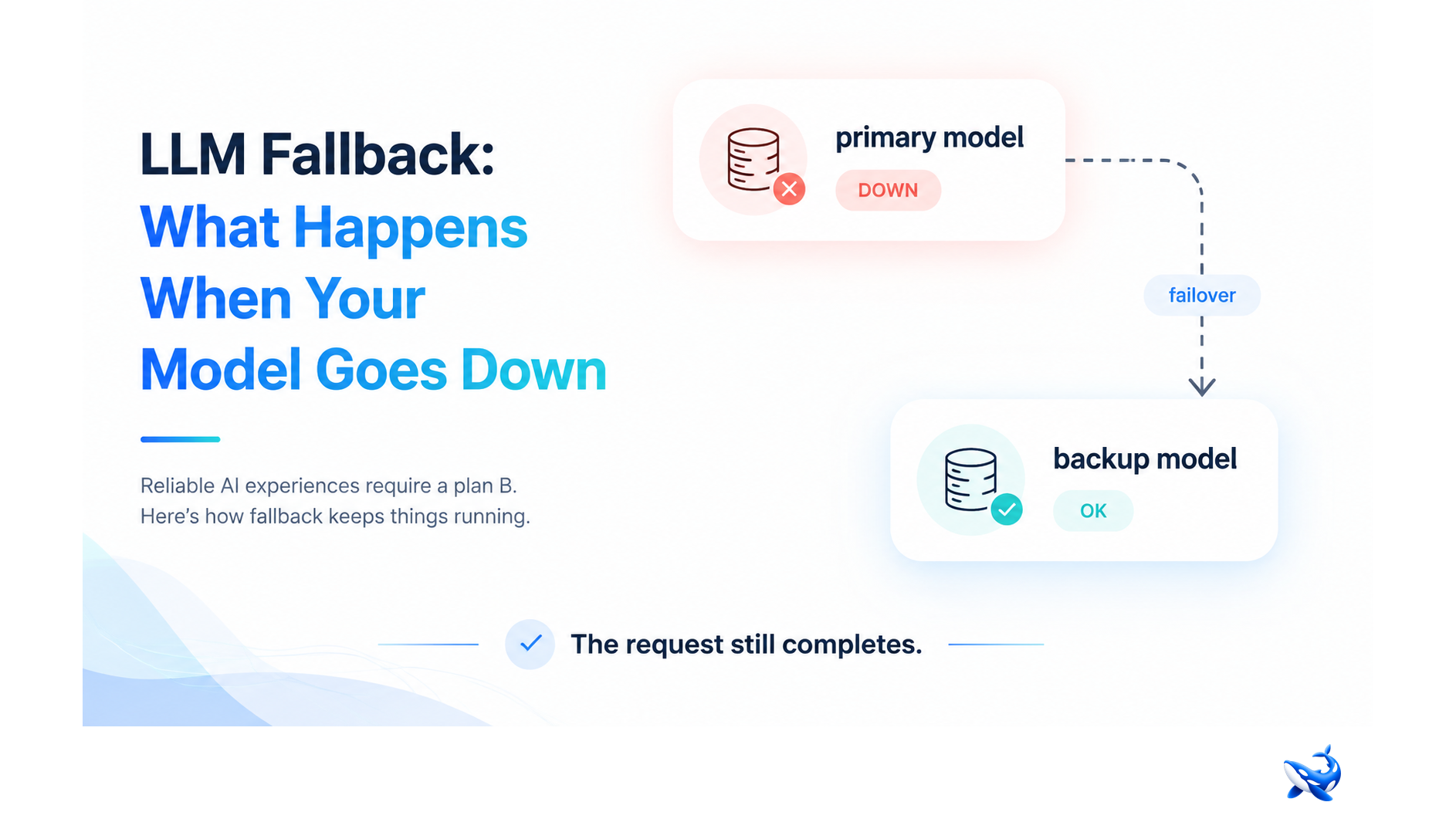
LLM fallback is the practice of sending a request to a backup model or route the moment the primary model fails — an outage, a rate limit, a timeout, or a response that is simply bad. It is not an advanced optimization; it is the reliability layer your application gets when it stops betting everything on one provider. When the switch happens at the routing layer, llm router turns a provider outage into a non-event — and when the chain reroutes to a different flagship, the live rate card for GPT-5.6 Sol shows what that backup actually costs per million tokens, so the safety net never surprises the bill. The short version: single-provider reliance is a single point of failure, and fallback is the cheapest insurance against it.
Every team that integrates a language model learns this the hard way, usually at 3 a.m. A model you have depended on for months returns a wall of server errors; your support channel fills with “it’s broken”; your on-call engineer tries to remember which config file controls the model ID. The outage is never just the model’s fault — it is the design that assumed one provider would always answer. This piece is the plain-English guide to what fallback actually means, which failure modes trigger it, how to design a fallback chain that does not make things worse, and when automatic beats manual.
Table of Contents
What LLM fallback actually means
LLM fallback means having a second path for a request when the first path fails. “Path” can be a different model from the same provider, a different provider entirely, or a different route to the same model — a fallback is any alternative that can produce an acceptable answer when the primary cannot.
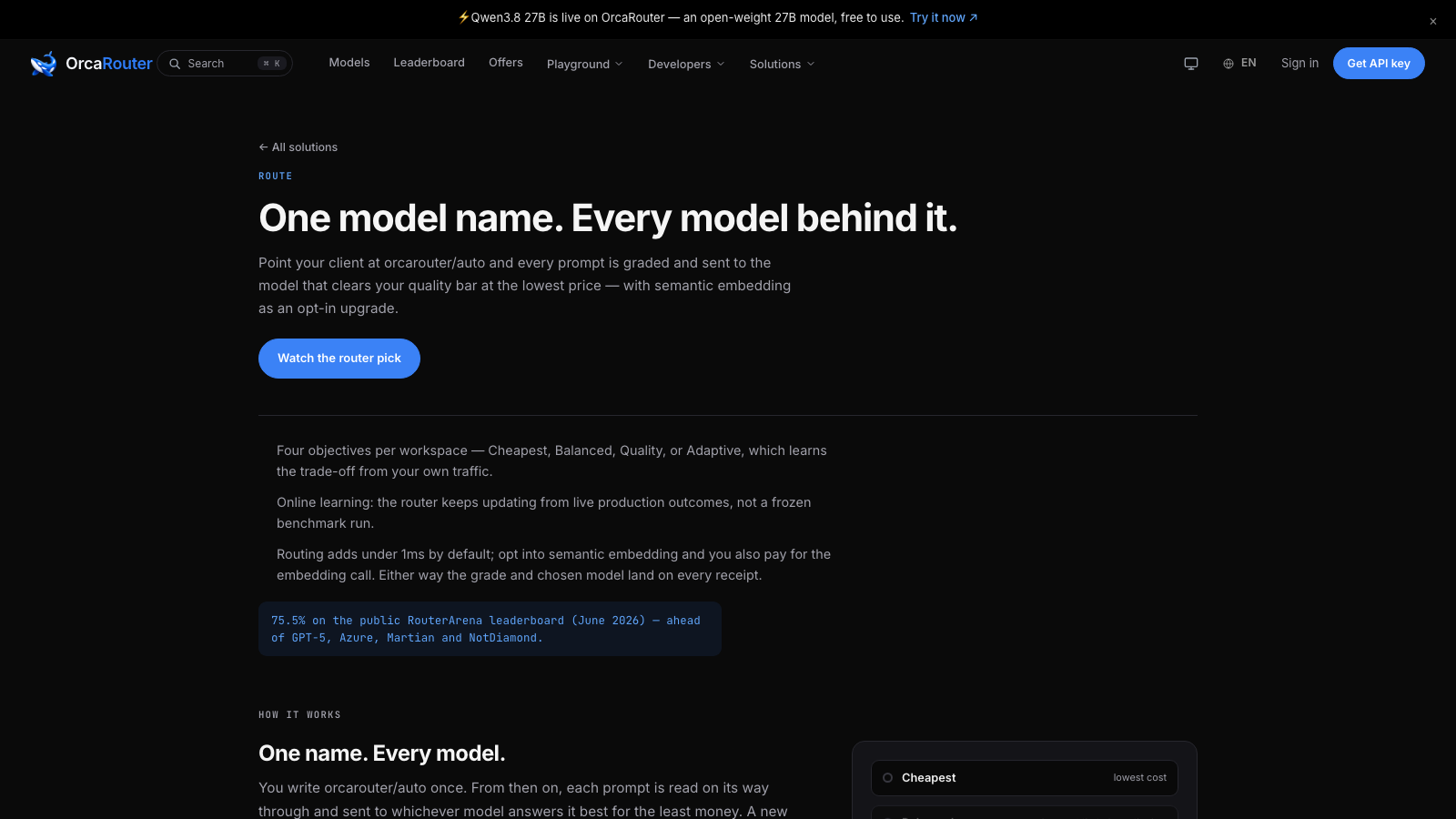
Two ideas are worth separating. Routing is proactive: it picks the best model for each request before you make it, based on cost, latency, and quality. Fallback is reactive: it rescues the request after the chosen model fails. A router that does both is running automatic failover — a listed capability on OrcaRouter’s own product page [OURS] — where every request carries a primary choice and a set of backups that activate on failure.
The distinction matters because fallback is a design decision, not a feature you get by accident. If your application only ever calls one model through one API key, there is nothing to fall back to. The moment you have two reachable models, you have a fallback — whether you planned it or not.
The failure modes that trigger a fallback
Fallback logic only works if it knows what counts as failure. In practice, a request can fail in five distinguishable ways, and each one needs a different response:
| Failure mode | What it looks like | Without fallback |
| Server error (5xx) | The provider’s infrastructure rejects or drops the request | The user sees a generic error, forever |
| Rate limit (429) | The provider throttles your key; a per-minute quota is hit | Requests pile up and time out |
| Timeout | No tokens arrive within your deadline; the connection stalls | The user waits, then gets an error |
| Empty or truncated response | HTTP 200 with an empty or cut-off body | The user gets a half answer that looks complete |
| Degraded quality | The model responds, but the answer is wrong, off-topic, or a refusal | The user gets a confident-sounding wrong answer |
The last row is the one most teams forget. A 200 status code is not a guarantee of a good answer — a model can return an empty completion, an apologetic refusal, or a confident hallucination. A quality guard on the response is what catches these before the fallback chain moves on [OURS].
Designing a fallback chain
A fallback chain is an ordered list of alternatives: try model A; if it fails, model B; then model C. It sounds trivial, but the order, the timing, and the exit conditions are where reliability is won or lost.
- Order. Put the best answer first and the acceptable answer second. The chain is not “cheapest to most expensive”; it is “best match for the task, then best alternative that still clears the bar.” If your primary is a reasoning-heavy flagship, your first fallback should be a strong generalist, not the smallest model in the catalog.
- Timeouts. Fail fast. If the primary has not produced its first token within your deadline, move on. A fallback chain without per-step timeouts is a chain that waits for a dead provider forever — it converts an outage into a longer outage.
- Quality guards. As the table above shows, an empty or garbage response is a failure even when the status code is 200. Check the response before accepting it: empty body, missing content, a refusal, truncated output — any of these should advance the chain.
- Bounded retries. Do not retry the same dead provider three times and then fall back; that triples your latency on every outage. Retry once for transient blips, then switch. Give the chain a terminal state — after the last option, return a real error instead of looping.
Automatic vs manual fallback
The oldest form of fallback is manual: a human notices the alerts, edits a config file, flips a flag, and redeploys. It works, but it costs minutes — on-call minutes, at 3 a.m., while users wait. Manual fallback converts a provider outage into a deployment exercise.
Automatic fallback does the detection and the switch for you. The routing layer observes the failed request, selects the next healthy route from the chain, and retries — usually within the same second, before a user has time to refresh. This is where a router earns its keep. OrcaRouter’s automatic failover [OURS] sits on the same machinery as its adaptive routing: every prompt is graded in under a millisecond, then routed to the cheapest model that still meets your standards [OURS], and when that model fails, the request moves to the next route instead of dying at your front door.
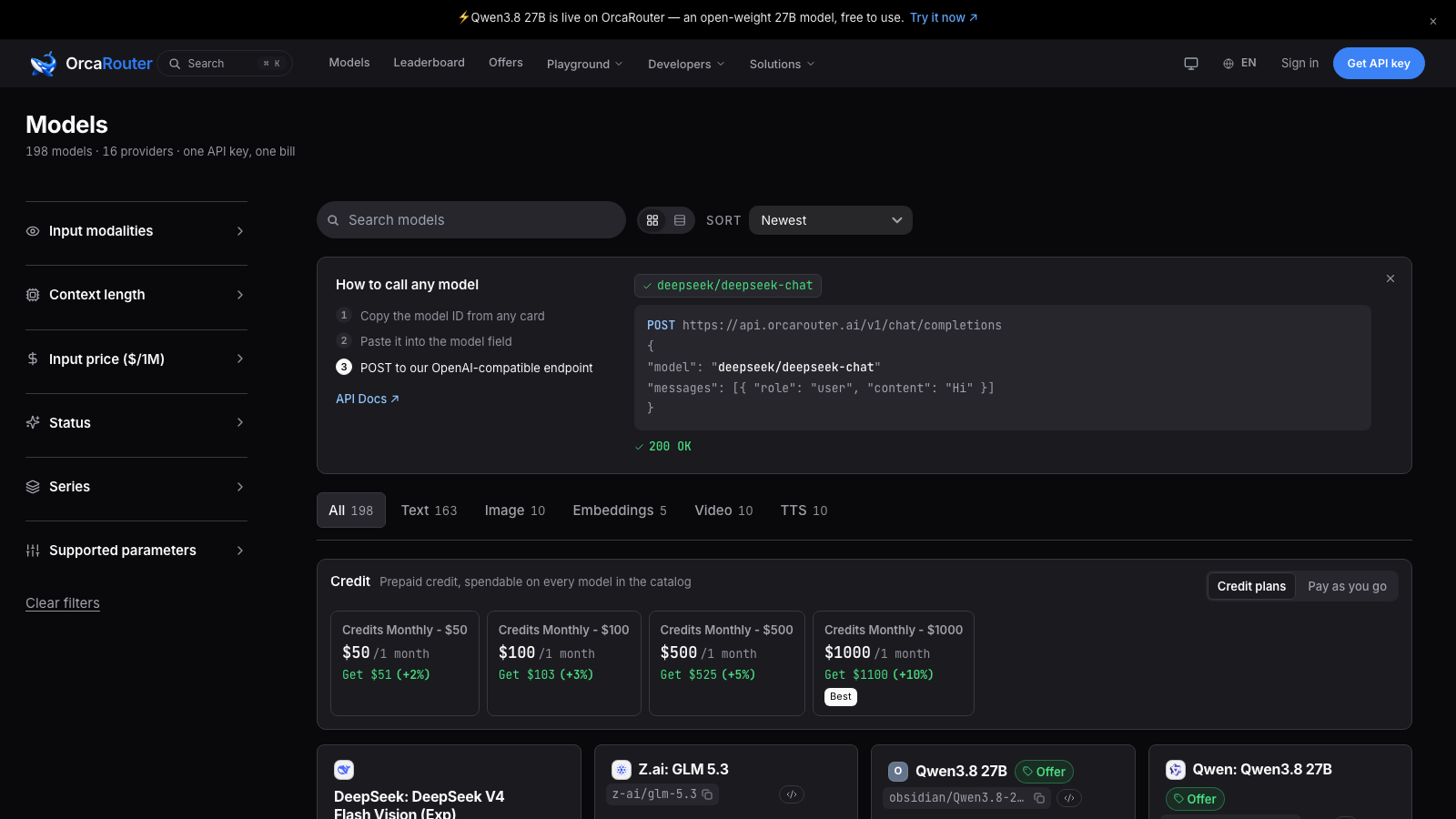
Automatic fallback also scales your options. A fallback chain is only as good as the catalog it draws from: two models give you one fallback; a single API key that reaches 200+ models across OpenAI, Anthropic, Google, Meta, Mistral, xAI, DeepSeek, Qwen, GLM, and MiniMax [OURS] gives you a chain that survives a whole provider going down, not just one model. And because the key passes through the vendor’s list price with no markup added [OURS], keeping a wide fallback chain warm does not mean paying a premium for the safety net.
The takeaway
Fallback is for anyone running real traffic against a model they do not host — which is almost everyone. If your application can tolerate downtime while a provider recovers, manual fallback and a documented runbook may be enough. If users, agents, or batch jobs depend on a model staying up, design an automatic fallback chain with timeouts and quality guards, and test it the way you test any failure path: kill the primary and watch the request still complete.
The teams that regret fallback are the ones that never added it; the teams that regret their chain are the ones that built a retry loop in disguise. Design the chain in advance, let the router execute it, and a model going down stops being an incident — it becomes a footnote.
INTERESTING POSTS
- Why Is Data Backup And Recovery So Important?
- How To Read Someone’s Text Messages Without Their Phone
- 6 Best Managed DDoS Testing Services to Stress-Test Without Risking an Outage
- 2025 Best AI Portrait Upgrades: Unblur Images and Generate Portraits
- What Happens in a Data Breach When Your Password Gets Stolen
- The Ultimate Guide to Using a VPN on Your iPhone – Tips and Tricks
About the Author:

Meet Angela Daniel, an esteemed cybersecurity expert and the Associate Editor at SecureBlitz. With a profound understanding of the digital security landscape, Angela is dedicated to sharing her wealth of knowledge with readers. Her insightful articles delve into the intricacies of cybersecurity, offering a beacon of understanding in the ever-evolving realm of online safety.
Angela's expertise is grounded in a passion for staying at the forefront of emerging threats and protective measures. Her commitment to empowering individuals and organizations with the tools and insights to safeguard their digital presence is unwavering.