

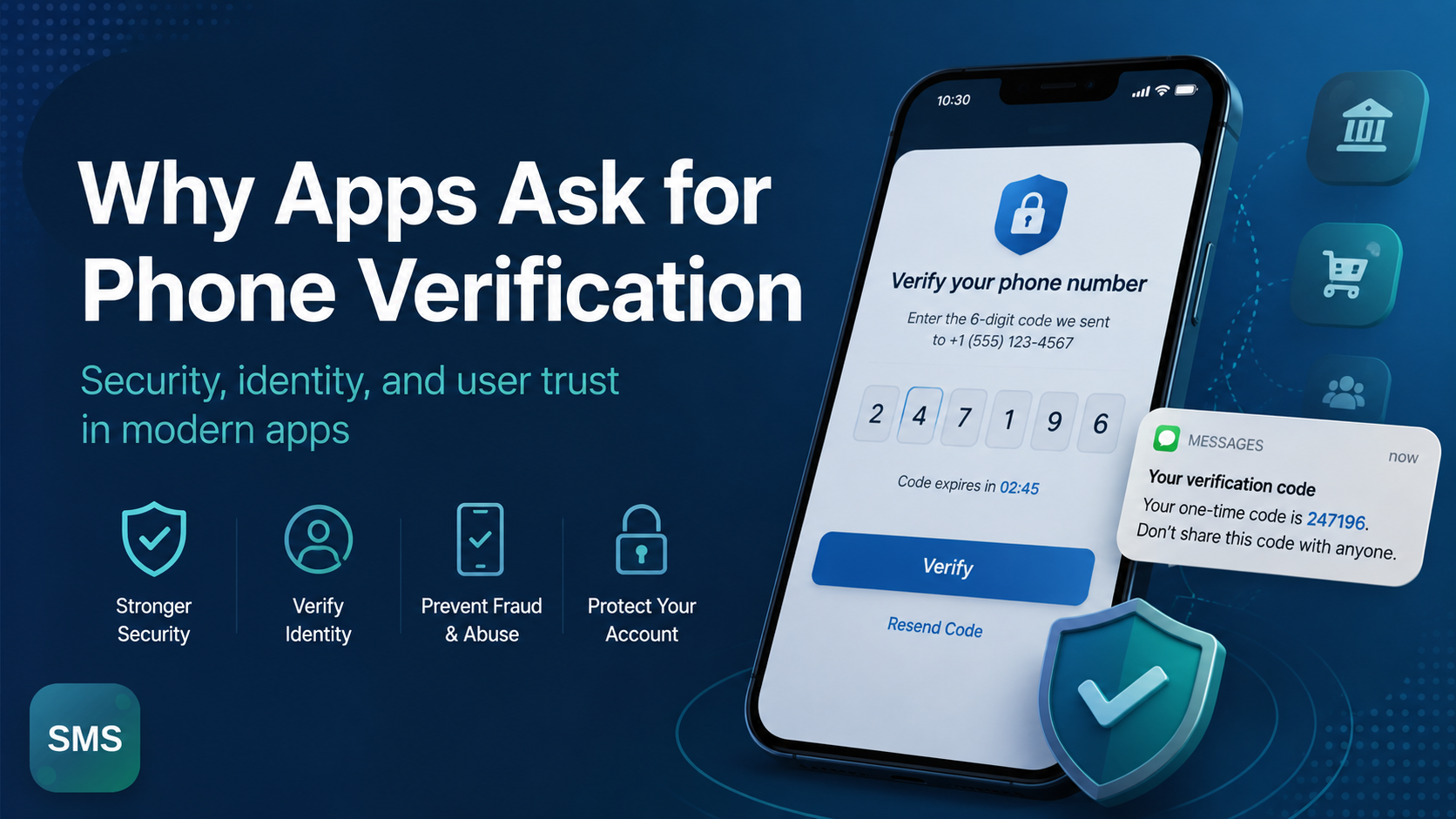
In this post, I will answer the question – why do so many apps ask for phone number verification?
Creating an account used to require little more than an email address and a password.
Today, many apps ask for something else before allowing users to continue: a mobile phone number.
Messaging platforms, social networks, marketplaces, delivery services, dating apps and financial applications frequently use phone verification during registration or when users perform sensitive actions.
The process is usually simple. A user enters a phone number, receives a one-time password by SMS and enters the code inside the app.
For users, it may feel like one more registration step. For app developers and businesses, however, phone verification solves several important problems at once.
So why has it become so common?
Table of Contents
Phone Numbers Make Automated Registrations More Difficult
One of the main reasons apps ask for phone numbers is to reduce fake and automated accounts.
Creating email addresses is relatively easy. Automated systems can generate large numbers of accounts quickly, particularly when an app only requires an email address and password.
This can create problems for businesses operating platforms where each account has economic or social value.
Fake accounts may be used to:
- send spam;
- abuse free trials or promotional offers;
- create fake reviews;
- manipulate ratings;
- scrape information;
- send unsolicited messages;
- operate automated bots;
- bypass account restrictions.
Adding phone verification introduces another step that automated account creators must overcome.
It does not completely eliminate abuse, but it can increase the cost and complexity of creating large numbers of accounts.
For many apps, that additional friction is enough to significantly reduce low-effort automation.
Why Apps Often Prefer Real Mobile Numbers
Not every phone number is treated equally by online platforms.
Some verification systems attempt to distinguish between traditional mobile numbers and numbers provided through internet-based VoIP services.
A real mobile number is generally associated with a mobile carrier and can receive SMS through the conventional cellular network. A non-VoIP number similarly refers to a number that is not primarily provided through a voice-over-IP service.
These distinctions matter because some apps restrict VoIP numbers during registration as part of their anti-abuse systems.
For users, this means that simply having a number capable of receiving messages does not always guarantee that an app will accept it.
The type of number, its carrier, country and previous usage can all influence whether verification succeeds.
SMS Verification Is Easy for Users to Understand
Another advantage of phone verification is familiarity.
Almost every mobile phone can receive an SMS message, and users generally understand what to do when an app says that it has sent a verification code.
There is no additional software to install and no complicated setup process.
A typical flow takes only a few steps:
- Enter a phone number.
- Receive a verification code.
- Enter the code in the app.
- Continue using the service.
This simplicity is one of the biggest reasons SMS verification remains widespread despite the availability of newer authentication technologies.
An app can introduce an additional verification layer without requiring users to understand authentication protocols or configure specialist security tools.
Phone Verification Helps Apps Limit Duplicate Accounts
Some services want to limit how many accounts one person can create.
This is particularly common in marketplaces, social platforms and services offering bonuses or free trials.
If registration only requires an email address, creating multiple accounts is relatively easy.
Requiring a phone number gives the platform another identifier that can be used to detect repeated registrations.
Again, this is not a perfect identity system. People may legitimately own multiple phone numbers, and numbers can change owners over time.
However, from the perspective of an app, phone verification provides another useful signal that can be combined with information such as device data, IP addresses and account behaviour.
Some Apps Need to Protect Communication Between Users
For messaging, marketplace and dating applications, fake accounts can create a particularly serious problem.
These platforms depend heavily on interactions between users.
If a large proportion of accounts are bots, scammers or spammers, legitimate users quickly lose trust in the service.
Phone verification helps platforms place an additional barrier between automated account creation and direct communication with other users.
That is why verification requirements are especially common in apps built around messaging, profiles and user-generated content.
The phone number itself does not guarantee that an account is legitimate, but requiring access to a real communication channel can make large-scale abuse more difficult.
Apps Also Use Phone Numbers for Account Recovery
Verification does not end when an account is created.
A phone number can later be used to help a user recover access.
For example, an app may send an SMS code when:
- a password has been forgotten;
- a login attempt comes from a new device;
- unusual account activity is detected;
- security settings are changed;
- the account owner requests recovery.
This makes the phone number part of the account’s security infrastructure.
It also explains why users should think carefully about which number they use for important services.
A number that works during registration but becomes unavailable later may cause problems if the application asks for another verification code during account recovery.
Why Users May Not Want to Share Their Main Phone Number
From the user’s perspective, repeatedly providing the same personal phone number creates a different set of concerns.
A primary phone number may remain with someone for many years.
During that time, it can become connected to dozens or even hundreds of accounts across different services.
This makes the phone number a persistent digital identifier.
Users may be reluctant to provide it to every new app they want to try, particularly when they are unsure whether they will continue using the service.
There are several common reasons for this.
One is spam.
A number originally provided for verification may later become another channel for promotional communication.
Another is privacy.
The fewer companies that store a user’s primary number, the fewer databases contain that identifier.
Users may also simply want to separate important accounts from less important registrations.
A personal number might be reserved for banking, work, family and essential services, while other numbers are used for apps that do not require a permanent connection to the user’s identity.
Temporary, Secondary and Non-VoIP Numbers
Users now have several options when they do not want to provide their primary mobile number to every app.
A second physical SIM card is the traditional solution, while eSIM technology makes it easier to maintain another long-term mobile number without adding a physical SIM.
Another option is a temporary number designed primarily for receiving an SMS verification message.
Services providing temporary phone numbers for SMS verification can be useful when someone needs a number for a short-term registration and does not want to expose their primary phone number.
Depending on the provider and country, these services may offer access to real mobile numbers or non-VoIP numbers connected to mobile networks rather than purely internet-based VoIP services.
This distinction can be important because certain apps are more likely to accept traditional mobile or non-VoIP numbers for verification.
However, no number type guarantees acceptance. Apps maintain their own verification rules and may change them over time.
Temporary Numbers Are Not Suitable for Every Account
Using a temporary phone number can make sense for some registrations, but it is not appropriate for every service.
The biggest issue is future access.
An application may send another verification code weeks or months after registration.
If the temporary number is no longer available, recovering the account may become difficult or impossible.
This is the main difference between a temporary number used for a one-time activation and a number that remains under the user’s control.
For services that may require repeated SMS verification, maintaining access to the same real mobile number for a longer period is more practical.
A rental phone number, for example, can provide continued access during a defined period rather than being used only for a single verification message.
Depending on the service, users may therefore choose between short-term temporary numbers, longer rental periods, or a permanent secondary SIM or eSIM.
The correct option depends on how important the account is and whether future SMS access is likely to be required.
Why Non-VoIP Numbers Matter for Some Apps
The term non-VoIP number has become increasingly common around app verification.
VoIP numbers use internet-based communications infrastructure and can be perfectly legitimate for calls and messaging. However, because some VoIP services make it relatively easy to obtain numbers at scale, certain platforms apply additional restrictions to them.
This is why users sometimes encounter messages indicating that a particular number cannot be used for verification.
A non-VoIP or real mobile number does not automatically bypass an app’s security systems. The platform may still evaluate other signals, including the carrier, geographic region, previous account activity and its own anti-fraud rules.
Nevertheless, understanding the difference helps explain why one SMS-enabled number may work with an application while another does not.
Important Accounts Should Use Numbers You Control Long Term
There are situations where convenience and privacy should not outweigh reliable account recovery.
Banking applications, government services, primary email accounts, cryptocurrency platforms and important business systems can contain valuable information or assets.
For these accounts, users should generally register a real mobile number they expect to control permanently.
Losing access to a temporary number can become a serious problem if the service later requires SMS verification.
The same principle applies to any account where losing access would create significant financial or personal consequences.
Temporary or rental numbers are better suited to situations where the risk of losing long-term access is understood and acceptable.
Why Apps Do Not Simply Use Email Instead
Email verification remains extremely common, but it solves a slightly different problem.
An email address proves that a user can access an inbox.
It does not necessarily provide much resistance to large-scale account creation because email accounts can be generated relatively easily.
Phone numbers generally introduce more friction.
Real mobile numbers are connected to telecom infrastructure, and acquiring large numbers of them typically requires more resources than generating email addresses.
That makes phone verification attractive for apps that experience significant abuse.
Many services therefore combine both methods.
Email may be used as the primary communication channel, while phone verification acts as an additional trust signal.
SMS Verification Is Not Perfect Security
Although phone verification can reduce abuse, it should not be treated as proof that a user is legitimate.
Phone numbers can be reassigned.
Devices can be stolen.
SMS messages can sometimes be intercepted through attacks against mobile accounts or telecom infrastructure.
Fraudsters can also obtain access to multiple numbers.
For this reason, security-sensitive applications increasingly use multiple signals rather than relying entirely on SMS.
These may include:
- device recognition;
- authenticator applications;
- passkeys;
- behavioural analysis;
- biometric authentication;
- risk-based login systems.
SMS is therefore best understood as one component of a larger authentication system.
Its biggest advantages remain accessibility and simplicity.
Verification Is Ultimately a Trade-Off
Every app has to balance security against usability.
If registration is too easy, automated accounts and fraud become easier.
If verification becomes too complicated, legitimate users may abandon the registration process.
Phone verification has become popular because it sits somewhere in the middle.
It creates meaningful friction for automated registrations while remaining familiar to most users.
For businesses, this makes SMS verification a practical tool for reducing abuse.
For consumers, however, it also creates a reason to think more carefully about where their primary phone number is shared and what type of number they use for different accounts.
Temporary numbers can provide separation for short-term registrations. Rental numbers can retain access for longer periods. Real mobile and non-VoIP numbers may also be required by apps with stricter verification systems.
The question is therefore no longer simply whether an app can send a verification code.
It is which phone number should be connected to that app — and for how long.
INTERESTING POSTS
About the Author:

Daniel Segun is the Founder and CEO of SecureBlitz Cybersecurity Media, with a background in Computer Science and Digital Marketing. When not writing, he's probably busy designing graphics or developing websites.