


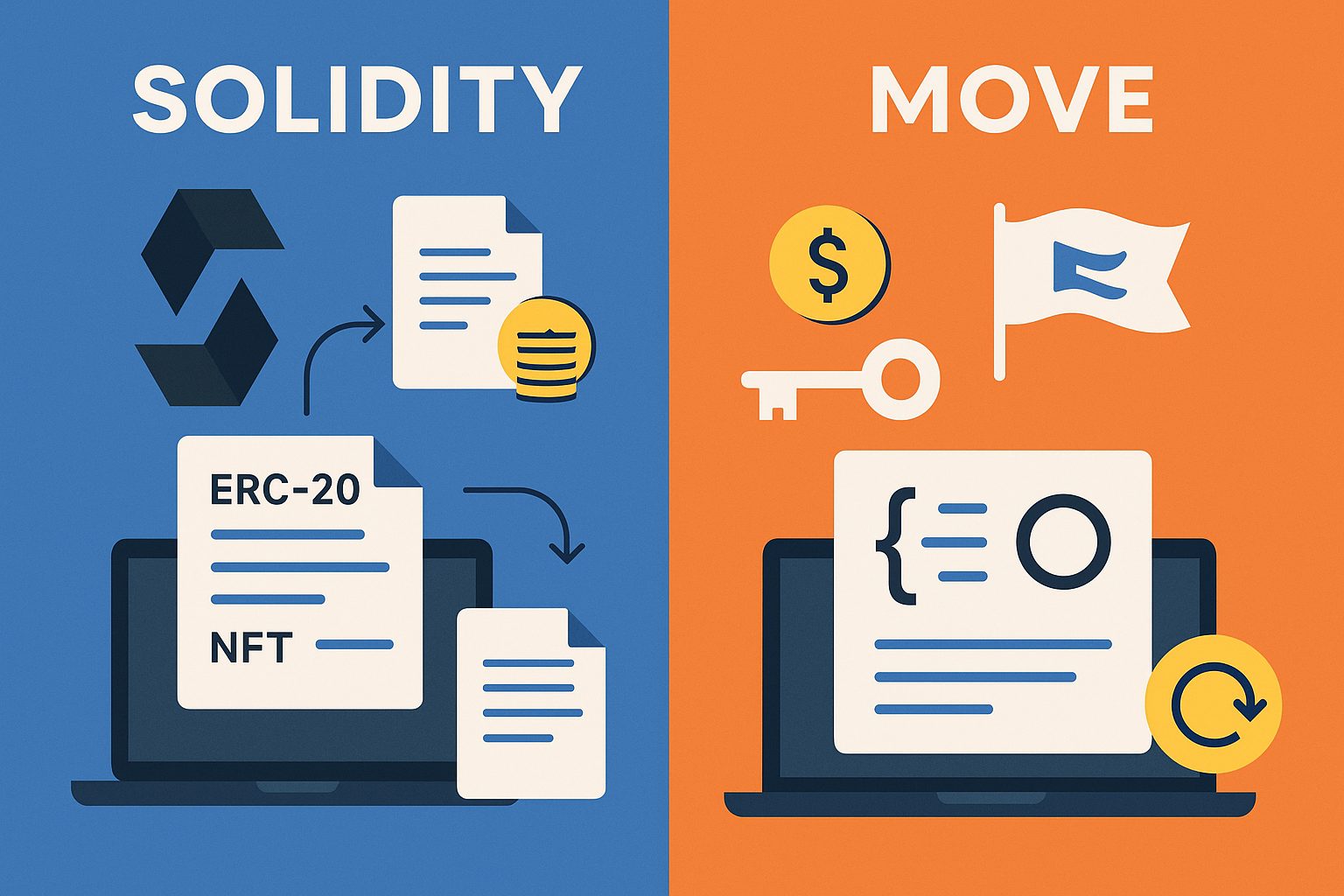

In this post, I will talk about what security engineers should know before switching.
Smart contract development is entering a new phase.
The Move language, born out of Meta’s Diem project and now powering Aptos and Sui, is reshaping how engineers think about safety, state management, and asset control.
Move was built to fix structural limitations in Solidity, the language that has defined Web3 for nearly a decade.
For teams exploring these ecosystems, conducting a Move smart contract audit is often the first step toward understanding the language’s unique security guarantees.
This article outlines the conceptual shifts between Solidity and Move, explaining what security engineers should expect when transitioning from EVM-based auditing to Move’s resource-oriented model.
Table of Contents
Two Worlds, Two Philosophies
Solidity and Move aim for the same outcome: secure computation on a public blockchain. However, they take opposite paths:
- Solidity Emphasizes Flexibility: Developers have wide freedom and depend on discipline and audits for safety;
- Move Enforces Safety by Restriction: It limits flexibility to guarantee predictable, resource-based ownership and transfer behavior.
The result: Solidity prioritizes freedom, whilst Move prioritizes structure. Security engineers moving to Move must focus less on exploit prevention and more on invariant preservation, ensuring system rules always hold.
Resource Ownership vs. Contract Balances
In Solidity, ERC-20s and NFTs rely on contract storage, essentially a mutable ledger. In Move, assets are resources that exist in a single location at a time. The compiler forbids duplication or unauthorized cloning.
Why It Matters to Security Engineers
- Reentrancy: Impossible by design, resources cannot be borrowed twice simultaneously;
- Underflows/Overflows: Caught at the type level, not runtime;
- New Risks: Capability leaks (improper delegation of resource permissions) become the main threat.
Auditors focus on verifying ownership relationships and capability lifecycles, not arithmetic edge cases.
Access Control: Modifiers vs. Capabilities
Solidity enforces access through function modifiers (onlyOwner, nonReentrant, etc.). They operate at runtime and depend on trusted variables like msg.sender.
Move replaces this system with capabilities, first-class objects representing authority.
A module might define:
struct BurnCapability has key { }
public fun create_burn_cap(account: &signer): BurnCapability { … }
Only capability holders can perform privileged actions.
Audit Focus
- Revocation and lifetime of capabilities;
- Cross-module privilege exposure through friend declarations;
- Signer misuse and indirect privilege escalation.
Auditors map capability creation, transfer, and destruction to confirm that no unintended authority persists post-deployment.
Storage Models: Global vs. Scoped

The EVM uses a global key-value store where contracts read and write directly to a shared state.
Every variable has a 32-byte slot, and bugs often stem from incorrect indexing or overwritten mappings.
Move’s storage is module-scoped. Each module owns its data under a distinct address, and resources can only be published or accessed through predefined APIs. This eliminates arbitrary writes but introduces new audit targets:
- Incorrect publish policies can allow unverified modules to overwrite logic;
- Unsafe store or drop usage can permanently lock user funds;
- Object dependencies in Sui (shared vs. owned) must be handled carefully to avoid orphaned assets.
For security engineers, this model feels closer to verifying file-system permissions than transaction logic, ownership boundaries, and not just balances.
Execution Environment and Parallelism
Aptos and Sui both leverage parallel transaction execution.
Instead of sequentially processing blocks, they analyze dependencies and run independent transactions simultaneously.
This architecture boosts throughput but adds complexity:
- Race conditions can occur if two transactions reference the same shared object;
- Developers must design contracts to remain deterministic regardless of execution order;
- Auditors simulate concurrent behavior to ensure no resource can be inconsistently modified.
Traditional EVM testing tools don’t capture these nuances. Move auditors use property-based fuzzing and parallel-execution simulations to stress test deterministic behavior under concurrency.
Formal Verification and the Move Prover
One of Move’s defining features is the Move Prover, a formal verification engine built into the toolchain. Developers can specify logical properties such as:
spec module Token {
invariant total_supply == sum(balances);
}
Advantages
- Enforces invariants at compile time;
- Reduces runtime uncertainty.
Limitations
- Only validates declared properties;
- Cannot verify timing, economic, or off-chain dependencies.
The best audits merge Move Prover analysis with fuzzing and manual reasoning to ensure logical and economic soundness.
Common Pitfalls When Transitioning from Solidity to Move

Even seasoned Solidity engineers stumble upon Move for the first time. Below are recurring patterns that appear in audits and code reviews:
- Expecting Inheritance/Modifiers: Move favors composition. Avoid recreating shared-module vulnerabilities;
- Misusing Abilities (copy, drop, store, key): Unrestricted drop can erase critical resources;
- Over-Trusting Safety Guarantees: Compiler checks don’t cover market logic or pricing errors;
- Leaking Capabilities: Improperly returned or stored privileges can persist indefinitely;
- Leaving Friend Modules: Forgotten friend access can become a lasting backdoor.
How Auditing Differs Between EVM and Move
The workflow appears familiar in terms of scoping, manual review, and testing, but the focus shifts dramatically.
|
Auditors in Move environments spend more time reasoning about ownership, life-cycle constraints, and logical invariants. The absence of inheritance and the presence of formal specifications shift review from pattern matching to specification alignment.
Economic and Logic-Level Risks
Language safety ≠ business-logic safety. Move prevents duplication but not design flaws like under-collateralized lending or oracle desyncs.
Auditors review:
- Collateral ratios and liquidation triggers;
- Oracle and price feed timing;
- Governance and upgrade controls;
- Parallel transaction ordering assumptions.
Economic correctness remains a major audit dimension.
Integrating Move Prover into Development
Testing is often reactive for Solidity developers: write code, then write tests. Move encourages spec-first design. Teams define invariants before coding modules.
Security engineers adopting this mindset can:
- Encode critical invariants early;
- Use spec blocks to express pre- and post-conditions;
- Run the prover continuously alongside unit tests;
- Treat failed proofs as early warnings rather than audit findings.
When audits happen, well-written specs accelerate review time and reduce the number of unknown assumptions.
The Human Element
Formal verification ensures mathematical soundness, but human auditors ensure contextual correctness.
Example: a verified function may still rely on a stale oracle feed or flawed governance assumption.
No proof system detects that; only human reasoning does.
Building an Audit-Ready Move Project

To ease the transition from Solidity to Move, security engineers can follow a few practical guidelines:
- Document Capability Flow: List who can mint, burn, upgrade, or transfer each resource;
- Run the Move Prover Regularly: Don’t wait for the audit to start formal checks;
- Limit Friend Visibility: Remove temporary friends before deployment;
- Review Upgrade Policies: Explicitly state whether redeployment is allowed;
- Fuzz Test for Concurrency: Parallel execution needs stress testing beyond unit tests;
- Keep Invariants Small and Testable: Large specs are harder to verify and maintain.
Following these principles doesn’t replace an audit but makes the process smoother and more focused on high-impact logic.
When to Schedule a Move Audit
- Before Mainnet Launch: Conduct a full audit once the codebase is feature-complete and frozen for deployment;
- After Any Change, Regardless of Size: Even minor adjustments can alter capability flow, storage behavior, or resource visibility. Re-verify all invariants and rerun the Move Prover after each modification;
- After Major Architectural or Capability Refactors: New modules, resource types, or publish/upgrade policies demand comprehensive reassessment;
- After Upgrading Move, Aptos, or Sui Toolchains: Compiler or framework updates can shift semantics or introduce subtle behavior changes.
Risks of Launching Without a Move Audit
- Lingering capabilities enabling unauthorized actions;
- Mis-scoped friends exposing private functions;
- Locked resources due to unsafe drop usage;
- Parallel inconsistencies causing nondeterministic state;
- Loss of trust from users and ecosystem partners.
The Future of Move Auditing
As Aptos and Sui evolve, audits are becoming structured and transparent:
- Integrated formal verification in every review;
- Capability graph visualization tools;
- Shared databases of Move-specific vulnerabilities;
- Foundations encouraging public audit disclosure.
This collective evolution mirrors Ethereum’s early audit standardization, only with stronger guarantees baked into the language.
Conclusion: Moving Securely into a Structured Future
Transitioning from Solidity to Move means adopting a new security mindset centered on ownership, explicit permissions, and provable invariants.
The Move language eliminates many Solidity-era bugs but introduces its own design challenges, capability control, visibility boundaries, and concurrency correctness.
A professional Move smart contract audit validates these assumptions and ensures that resource safety and logic integrity align across all conditions.
As more engineers make the switch, shared audit knowledge across ecosystems will continue to raise the standard of blockchain security, one verified invariant at a time.
INTERESTING POSTS
- 5 Features Of A Good Manufacturing Company
- Cloud Security: Why Companies Should Not Fear To Move On The Cloud?
- The Pros And Cons Of Outsourcing Your Cybersecurity Audit
- The Increasing Need for Smarter Tech in a High-Activity World
- How to Use Land Owner Maps to Resolve Boundary and Ownership Conflicts
- Top Factors to Consider Before Switching to Cable Internet
About the Author:

Daniel Segun is the Founder and CEO of SecureBlitz Cybersecurity Media, with a background in Computer Science and Digital Marketing. When not writing, he's probably busy designing graphics or developing websites.



