



In this post, I will talk about Dechecker AI Checker.
For a long time, I thought my writing was improving. Sentences were clearer. Paragraphs were tighter. Transitions were smooth. On paper, everything looked professional. But something else was happening at the same time, and I didn’t notice it right away.
People were reading less carefully. They stayed, but they didn’t linger. They finished articles without reacting. That silence is what eventually pushed me to start using AI Checker from Dechecker—not to hunt for AI, but to understand what my writing had quietly turned into.
Table of Contents
When Writing Gets Too Polite
The Comfort of “Acceptable” Text
AI-assisted writing has a very specific personality. It’s reasonable. Balanced. Calm. It avoids extremes. And if you’re not careful, your own voice slowly adapts to that tone. I noticed my drafts becoming increasingly “acceptable.” Nothing wrong. Nothing risky. Nothing memorable either.
This didn’t happen overnight. It happened because AI made writing easier, and I let ease replace intention. AI Checker helped me see that shift clearly. The flagged sections were almost always the same kind of paragraphs: summaries that didn’t say anything new, explanations that felt unnecessary, conclusions that wrapped things up too neatly.
Readers Notice Before You Do
Writers often assume readers want clarity above all else. That’s only partly true. Readers want to feel like someone is thinking on the page. When writing becomes too composed, it loses that feeling. AI Checker doesn’t measure emotion, but it highlights the patterns that often remove it. That’s enough to start asking better questions during editing.
How I Use AI Checker Without Letting It Control My Writing
A Pause, Not a Verdict
I never rewrite blindly based on AI Checker results. I pause. I reread. I ask myself if I actually meant what the sentence says. Sometimes the answer is yes, and I leave it. Other times, I realize the sentence exists only because it sounded “right.” Those are the lines I cut or rewrite.
That pause is valuable. It forces you to re-engage with your own thinking instead of trusting the shape of the sentence.
Catching Patterns, Not Mistakes
The real benefit isn’t catching individual lines—it’s catching habits. Over time, you start noticing how AI nudges you toward certain structures. Explanatory openers. Balanced clauses. Predictable conclusions. AI Checker surfaces those habits so you can decide whether they belong in the piece or not.
Different Writing Scenarios, Same Underlying Issue
Blog Content and SEO Writing
SEO writing is especially vulnerable to over-automation. When keywords matter and structure matters, it’s tempting to let AI handle too much. The result is content that ranks but doesn’t resonate. I use AI Checker here to protect tone. If a paragraph reads like it was written for a search engine instead of a person, that’s usually a sign I’ve gone too far.
Editorial and Opinion Pieces
Opinion writing should feel uneven. It should feel like someone is thinking in real time. AI smooths that out. It removes hesitation and sharpness. AI Checker flags the sections where that smoothing happens. I’ve learned to rewrite those parts with less polish and more honesty. Readers respond better to that, even if the writing feels less “perfect.”
Interview-Based and Spoken Content
When I work with recorded material, my process usually starts with transcription. I’ll use an audio to text converter to get everything into text quickly. That raw transcript has personality. The danger comes during editing, especially if AI tools are involved. AI Checker helps me make sure I haven’t cleaned the text so much that the speaker’s voice disappears.
What Changes After Long-Term Use
You Stop Writing on Autopilot
One thing I didn’t expect was how AI Checker would affect my first drafts. I’m more aware now, even before editing. I notice when I’m writing filler. I notice when I’m summarizing instead of thinking. The tool trains attention, not obedience.
You Accept Imperfection More Easily
Real writing isn’t symmetrical. Some paragraphs are stronger than others. Some thoughts trail off. AI encourages uniformity. AI Checker reminds you that uniformity isn’t the goal. Leaving small imperfections often makes the entire piece feel more believable.
Why This Tool Earned a Permanent Place in My Workflow
No Pressure, No Panic
I’ve tried tools that turn detection into anxiety. Percentages. Warnings. Red highlights everywhere. That approach kills creativity. Dechecker doesn’t do that. It gives information without urgency. You decide what matters.
It Respects Different Writing Goals
Not every piece is trying to do the same thing. A product page, a blog post, and a reflective essay shouldn’t sound alike. AI Checker adapts to that reality. It doesn’t push everything toward one neutral voice. It just helps you notice when the voice stops being yours.
Thinking About Writing in an AI-Heavy Future
Tools Will Keep Improving
There’s no going back. AI writing will become more convincing, not less. That’s exactly why tools like AI Checker matter. Not as enforcers, but as reference points. Something that helps you stay oriented when everything else is getting smoother and faster.
Voice Is Still a Choice
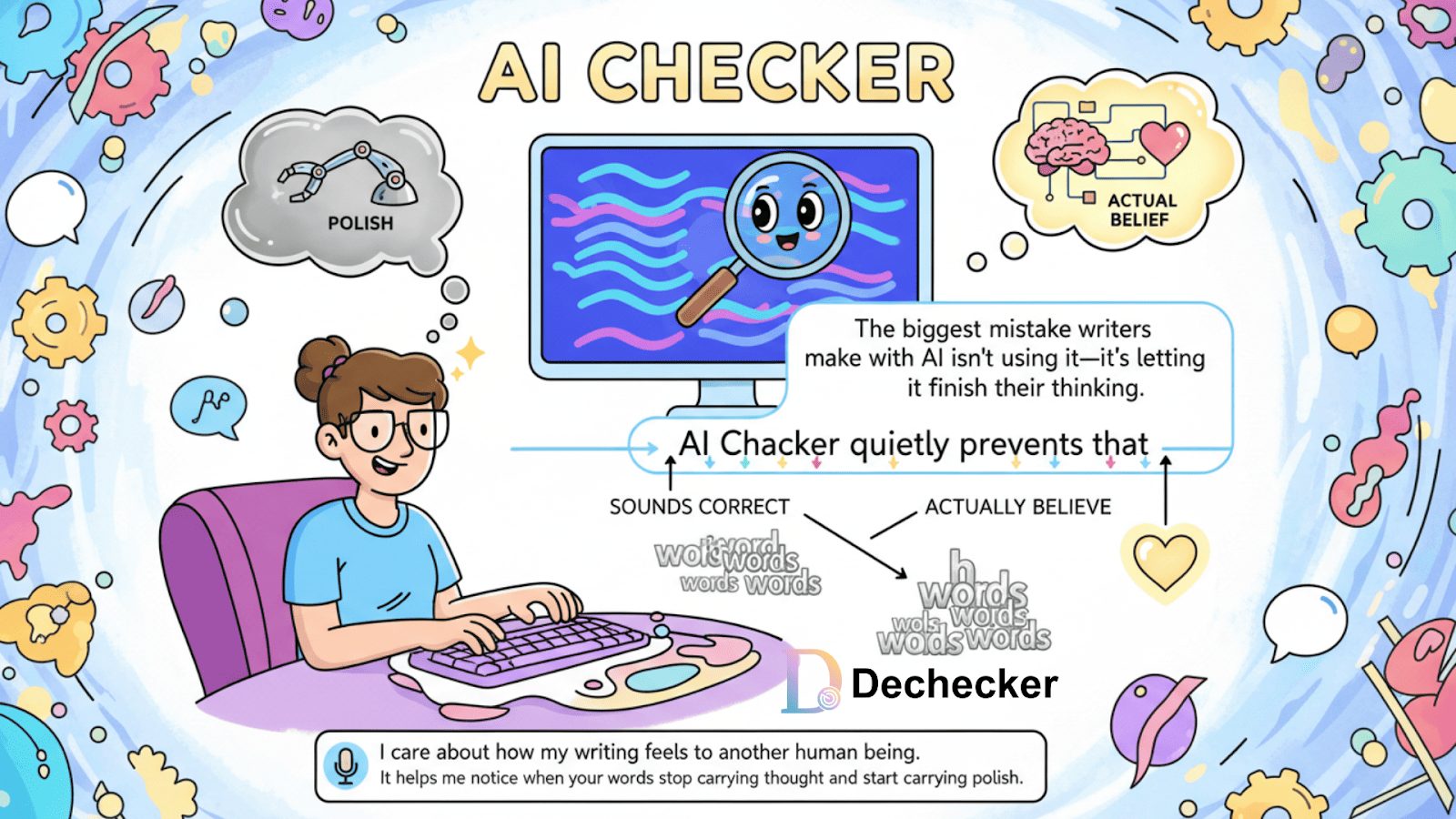
The biggest mistake writers make with AI isn’t using it—it’s letting it finish their thinking. AI Checker quietly prevents that. It creates a moment where you have to decide whether a sentence reflects what you actually believe or just what sounds correct.
I don’t use Dechecker AI Checker because I’m afraid of AI detection. I use it because I care about how my writing feels to another human being. It helps me notice when my words stop carrying thought and start carrying polish instead. And once you see that difference, you can’t unsee it. That awareness alone changes how you write—and how your work is received.
INTERESTING POSTS
About the Author:

Daniel Segun is the Founder and CEO of SecureBlitz Cybersecurity Media, with a background in Computer Science and Digital Marketing. When not writing, he's probably busy designing graphics or developing websites.


