




In this post, I will talk about real-time data scraping.
If you do business, regardless of the kind, you’ll agree that market conditions shift by the minute. Also, consumer behavior is changing faster than ever. For these reasons, being able to collect and act on data in real time is a genuine competitive advantage.
Real-time data scraping involves continuously extracting live data from websites and online sources. In other words, you get information as it’s generated or updated, rather than collecting static details on a scheduled basis.
The good news is that real-time data scraping doesn’t have to be difficult. In this guide, we’ll explain how you can go about it effectively.
Table of Contents
What Is Real-Time Data Scraping?

Traditional web scraping operates on a schedule. For a typical project, your script runs once a day, collects data, and stores it for later analysis. Real-time scraping is much more different. It has to do with steady monitoring of web sources and collecting data the moment it appears or changes.
The distinction matters a lot depending on the use case. For instance, a price change on a competitor’s website at 9:00 AM can be useful at 9:01 AM. However, if left until the following morning, it becomes almost irrelevant. Real-time scraping fixes that gap, providing current, immediately usable information.
Where Real-Time Data Scraping is Useful
We can point to several business areas where you can apply real-time data scraping for positive results. However, let’s consider the six major ones:
1. Financial Market Data
Traders, analysts, and fintech platforms can use real-time scraping to monitor stock prices, cryptocurrency values, commodity rates, and financial news. In such an industry, even milliseconds of delay can result in huge trading differences. As such, up-to-date data is always a priority.
2. E-Commerce Price Tracking
Retailers and price comparison platforms regularly scrape product pages. They do so to detect price changes, flash sales, and stock availability updates the moment they happen. Many pricing engines feed directly from this real-time data to automatically adjust prices.
3. News and Media Monitoring
PR agencies, communications teams, and intelligence platforms need to track brand mentions and breaking stories as they develop. Scraping news outlets, blogs, and social media feeds in real-time makes that possible.
4. Sports and Betting Data
We can’t debate that live sports scores, odds changes, and in-game statistics are among the most time-sensitive data types on the web. Real-time scraping powers the data feeds that betting platforms, DFS apps, and sports analytics tools depend on.
5. Travel and Hospitality
Here, the focus is on flight prices, hotel availability, and vacation rental rates. These details change frequently, and real-time scraping enables aggregators to obtain accurate pricing. They won’t have to deal with just cached results.
6. Cybersecurity Threat Intelligence
Security teams use real-time scraping to monitor dark web forums, paste sites, and threat intelligence feeds. That’s how they can quickly detect signs of data breaches, leaked credentials, and other cybercrimes.
Top Proxy Services for Real-Time Data Scraping
We’ve tested and evaluated several providers based on speed, reliability, scalability, and anti-detection performance. Below are some of the best proxy services for handling real-time scraping workloads:
Oxylabs — Enterprise-Level Speed & Real-Time Integration
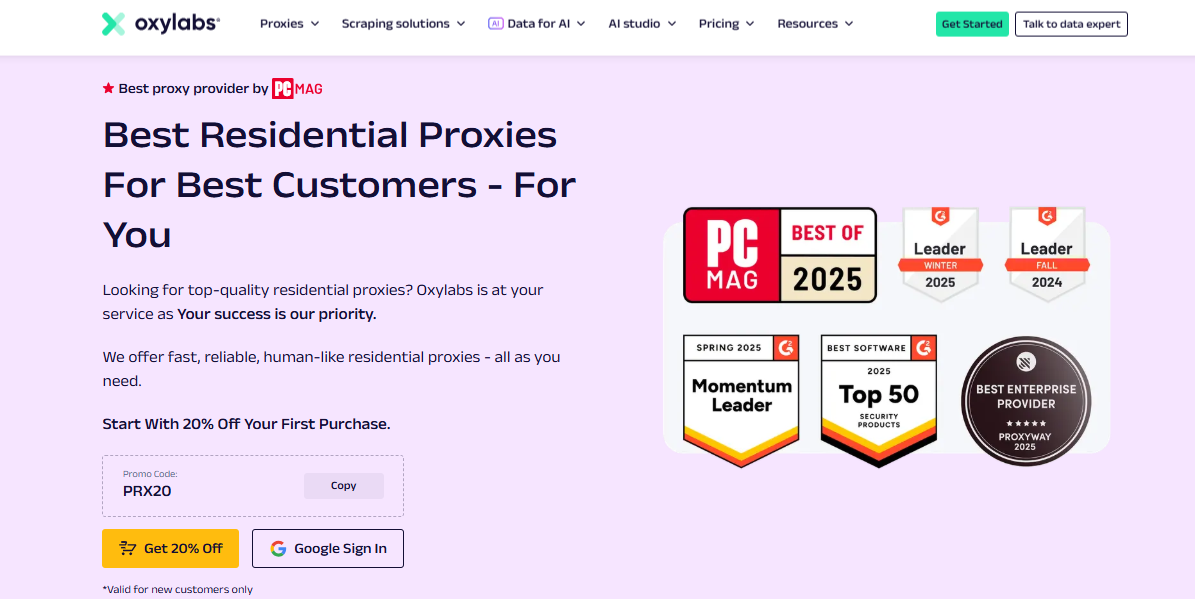
Oxylabs is built for high-frequency, large-scale scraping environments where performance and uptime are critical. One of its standout features is the Realtime integration within its Web Scraper API, allowing you to extract data continuously without building complex infrastructure from scratch.
With a massive residential proxy pool, AI-powered scraping tools, and enterprise-grade SLAs, Oxylabs is ideal for:
- Financial data monitoring
- E-commerce price tracking at scale
- Mission-critical real-time pipelines
👉 If you’re running operations where every second matters, Oxylabs delivers consistency and precision.

Decodo — Smart Automation & Anti-Detection Strength
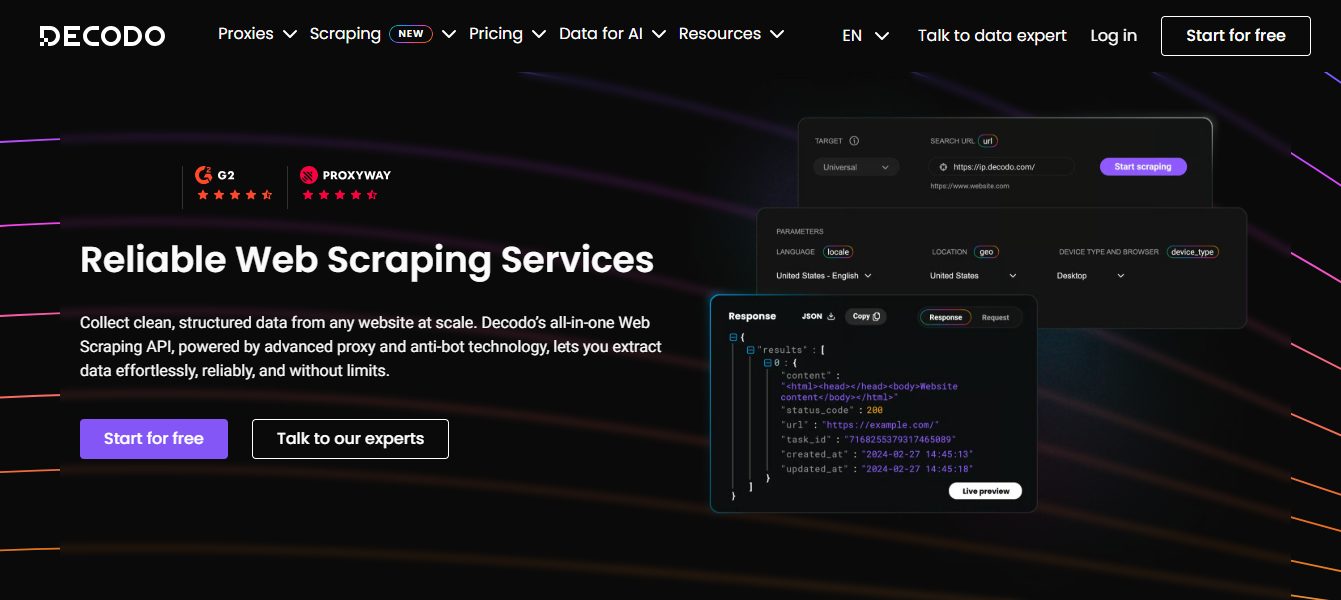
Decodo (formerly Smartproxy) is a strong choice for teams that want automation and flexibility without heavy engineering overhead. It features automatic proxy rotation, built-in CAPTCHA handling, and seamless Web Scraping API integration, making it easier to maintain stable real-time data flows.
Its infrastructure supports residential and mobile proxies, which are highly effective against modern anti-bot systems.
Best suited for:
- Geo-targeted scraping
- Platforms with strict bot detection
- Scalable real-time monitoring setups
👉 If your focus is staying undetected while scaling efficiently, Decodo is a reliable option.

Webshare — Fast, Scalable & Cost-Efficient
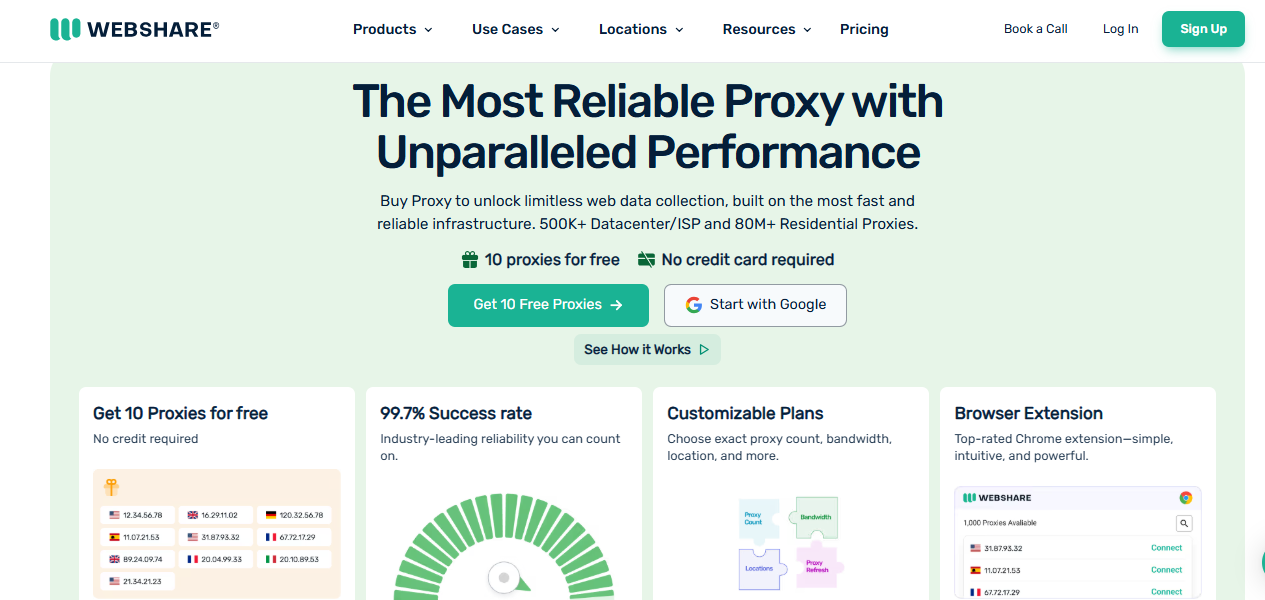
Webshare offers a practical balance of speed, affordability, and global coverage. With 500,000+ datacenter IPs and 80+ million residential proxies, it supports high concurrency and rapid request handling.
Its infrastructure is optimized for rate-limit avoidance and consistent throughput, which is essential for real-time scraping tasks that rely on frequent requests.
Ideal for:
- Startups and growing data operations
- High-volume scraping with budget constraints
- Projects needing simple, quick deployment
👉 If you want solid performance without overspending, Webshare is a strong contender.

IPRoyal — Flexible & Developer-Friendly
IPRoyal is known for its flexible pricing models and ease of integration, making it attractive for developers and smaller teams building real-time scraping systems. It offers residential, mobile, and datacenter proxies, with a focus on transparency and control.
While not as enterprise-heavy as Oxylabs, it performs well for:
- Mid-scale scraping projects
- Testing and development environments
- Businesses needing cost control with decent performance
👉 A good option if you want flexibility and simplicity without committing to enterprise pricing.
Mars Proxies — Emerging Option with Competitive Pricing
Mars Proxies is a newer player gaining attention for its competitive pricing and reliable proxy performance. It provides residential proxies with decent speed and uptime, making it suitable for light to moderate real-time scraping tasks.
It may not yet match the scale of top-tier providers, but it’s useful for:
- Budget-conscious scraping setups
- Smaller automation workflows
- Supplementing primary proxy networks
👉 Think of Mars Proxies as a supporting layer or entry-level solution for real-time scraping.
Quick Comparison Snapshot
| Use Case | Best Choice |
|---|---|
| Enterprise, mission-critical real-time scraping | 🟢 Oxylabs |
| Automation + anti-bot resilience | 🔵 Decodo |
| Budget-friendly high-speed scraping | 🟠 Webshare |
| Flexible, developer-friendly setup | 🟣 IPRoyal |
| Entry-level or supplementary usage | ⚫ Mars Proxies |
Setting Up a Real-Time Scraping Operation
If you want to build a real-time scraping project, the setup is quite different from regular batch scraping. Based on our expertise, these are the most essential components you need:
Event-Driven Design
Real-time systems can’t run scrapers on a fixed schedule. Instead, they use an event-driven death, such that the scraper kicks off upon a trigger. It can be when a monitored page changes, a new listing appears, or some other condition is met. This approach minimizes wasted requests and guarantees fresh data.
Headless Browsers
Many modern websites are JavaScript-heavy and don’t render meaningful content in a basic HTTP request. Therefore, you’ll need headless browser tools like Playwright and Puppeteer. They can simulate full browser environments, allowing you to scrape content that loads automatically on a page.
WebSocket and API Monitoring
Some platforms deliver live data through WebSocket connections or public APIs. They skip the traditional HTTP pages. Such platforms are far more efficient than repeatedly requesting and parsing full web pages. However, you may need permission.
Message Queues and Stream Processing
Depending on the scale, real-time scraping can generate enormous volumes of data. To process such large amounts of information without issues, you need tools like Apache Kafka and RabbitMQ. They handle high-throughput data streams, so the scraped data can be smoothly transferred into your storage and analytics systems.
Low-Latency Storage
Real-time data becomes useless if it can’t be stored and accessed fast. The best solutions here are in-memory databases like Redis and time-series databases like InfluxDB. As experts, we rate them as dependable for high-speed, time-stamped data that real-time scraping produces.
Function of Proxies in Real-Time Scraping

When you query the same sites continuously, you’ll often encounter IP-based rate limits and bot detection systems. So, for us, robust proxies are non-negotiable for real-time scraping. We’ve tested and ranked the top five services you can use below:
- Oxylabs: This proxy service has a dedicated Realtime integration for its WebScraper API. You can use it to handle large-scale data extraction by the minute.
- Decodo: This platform uses automatic proxy rotation and CAPTCHA handling for optimal real-time scraping. You can work with the Web Scraping API integration to make things easier.
- Webshare: This proxy has 500,000+ datacenter IPs with fast servers and dedicated bandwidth. They have rate-limit avoidance that’s perfect for real-time scraping.
If you want more proxy options, check out IP Royal or Mars Proxies. Each has dependable proxy IPs for real-time data scraping.
Bottom Line: Real-Time Data is a Strategic Asset
Mastering real-time data scraping helps you move faster and make better decisions as a business or agency. You may want to adjust prices the moment a competitor moves or capitalize on a market opportunity the instant it appears. Whichever it is, real-time information is invaluable.
As we explained, you’ll need the right technical tools to begin. Plus, a reliable proxy service built on providers like Oxylabs, Decodo, and Webshare is essential. That said, speed is only one angle for success. You also need to ensure quality by defining the right data fields and types.
FAQs: Real-Time Data Scraping
1. What is real-time data scraping and how is it different from traditional scraping?
Real-time data scraping involves continuously collecting data as it is created or updated, rather than pulling it at fixed intervals like traditional scraping.
The key difference is timing:
- Traditional scraping → Scheduled (e.g., once daily)
- Real-time scraping → Instant, event-driven
This matters because some data—like price changes or breaking news—loses value quickly if not captured immediately. Real-time scraping ensures you always work with fresh, actionable data.
2. What are the main use cases for real-time data scraping?
Real-time scraping is especially valuable in industries where timing is critical. Common use cases include:
- Financial markets → Tracking stock and crypto price movements
- E-commerce → Monitoring price changes and stock availability
- News & media → Detecting breaking stories and brand mentions
- Sports & betting → Capturing live scores and odds
- Travel → Updating flight and hotel pricing
- Cybersecurity → Monitoring threats and data leaks
In all these cases, even a small delay can reduce the usefulness of the data.
3. What technologies are required for real-time scraping?
A proper real-time scraping setup requires more advanced infrastructure than basic scraping. Key components include:
- Event-driven systems → Trigger scraping when changes occur
- Headless browsers → Handle JavaScript-heavy websites
- WebSocket/API monitoring → Capture live data streams
- Message queues (Kafka, RabbitMQ) → Process large data flows
- Low-latency databases (Redis, InfluxDB) → Store and access data instantly
These tools ensure your system can capture, process, and deliver data without delays.
4. Why are proxies essential for real-time data scraping?
Real-time scraping sends frequent requests to the same websites, which can quickly trigger rate limits, IP bans, or bot detection systems.
Proxies solve this by distributing requests across multiple IP addresses, ensuring continuous access. For reliable performance:
- Oxylabs → Offers real-time integration with its Web Scraper API for large-scale operations
- Decodo → Provides automatic proxy rotation and CAPTCHA handling
- Webshare → Delivers fast datacenter proxies with strong rate-limit avoidance
Using the right proxy provider ensures your scraping stays fast, stable, and uninterrupted.
5. What are the biggest challenges in real-time data scraping?
Real-time scraping is powerful, but it comes with challenges:
- High infrastructure demands
- Handling large volumes of streaming data
- Avoiding detection and blocks
- Maintaining low latency for storage and processing
- Ensuring data quality and accuracy
To succeed, you need a combination of strong architecture, efficient data pipelines, and reliable proxy services like Oxylabs, Decodo, or Webshare.
When done right, real-time scraping becomes a strategic advantage, helping you act faster than competitors.
INTERESTING POSTS
About the Author:

Daniel Segun is the Founder and CEO of SecureBlitz Cybersecurity Media, with a background in Computer Science and Digital Marketing. When not writing, he's probably busy designing graphics or developing websites.



