



In this post, I will talk about market research web scraping.
Market research has to do with gathering the right information at the ideal time. Nowadays, almost every business is data-driven, and web scraping is one of the most reliable ways to collect data at scale. You may want to track your competitors or monitor your customers’ preferences. Whichever it is, we’ll explain how web scraping can help as you continue reading.
Table of Contents
What is Market Research Web Scraping?

Simply put, market research web scraping involves extracting publicly available data for business purposes. As a business owner, your team won’t have to manually visit hundreds of web pages to copy information. Instead, you use scraping tools and scripts to automatically collect, structure, and analyze the data. It’s faster and much more efficient.
You can gather almost any type of market information using web scraping. That said, the common details most businesses are after include:
- Competitor pricing
- Product listings
- Customer reviews
- Social media mentions
- Job postings
- News articles
- Industry trends
If done properly, market research web scraping gets you detailed insights that would be impossible to do manually.
Reliable Proxies for Market Research Web Scraping
Choosing the right provider is critical because your entire data pipeline depends on speed, success rate, and resistance to blocking. Below are some of the best-performing options:
Oxylabs — High Success Rate & Enterprise Reliability
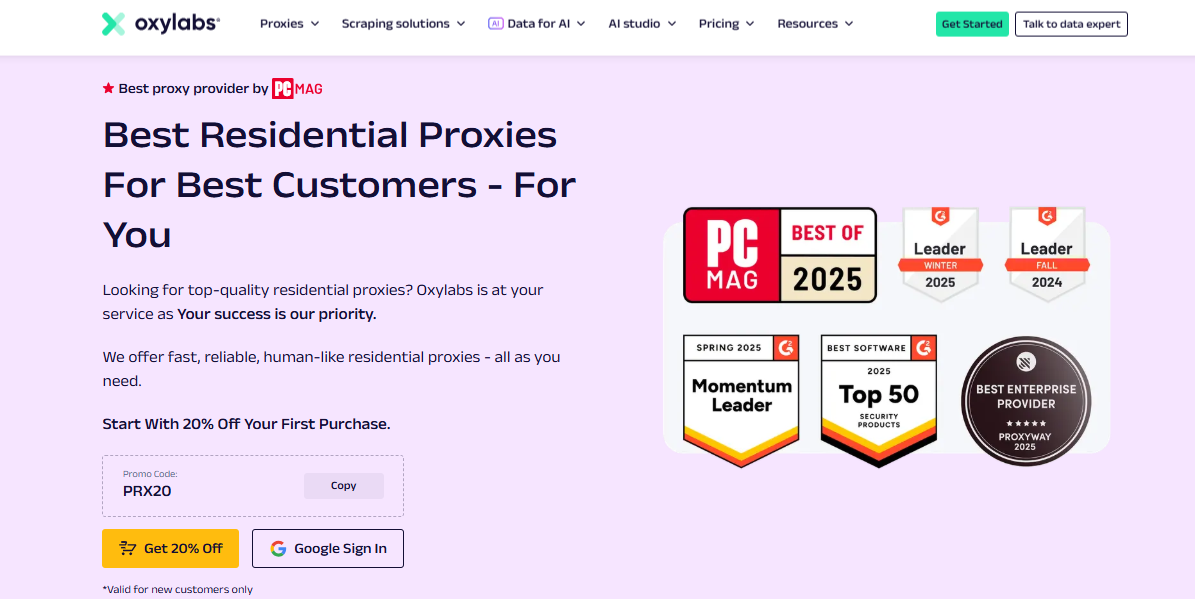
Oxylabs is widely recognized for delivering premium, enterprise-grade proxy infrastructure. With a 99% success rate, it’s built to handle demanding market research tasks where missing data is not an option.
It offers:
- Dedicated datacenter proxies for high-volume scraping
- One of the largest residential proxy networks globally
- Advanced tools like a Web Scraper API for automation
This makes Oxylabs especially effective for:
- Large-scale competitor price monitoring
- Aggregating product listings across multiple platforms
- Continuous data collection without interruptions
👉 If your focus is accuracy, uptime, and scale, Oxylabs is a top-tier choice.
Decodo — Smart Scraping with Built-In Automation
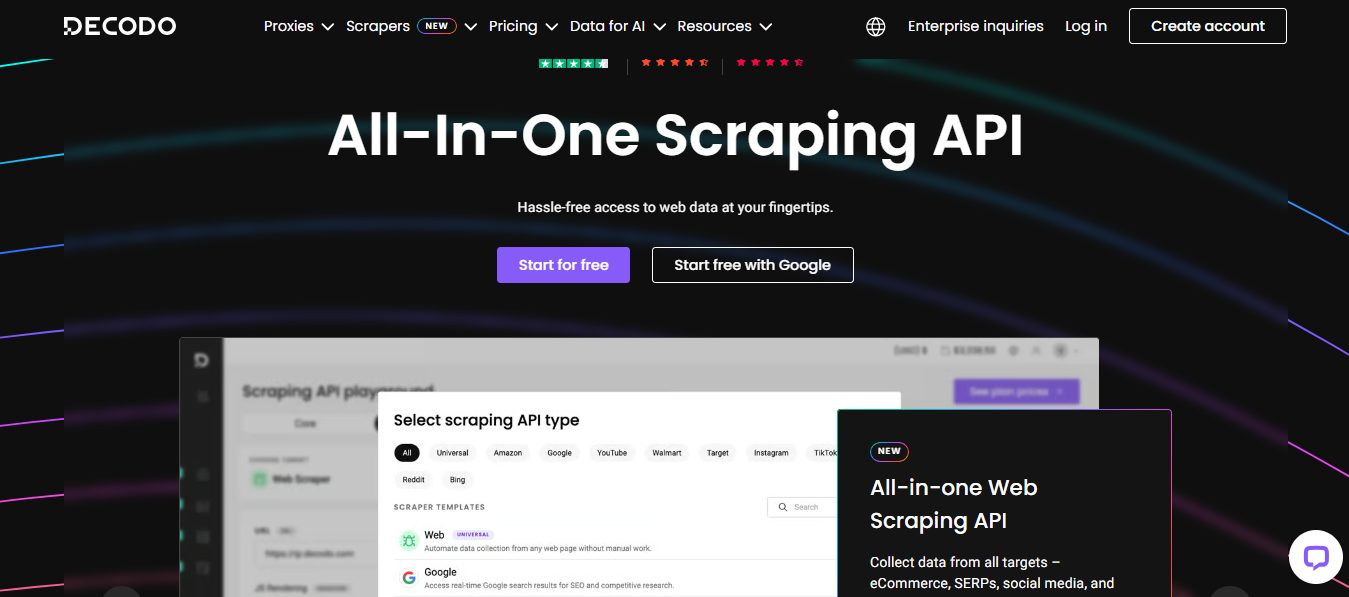
Decodo (formerly Smartproxy) is an award-winning proxy provider designed for efficiency and ease of use. Its standout feature is the dedicated Web Scraping API, which simplifies complex scraping workflows.
Key advantages include:
- Access to millions of IPs worldwide
- Automatic proxy rotation to avoid detection
- Built-in anti-blocking and CAPTCHA handling
Decodo is ideal for:
- Businesses that want plug-and-play scraping solutions
- Teams scaling data collection without heavy infrastructure
- Projects involving geo-targeted or restricted content
👉 If you want a balance of power, automation, and simplicity, Decodo delivers strong performance.
Webshare — Scalable, Cost-Effective & Easy to Use
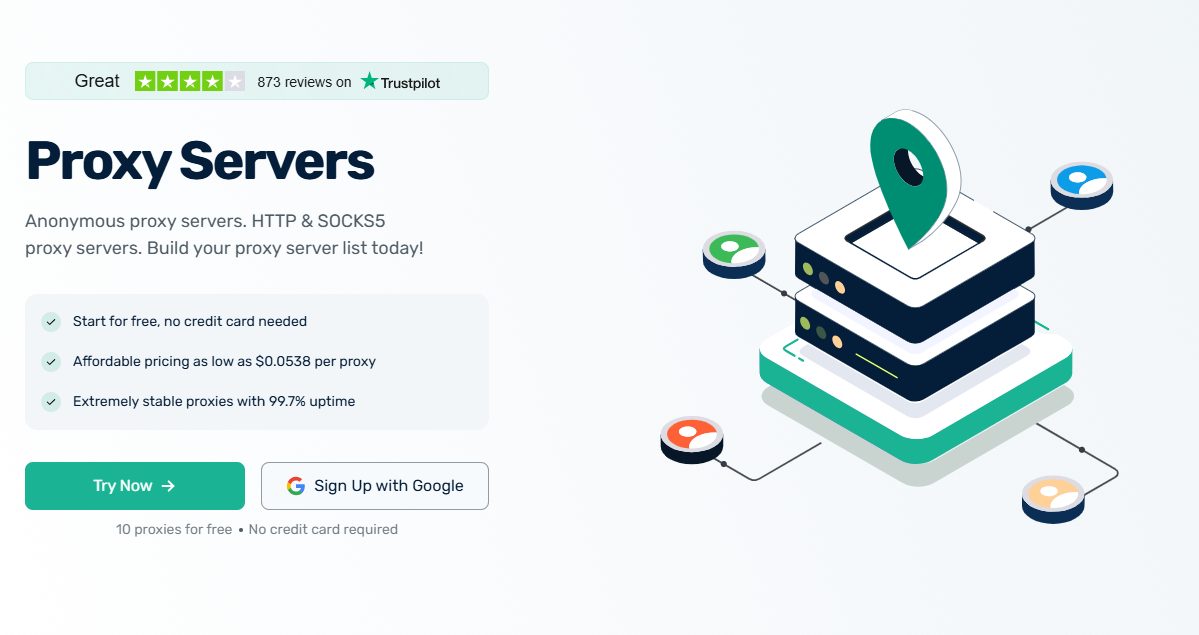
Webshare is a practical option for businesses that need reliable performance without excessive costs. With 500,000+ datacenter IPs and millions of residential proxies, it supports a wide range of market research use cases.
What makes Webshare stand out:
- Optimized for pricing intelligence and public data extraction
- Fast servers with dedicated bandwidth for consistent speed
- 24/7 expert customer support to assist with setup and scaling
It’s particularly useful for:
- Startups and growing data teams
- High-volume scraping with budget considerations
- Teams that want a simple, no-friction setup
👉 If your goal is affordable scalability with dependable support, Webshare is a solid choice.
Quick Recommendation Guide
| Need | Best Option |
|---|---|
| Enterprise-scale, high accuracy | 🟢 Oxylabs |
| Automation + ease of integration | 🔵 Decodo |
| Budget-friendly, scalable scraping | 🟠 Webshare |
5 Major Use Cases in Market Research
As we explained earlier, you can source various types of data using market research web scraping. Let’s now look at the five major ones:
1. Competitor Price Monitoring
Many businesses want to know what their competitors are charging, so they can adjust their prices accordingly. This is common, especially for service providers, where pricing is often private. Large-scale online businesses like e-commerce and travel platforms also use it to aggregate data from many sites. In such niches, web scraping allows you to extract and monitor costs in real time.
2. Consumer Sentiment Analysis
After competitors, customers are the most important profiles to businesses. So, many companies use market research web scraping to source product reviews, forum discussions, and social media comments. That way, they know how customers feel about their products and services. It’s qualitative data that’s invaluable for marketing strategies and business development.
3. Trend Identification
If you’re in an industry and you don’t know what’s trending, your business won’t sell. To catch all the latest updates, you can use web scraping to retrieve data from news sites, niche blogs, and search engine results. The main advantage is that you’ll spot the trends early, before they become mainstream. As you adjust your strategy or product roadmap, you stay ahead of the competition.
4. Lead Generation and Prospecting
Converting leads and prospects is one of the best signs of a successful business. Market research web scraping on directories, LinkedIn, and other industry sites can help you identify the right people to message. From the data you collect, you can build comprehensive prospect lists with business names, contact information, and company details.
5. Product and Inventory Research
This use case applies mostly if you’re a manufacturer or product retailer. Web scraping can be reliable in curating information from supplier catalogs and competitor product pages. Subsequently, you apply the data to track inventory levels and launch new, better products.
Proxies for Market Research Web Scraping

When scraping data for market research, it’s usually a large-scale project. Therefore, it’s necessary to get a reliable proxy to facilitate the process. The reason is that most websites set rate limits per IP address. So, if a site detects too many requests from a single IP, it automatically blocks that IP. Without proxies, then, data collection is slow, and the entire research operation may fail.
Thankfully, there are many secure proxies you can rely on for your market research. Here are our best picks:
- Oxylabs: Offers high-quality proxies with a 99% success rate for retrieving public data. It has dedicated datacenter IPs for high-volume web scraping in the market research space.
- Decodo: An award-winning proxy service with a dedicated web scraping API. The API lets you scrape data with millions of IPs and built-in anti-blocking technology.
- Webshare: Features 500,000+ datacenter IPs with specific use cases for pricing intelligence and public data. Expert customer support is available 24/7 to help you with your project.
If you’re on a tighter budget, you can also consider IP Royal or Mars Proxies. Both have first-hand residential proxies that can be used for web scraping efficiently.
Bottom Line: Web Scraping Offers a Competitive Advantage
As a business, investing in web scraping for market research can easily put you ahead of your competitors. That’s because it gives you a broad view of the entire industry with data you can’t fetch through manual browsing or periodic reports. All you need is a proper scraping tool and a secure proxy like Oxylabs, Decodo, or Webshare.
You can use the Python-based Scrapy, which is highly customizable. Alternatively, you can go for Puppeteer or Playwright if the site is JavaScript-heavy and requires browser rendering. BeautifulSoup is also a decent option for lighter parsing tasks.
While scraping, it’s important to maintain ethical standards. What you’re after is mainly product or service information, pricing, reviews, and other publicly available business data. Define your targets, and avoid collecting personal information. Also, if the source website has an API, use it instead of scraping directly.
FAQs: Market Research Web Scraping
What is market research web scraping?
Market research web scraping is the process of automatically collecting publicly available data from websites to gain business insights. Instead of manually browsing hundreds of pages, scraping tools gather and structure data such as:
- Competitor pricing
- Product listings
- Customer reviews
- Social media mentions
- Industry trends
This allows businesses to make faster, data-driven decisions at scale.
How do businesses use web scraping for market research?
Businesses use web scraping across several key areas:
- Competitor monitoring → Track pricing and offerings
- Customer insights → Analyze reviews and sentiment
- Trend discovery → Identify emerging market opportunities
- Lead generation → Build targeted prospect lists
- Product research → Monitor inventory and supplier data
These insights help companies stay competitive and respond quickly to market changes.
Why are proxies important for market research scraping?
When scraping at scale, sending too many requests from a single IP can trigger rate limits or blocks. Proxies solve this by distributing requests across multiple IP addresses, ensuring smooth and uninterrupted data collection.
Top proxy providers for market research include:
- Oxylabs → High success rates and strong performance for large datasets
- Decodo → Advanced scraping API with built-in anti-blocking features
- Webshare → Reliable datacenter proxies with strong support and scalability
Using proxies ensures your scraping operation remains efficient and consistent.
4. Is market research web scraping legal?
Yes—if done correctly. Market research scraping should focus only on publicly available data such as pricing, product information, and reviews.
Best practices include:
- Avoid scraping personal or sensitive data
- Respect website terms of service
- Use official APIs where available
Following these guidelines helps ensure your data collection remains ethical and compliant.
5. What tools are best for market research web scraping?
The right tools depend on the complexity of your project:
- Scrapy → Powerful and customizable for large-scale scraping
- Puppeteer / Playwright → Ideal for JavaScript-heavy websites
- BeautifulSoup → Lightweight option for simple parsing tasks
To maximize performance, combine these tools with reliable proxies like Oxylabs, Decodo, or Webshare for scalable data extraction.
This combination allows you to build a robust, efficient market research system.
INTERESTING POSTS
- The Ultimate Guide to Proxies for Legitimate Web Scraping
- Enterprise Web Scraping Solutions For 2026
- Why Smart CEOs View Outsourced IT as Their Secret Competitive Weapon
- Google Scraper: How to Ethically and Efficiently Extract Search Data
- Real-Time Data Scraping: A Complete Guide
- Legal Considerations for Web Scraping
About the Author:

Daniel Segun is the Founder and CEO of SecureBlitz Cybersecurity Media, with a background in Computer Science and Digital Marketing. When not writing, he's probably busy designing graphics or developing websites.



