



In this post, I will answer the question – what is the digital personal data protection act and who does it apply to?
It’s not news that there’s an increase in reliability on digital information. We live in an era of rapid digitization of data. Our personal, organisational, healthcare, educational and financial identity exists online. While this has improved convenience, it also raises concerns about data privacy and potential exploitability of data.
Businesses collect customer data like names, contact details, e-mail Ids and even financial information on a regular basis. With so much access to personal data, who is responsible for its protection and privacy?
Businesses themselves are responsible.
India has introduced the DPDP Act as its legal framework towards data protection and privacy. It holds organisations accountable for lawful handling of the acquired personal data of individuals.
It clearly defines the acceptable rules for collecting, storing and sharing of customer information.
This is a comprehensive guide to help organisations comply with DPDPA and move forward with responsibility.
Table of Contents
What Is the Digital Personal Data Protection Act (DPDPA)?
The Digital Personal Data Protection Act (DPDPA) is India’s primary legislation for governing the processing of digital personal data.
The framework was introduced in 2023, and it became fully operational in 2025. It applies to personal digital data and also data that is collected offline and later digitised.
The act rigorously focuses on protection and privacy of digital personal data. It establishes rules for organisations to handle personal digital information responsibly.
Before we dive deeper into the topic, it is important to understand the widely used terms of the DPDP Act:
- Data Principal: Data principal refers to individuals who have consented to share their personal data with an organisation/body/institution. For example, students providing their Aadhar Card numbers for admission in an university. In this case, the students are considered as the data principals.
- Data Fiduciary: Any person, company, government entity or organisation that collects and processes the personal data of data principals is called a data fiduciary. Referring to the above example, the university is deemed to be a data fiduciary in that case.
- Significant Data Fiduciary (SDF): Data fiduciaries that possess large volumes of personal or sensitive information are tagged as significant data fiduciaries. Examples include banks or healthcare organisations among others. Since these bodies pose a higher risk, they are expected to comply with more rigid laws under the framework.
The act operates under the Data Protection Board of India. It is a dedicated authoritative body appointed for the DPDP Act. It is responsible for handling complaints, enforcing compliance and imposing penalties in case of violation.
Objectives of the DPDP Act
The objectives of the DPDP Act aim to balance individual privacy with growing digital economy by promoting responsible data governance. Following are the primary objectives of the DPDP Act:
- Safeguarding Individual Privacy: The most fundamental goal of this policy is safeguarding individuals from unauthorised access or misuse of their personal data. DPDPA enforces strict laws and regulations on organisations to protect personal data throughout its lifecycle.
- Promoting Responsible Data Processing: The act also emphasises on the importance of responsible data processing. Organisations that have acquired individual personal data must act in accordance with the obligations of DPDPA.
- Consent-Centric Framework: Organisations cannot access, acquire or share personal information of individuals without clear and specific consent. Individuals are also allowed to withdraw their consent, and companies must conform to it.
- Supporting Digital Innovation: Beyond data protection, the act also strives to focus on innovation. It aims to minimise unnecessary compliance burdens for startups and smaller companies while imposing stricter obligations on businesses that are highly customer-data centric.
- Enabling Cross-Border Data Transfers: DPDPA supports transfer of personal data outside India, but only to territories that are approved by the central government. This encourages global business operations while implementing appropriate safety measures for personal data.
Key Features of the DPDP Act
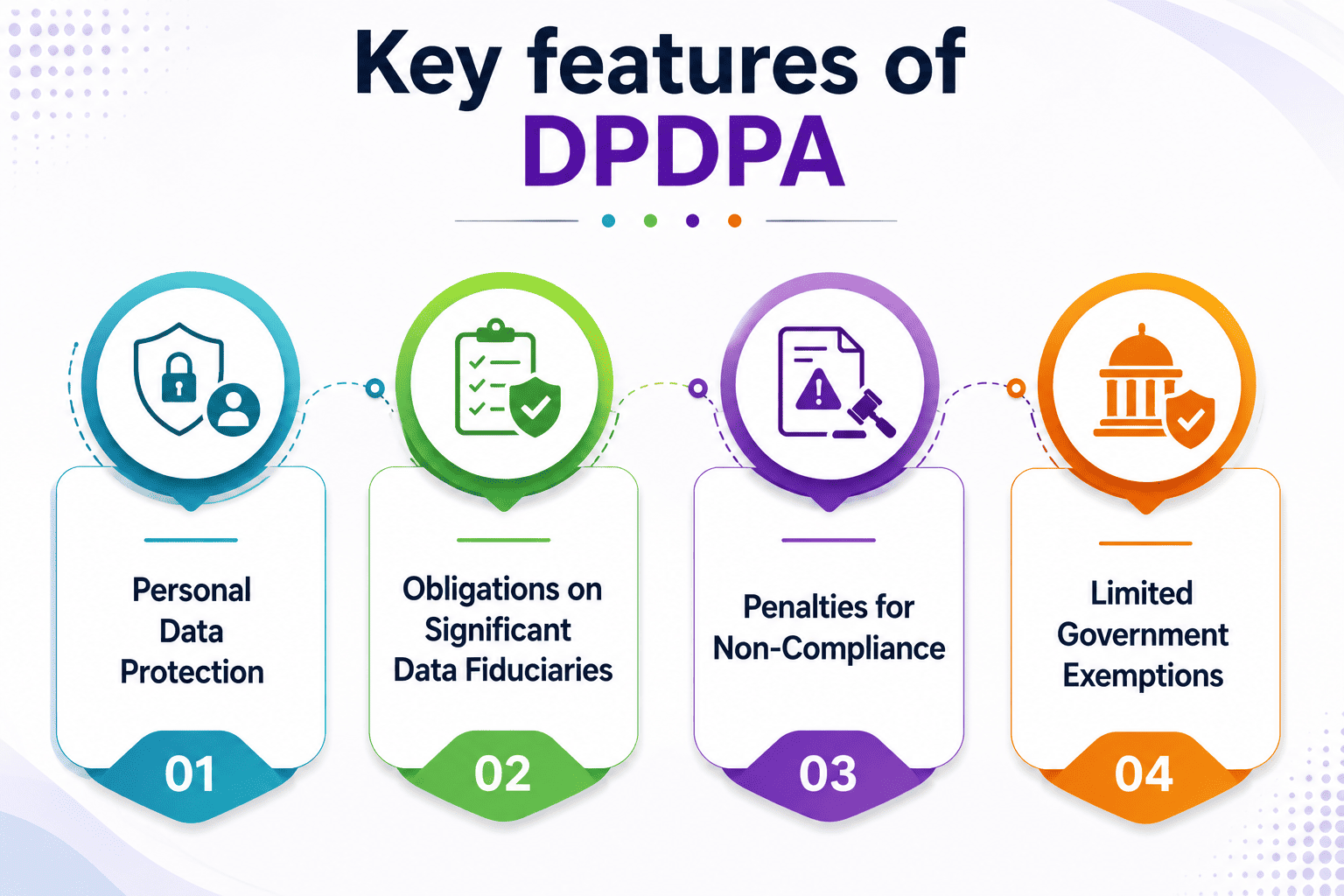
The DPDP Act reinforces privacy and protection by introducing provisions that define duties of organisations as data fiduciaries.
Below are the key features of DPDPA:
- Personal Data Protection: Protection of personal data is given primary importance though the DPDP Act. The framework holds organisations responsible for data privacy and protection. Even individuals are bestowed with rights that allow them to access or withdraw their data from organisations at any given time.
- Obligations on Significant Data Fiduciaries: Strict obligations are imposed on significant data fiduciaries. They must comply with additional requirements like appointing a Data Protection Officer (DPO), conducting periodic audits and executing stringent government measures.
- Penalties for Non-Compliance: The consequences of failure in complying with the rules of the DPDP framework include financial penalties ranging from ₹10 crore to ₹250 crore, depending on the characteristic and severity of the violation.
- Limited Government Exemptions: The act permits certain levels of exemption for government agencies in situations of national security, public order or emergency management.
Data Principal Rights
The DPDP Act secures data principals with an established set of rights. This helps individuals exercise power over the usage and protection of their data. Organisations should be aware of the rights of individuals in order to co-operate and help their customers better.
Following are the rights of individuals under Digital Personal Data Protection Act:
- Right to Access Information: Individuals have the right to access their data anytime and question why their data was collected and know if it has been shared with any third parties.
- Right to Correction and Updating: Individuals can request to make revisions if the shared personal data is inaccurate, incomplete, or outdated. Organisations must obey the request and make corrections within the prescribed timelines.
- Right to Erasure: Data principals can rightly request data fiduciaries to erase their information when the purpose is served, after consent withdrawal or when the organisation no longer requires the information.
- Right to Grievance Redressal: Individuals can raise any concern regarding their shared personal data. Organisations are obliged to respond on time, typically through a designated data protection officer.
- Right to Nominate: Individuals are allowed to nominate another person to exercise their DPDPA rights on their behalf in the event of death or incapacity, to ensure continued protection of their personal data.
Who Does the DPDP Act Apply To?
The Digital Personal Data Protection Act applies to a broad variety of organisations that possess and process digital personal data, regardless of the industry.
It essentially covers companies that collect customer data through websites, mobile applications, e-commerce platforms, payment systems, healthcare portals, educational institutions, financial services, telecommunication providers and online service platforms.
In summary, the Act applies to:
- Startups and big businesses that operate within the country that collect or process digital personal data
- Government departments and public authorities processing personal data
- Foreign organisations processing the personal data of individuals located in India while offering goods or services in India
In practice, if an organisation collects names, email addresses, phone numbers, financial details, employee records, or any other personally identifiable information in digital form, it should assess its obligations under the Digital Personal Data Protection Act.
Conclusion
The Digital Personal Data Protection Act is a notable stepping stone toward our country’s data protection and privacy landscape. Organisations are now taking an initiative to understand concepts of consent, data fiduciary responsibilities, individual rights and responsible data processing.
This legal framework has provided security to individuals in terms of their personal information, which allows them to move confidently in this highly digitised era.
To understand and implement the rules of DPDPA seamlessly, consider consulting with knowledgeable firms like CyberNX, who can help you gain complete understanding of the act and can further guide you toward successful implementation and compliance with the DPDP Act.
INTERESTING POSTS
- Protecting Business Data When Teams Work From Different Locations
- How AI Models Are Transforming Cybersecurity Workflows
- Bot Traffic, Click Farms, and Ad Fraud: The Cyber Threats Marketers Keep Ignoring
- Surfshark Black Friday Deals 2025 – Bigger Discounts and More Security
- Is It Safe to Apply for a Loan on Public Wi-Fi?
About the Author:

Daniel Segun is the Founder and CEO of SecureBlitz Cybersecurity Media, with a background in Computer Science and Digital Marketing. When not writing, he's probably busy designing graphics or developing websites.



