




In this post, I will talk about the best SendGrid alternatives for Developers in 2026.
SendGrid has been the developer’s default choice for years, but complaints like deliverability issues on shared IP pools and PHP SDK that ships the entire platform keep surfacing among engineering teams.
This guide compares four providers worth considering if you plan on switching to another platform. The best SendGrid alternatives for developers in 2026 are Mailtrap, Mailgun, Amazon SES, and Postmark.
Table of Contents
SendGrid Alternatives: Quick Comparison
| Provider | Best for | Free tier | Starting price | SDK languages | G2 rating |
| Mailtrap | High deliverability & stream separation | 4,000 emails/mo | $15/mo | Node.js, Ruby, PHP, Python, .NET, Elixir, Java | 4.8/5 |
| Mailgun | API routing and validation | 100 emails/day | $15/mo | Python, PHP, Java, Ruby, Node.js, Go | 4.2/5 |
| Amazon SES | Cost-efficient sending at scale | 3,000 emails/mo* | $0.10/1,000 emails | Full AWS SDK | 4.3/5 |
| Postmark | Delivery speed | Trial only (100 emails) | $15/mo | Node.js, PHP, Python, Ruby, .NET, Java, Go | 4.6/5 |
*Free when sending from EC2, first 12 months only.
Mailtrap: Best for High Deliverability
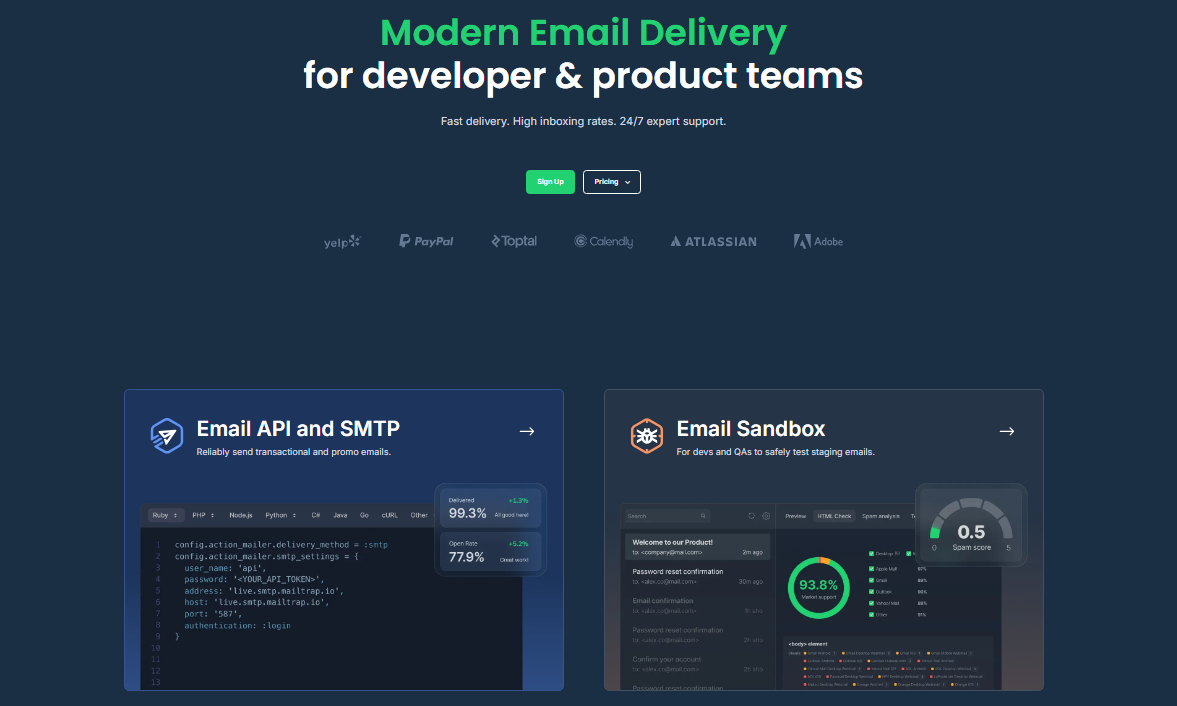
Mailtrap is an email delivery platform built for developer and product teams that need transactional and bulk email to stay architecturally separate. It offers isolated sending streams with independent IP pools, which means a spike in bulk email complaints cannot affect the sender reputation of your password resets or order confirmations. This is the core deliverability advantage, and most of the features below build on it.
SDK and Integrations
Setup runs about five minutes from account creation to first send. Mailtrap ships official SDKs for Node.js, Ruby, PHP, Python, .NET, Elixir, and Java, plus 25+ framework snippets covering Laravel, Symfony, Django, Rails, and Next.js. Native integrations are available for Vercel and Supabase.
For teams building AI-powered workflows, Mailtrap ships an MCP server compatible with VS Code, Cursor, and Claude, plus a set of agent skills that give AI coding assistants accurate context for sending emails, managing templates, and configuring sending domains.
Deliverability and authentication
SPF, DKIM, and DMARC configure automatically once you add the DNS records. DKIM keys rotate on their own every month. Dedicated IPs on the Business plan include automatic warmup, so there is no need to hand-schedule the two-to-four-week ramp yourself.
Webhooks and logs
Webhooks cover opens, clicks, bounces, spam complaints, and delivery events with 40 retries every five minutes. Email logs are retained for up to 30 days with drill-down reports broken down by mailbox provider, domain, and stream. Analytics are included on every paid plan with no add-ons required. Mailtrap also carries a 99% uptime SLA backed by distributed infrastructure, along with ISO 27001, SOC 2 Type II, and GDPR certifications.
Pricing
Free tier: 4,000 emails per month. Paid plans start at $15/month for 10,000 emails. The Business plan ($85/month) covers 100,000 emails and adds a dedicated IP with automatic warmup and access to deliverability engineers. Enterprise starts at $750/month for 1.5 million emails. One tradeoff worth noting: 24/7 support is only available from the Business plan upward.
Best for: Developer and product teams that need high deliverability, stream separation, and complete analytics without assembling separate infrastructure.
Mailgun: Best for API Routing and Validation
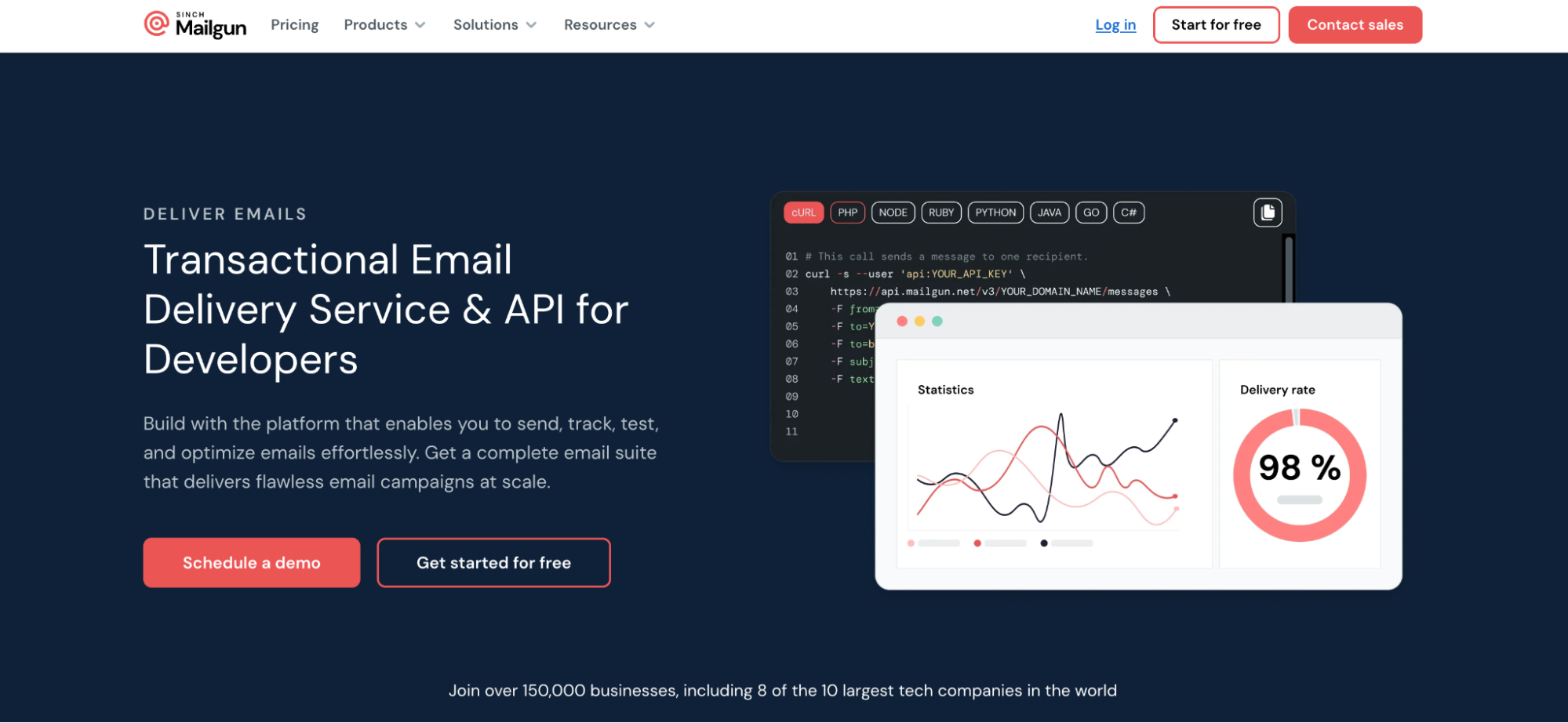
Mailgun is a developer-focused transactional email API with granular routing control. Its standout feature is a built-in email validation API that verifies addresses for deliverability before an email goes out. This removes the need to bolt on a separate third-party validation service and is particularly useful for AI agents sending automated emails at scale.
SDK and Integrations
Official SDKs cover Python, PHP, Java, Ruby, Node.js, and Go. The API is also available as a Postman collection with organized examples and environment variables, which is useful for testing integrations before deploying. Inbound routing lets you forward, filter, or route incoming emails to different webhooks based on regex patterns. This covers reply-by-email comment workflows, email-based support ticketing, and email-to-app routing in ways that Postmark and others do not handle out of the box.
Mailgun’s MCP server exposes 50+ tools covering sending, receiving, domain management, and DNS troubleshooting. Domain-specific API keys and a batch API for up to 1,000 recipients per call are both available as standard. EU and US data centers are available for teams with regional data requirements.
Pricing
Free tier: 100 emails per day. Paid plans start at $15/month for 10,000 emails. Dedicated IPs are available from the Foundation plan at $59/month, the highest dedicated IP cost on this list. Log retention on the base plan is limited to 5 days.
Best for: Engineering teams that need pre-send address validation, inbound email routing, and per-domain API key control as core parts of their workflow.
Amazon SES: Best for Cost-Efficient Sending
Amazon SES is a pay-as-you-go SMTP and API service for engineering teams already operating within AWS. At $0.10 per 1,000 emails, it is the cheapest option in this comparison.
SDK and Integrations
SES uses the full AWS SDK, which covers every major language but carries a significantly heavier footprint than Mailtrap or Mailgun. Getting to production requires configuring IAM roles, requesting sandbox removal, managing suppression lists, and setting up bounce and complaint handling through Lambda and SNS. None of that is unreasonable for an experienced AWS engineer, but it is a genuine setup investment before a single production email goes out.
The Virtual Deliverability Manager provides dashboards and optional automatic reputation monitoring. Global endpoints let you select server regions for latency or data residency requirements. Native integrations with Lambda, S3, and SNS enable automated email workflows at scale. SES is also covered under AWS compliance certifications including SOC 2, ISO 27001, and FedRAMP.
Pricing
$0.10 per 1,000 emails. Free tier: 3,000 emails per month for the first 12 months on EC2. Dedicated IPs cost $24.95/month as an add-on. Data transfer and attachment fees apply at $0.12/GB. Standard support is ticket-based; phone and chat support require a separate AWS support plan.
Best for: Engineering teams already on AWS with the DevOps capacity to build suppression management, bounce handling, and analytics themselves, and where per-email cost is the deciding factor.
Postmark: Best for Delivery Speed
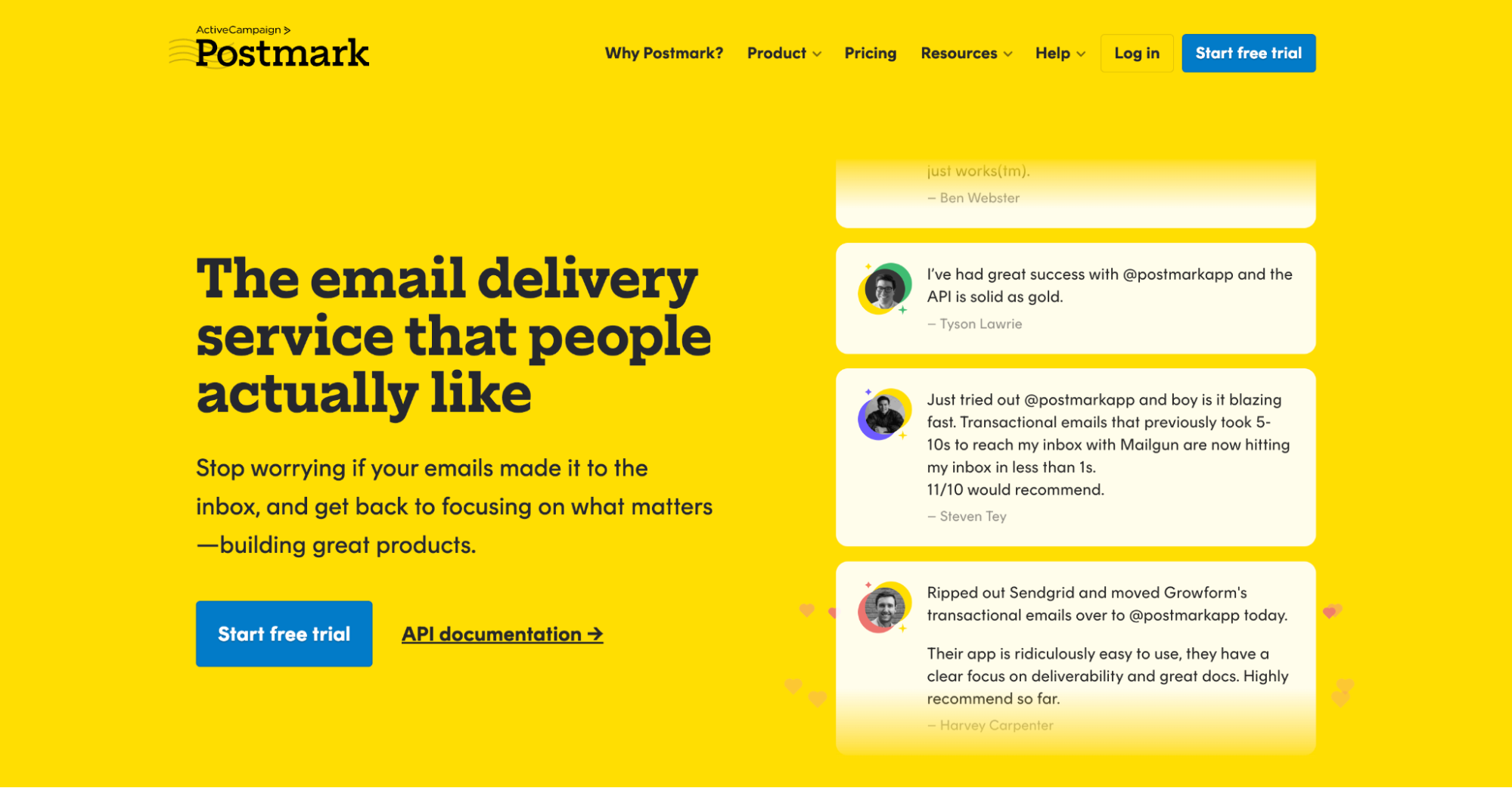
Postmark is built specifically for transactional email. Every new account goes through a manual review before live sending is enabled, which keeps the shared IP pools clean across all users on the platform. That policy is a large part of why Postmark is the go-to for teams where a delayed 2FA code or password reset directly causes a support ticket.
SDK and Integrations
Official SDKs cover Node.js, PHP, Python, Ruby, .NET, Java, and Go. Traffic is isolated using Message Streams, which separate transactional, broadcast, and inbound email at the infrastructure level. Log retention runs 45 days, the longest of any provider in this comparison. Bounce processing, categorization, and suppression are all handled automatically. Every analytics feature and log is included on all plans, with no feature-gating by tier.
Pricing
Postmark has no permanent free tier. The developer trial covers 100 emails. Paid plans start at $15/month for 10,000 emails. The cost scales steeply: 50,000 emails run $60.50/month, and 125,000 emails cost $138/month. A dedicated IP adds $50/month and is only available at 300,000+ monthly sends.
Best for: Teams sending time-sensitive transactional email where delivery speed is non-negotiable and the higher cost at scale fits the budget.
Conclusion
The right SendGrid alternative depends on what your stack actually requires. Mailtrap covers the most ground for developer and product teams: separated sending streams, seven-language SDK coverage with 25+ framework snippets, MCP server integration, and complete analytics all included without extra infrastructure.
Amazon SES is hard to beat on cost if your team already lives in AWS. Postmark is worth the higher price when inbox delivery speed is non-negotiable. Mailgun makes the most sense when pre-send validation and advanced routing are core requirements.
Frequently Asked Questions
Which SendGrid alternative has the best developer experience?
Mailtrap has the fastest path to production. Setup from account creation to first send takes about five minutes. DNS authentication records validate automatically, DKIM rotates without manual intervention, and official SDKs cover Node.js, Ruby, PHP, Python, .NET, Elixir, and Java.
Do I need a dedicated IP address?
For most teams sending under 100,000 emails per month, a shared IP from a reputable provider is fine. Above that volume, a dedicated IP gives you full control over your sender reputation. Mailtrap includes a dedicated IP with automatic warmup in the Business plan ($85/month). Postmark’s dedicated IP ($50/month) is only accessible at 300,000+ monthly sends. Mailgun charges $59/month for a dedicated IP, available from the Foundation plan.
How long does it take to migrate from SendGrid?
The technical migration (updating DNS records and swapping API credentials or SMTP settings) typically takes one to three days. If you are moving to a new dedicated IP, plan for an additional two to four weeks of warmup. Running your old and new providers in parallel during the transition is the safest approach to avoid any delivery gaps.
INTERESTING POSTS
- Best Email Service Provider For Product Teams
- Why High Growth Small Businesses Hire Squarespace Developers to Build Scalable, Conversion Focused Websites
- Dedicated Development Teams for Startups: Benefits and Costs
- How AI Recruiter Agents Have Redefined Candidate Engagement
- How SPF Flattening Can Instantly Improve Your Email Deliverability
About the Author:

Meet Angela Daniel, an esteemed cybersecurity expert and the Associate Editor at SecureBlitz. With a profound understanding of the digital security landscape, Angela is dedicated to sharing her wealth of knowledge with readers. Her insightful articles delve into the intricacies of cybersecurity, offering a beacon of understanding in the ever-evolving realm of online safety.
Angela's expertise is grounded in a passion for staying at the forefront of emerging threats and protective measures. Her commitment to empowering individuals and organizations with the tools and insights to safeguard their digital presence is unwavering.



