




In this post, I will talk about the top 10 AI-Powered automated pentesting tools.
Is your security strategy keeping pace with daily code updates? Most manual pentests take weeks, but software ships every hour. Today, 97% of CISOs are turning to a hybrid approach using AI-powered tools and having manual oversight to stay ahead. These intelligent solutions cut testing costs by half while offering continuous, real-time protection.
Legacy scanners often miss complex business logic flaws that hackers love. AI-driven pentesting bridges this gap by simulating real-world attacker reasoning autonomously. Integrating these tools into your CI/CD pipeline delivers continuous security validation, allowing you to maintain audit-ready compliance at the speed of modern development.
Table of Contents
Top Automated Pentesting Tools: Quick Overview
| Tool | Primary Focus | AI/Automation Level | Compliance Support | Best For |
| ZeroThreat.ai | AI-driven web & API pentesting | High (AI-led attack simulation) | PCI, ISO, GDPR, HIPAA | Startups, SaaS, DevSecOps teams |
| Burp Suite | Web app security testing | Medium (scanner + manual) | Enterprise reporting | Security teams & pentesters |
| Nessus | Vulnerability scanning (network & systems) | High (automated scanning) | PCI, HIPAA, ISO | IT, security & compliance teams |
| Metasploit | Exploit development & validation | Medium (framework automation) | Indirect (via reporting) | Security researchers & red teams |
| Rapid7 | Automated DAST (InsightAppSec) | High (automated scanning) | PCI, SOC 2, ISO | Enterprises & compliance teams |
| OWASP ZAP | Open-source DAST | Medium (automated + manual) | Limited built-in | Developers & SMBs |
| w3af | Open-source web scanner | Medium | Limited | Developers & researchers |
| SQLmap | Automated SQL injection testing | Medium (specialized automation) | Command-line | Security testers & researchers |
| Traceable | API security & runtime protection | High (behavioral AI) | SOC 2, PCI | API-first companies |
| Terra Security | Automated web pentesting | High (AI automation) | SOC 2 ready reports | Growing SaaS companies |
Best AI-Driven Automated Penetration Testing Tools
Traditional penetration testing is often too slow and expensive to keep up with today’s rapid release cycles. Automated pentesting tools bridge this gap by simulating human intelligence to find complex vulnerabilities at machine speed. Here are the top tools you must try using to automate your pentesting workflow.
1. ZeroThreat.ai
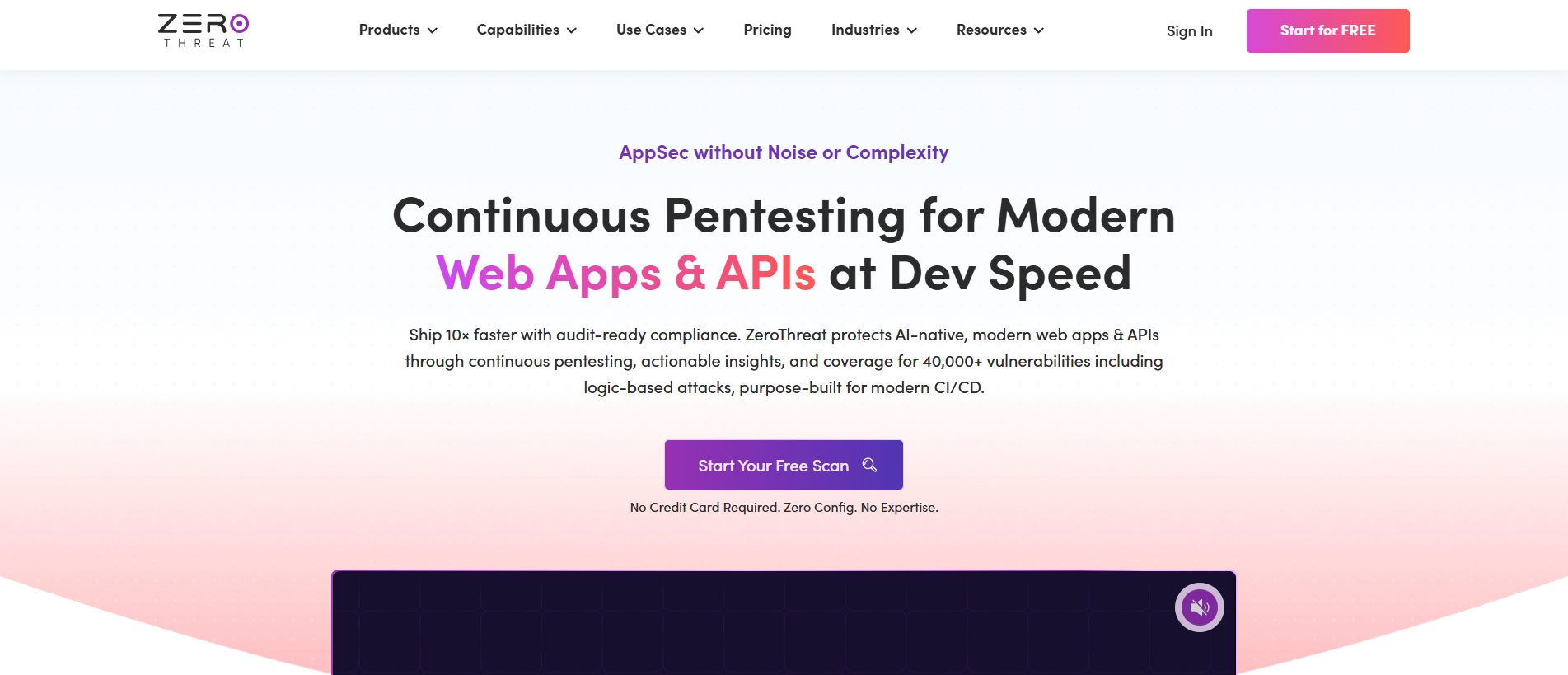
ZeroThreat.ai is an AI-driven automated penetration testing tool for web apps and APIs. It uses advanced AI to conduct attacker-style testing, covering everything from scanning to complex exploit validation processes.
The platform stands out by focusing on high-signal results and proven exploitability. By using agentic AI reasoning to validate attack paths, it eliminates false positives and provides developers with clear, actionable evidence. Its pentesting tool detects over 40,000 threats, cuts manual testing by 90%, and produces audit-ready reports aligned with GDPR, PCI DSS, HIPAA, and ISO standards.
Key Features of ZeroThreat.ai…
- Agentic AI Exploit Validation: Controlled AI-powered reasoning explores complex apps, adapts attack paths, and proves exploitability within user-defined boundaries.
- Complex UI & SPA Scanning: Navigates modern Single Page Applications (SPAs) and intricate user interfaces with ease, ensuring deep coverage for frameworks like React, Angular, and Vue.
- Shift-Left Security Testing: Integrates into your CI/CD pipeline to identify and remediate vulnerabilities early in the SDLC, preventing costly data breaches.
- Comprehensive API Pentesting: Analyzes REST and GraphQL endpoints to find hidden shadow APIs and complex authorization flaws like Broken Object Level Authorization (BOLA).
- Open Attack Template Support: Allows security teams to stay ahead of emerging threats by supporting custom and open-source attack templates for highly specific testing scenarios.
- MFA & SSO Navigation: Handles complex authentication flows, including Multi-Factor Authentication, to ensure that even protected user journeys are thoroughly tested for gaps.
- Business Logic Testing: Goes beyond simple signatures to detect flaws in application workflows and the potential misuse of functional logic across the web apps and APIs.
- Contextual Remediation Reports: Provides developers with exact exploit evidence and clear fix instructions to significantly reduce the mean time to repair critical security risks.
2. Burp Suite
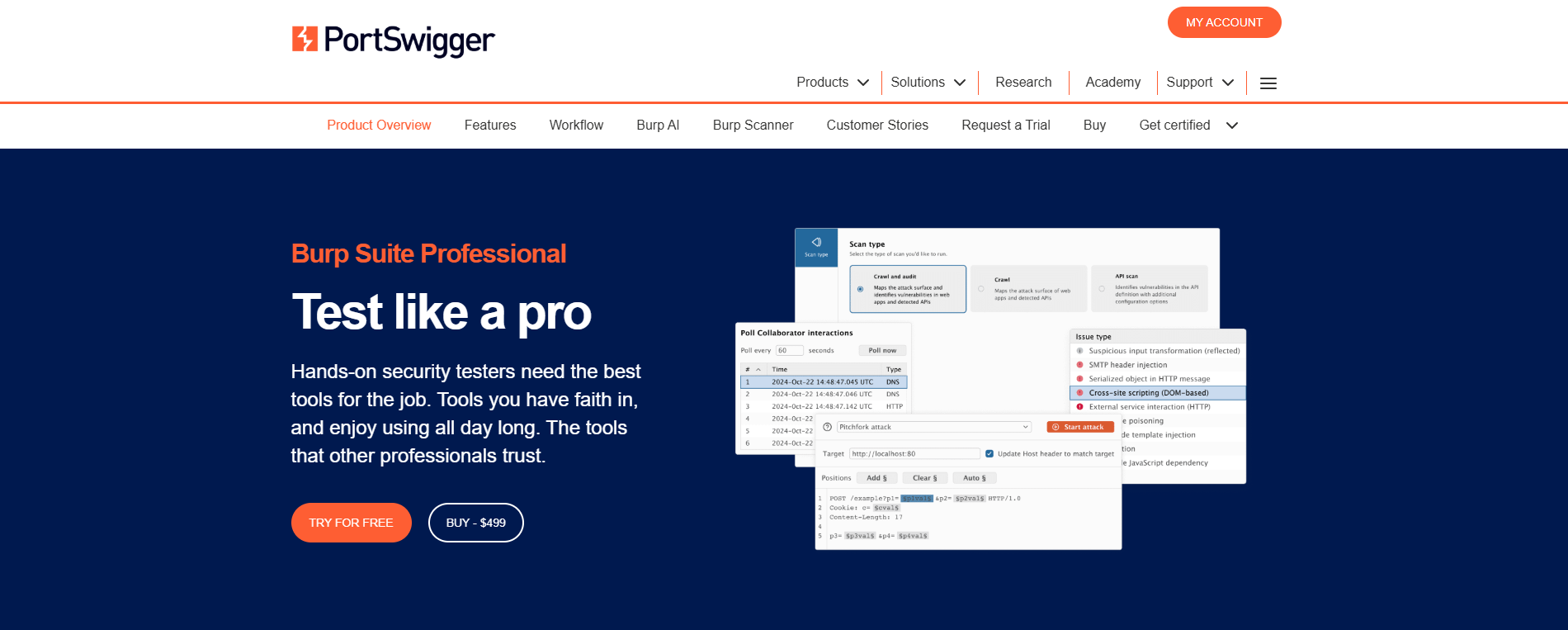
Burp Suite is the industry-standard toolkit for web application penetration testing. It combines an intercepting proxy with an automated scanner to identify vulnerabilities across complex environments. Professionals trust it for providing deep granular control over every aspect of live web traffic..
The platform allows testers to manually manipulate live traffic while automating repetitive tasks. It supports a massive ecosystem of community plugins, making it adaptable for various modern web technologies. This helps teams find flaws that typical automated tools might miss.
Key Features of Burp Suite…
- CI-Driven DAST: Automates dynamic security testing within your existing DevOps workflows to shift security further left and reduce release risks.
- Scanning Engine: Uses highly accurate algorithms to detect a vast array of web vulnerabilities, including SQL injection and cross-site scripting.
- Extensive BApp Store: Offers hundreds of community-developed plugins that allow users to extend and customize the tool for any technical scenario.
- Recorded Login Sequences: Features an intuitive macro recorder that enables the scanner to navigate complex authentication and multi-step forms with ease.
- Vulnerability Management: Centralizes discovery data to provide a clear view of your security posture across multiple applications and development environments.
- Burp Intruder for Fuzzing: Automates customized attacks against web applications to identify edge-case bugs and unexpected application behaviors effectively.
3. Nessus
Nessus is one of the most trusted vulnerability assessment tools in the cybersecurity industry, known for its extensive coverage and high-speed scanning. It helps security professionals identify misconfigurations, outdated software, and weak passwords across a diverse range of IT assets.
The platform provides a deep look into your attack surface by scanning cloud environments, operational technology (OT), and traditional network devices. It offers pre-built policies and templates that simplify the auditing process, ensuring you meet various compliance standards with minimal effort.
Key Features of Nessus…
- Comprehensive Vulnerability Database: Access over 200,000 plugins that cover the latest security threats and historical vulnerabilities for unmatched detection depth across all your systems.
- Pre-Configured Scan Templates: Speed up your workflow with out-of-the-box templates for PCI DSS, HIPAA, and other regulatory frameworks, making it easier to maintain continuous compliance effortlessly.
- Agent-Based Scanning: Deploy lightweight agents on remote or transient assets to gather security data without requiring credentials, providing visibility into devices that are not always on the network.
- Advanced Reporting: Generate customizable, professional reports that detail discovered risks and provide clear remediation steps, helping stakeholders understand the current security posture and necessary fixes.
- Live Results Analysis: Perform offline vulnerability assessment based on previously collected scan data, allowing you to identify new risks as soon as updated threat intelligence becomes available.
4. Metasploit
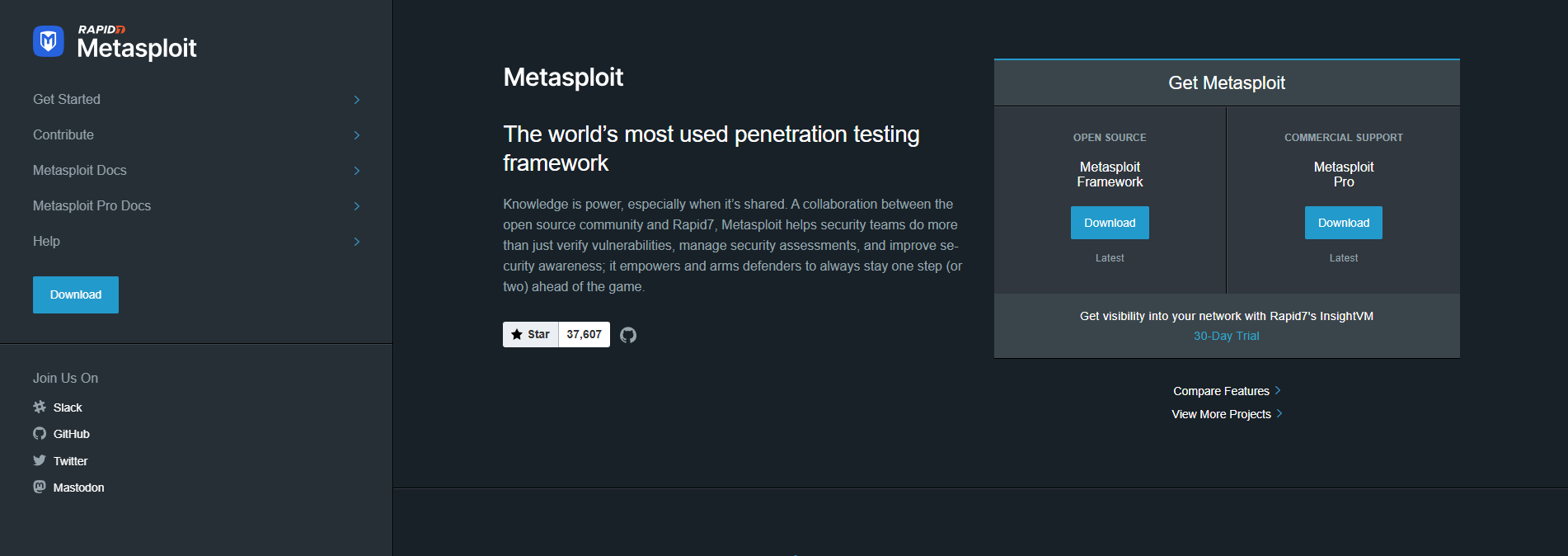
Metasploit is widely considered the world’s most used penetration testing framework, serving as a powerful collaboration between the open-source community and Rapid7. It allows security teams to verify vulnerabilities, manage deep security assessments, and improve overall security awareness effectively.
The framework empowers defenders to stay ahead by providing access to a massive database of exploit code and payloads. It helps experts simulate real-world attacks to test defenses, ensuring that organizations can validate their security controls against the latest threats.
Key Features of Metasploit…
- Vulnerability Validation: Seamlessly verify if a discovered bug is truly exploitable, helping teams prioritize remediation efforts based on actual risk factors.
- Massive Exploit Database: Accesses thousands of pre-configured exploits and payloads to test against a wide variety of platforms and services.
- Post-Exploitation Modules: Deeply explore a compromised system’s environment to understand the potential impact and lateral movement possibilities of a successful breach.
- Smart Payload Generation: Automatically generate and encode payloads to bypass basic security measures and test the effectiveness of existing endpoint protection systems.
- Interoperable Framework: Integrates with many other security tools, allowing for a unified workflow that covers everything from initial scanning to final exploit.
5. Rapid7
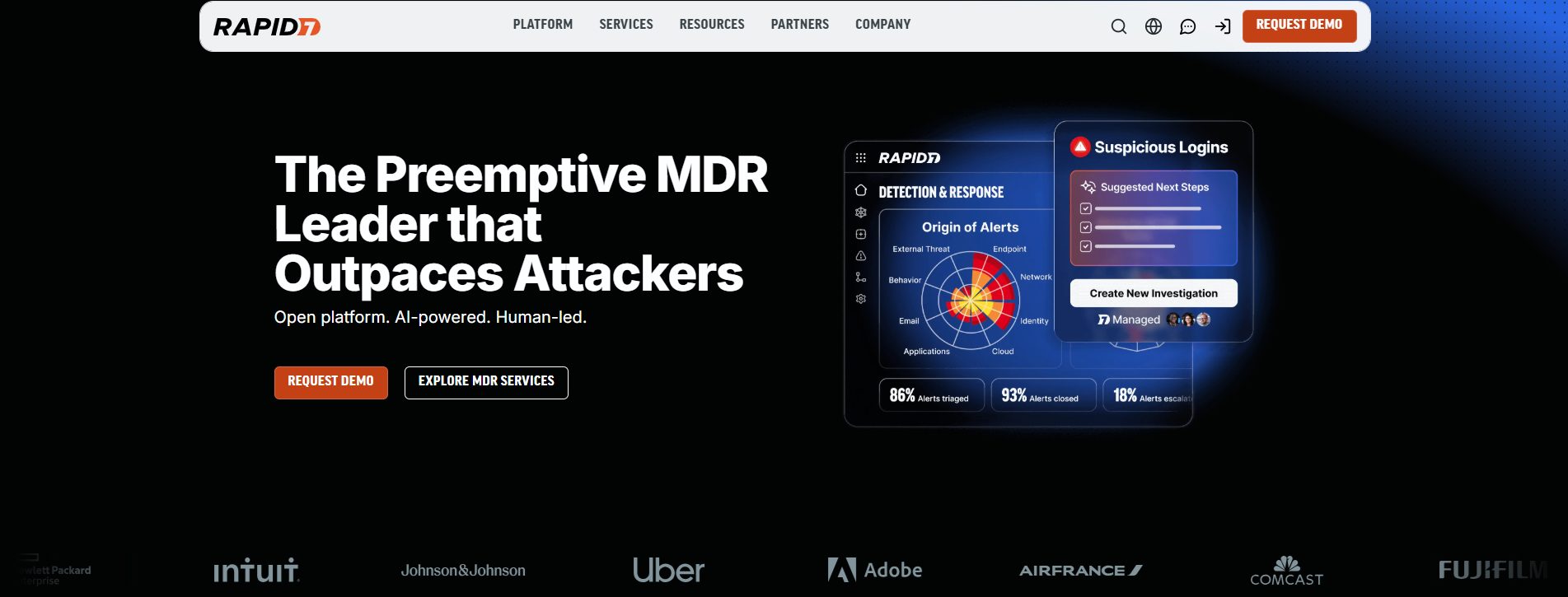
Rapid7 provides a unified cybersecurity platform that focuses on exposure management and automated risk detection. Their tools are built to help modern enterprises outpace attackers by providing continuous assessment of the entire attack surface with deep technical context.
The platform combines AI-powered analytics with human-led expertise to pinpoint threats wherever they start. By integrating vulnerability management and incident response, Rapid7 ensures that security teams can move quickly from detecting a gap to fixing the underlying issue.
Key Features of Rapid7…
- InsightVM Integration: Provides advanced vulnerability management that maps your specific network risks to the actual exploits available in the wild for better clarity.
- Continuous Attack Surface Management: Get a unified view of all digital assets across your estate to identify and triage risks faster than before.
- Automated Risk Prioritization: Uses advanced analytics to rank vulnerabilities based on how likely they are to be targeted by active, real-world attackers.
- Preemptive MDR Services: Combines 24/7 XDR monitoring with incident response experts to discover threats and manage vulnerabilities before they become breaches.
- Cloud Security Monitoring: Secure multi-cloud environments with complete visibility, allowing for immediate risk monitoring and detection of policy gaps or misconfigured cloud settings.
- Agent-Based Scanning: Deploy lightweight agents across your endpoints to gather real-time security data and ensure no part of the infrastructure remains unvetted.
6. OWASP ZAP
OWASP ZAP (Zed Attack Proxy) is a widely used, free, and open-source platform specializing in web application security. It acts as both a proxy for manual testing and a robust automated scanner. It is maintained by a global community of security experts.
This tool is a favorite for developers due to its seamless CI/CD integration and accessibility. It allows for continuous security checks within production pipelines without licensing hurdles. It provides a reliable baseline for identifying common web-layer vulnerabilities.
Key Features of OWASP ZAP…
- Active Attack Engine: Executes targeted probes against your web application to identify deeper flaws like SQL injection, cross-site scripting, and broken authentication.
- Automated Passive Scanning: Analyzes the traffic between your browser and the server to find security issues without actively attacking or disrupting the application.
- Flexible API & Automation: Provides a robust API and daemon mode, making it simple to integrate automated security scans directly into your CI/CD pipelines.
- ZAP Marketplace Add-ons: Extend the core functionality with a wide variety of community-contributed plugins to handle specific technologies or unique security testing requirements.
- Spidering & AJAX Crawling: Automatically discovers the structure and hidden pages of your application, including modern sites that rely heavily on complex JavaScript frameworks.
- Fuzzer for Manual Testing: Send custom, invalid, or unexpected data to your application endpoints to uncover edge-case bugs and unexpected application behavior.
7. w3af
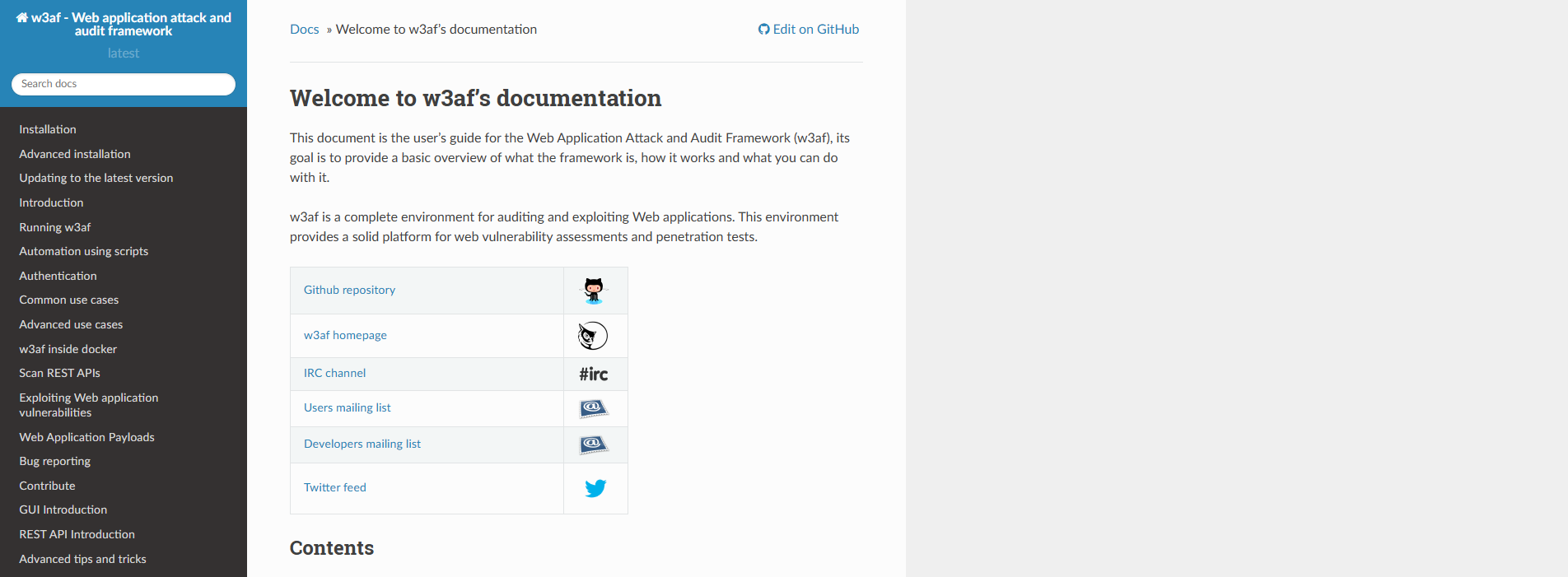
w3af is an open-source web application attack and audit framework that focuses on finding and exploiting web vulnerabilities. It provides a robust core that identifies more than 200 different security threats, including SQL injection, cross-site scripting, and remote file inclusion.
The framework is highly extensible through a plugin-based architecture, allowing users to customize their scans according to specific application needs. It acts as both a scanner and an exploitation tool, making it a versatile choice for developers and security researchers.
Key Features of w3af…
- Comprehensive Plugin System: Features over 150 plugins categorized into discovery, audit, and grepping to handle various stages of a security assessment.
- Support for Multiple Interfaces: Offers both a powerful Graphical User Interface (GUI) for ease of use and a Command Line Interface (CLI) for automation.
- Advanced Web Crawling: Deeply explores application structures to identify hidden links, directories, and files that might harbor undiscovered security vulnerabilities or sensitive data.
- Fuzzing Capabilities: Sends a wide range of unexpected data to application inputs to trigger errors and uncover edge-case flaws in the application logic.
- Automated Exploitation: Includes modules that can actively exploit identified vulnerabilities to provide proof of concept and demonstrate the actual impact of a bug.
- Detailed Reporting: Generates thorough reports in various formats, providing clear technical evidence and remediation advice to help developers fix discovered security issues.
8. SQLmap

SQLmap is an open-source penetration testing tool that automates the process of detecting and exploiting SQL injection flaws. It is a highly specialized engine that can take over database servers by leveraging various injection techniques with surgical precision.
This tool is essential for security researchers who need to verify the depth of a database vulnerability. It supports a wide range of database management systems and provides a powerful command-line interface for complex data extraction tasks.
Key Features of SQLmap…
- Automated Data Extraction: Effortlessly create entire database tables, fetch specific columns, or extract sensitive user credentials and password hashes to demonstrate the potential impact of a successful SQL injection attack.
- Full Support for Six Injection Techniques: Automatically detects and exploits flaws using boolean-based blind, time-based blind, error-based, UNION query-based, stacked queries, and out-of-band injection methods.
- Broad Database Compatibility: Works seamlessly with major database systems like MySQL, PostgreSQL, Oracle, and Microsoft SQL Server, as well as specialized platforms like Firebird, Sybase, and SAP MaxDB.
- Direct Database Connectivity: Direct connection to the database without passing through a web application, allowing for faster and more reliable testing when you have the necessary credentials.
- OS Command Execution: Capability to execute arbitrary commands on the underlying operating system of the database server, enabling advanced post-exploitation tasks such as privilege escalation or lateral network movement.
9. Traceable
Traceable offers an intelligent API security platform designed for discovery and attack detection at enterprise scale. It captures and analyzes activity across your entire app ecosystem to identify and remediate vulnerabilities from code to runtime environments.
This platform emphasizes context-aware security by focusing on active APIs to boost accuracy. It helps organizations modernize legacy systems and expand their API footprint while maintaining visibility and proactive protection against the evolving landscape of sophisticated web threats
Key Features of Traceable…
- Continuous API Discovery: Automatically identifies every API endpoint in your ecosystem, providing an up-to-date inventory and mapping how data flows between different services.
- Behavioral Threat Detection: Uses AI to establish a baseline of normal API usage, allowing it to detect and block anomalous activity and sophisticated attacks.
- BOLA & Authorization Testing: Specifically focuses on detecting broken object-level authorization and other logic flaws that allow unauthorized access to sensitive user data.
- Sensitive Data Tracking: Monitors how PII and other sensitive data move through your APIs, ensuring compliance with data privacy regulations like GDPR and CCPA.
- Shift-Left Security Testing: Integrates into CI/CD pipelines to scan APIs for vulnerabilities during the development phase, catching security gaps before they reach production.
- API Risk Quantification: Assigns a risk score to every API based on its exposure, the sensitivity of the data it handles, and its historical security performance.
10. Terra Security
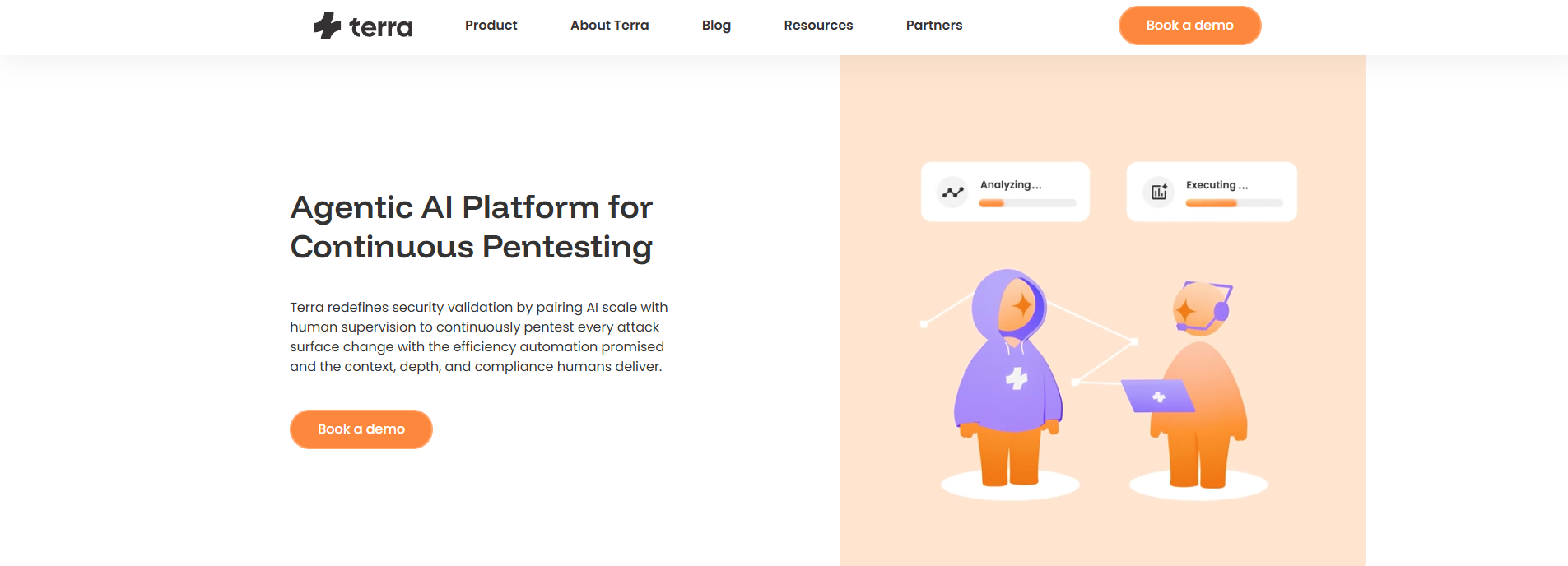
Terra provides an agentic AI platform for continuous penetration testing that pairs machine scale with human supervision. It validates every attack surface change across web, AI, network, and cloud environments to identify real exploitability rather than theory.
The platform focuses on risk-based insights by scoring vulnerabilities based on business impact and technical probability. By integrating human oversight into an AI-driven swarm model, it delivers the depth and compliance readiness required for modern regulatory audits.
Key Features of Terra…
- Agentic AI Pentesting: Employs intelligent AI agents that perform deep reasoning to discover and validate complex attack paths across web, mobile, and cloud environments.
- Business Logic Context: Factors in your specific business logic and workflows, ensuring that security tests are relevant to how your application actually functions.
- Continuous Security Validation: Performs ongoing assessments triggered by code changes or new deployments, providing real-time visibility into your current security posture and risks.
- Full Surface Coverage: Extends testing across web applications, APIs, internal tools, and cloud infrastructure, ensuring no part of your digital estate remains unvetted.
- Exploit-Validated Results: Only reports vulnerabilities that have been proven to be exploitable, significantly reducing noise and allowing teams to focus on critical remediation tasks.
How to Choose the Right AI-Powered Pentesting Testing Tool?
Choosing the right automated penetration testing tool is not just about features. It is about accuracy, compliance alignment, and real risk visibility. The right tool should help you detect vulnerabilities, validate security controls, and stay audit-ready without slowing down development.
Align the Tool with Your Compliance Requirements
Start with your compliance goals. Are you working toward PCI DSS, ISO 27001, SOC 2, HIPAA, or GDPR? The tool should map findings to compliance controls. It must generate audit-ready reports. Compliance-driven visibility saves time during assessments and reduces manual evidence collection.
Look for AI-Driven Risk Prioritization
Modern environments generate thousands of alerts. An AI-powered pentesting tool should filter noise and highlight exploitable risks. It should simulate real attack paths and prioritize what truly impacts compliance scope. Smart prioritization helps security teams fix what auditors actually care about.
Ensure Coverage Across Web, API, and Cloud
Compliance failures often hide in APIs and cloud misconfigurations. The tool should test web apps, APIs, authentication flows, and cloud exposures. Broad attack surface coverage ensures you do not miss gaps that could lead to regulatory penalties or failed audits.
Validate Real Exploitability, Not Just Vulnerabilities
Scanners often report theoretical issues. For compliance, you need proof of exploitability. The right pentesting tool should validate business logic flaws, access control bypasses, and chained attacks. This reduces false positives and strengthens your compliance documentation.
Check Reporting and Evidence Capabilities
Audit teams need structured evidence. Choose a tool that provides detailed technical findings, remediation guidance, risk ratings, and compliance mapping. White-label or customizable reports are helpful for consultants and MSSPs managing multiple client compliance programs.
Consider Automation and Continuous Testing
The tool should support automated and recurring scans within CI/CD pipelines. Continuous testing ensures new releases do not introduce compliance gaps. This keeps your security posture aligned with evolving regulatory standards.
Wrapping Up
AI-powered automated penetration testing tools are changing how organizations approach security. They go beyond basic vulnerability scanning or traditional pentesting tools and focus on real exploitability, risk prioritization, and continuous validation.
There are pentest tools available for startups, enterprises, red teams, and compliance-driven environments. The right tool depends on your goals, environment, and security maturity.
Some platforms offer deep AI-driven attack simulation, while others provide open-source flexibility. Choose a solution that aligns with your risk profile, compliance needs, and long-term security strategy.
INTERESTING POSTS
- Evaluating ZeroThreat.ai: A Practical Look at AI-Powered Pentesting for Modern Apps
- Embedded Systems Penetration Testing at the Hardware–Software Interface
- 11 Thrifty Reasons Why Mobile Automation Testing Is Needed
- What Is Automated IP Address Management?
- What is Penetration Testing? Importance, Types and Process
- Web Application Penetration Testing Services: Securing the Modern Web
About the Author:

Meet Angela Daniel, an esteemed cybersecurity expert and the Associate Editor at SecureBlitz. With a profound understanding of the digital security landscape, Angela is dedicated to sharing her wealth of knowledge with readers. Her insightful articles delve into the intricacies of cybersecurity, offering a beacon of understanding in the ever-evolving realm of online safety.
Angela's expertise is grounded in a passion for staying at the forefront of emerging threats and protective measures. Her commitment to empowering individuals and organizations with the tools and insights to safeguard their digital presence is unwavering.



