


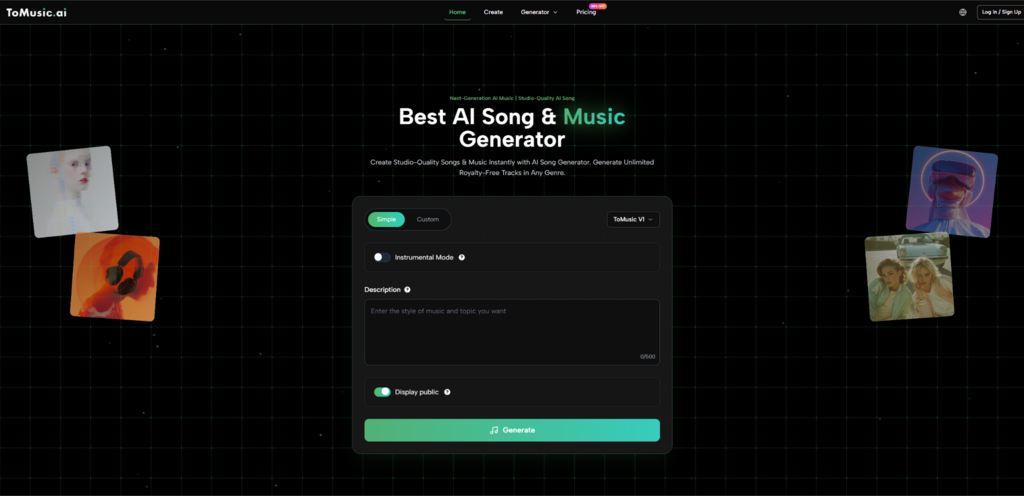

In this post, I will talk about rethinking song creation through language driven systems.
The first time I experimented with an AI Music Generator, it felt less like using software and more like having a conversation. Instead of arranging tracks or selecting plugins, I was describing intentions—tone, pacing, emotion. That experience highlighted a persistent issue in traditional music workflows: the distance between creative ideas and technical execution.
For many people, music production has never been limited by imagination, but by tools. These new systems suggest that the barrier may not be necessary at all.
Table of Contents
How Language Functions As A Control Layer For Music
Unlike conventional tools, the system does not ask for technical parameters. It asks for meaning.
Descriptive Input Replaces Technical Configuration
Users describe:
- Mood
- Style
- Energy
- Context
This replaces:
- BPM adjustments
- Instrument layering
- Manual arrangement
The shift is subtle but significant.
Interpretation Instead Of Direct Manipulation
The system interprets intent rather than executing commands. This means:
- Results are not deterministic
- Variations are expected
In practice, this creates a more exploratory workflow.
What Happens When Lyrics Drive The Entire Process
Introducing lyrics changes the system’s behavior in noticeable ways.
Text Structure Influences Musical Timing
Line breaks and phrasing guide:
- Rhythm
- Melody placement
- Section transitions
This creates a natural alignment between words and sound.
Narrative Content Shapes Musical Progression
When using Lyrics to Music AI, I noticed that songs tend to evolve in a way that mirrors the narrative arc of the lyrics. This is different from purely descriptive prompts, which can feel more static.
Vocal Generation Becomes Central
With lyrics, vocals are no longer optional—they become the focal point of the composition.
Simplified Workflow That Masks Complex Processing
Despite the sophistication behind the scenes, the user experience is intentionally minimal.
Step One: Provide Creative Input
Users either:
- Enter descriptive prompts
- Input structured lyrics
No prior setup is required.
Step Two: Choose Style And Generation Mode
Options include:
- Automated generation
- More controlled customization
This step defines how much influence the user has.
Step Three: Generate Multiple Outputs
Each run produces:
- A unique variation
- Slight differences in arrangement and tone
Iteration becomes part of the process.
Comparing Creative Control Across Different Approaches
The system introduces a different kind of control—less precise, but more accessible.
| Dimension | Conventional Tools | Language Driven Systems |
| Control Type | Direct manipulation | Indirect interpretation |
| Learning Curve | Steep | Minimal |
| Output Speed | Slow | Fast |
| Creative Flexibility | High but technical | High but abstract |
| Iteration Style | Manual edits | Regeneration |
This comparison shows that the trade-off is not about quality, but about method.
Where This Approach Delivers The Most Value
The usefulness of this system depends heavily on context.
Rapid Content Production Environments
In fast-paced environments:
- Social media
- Video production
The ability to generate music quickly is highly valuable.
Creative Exploration Without Technical Constraints
For individuals without production experience:
- Ideas can be tested instantly
- No learning curve is required
This lowers the barrier to entry.
Concept Development For Professional Creators
Even experienced musicians can use it to:
- Explore ideas
- Generate references
- Test variations
It acts as a creative assistant rather than a replacement.
Limitations That Define Its Current Boundaries
No system is without constraints, and these become clearer with extended use.
Dependence On Prompt Quality
The system’s output is directly tied to:
- Clarity of description
- Specificity of input
Ambiguous prompts lead to less coherent results.
Reduced Editing Precision
Users cannot:
- Fine-tune individual elements
- Adjust specific sections
This limits post-generation control.
Inconsistency Across Generations
While variation is useful, it can also:
- Make reproducibility difficult
- Require multiple attempts
How This Changes The Definition Of Music Creation
The most interesting aspect is not the technology itself, but its implications.
From Craft To Conversation
Music creation becomes:
- Less about building
- More about describing
This changes the role of the creator.
New Skill Sets Emerging
Instead of technical skills, users develop:
- Descriptive clarity
- Conceptual thinking
These skills are transferable across creative domains.
Potential Long Term Impact On Creative Industries
If this approach continues to evolve, several changes seem likely.
Broader Participation In Music Creation
More people can:
- Create music without training
- Experiment freely
This democratizes the process.
Shift In Value Toward Original Ideas
As production becomes easier:
- Unique concepts become more important
- Execution becomes less of a bottleneck
Why The Real Advantage Lies In Iteration Speed
The system’s strength is not just output quality, but iteration speed.
- Multiple versions can be generated quickly
- Feedback loops are immediate
- Creative risk is reduced
This encourages experimentation over perfection.
Ultimately, the system does not remove the need for creativity—it amplifies the ability to explore it.
INTERESTING POSTS
- OffBeat: Why Remove Vocals From A Song?
- 6 Most Common Web Security Vulnerabilities (And How To Tackle Them)
- Protecting Your Website Against Cross-Site Scripting (XSS) Attacks
- 5 Top Music Streaming Services In The World
- Let Viddo AI Take You to Witness the Next Revolution in Video Creation
- Data Security – How Safe Is Data In Our Technology Driven World?
About the Author:

Amaya Paucek is a professional with an MBA and practical experience in SEO and digital marketing. She is based in Philippines and specializes in helping businesses achieve their goals using her digital marketing skills. She is a keen observer of the ever-evolving digital landscape and looks forward to making a mark in the digital space.



