


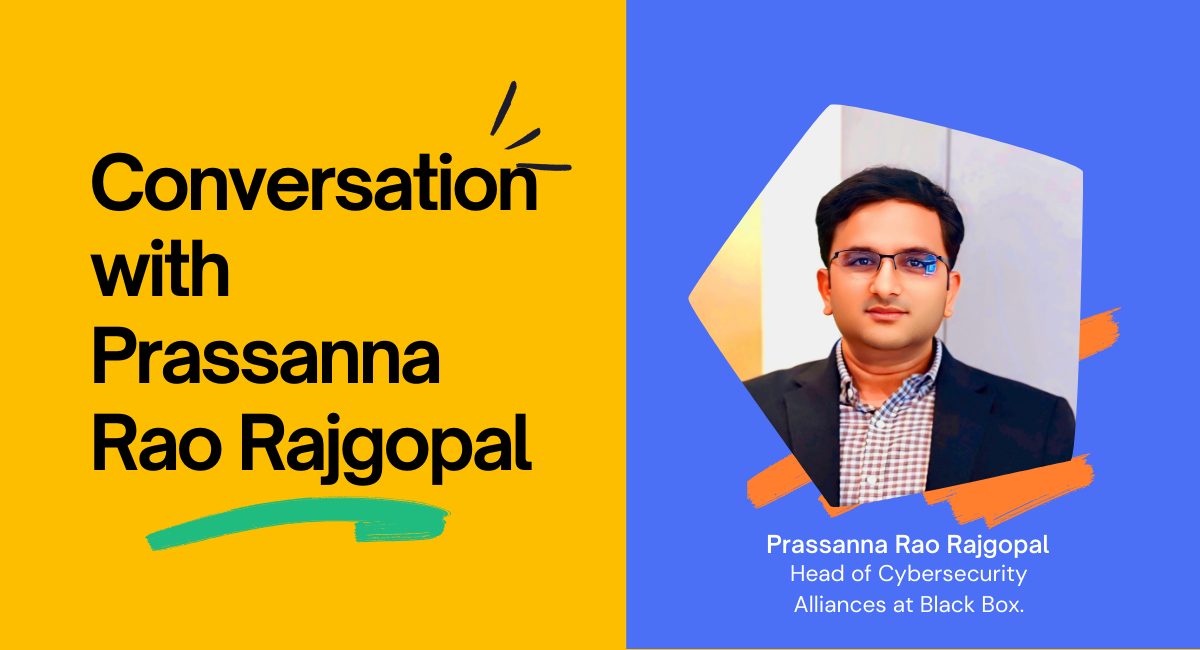

Here is an interview with Prassanna Rao Rajgopal, Head of Cybersecurity Alliances at Black Box.
As cybersecurity ecosystems continue to evolve, collaboration, partnerships, and AI-driven services are becoming critical to building resilient security strategies at scale.
One leader driving this shift is Prassanna Rao Rajgopal, Head of Cybersecurity Alliances at Black Box, where he focuses on building partner-led security ecosystems and advancing AI-driven managed security services.
With extensive experience in cybersecurity strategy, alliances, and ecosystem development, Prassanna brings a forward-looking perspective on how organizations can strengthen their security posture through collaboration and innovation.

Prassanna Rao Rajgopal, Head of Cybersecurity Alliances at Black Box.
In this interview with SecureBlitz, he shares insights on his professional journey, the evolving role of cybersecurity alliances, and his views on the future of partner-driven security models. Here is our conversation with Prassanna Rao Rajgopal.
Table of Contents
Interview With Prassanna Rao Rajgopal, Head of Cybersecurity Alliances at Black Box
Q1: Before we dive into AI-driven security and enterprise transformation, can you take us back to where it all began? What first drew you into cybersecurity, and how did those early experiences shape your leadership philosophy?
I began my cybersecurity journey more than two decades ago, when security was still viewed as a technical support function rather than a strategic business priority. I started in security operations and incident response, working directly on high severity incidents where containment speed, forensic accuracy, and executive communication all mattered. Those early experiences taught me something fundamental. Cyber risk is business risk.
As my career progressed, I moved from responding to incidents to designing the systems that prevent them at scale. I have had the privilege of working with large Fortune 500 enterprises including Microsoft, BP, FedEx, Comcast, Conagra Brands, Tyson Foods, McD and Kraft. where cybersecurity is deeply intertwined with operational continuity, global compliance, and brand trust. In those environments, I led SOC transformations, built enterprise-wide vulnerability management programs, and implemented automation frameworks that significantly improved response precision and operational efficiency.
Over time, my work evolved beyond program execution into shaping operating models and security frameworks that could scale across geographies and industries. I began contributing to the development of Zero Trust accelerators, AI driven SOC automation strategies, and alliance-based security ecosystems designed to modernize enterprise defense in measurable ways.
The global threat landscape has transformed dramatically. Organized ransomware groups, AI enabled attacks, cloud expansion, and geopolitical cyber activity have reshaped the playing field. In response, my leadership philosophy evolved toward building adaptive, intelligence driven, and outcome focused security programs.
Today, I believe cybersecurity leadership is about architecting resilience at enterprise scale. Security must enable innovation while continuously reducing risk. Contributing to scalable frameworks that others can adopt and refine has been one of the most meaningful parts of my journey, and it continues to shape how I approach transformation initiatives worldwide.
Q2: Building on that foundation, how has your evolution from frontline operations to AI-driven security leadership shaped the way you design adaptive and scalable cybersecurity programs today?
When I began my career, cybersecurity was perimeter-centric. Firewalls, antivirus, and basic SIEM deployments defined maturity. Security teams were largely reactive, responding to isolated malware outbreaks with limited executive visibility.
Today, the environment is fundamentally different. Threat actors operate as coordinated enterprises. Ransomware ecosystems, supply chain intrusions, AI-enabled phishing, and geopolitical campaigns have elevated cyber risk to a board-level concern. Cloud adoption, SaaS platforms, and distributed workforces have dissolved traditional boundaries, shifting the focus toward identity, data, and real-time telemetry.
Having experienced this shift firsthand, my leadership approach centers on adaptability and measurable outcomes. Scalable programs rely on platform integration, automation, and intelligence-led operations. AI now plays a critical role in detection, response acceleration, and exposure management.
For me, cybersecurity leadership is about architecting resilience that supports business velocity. Security should strengthen growth, not slow it. That principle guides every transformation I lead across global enterprises.
Q3: With boards becoming more engaged in cyber risk, how should CISOs structure conversations to move from technical reporting to strategic accountability?
Boards no longer want dashboards full of alerts and patch counts. They want clarity on exposure, resilience, and business impact. The shift from technical reporting to strategic accountability begins with translating cyber risk into financial and operational language.
CISOs should anchor discussions around three elements: risk quantification, resilience metrics, and decision tradeoffs. Instead of reporting vulnerability volume, report potential loss scenarios, crown jewel exposure, recovery time objectives, and control maturity aligned to frameworks such as NIST CSF or ISO 27001. Tie threat intelligence to business processes, not just infrastructure.
Boards also expect evidence of readiness. That includes tabletop exercises, incident response testing, ransomware recovery validation, third party risk concentration analysis, and measurable reduction in attack surface over time.
Most importantly, the conversation must move from “Are we secure?” to “Are we prepared, and what level of risk are we willing to accept?”
When CISOs frame cybersecurity as a governance and capital allocation decision, not just an IT function, they earn a strategic seat at the table and drive true accountability.
Q4: In your current role leading Cybersecurity Alliances at Black Box, what distinguishes your strategic contributions, and how do they influence enterprise security outcomes at scale?
At Black Box, my mandate goes beyond transactional partnership management. It is strategic ecosystem architecture. My role involves aligning major cybersecurity platforms across network, endpoint, identity, cloud, and asset visibility into unified, outcome driven solutions.
What distinguishes this contribution is the integration model. Instead of positioning vendor tools independently, I focus on engineering alignment, joint solution blueprints, and measurable service delivery models that translate into scalable managed security offerings. This includes Zero Trust frameworks, AI augmented SOC operations, and platform consolidation strategies that reduce client complexity while strengthening resilience.
From a leadership perspective, the objective is to influence both revenue acceleration and security posture improvement simultaneously. By building structured alliance scorecards, joint go to market frameworks, and co engineered offerings, we enable enterprises to move from fragmented security stacks to integrated defense architectures.
In a landscape where tool sprawl creates operational blind spots, strategic alliance leadership becomes a force multiplier. My contribution centers on making that ecosystem both technically coherent and commercially sustainable.
Q5: Can you share examples of how your alliance-led strategy has produced measurable enterprise and industry impact?
In my previous leadership role at Infosys and in my current position leading Cybersecurity Alliances at Black Box, I have focused on transforming partnerships into engineered integration ecosystems rather than transactional vendor relationships.
In earlier roles, alliance-driven cybersecurity strategies contributed to over $50M in new and renewal cybersecurity business across North America, while accelerating pipeline growth by approximately 25 percent year over year. By formalizing joint Zero Trust and AI-augmented SOC frameworks with strategic partners, we improved cross-domain telemetry visibility and reduced operational tool sprawl for enterprise clients across retail, healthcare, manufacturing, and financial services.
These repeatable integration blueprints reduced manual SOC workload through automation models, shortened incident response cycles, and supported measurable attack surface reduction in large-scale hybrid environments.
At Black Box, I am institutionalizing this model through structured alliance scorecards, joint engineering validation, and scalable managed security offerings. The significance lies in converting platform integration into a standardized growth and resilience engine that influences both enterprise security posture and sustained revenue expansion.
Q6: You developed a wearable cybersecurity device concept. What inspired it, and why is it significant in today’s threat landscape?
The wearable security concept emerged from a recurring observation across enterprise environments: automation can validate credentials, but it cannot always validate human intent.
As Zero Trust architectures matured, I saw a gap in high-risk operational workflows, particularly in privileged access and sensitive infrastructure control. While working with large enterprises, I recognized that adding an out-of-band, human-centric verification layer could meaningfully reduce insider risk and high-impact intrusion scenarios.
The UK Intellectual Property Office granted registration for this wearable security design, validating its novelty. The concept integrates physical confirmation into digital trust decisions, extending security beyond dashboards into contextual, real-time human signaling.
What makes it significant is not the device alone, but the architectural shift it represents. It introduces a practical framework for embedding human validation into automated security ecosystems. Enterprise innovation teams have evaluated the model for potential pilot discussions, reinforcing industry interest in redefining how trust is verified in high-stakes environments.
Q7: Your book “The AI Shield” has received attention across both industry and academia. What gap were you addressing, and how has it influenced enterprise security conversations?
The AI Shield was written to address a practical gap I observed while advising enterprises adopting AI at scale. Many organizations were accelerating AI deployment without structured security governance, model validation discipline, or secure data pipelines. There was strong innovation momentum, but limited operational guardrails.
The book translates complex AI risk concepts into actionable enterprise frameworks, covering secure model lifecycle design, adversarial testing, data integrity controls, and governance integration. Its objective was not theory, but implementation clarity for CISOs and technical leaders.
The response has been encouraging. The publisher documented direct engagement at a major international book fair, and academic institutions have formally added the book to their library collections. Industry practitioners have referenced its AI governance models in executive discussions and planning sessions.
The book is publicly available through Amazon (https://amzn.in/d/4LyCRlk), reflecting its broader accessibility to practitioners and academic audiences.
What makes this meaningful is the bridge it creates between AI innovation and enterprise accountability. By connecting governance architecture with operational execution, the work contributes to shaping how organizations secure AI-driven environments at scale.
Q8: As AI becomes embedded across enterprise workflows, what core principles should organizations adopt to secure AI systems responsibly and at scale?
As AI becomes embedded across enterprise workflows, organizations must treat AI systems as critical infrastructure, not experimental tools. The first principle is secure data foundations. AI is only as trustworthy as the data pipelines that feed it, so strong identity controls, data integrity validation, and provenance tracking are essential.
The second principle is model lifecycle governance. This includes controlled training environments, adversarial testing, version accountability, and continuous monitoring for drift, bias, and manipulation. AI models should be governed with the same rigor as production software, if not more.
Third is architectural containment. AI systems must operate within defined trust boundaries, with least-privilege access to data, APIs, and automated actions. Agentic workflows should be observable, auditable, and reversible.
Finally, human oversight remains non-negotiable. AI should augment human decision making, not silently replace it. Clear accountability, escalation paths, and fail-safe mechanisms are critical.
When these principles are designed into the architecture, AI becomes a scalable advantage rather than an uncontrolled risk. Responsible AI security is not a feature. It is an operating discipline.
Q9: How can enterprises operationalize responsible AI security in real-world environments, and what role do security platforms and strategic alliances play in enabling this at scale?
Operationalizing responsible AI security requires treating AI as a production system, not a side experiment. In real-world environments, that means embedding security controls directly into data pipelines, model lifecycles, and automated workflows from day one. Enterprises must standardize telemetry, enforce identity-centric access, validate models continuously, and ensure AI-driven actions are observable and reversible.
This is where security platforms and strategic alliances become essential. No single tool can secure the AI lifecycle end to end. Platform integration enables unified visibility across cloud, endpoint, network, and data layers, while alliances allow organizations to move faster by leveraging pre-engineered integrations and proven architectures.
From an execution standpoint, alliances shift AI security from custom engineering to repeatable operating models. They reduce deployment friction, accelerate governance maturity, and enable scalable managed services. When platforms are aligned through strategic partnerships, enterprises can innovate with AI while maintaining control, accountability, and resilience.
At scale, responsible AI security is not achieved through isolated controls, but through ecosystems designed to operate securely, consistently, and measurably across the enterprise.
Q10: As AI, automation, and ecosystem-driven security continue to converge, how do you see the cybersecurity industry evolving over the next decade, and what role will strategic alliances play in shaping that future?
Over the next decade, cybersecurity will evolve from a collection of controls into an adaptive operating system for digital trust. AI will accelerate detection, decision support, and automation, but the real transformation will come from how security is architected and governed at scale. Enterprises will move toward platform-centric architectures where identity, data, and resilience form the core control planes.
Strategic alliances will play a defining role in this shift. No single vendor or organization can address the complexity of AI-driven environments alone. Alliances enable deep integration, shared intelligence, and repeatable architectures that scale across industries and geographies.
The leaders who shape the future of cybersecurity will be those who design ecosystems, not silos. They will balance innovation with accountability, automation with human oversight, and speed with resilience. That convergence of AI, platforms, and alliances will define the next era of enterprise security and digital trust.
Editor’s Closing Remarks
As cybersecurity enters a defining decade shaped by AI, geopolitical risk, and ecosystem interdependence, leaders who can bridge technical depth with enterprise strategy will shape the industry’s direction.
Through global advisory work, published research, intellectual property innovation, and strategic alliance leadership, Prassanna Rao Rajgopal has played a meaningful role in that evolution across North America and international markets.
His focus on scalable resilience, responsible AI governance, and integrated security architecture reflects the type of leadership required as digital trust becomes a competitive differentiator. The next era of cybersecurity will demand systems that endure volatility while enabling growth, and this conversation highlights the thinking behind that shift.
INTERESTING POSTS
- Enterprise Security Guide: Your Roadmap To A Secure Business
- Business Class Deals UK: The Role of Regional Airports
- Cybersecurity Is Now a Financial Disclosure Issue: Are Boards Ready?
- Why Cybersecurity is a Business Strategy
- Why Digital Resilience Is Key In An Uncertain World
- Securing AI Data Growth with Scalable Object Storage
About the Author:

Daniel Segun is the Founder and CEO of SecureBlitz Cybersecurity Media, with a background in Computer Science and Digital Marketing. When not writing, he's probably busy designing graphics or developing websites.



