

In this post, I will show you the top NFL prediction market platforms and apps in 2026.
Prediction markets have changed how many people follow the NFL, and the shift is easy to miss if you only see the headline percentages.
These are not fixed quotes set by a house. They are event contracts listed on regulated exchanges, where the displayed percentage reflects what participants collectively think an outcome is worth. The number moves because people move it.
Below is a round-up of the platforms in this space, starting with the one built around sports.
Table of Contents
1. Fanatics Markets
Suited to: sports-first participants who want NFL markets alongside broad category coverage.
Fanatics Markets sits inside the wider Fanatics ecosystem, which gives it something the others do not: sports brand recognition among people who were not previously trading.
How the NFL board is structured
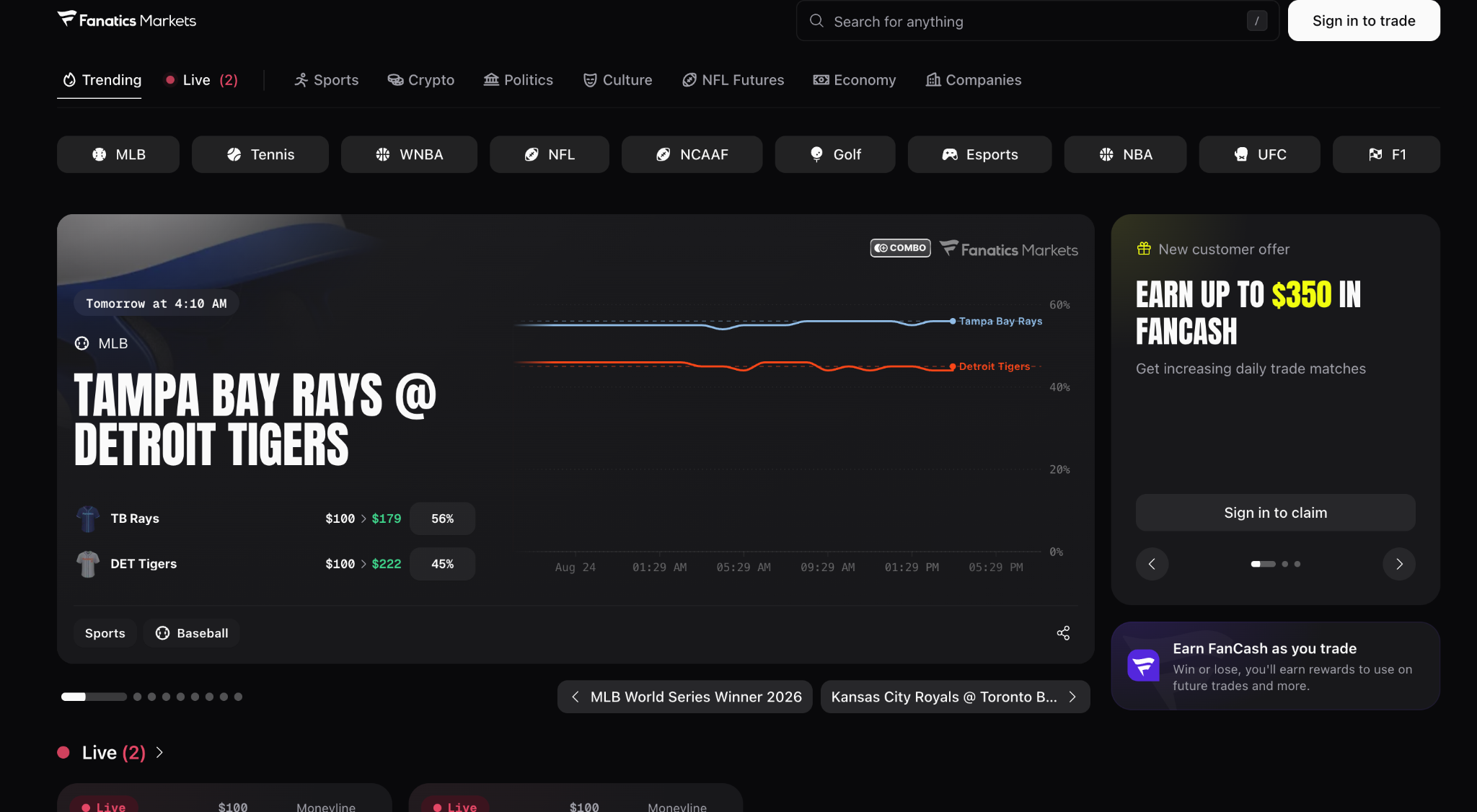
Markets are listed as moneyline pairs, showing the implied percentage for each team alongside what a $100 position returns if that outcome resolves correctly. Each listing also displays volume, the figure most people skip and probably should not.
A snapshot from a late August session shows how that looks in practice.
Pittsburgh Steelers at Buffalo Bills headlined the board for the Friday 28 August fixture, with Buffalo implied at 55 percent against Pittsburgh at 46 percent. A $100 position on Buffalo showed a $182 return, against $217 for Pittsburgh.
The chart is worth noting. Across the Aug 21 to Aug 26 window the two lines crossed more than once, with a sharp move around Aug 24 before settling. A five-day chart shows that movement more honestly than any single percentage.
Where the board was tightest
Four matchups showed genuine disagreement, which is where prediction market pricing tells you the most.
Seattle Seahawks at Kansas City Chiefs priced at 49 percent to 52 percent on $650 volume, the closest market listed. San Francisco 49ers at Las Vegas Raiders sat at 47 percent to 54 percent on $3,000, tied for the deepest on the board. Tampa Bay Buccaneers at Jacksonville Jaguars showed 54 percent to 47 percent on $1,000. And Houston Texans at Carolina Panthers at 55 percent to 46 percent on $543.
Where consensus had formed
Atlanta Falcons at Miami Dolphins showed the widest gap on the board at 66 percent to 35 percent, with Miami at a $286 return on $513 volume. LA Rams at LA Chargers sat at 37 percent to 65 percent on $2,000 volume. Washington Commanders at Baltimore Ravens priced at 40 percent to 60 percent on $941.
The rest of the board: Patriots vs Browns at 57 to 42 percent on $3,000, Giants vs Jets at 59 to 41 percent on $533, Bengals vs Eagles at 43 to 58 percent on $154, and Cardinals vs Packers at 57 to 44 percent on $784.
Regulatory structure
Event contracts are listed, priced and cleared by CDNA, a CFTC-regulated exchange and clearinghouse. Customers are introduced by Paragon Global Markets, LLC, doing business as Fanatics Markets IB, an Introducing Broker registered with the CFTC and a member of the NFA.
That structure matters when comparing platforms, because it determines what oversight applies to the contracts rather than just the interface.
Beyond the NFL board
Sports coverage spans tennis, soccer, baseball, basketball, golf, NCAAF, esports, fighting, motorsports and hockey, plus a separate NFL Futures section. Non-sports categories cover crypto, politics, culture, economy and companies.
For anyone following the season market by market, the NFL betting board updates continuously and can be charted across live, 24-hour and full-window views.
Consider: availability varies by state and eligibility requirements apply. Volume ranged from $154 to $3,000 in this snapshot, so depth is not uniform across the board.
2. Kalshi
Suited to: participants who want breadth across non-sports categories.
Kalshi operates as a CFTC-regulated designated contract market and built its reputation on economics, politics and macro events before expanding into sports.
Consider: the platform’s identity is broader than sports, which suits participants who came for elections or inflation prints. Someone arriving specifically for NFL markets may find the sports experience less central than on a sports-first platform.
3. Polymarket
Suited to: participants comfortable with crypto-native infrastructure.
Polymarket is known for high-profile event markets and deep liquidity on major questions, with a large following around politics and culture.
Consider: the crypto-based structure is a meaningful difference in how funding and settlement work, and it suits people already comfortable in that environment more than those coming from a traditional sports background.
4. DraftKings Predictions
Suited to: existing DraftKings users wanting prediction markets in a familiar app.
DraftKings has extended into prediction markets, which gives its established user base a route in without learning a new interface.
Consider: the prediction market’s product sits alongside other offerings rather than being the core proposition, so the depth of market coverage differs from platforms built around event contracts alone.
5. FanDuel
Suited to: existing FanDuel users exploring event-based markets.
FanDuel has similarly moved into the space, with the same advantage of an existing audience and app familiarity.
Consider: as with DraftKings, prediction markets are one product among several, and availability varies by state.
Comparison at a glance
| Platform | Sports-first | Non-sports categories | Structure |
| Fanatics Markets | Yes | Crypto, politics, culture, economy, companies | Event contracts via CDNA |
| Kalshi | No | Extensive | Designated contract market |
| Polymarket | No | Extensive | Crypto-native |
| DraftKings Predictions | Partly | Limited | Prediction markets product |
| FanDuel | Partly | Limited | Prediction markets product |
Platform details other than Fanatics Markets reflect published positioning. Confirm current availability and features directly.
How to read an NFL prediction market board
Four things worth understanding before the percentages mean anything.
Percentages do not sum to 100. Buffalo at 55 and Pittsburgh at 46 sums to 101. Every pair on the board behaves this way. The gap reflects the two-sided spread that keeps liquidity available on both outcomes, and it is part of your calculation rather than an error.
Volume qualifies the percentage. A 57 percent implied outcome on $3,000 and a 43 percent implied outcome on $154 are not equivalent signals. The first reflects a genuine collective view. The second reflects very few positions.
Charts show conviction, not just price. A market holding a steady band all week says something different from one that crossed twice in five days. The Steelers and Bills chart did the latter.
Implied percentage is not a forecast. It is what participants currently think an outcome is worth. Related, but not identical.
Account security matters more here than in most apps
One thing worth raising, because it applies across every platform on this list.
These are financial accounts holding funded positions, not entertainment logins. That makes them a more attractive target than a streaming subscription, and the account security practices you would apply to a brokerage account belong here too.
The same habits that apply to online banking security apply here. Use a long, unique password rather than one recycled from elsewhere, since length does more for resistance than complexity rules do. Enable two-factor authentication where offered, so a compromised password alone is not enough to get in.
Then add two that are specific to this context. Be alert to phishing timed around major fixtures, because attackers schedule campaigns for periods of heightened activity and a Sunday morning “verify your account” message lands differently during a game week. And review connected devices periodically.
None of that is unusual advice. The point is that people apply brokerage-grade caution to brokerage accounts and app-grade caution to apps, and these sit in the first category regardless of how the interface feels.
What to check before you participate
Availability in your state. Access varies, and eligibility requirements apply.
Age and residency. Participants must be US residents aged 21 or over.
The risk profile. Event contracts are derivatives products. Trading them involves significant risk and is not appropriate for everyone. You risk losing the cost of entering a transaction, including fees.
What is not endorsed. No event contract is endorsed by any sports league, association or individual participant, and the use of a team or league name does not indicate endorsement.
Data timing. Live market data is informational and may be delayed.
The short version
The NFL board is a useful place to understand how prediction markets work, because the events are frequent, clearly resolvable and heavily followed.
Fanatics Markets suits participants who want that alongside genuine sports depth and broad category coverage. Kalshi and Polymarket suit those whose interest runs wider than sport. DraftKings and FanDuel suit existing users who want prediction markets inside an app they already use.
Whichever you look at, read the volume alongside the percentage, note that pairs sum above 100 for structural reasons, and treat the account like the financial account it is.
INTERESTING POSTS
- Who Is the Youngest Player in the NFL? Rising Young Football Players Explained
- Hardware-Rooted Trust: Why Security Must Start at the PCB Level
- The IoT Appliance Repair Gap: When Your Wi-Fi Dishwasher Breaks, Who Actually Fixes It?
- Protecting Your Predictive Edge From Digital Threats
- The Fastest Way to Trade Prediction Markets Just Went Live
About the Author:

Mikkelsen Holm is an M.Sc. Cybersecurity graduate with over six years of experience in writing cybersecurity news, reviews, and tutorials. He is passionate about helping individuals and organizations protect their digital assets, and is a regular contributor to various cybersecurity publications. He is an advocate for the adoption of best practices in the field of cybersecurity and has a deep understanding of the industry.