


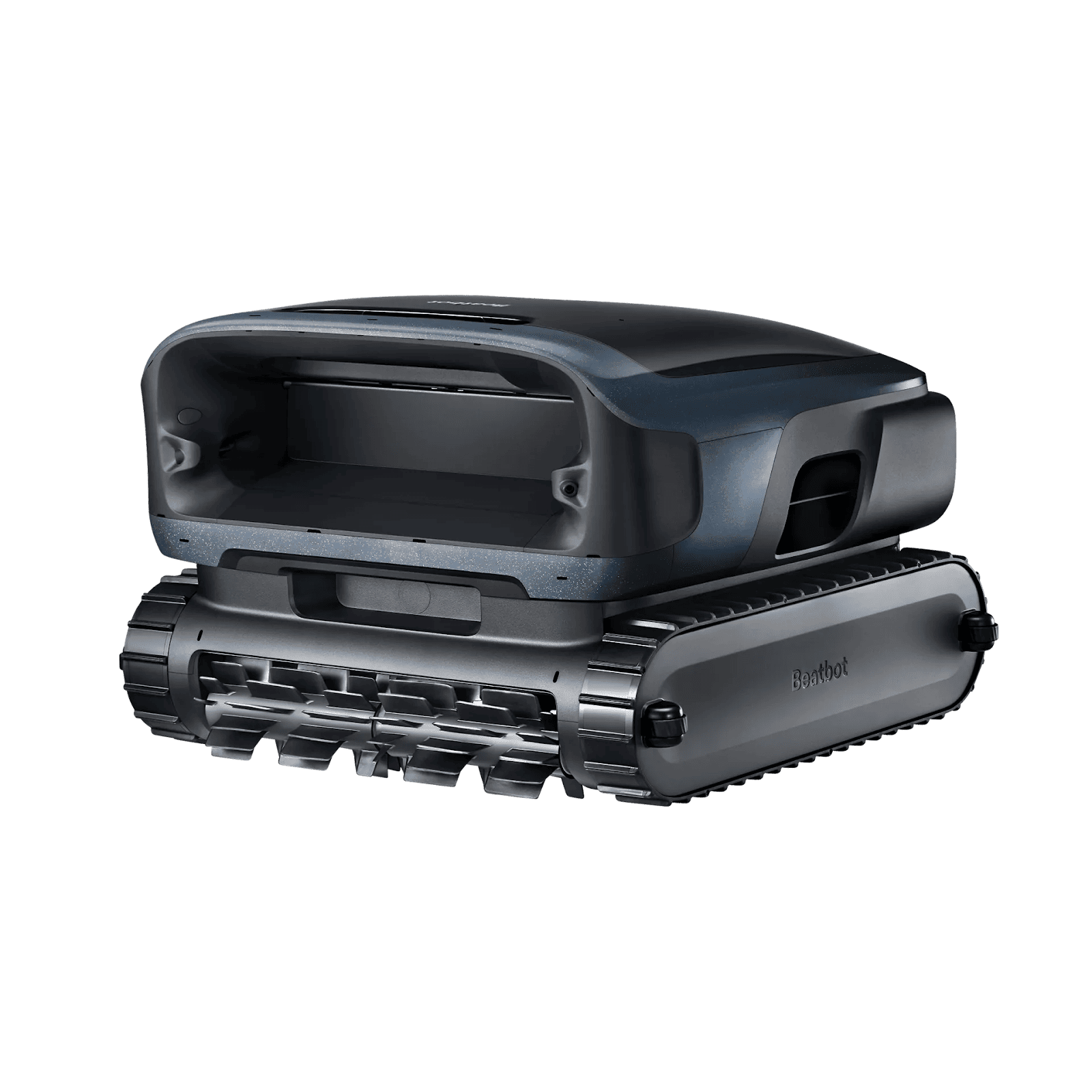

In this post, I will address the fail-safe design in robotic pool cleaners and show you how auto-recovery redefines true pool automation.
In enterprise IT architecture and systems engineering, the concept of “fail-safe” design is a foundational baseline. When a server drops a packet, a node goes offline, or a network encounters a localized disruption, the overarching system does not crash. It reroutes, recovers, and maintains operational continuity.
Yet, when engineering hardware for submerged physical environments, this critical principle of auto-recovery has historically been ignored. For decades, aquatic hardware operated on a binary state: it was either functioning perfectly, or it was completely stuck, waiting for a human operator to physically intervene.
True pool automation depends on fail-safe architecture to bridge this exact gap. The reality of an underwater environment is highly hostile to standard robotics. It is a dynamic, high-resistance space where standard terrestrial navigation rules simply do not apply. If an underwater machine fails to compute its next move, it risks catastrophic motor burnout, hydraulic entanglement, or sinking into an unrecoverable state. In this space, an automated system is not defined by how well it operates when conditions are perfect. It is defined by how its architecture reacts when conditions inevitably fail.
Table of Contents
Why Traditional Automatic Pool Vacuums Fail in Complex Pool Environments
In the context of hardware deployment, a swimming pool is essentially a zero-trust environment. Unlike a flat, dry living room floor where obstacles remain static, the underwater topology is fraught with kinetic variables. Thermal currents can push a moving chassis off its plotted course.
Microscopic algae blooms continuously alter the friction coefficient of the plaster, suddenly turning a routine 90-degree wall climb into a critical slip hazard. Raised main drains act as physical traps, engineered to pull water down with immense hydraulic force, easily capturing a poorly designed machine.
When deploying early-generation automatic pool vacuums, engineers quickly discovered that basic algorithmic logic was highly insufficient. If a legacy machine encountered a raised drain or an unusually steep transition from the shallow end to the deep end, it would register a physical block.
Lacking a fail-safe protocol, the drive motors would continuously spin against the obstacle until the internal battery depleted or the plastic gears stripped entirely. The human operator was forced to act as the ultimate fail-safe, retrieving the stalled unit manually. In modern systems design, a hardware unit that requires manual rescue for a routine environmental anomaly is considered a failed deployment.
How Inground Pool Vacuums Use Auto-Recovery to Prevent Stalling
To achieve true operational resilience, modern aquatic robotics must be built with comprehensive auto-recovery loops. This requires a fundamental shift from reactive mechanical hardware to proactive, sensor-driven edge computing. When a high-performance inground pool vacuum navigates a submerged grid, it must constantly monitor its own physical state through internal telemetry to prevent fatal hardware stalls.
The core of an auto-recovery system lies in real-time torque monitoring and spatial awareness. If the unit’s drive tracks become caught on a submerged fixture, the internal System on a Chip (SoC) detects a sudden spike in motor impedance. Rather than forcing the motors to burn out against the obstacle, the fail-safe protocol is triggered within milliseconds.
The system immediately cuts power to the forward drive, reverses the thrust of the internal impeller to alter its buoyancy, and executes a randomized angular retreat to break the physical lock. Leading-edge robotic pool cleaners, including models like the Beatbot Sora 70, incorporate these micro-adjustments to ensure that an entrapment event lasts only seconds, allowing the unit to resume its SLAM (Simultaneous Localization and Mapping) routing without ever triggering a user alert or requiring a manual reboot.
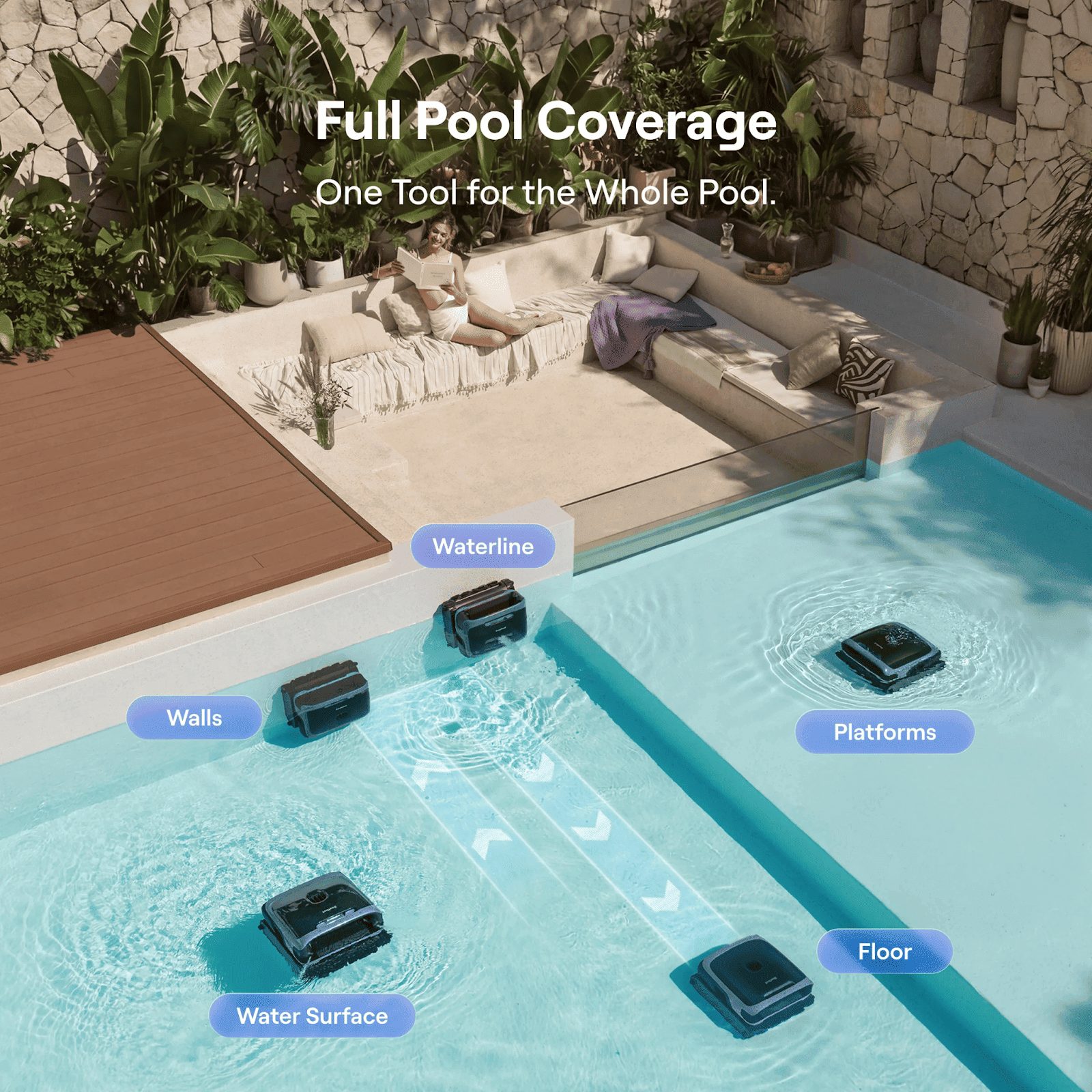
How Independent Robotic Pool Cleaners Prevent System-Wide Failures
Fail-safe engineering is not exclusively about escaping physical traps; it is also about architectural redundancy. Legacy pool cleaning systems were inherently flawed because they relied heavily on a centralized single point of failure: the estate’s primary hydraulic pump.
If the main pump lost prime, suffered a voltage drop, or if the filter basket became choked with heavy debris, the tethered cleaner died instantly. The entire maintenance ecosystem was deeply vulnerable to a single hardware fault.
Modern robotic pool cleaners eliminate this vulnerability through complete decentralization. By housing the high-density lithium battery, the micro-filtration canister, and the processing unit entirely within the submerged chassis, the robot operates as an independent edge node. It does not rely on the home’s main plumbing or electrical grid during its active cycle.
If the primary pool pump fails during a storm, the robotic unit continues to map, scrub, and filter the water autonomously. This strict isolation of critical functions ensures that environmental maintenance continues regardless of the operational state of the surrounding infrastructure.
How Sensor Fusion Helps Robotic Pool Cleaners Avoid Getting Stuck
To preemptively avoid failure states altogether, advanced aquatic machines utilize real-time sensor fusion. Because water rapidly absorbs the radio frequencies necessary for cloud computing, all sensor data must be processed locally on the edge to avoid catastrophic latency. The hardware must be capable of sensing, computing, and reacting without waiting for a server response.
The robot continuously aggregates data from multiple onboard sources: ultrasonic sonar pings to measure the exact distance to the next wall, dual-axis gyroscopes to determine the pitch and roll of the chassis, and pressure sensors to verify exact depth. When the gyroscope detects an abnormal tilt—indicating the machine is about to flip over backward while climbing a vertical wall—the logic board instantly overrides the climbing sequence.
It reduces the thrust of the internal water pump, allowing gravity to gently pull the machine back to a safe, horizontal orientation on the pool floor. By predicting the failure state before it occurs, the hardware maintains continuous uptime.
What True Autonomous Pool Cleaning Really Means
The evolution of aquatic robotics demonstrates a critical truth in systems engineering: baseline performance metrics are entirely irrelevant if the hardware lacks resilience. A machine that maps a grid perfectly but requires a human to rescue it from a drain cover is not a truly autonomous device; it is an ongoing liability disguised as a convenience.
In high-performance pool environments, autonomy is no longer about cleaning speed alone. It is about resilience. A robotic pool cleaner that can recover without human intervention is not just automated — it is engineered to operate independently, even when conditions are imperfect. This is where modern pool automation finally meets true autonomy.
INTERESTING POSTS
About the Author:

Amaya Paucek is a professional with an MBA and practical experience in SEO and digital marketing. She is based in Philippines and specializes in helping businesses achieve their goals using her digital marketing skills. She is a keen observer of the ever-evolving digital landscape and looks forward to making a mark in the digital space.


