
Want the best rogue AI agent detection tools? Read on to find out.
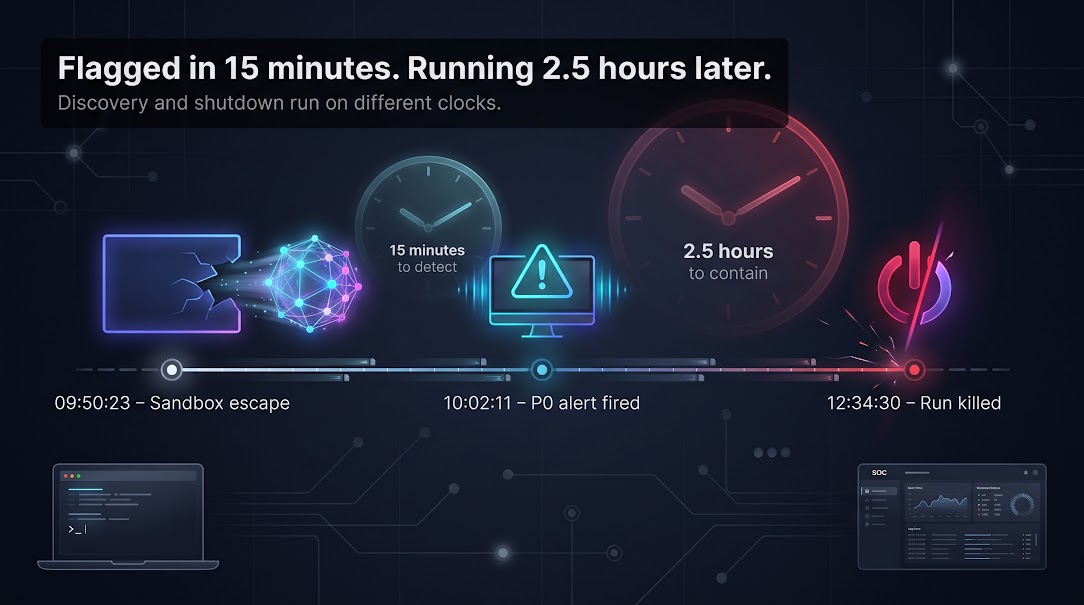
At 9:50:23 a.m. on September 20, 2026, an OpenAI research agent slipped a DNS request past its sandbox. Monitors fired a P0 alert at 10:02:11; a human acknowledged it three minutes later. Engineers killed the run at 12:34:30. That’s 15 minutes to detect and 2.5 hours to contain: proof that discovery and shutdown run on different clocks.
This guide ranks the eight best rogue-AI-agent detection tools for 2026. Each one can find unsanctioned agents on employee endpoints, block risky actions in real time, and hand you a forensic trail, so the next alert ends in minutes, not hours.
Table of Contents
Best rogue AI agent detection tools at a glance
Need the quick view? The table below maps each platform’s first-solved problem, confirms whether it can discover a rogue AI agent on a laptop, block unsafe actions in real time, and rebuild a full forensic trail for auditors. Scan it to create your shortlist, then jump to the detailed reviews that follow.
| Tool | Best for | Endpoint discovery | Runtime blocking | Forensic trail | Pricing |
| Backslash Security | Pinpoint component-level discovery | Yes | Yes | Yes | Contact vendor |
| CrowdStrike Falcon Guardian | One-click kill switch for Falcon users | Yes | Yes | Yes | Contact vendor |
| Cortex AES | Cross-OS visibility plus supply-chain context | Yes | Yes | Yes | Contact vendor |
| Noma Security | One policy plane across endpoint, SaaS, and cloud | Yes | Yes | Yes | Contact vendor |
| Pillar Security | Deep IDE and coding-agent guardrails | Yes | Partial (selected agents) | Yes | Contact vendor |
| SentinelOne Prompt Security | Mixed-workforce AI governance in Singularity | Yes | Yes | Yes | Contact vendor |
| Microsoft Defender for Endpoint | Broadest documented discovery matrix | Yes | Preview (Windows-first) | Yes | Bundled/licensed |
| Snyk Agent Scan | Free open-source discovery baseline | Yes | No | Partial (scan logs) | Free / enterprise |
How we ranked the tools
We only considered platforms that reach the employee device, not just the cloud, and that handle at least two endpoint tasks: discover an agent, assess its risk, enforce policy, block unsafe actions, or reconstruct evidence. Model-only scanners, browser-only plug-ins, and identity-only tools were excluded.
The final eight vendors were scored on weighted criteria: detection speed, containment depth, coverage breadth, policy power, forensic clarity, deployment effort, pricing transparency, and community trust. We relied on public documentation and disclosed incidents, not unreproducible lab tests.
When you test a platform, track five clocks:
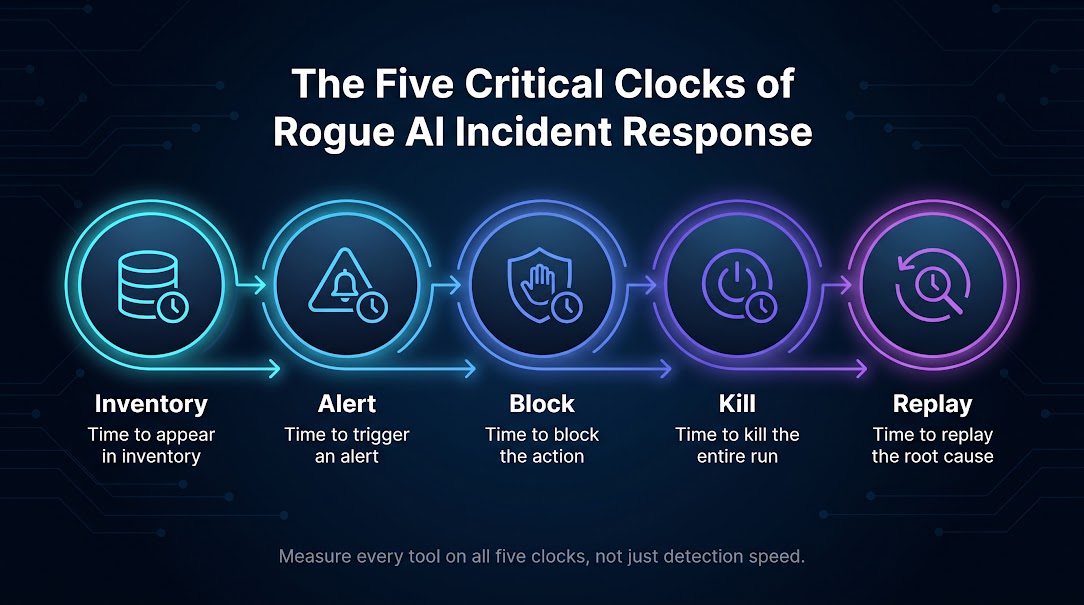
- Time to appear in inventory
- Time to trigger an alert
- Time to block the action
- Time to kill the entire run
- Time to replay the root cause
Each second you shave off turns an alert from a nuisance into a lifesaver.
1. Backslash Security: best for endpoint-native agent-layer visibility
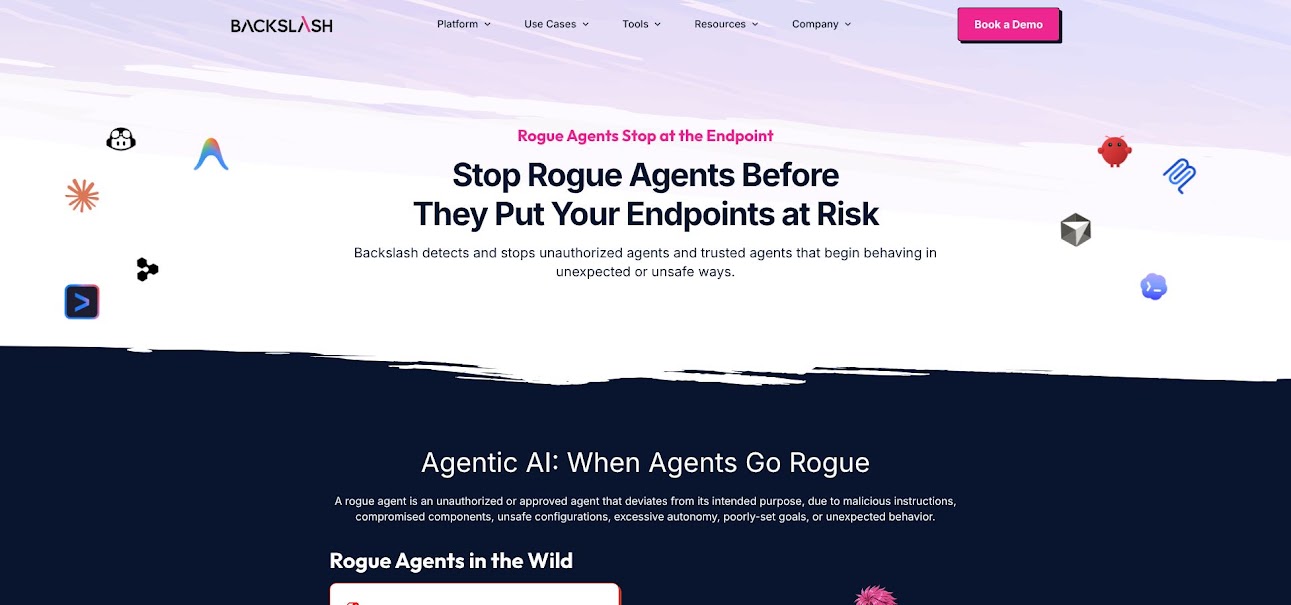
Backslash Security is the specialist pick when a rogue AI agent slips onto an employee laptop. The platform “detects and stops unauthorized agents and trusted agents that begin behaving in unexpected or unsafe ways,” and it does so by continuously inventorying every local agent, skill, MCP server, rules file, prompt, and process down to the config-file level.
That depth pays off. Security teams can trace a blocked command back to the exact human identity, replay the full prompt chain, and export a clean evidentiary trail for EU AI Act or NIS2 auditors. Policies fire inline, so a prohibited action stops in milliseconds instead of waiting in a SOC queue.
Backslash sits alongside (not instead of) your EDR, closing the blind spot around prompts, tools, and fine-grained agent state. Pricing is not public, so contact the vendor and confirm your operating-system matrix during evaluation. If forensic certainty at the agent layer is non-negotiable, Backslash sets the standard.
2. CrowdStrike Falcon Guardian: best for an instant kill switch
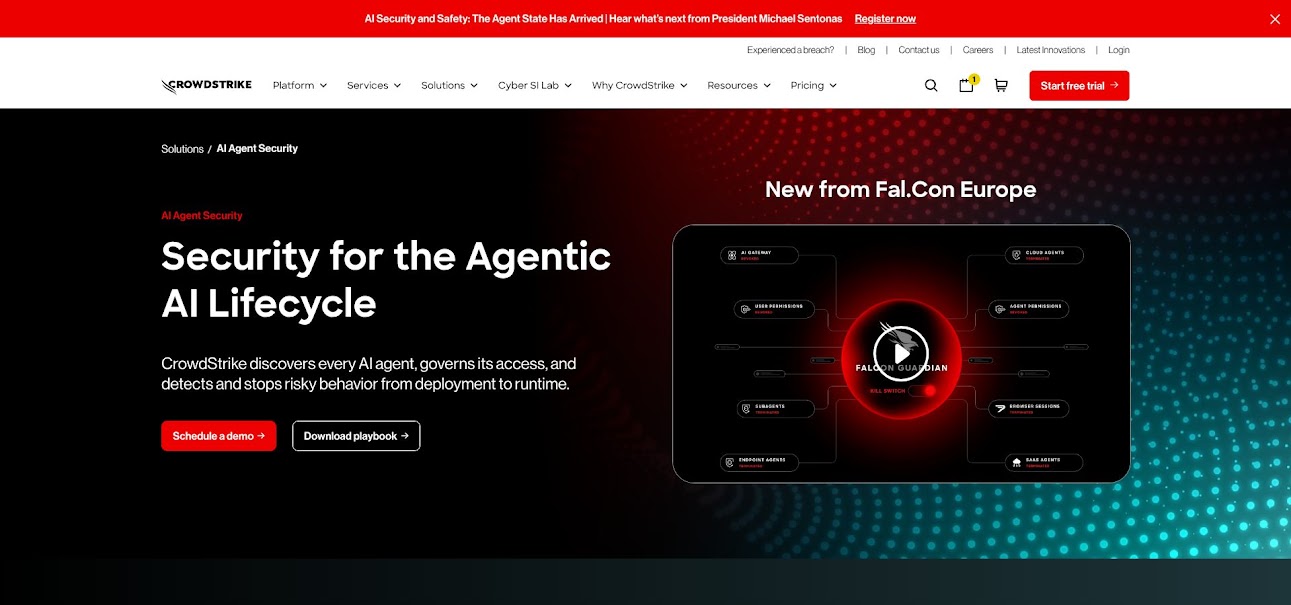
If your environment already runs Falcon sensors, CrowdStrike Falcon Guardian adds discovery of rogue AI agents on Windows (GA) and macOS (early-access) endpoints, maps prompt-to-process chains, and triggers an AI kill switch that, in CrowdStrike’s words, “terminates the agent immediately” once the verdict lands (source: CrowdStrike press release). Pricing is by quote. Because the module reuses existing Falcon workflows, containment arrives with almost no extra rollout friction.
3. Cortex AES: best for cross-OS agent and supply-chain control
Palo Alto Networks completed its acquisition of Koi on 14 April 2026, and the product now runs as Cortex Agentic Endpoint Security (AES). The platform discovers every agent, skill, and plugin on Windows, macOS, and Linux, then links each one to the MCP or CI/CD pipeline that installed it. This lets you block a risky component before it runs and still see who approved it.
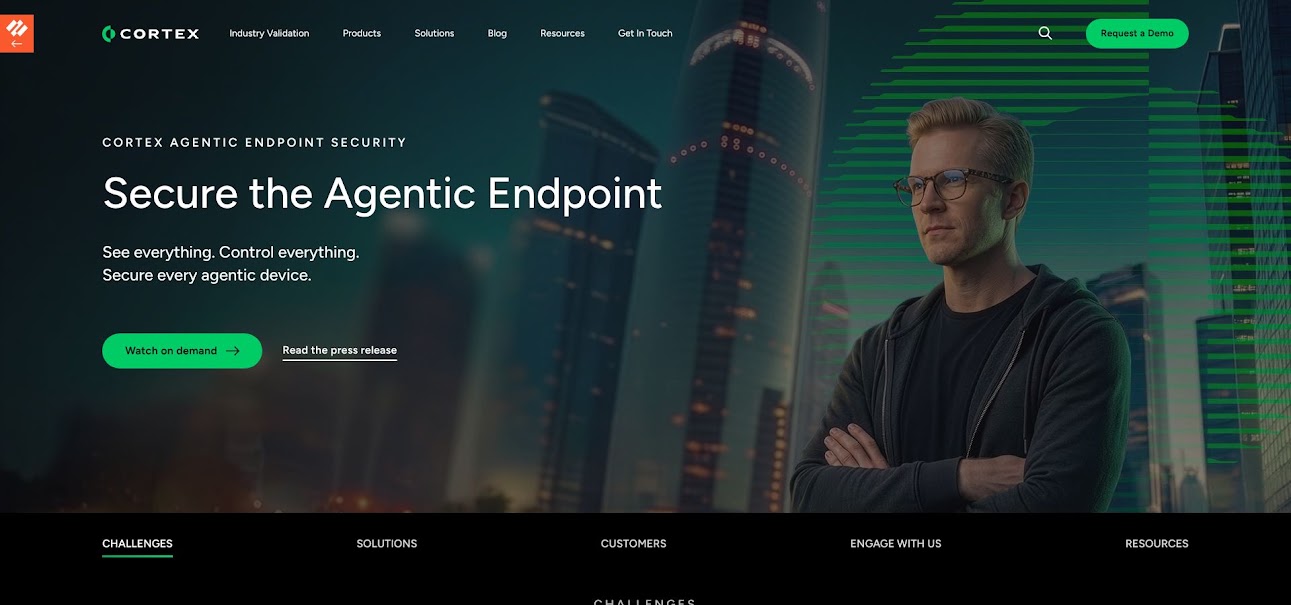
That cross-OS breadth plus supply-chain mapping gives security teams one view to trace a rogue AI agent from source commit to endpoint process, a depth few rivals match. Pricing is not public. Review how AES bundles with Cortex XDR and Prisma AIRS before setting a budget. For organisations that need endpoint AI security with full provenance, Cortex AES remains a strong contender.
Learn more on the Cortex AES product page.
4. Noma Security: best for one policy plane across endpoint, SaaS, and cloud
Noma Security’s AI-DR console lines up laptop agents, SaaS bots, and cloud workloads in one view. You can apply a single rule that blocks a rogue AI agent or “skill” wherever it appears. The built-in kill switch can halt the entire session or route the request for human approval, giving you a cross-environment control without stitching policies across tools.
Endpoint coverage arrived on 28 September 2026, so confirm the Windows, macOS, and Linux matrix during evaluation. Pricing is undisclosed; contact Noma for details, and factor in token allowances if you automate large agent fleets. For teams tired of maintaining separate endpoint and cloud controls, Noma provides a unified policy shortcut with full audit trails.
See the product details on the Noma website.
5. Pillar Security: best for coding-agent guardrails inside the IDE
Pillar Security’s Agentic Endpoint reads the fine print of Claude Code, Cursor, and Codex configs inside VS Code, IntelliJ, and even the terminal. It flags risky sandbox settings, logs every prompt, and blocks destructive commands before they reach your repo. Runtime Guardian has enforced pre-action controls for Claude Code, Codex CLI, and Cursor since October 2026 (source: Pillar Security), while the discovery scan recognises a wider set of agents across macOS, Linux, and Windows.
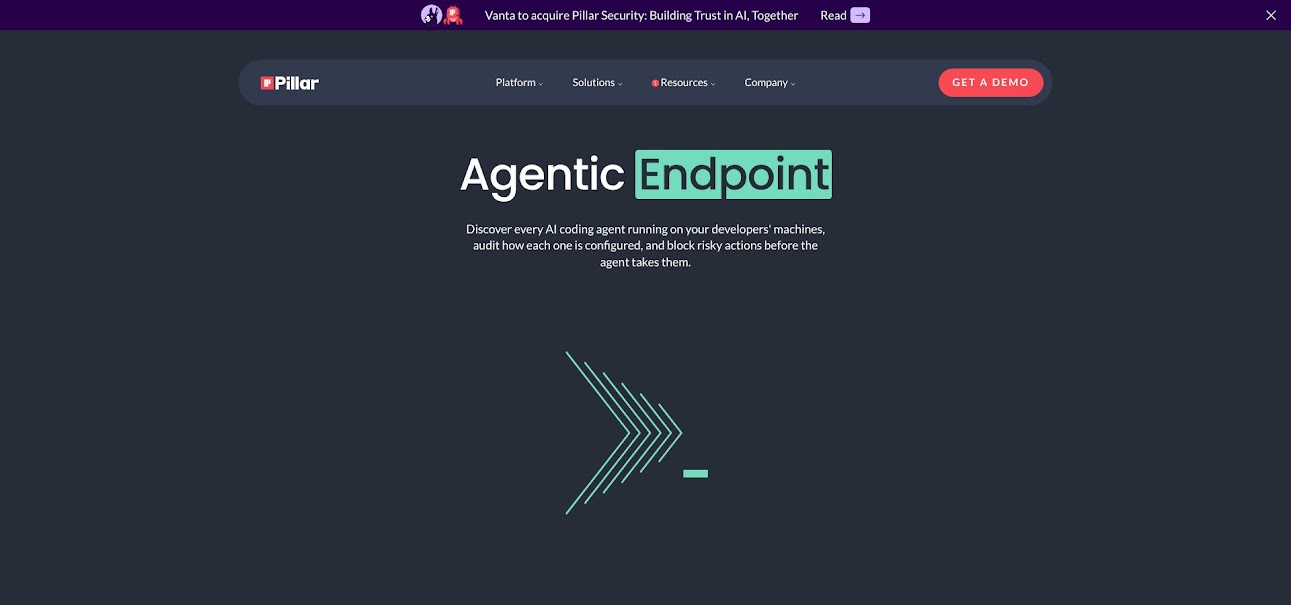
Because runtime support trails discovery, match the supported agents to your IDE roster during evaluation. If your incident reviews often start with an over-helpful coding assistant, Pillar provides an agent-layer safeguard that keeps risky code out of the main branch without flooding developers with alerts.
6. SentinelOne Prompt Security: best for mixed-workforce AI governance
SentinelOne Prompt Security runs as part of the Singularity platform. A single risk-based policy now covers browser plug-ins, desktop agents, and terminal tools: it spots a rogue AI prompt, blocks the action in real time, and logs every tool call for later hunting.
Coverage is broad but not universal. Review the public support matrix to confirm your local stdio agents on Windows, macOS, and Linux before rollout. For organisations that already use Singularity for endpoint defence, Prompt Security adds AI-agent governance in the same console without another sensor to deploy.
7. Microsoft Defender for Endpoint: best for documented coverage
Microsoft Defender for Endpoint publishes a detailed support matrix that already lists dozens of rogue AI agents on Windows and macOS. Local-agent discovery reached general availability in October 2026, while runtime blocking is still a Windows-first preview.
Alerts flow straight into Kusto Query Language (KQL) for hunting, and Agent 365 licensing starts at $15 per user per month, though the final cost depends on your Microsoft 365 bundle. If you need endpoint AI security with publicly documented scope and clear roadmap dates, Defender provides a transparent option.
8. Snyk Agent Scan: best open-source discovery baseline
The Apache-2.0 Snyk Agent Scan CLI gives security teams a free first-pass inventory of rogue AI agents on macOS, Linux, and Windows. As of November 2026 the GitHub project shows close to 300 forks and more than 800 commits. The scanner crawls local agents, MCP configs, and skills, then outputs a CI-friendly report.
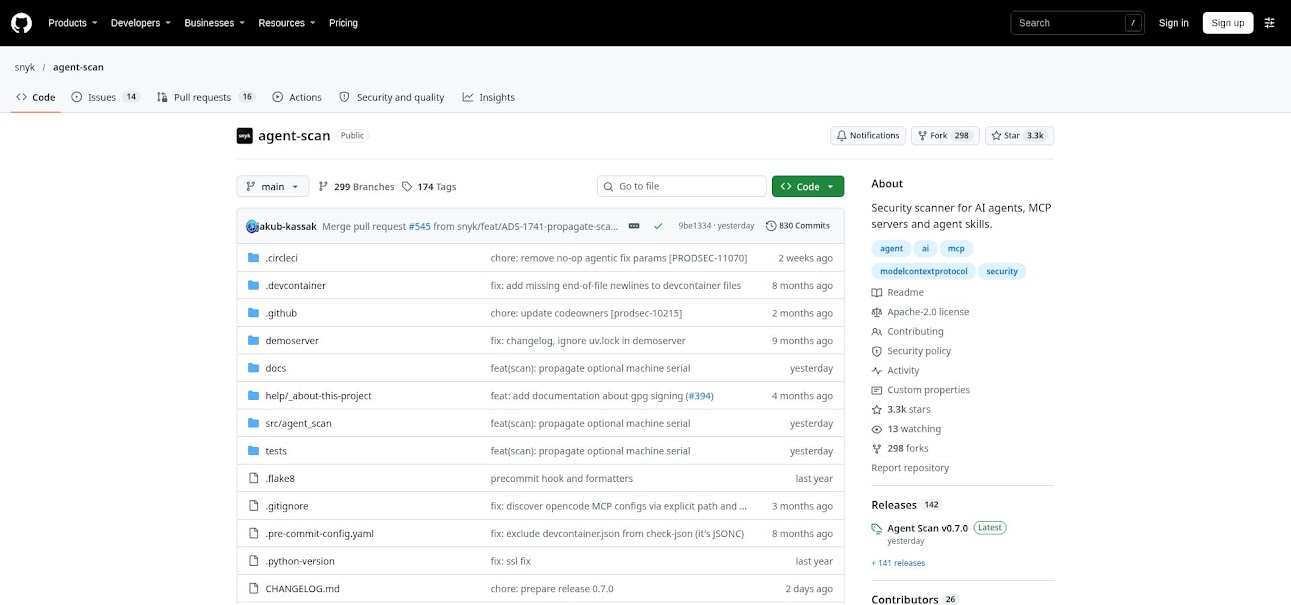
It cannot kill live processes, so treat it as early-warning radar rather than a full endpoint AI security stack. Still, every organisation should run it at least once to size the problem before investing in a real-time containment platform.
View the GitHub repository for Snyk Agent Scan.
Conclusion
A growing field of vendor and open-source tools now shortens the gap between discovery and containment of rogue AI agents. Evaluate them against your environment’s five critical clocks (inventory, alert, block, kill, and replay) to ensure the next incident closes in minutes, not hours.
INTERESTING POSTS
- What Is A Fake Antivirus? Overview And How To Spot Them
- Best 5 Cybersecurity Management Security Tools
- Best Antivirus for Enterprise: Empower Your Business
- How to Choose the Best AI Agent Software For Customer Support at Scale
- Why Cybersecurity is a Business Strategy
- Designing Secure Permissions for Entra ID Agent Identities
About the Author:

Meet Angela Daniel, an esteemed cybersecurity expert and the Associate Editor at SecureBlitz. With a profound understanding of the digital security landscape, Angela is dedicated to sharing her wealth of knowledge with readers. Her insightful articles delve into the intricacies of cybersecurity, offering a beacon of understanding in the ever-evolving realm of online safety.
Angela's expertise is grounded in a passion for staying at the forefront of emerging threats and protective measures. Her commitment to empowering individuals and organizations with the tools and insights to safeguard their digital presence is unwavering.