




In this post, I will discuss the no-contract Internet plans Georgia comparison. Also, I will talk about their speed, price & fees side-by-side.
Georgia internet shoppers can finally skip the fine print. About 52 percent of the state already sits on fiber lines, and 5G fixed-wireless is filling most remaining gaps, according to BroadbandNow Georgia coverage data.
That reach translates into real choice. If your bill jumps or your lease ends, you can change providers next month with no exit fee. In the guide below, we compare every major contract-free option, list their speeds and true costs, and spotlight the hidden fees most charts miss.
Before you pick a plan, lock down security. Our quick secure-home-internet checklist covers strong passwords, router updates and other easy wins—then dive in and find the flexible service that fits your life.
Table of Contents
Why month-to-month internet beats long-term contracts
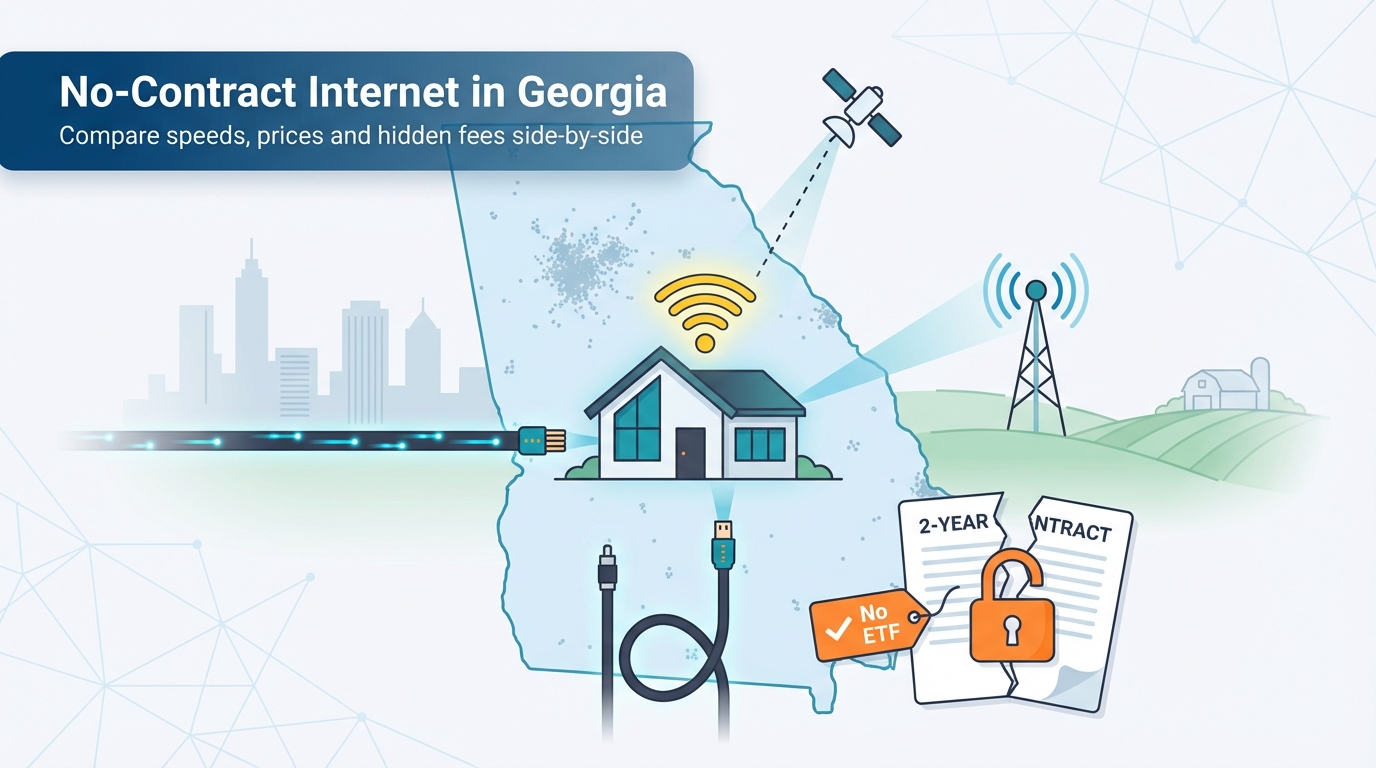
Early-termination fees used to trap Georgia households in two-year agreements. Month-to-month plans remove that penalty. If speeds drop or you move apartments, you can cancel on Friday and start fresh on Saturday with no $200 exit charge.
Flexibility brings hidden perks. Students can pause service between semesters, traveling professionals can test a 5G router during a three-month project and homeowners can switch to fiber the day crews finish the line. Freedom leads to smarter choices.
Afraid a no-contract plan costs more? In most cases it doesn’t. Spectrum’s base package now starts at $30 per month in Georgia, taxes extra, with zero commitment, according to Allconnect’s Georgia pricing data. Several fiber providers, including AT&T, advertise the same promo rate whether you sign a contract or not.
Service quality stays high. The state’s top-rated networks, AT&T Fiber and Google Fiber, operate exclusively month-to-month, so performance—not paperwork—keeps customers.
Watch two trade-offs. Some cable companies add about $10 if you pass on their one-year discount, and nearly all raise the introductory rate after 12 months. The advantage is simple: you can renegotiate or switch the moment the higher bill appears.
Choose a contract-free plan and the balance of power shifts to you. That consumer control is built into the billing cycle.
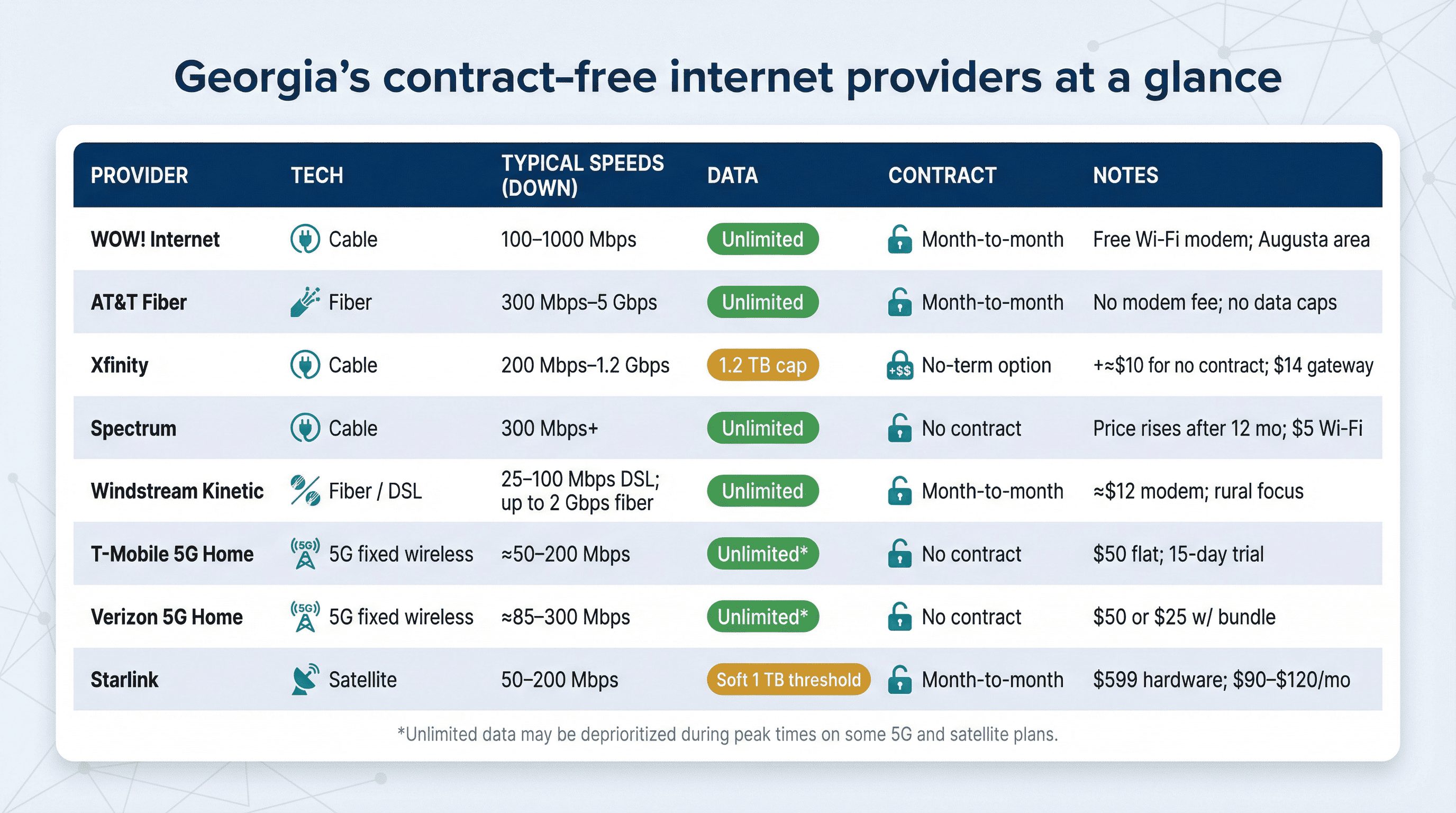
Georgia’s contract-free providers at a glance
Most comparison sites dump giant price tables on the screen. We take a different route, walking you through each network in plain English so you know when you can cancel without penalty.
In the next sections, we break down performance, fees and who benefits most from every provider, one at a time.
WOW! Internet: no fees, no fuss in Augusta and beyond
WOW! keeps the offer simple: one bill, no contract and a free Wi-Fi modem. Before you hop online, follow WOW!’s advice to change the modem’s default password and install the latest firmware. Need step-by-step help with password resets, firmware updates and built-in malware blocking? WOW!’s guide, How to Secure Your Home Internet from Hackers, walks you through the two-minute process and other quick safeguards, sealing your new connection against easy hacks.
The regional cable network reaches a small part of Georgia, mainly Augusta and nearby suburbs, yet performance is solid wherever the lines are active.
Entry speeds of about 100 Mbps cost roughly $40 per month, and the gigabit tier sits near $65. Both plans renew month to month, so you can cancel as soon as service slips or your lease ends.
Because WOW!’s coax lines terminate at neighborhood nodes, download speeds usually stay within 10 percent of the advertised rate. Latency is low enough for online shooters, and the company removed data caps in 2025, so 4K streams will not create extra fees.
Most homes qualify for a free self-install kit; a technician visit is about $50 if you prefer help with the splitter and coax. In either case, no early-termination fee appears on the paperwork.
Renters save close to $200 in hardware costs over a year compared with cable rivals that charge modem rent. The trade-off is geography: move one county east and WOW! gives way to Xfinity or Spectrum.
If Augusta is your ZIP code, WOW! delivers one of Georgia’s clearest contract-free deals.
AT&T Fiber: top-speed workhorse for city and suburb
AT&T spent the past five years laying fiber across metro Atlanta and its fast-growing suburbs, and the results show up the moment you run a speed test. The entry tier delivers 300 Mbps up and down, enough for four simultaneous Zoom calls while the kids stream Disney+. Power users can push service to 1 Gbps, 2 Gbps or even 5 Gbps in qualified neighborhoods.
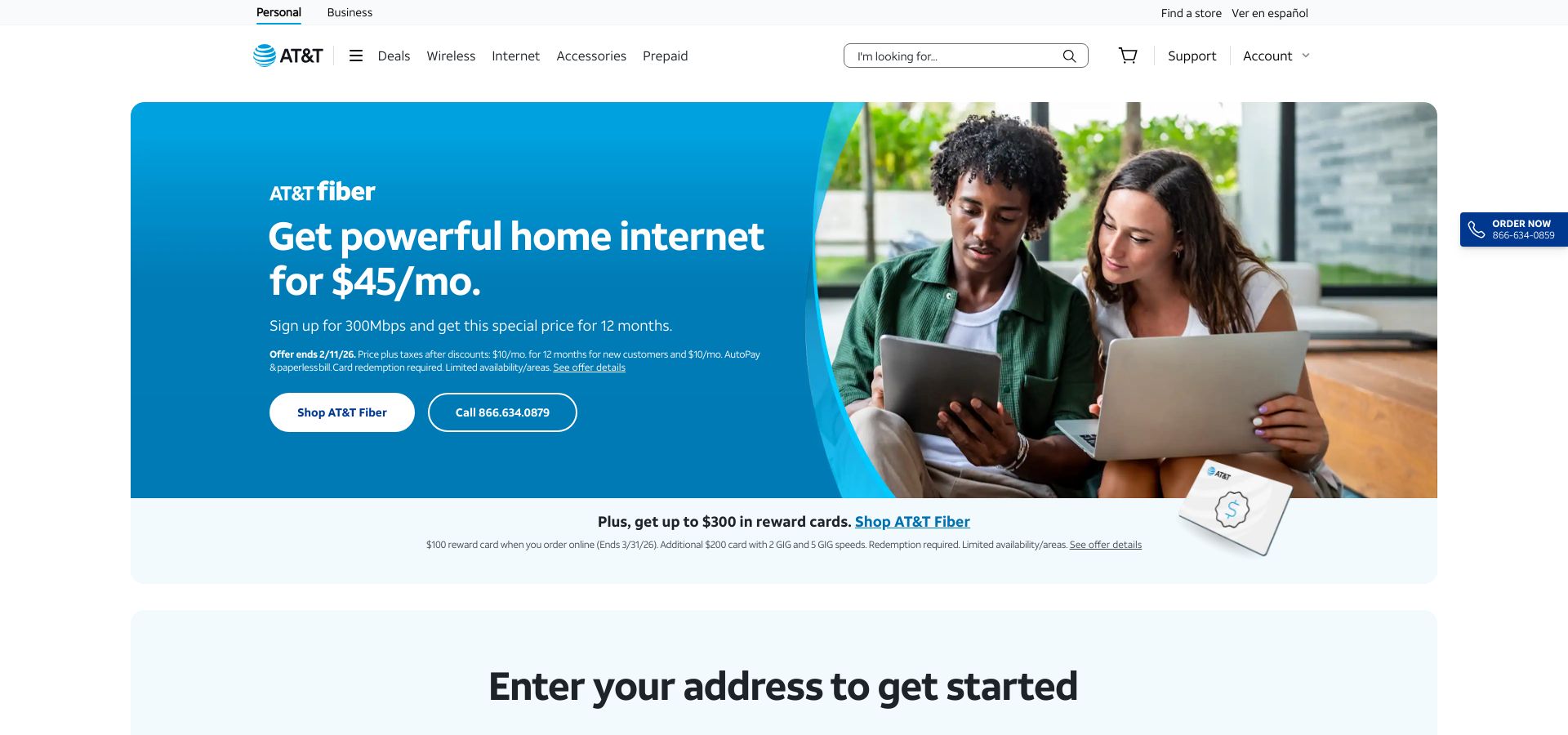
Pricing stays predictable. The 300 Mbps plan lists at $55 per month with equipment included. Each faster step adds about $10–$30, and every tier shares the same perks: no annual contract, no data cap and no modem-rental fee.
Installation is usually a one-time $99 technician visit to mount an optical network terminal and pull the fiber inside. Order online and AT&T often waives that charge. After setup, keep the gateway powered and autopay enabled to hold the quoted rate.
Performance sets AT&T Fiber apart. Because every home receives its own fiber strand, peak-hour slowdowns are rare. Upload speeds match downloads, helping remote workers send large files, and livestreamers can push 4K video. Latency sits in the teens, so competitive gamers can finally drop the ping excuses.
Availability is the main drawback. Some Atlanta suburbs enjoy full coverage, while the next street is still on legacy DSL. If fiber has not reached your block, cable or 5G may serve as an interim option. Price increases after the first year are possible with 30 days’ notice, but the month-to-month agreement lets you switch providers if the bill rises.
When the fiber light turns green at your address, AT&T delivers Georgia’s fastest widely available internet without locking you into a contract.
READ ALSO: 5 Affordable Enterprise Internet Scalability Solutions in South Carolina Compared
Xfinity: cable speeds everywhere, contract optional
Comcast’s Xfinity network covers about half of Georgia, from downtown Atlanta to rural strip malls, making it the default choice where fiber has not arrived.
Plans range from 200 Mbps to 1.2 Gbps, and every tier offers a no-term option. Declining the one-year promo adds roughly $10 per month, yet removes early-termination fees. Select plans include a five-year price guarantee, which helps shoppers worried about sudden hikes.
Performance is steady. Download speeds stay close to the headline rate, while uploads top out at 35 Mbps on the gigabit tier, so large backups run slower than on symmetrical fiber.
Fees call for attention. Renting Comcast’s gateway adds $14 each month. Bring a DOCSIS 3.1 modem and that charge disappears, but you lose the xFi security dashboard and hotspot access. The 1.2-TB data cap is fine for most households; heavy creators may need the $30 unlimited add-on.
Professional installation costs $100, while a mailed self-install kit is free. Either way, setup usually finishes in under an hour once the modem shows a steady white light.
Xfinity’s main advantage is reach. If fiber skips your street and 5G fails to penetrate your walls, its cable line is probably already in the junction box outside. Choose no-term pricing, supply your own modem and watch your usage to enjoy reliable gigabit downloads without a long contract.
Spectrum: unlimited cable that never locks you in
Spectrum keeps things simple: no contract, no data cap, solid speed. Its Georgia footprint zigzags around Xfinity territory, covering Athens, Gainesville, parts of Savannah and many smaller towns.
The base plan starts near $30 per month for 300 Mbps with equipment included. After 12 months the price climbs by about $20, but you can renegotiate or cancel the same day because no term agreement blocks you.
Download speeds usually land within 5 percent of the headline rate, while uploads sit between 10 and 25 Mbps. That imbalance matters only if you upload large files daily; gamers and streamers rarely notice.
Hidden costs are few. A $19.99 activation fee appears on the first bill, and the optional Wi-Fi router rental costs $5 per month. Bring your own mesh system and skip that charge.
Spectrum also offers a contract-buyout credit up to $500 for customers stuck with early-termination fees elsewhere, letting you switch providers without penalty.
Windstream Kinetic: rural Georgia’s fiber lifeline
Kinetic operates where larger brands rarely build. Drive through Dahlonega, Dublin and many farm roads in central counties and the only buried line in the right-of-way is often Windstream’s.
Speeds depend on the upgrade schedule. If crews have run new fiber on your road, you can order symmetrical service up to 1 or 2 Gbps for about $70 per month. If not, the company falls back to VDSL, usually 25–100 Mbps at roughly $40. Either way the contract term is identical: none.
Unlimited data is standard, a rarity among rural telcos. The catch is equipment rental. Expect a $12 modem fee unless you supply your own hardware. Professional installation adds another $50, although Windstream often waives that charge during fiber-launch promotions.
Real-world results mirror the technology. Fiber addresses see latency in the teens, while DSL lines vary with weather and distance to the cabinet. You can test service for a month and cancel without penalty if the copper line falls short, then pivot to 5G or Starlink.
For many small-town Georgians, Kinetic provides the first practical alternative to satellite. When the fiber crew sends its upgrade notice, sign up quickly to secure the fastest contract-free connection outside Georgia’s cities.
T-Mobile 5G Home Internet: plug-and-play freedom statewide
Place the gray cylinder by a sunny window, scan a QR code and you are online in about 10 minutes. That friction-free setup is T-Mobile Home Internet’s biggest advantage, especially for renters who cannot drill holes or wait for a weekday technician.
The pricing model is just as clear. Fifty dollars per month covers unlimited data, taxes and the Wi-Fi 6 gateway. Add a Magenta Max cell line and the bill falls to 30 dollars. There is no contract, no standard credit check and a 15-day “try it and return it” window.
Speed depends on tower load. Suburban testers often record 100–200 Mbps downloads, while rural users sit closer to 50 Mbps. Uploads land around 10–25 Mbps, adequate for Zoom but light for Twitch streams. Latency ranges from 30 to 60 ms, acceptable for casual gaming yet risky for tournament play.
Because the gateway shares spectrum with mobile phones, speeds can slow during evening peaks. T-Mobile notes that heavy home-internet users may be deprioritized behind mobile traffic, although the plan has no hard data caps or overage fees.
In many Georgia counties with limited cable and early-stage fiber, T-Mobile provides the first portable broadband service you can move from apartment to apartment. Test it for two weeks; if the signal stays solid, keep it. If not, return the hardware and owe nothing. That is contract-free flexibility at its simplest.
Verizon 5G Home: city-centric speeds, zero strings attached
Verizon targets dense pockets of Atlanta, Athens and nearby suburbs where its mid-band 5G can power both phones and home routers. Eligible addresses typically see 85–300 Mbps downloads on the standard plan, with occasional gigabit bursts in Ultra zones.
Pricing mirrors T-Mobile’s model: 50 dollars per month flat, or 25 dollars when you bundle an eligible Verizon Unlimited line. Equipment, taxes and fees are included, and Verizon says the rate stays fixed for at least two years. Cancel anytime and you pay only for the days of service.
Setup is quick. Most homes receive an indoor receiver-router that sticks to a window with Velcro and plugs into one outlet. If line-of-sight is required, Verizon sends a technician to mount an outdoor antenna at no extra cost.
Performance swings with signal strength. Office workers on Teams calls will appreciate steady 15–30 Mbps uploads, while competitive gamers may notice jitter during evening peaks. Data is unlimited; the network simply prioritizes mobile phones if towers fill up.
Availability is the main hurdle. Outside metro hubs, Verizon’s coverage map often reads “coming soon.” If your address is inside a green zone, 5G Home can deliver cable-class downloads without a long-term contract.
Starlink: contract-free lifeline where roads end
In the pine forests north of Ellijay or the flat farmland near Bainbridge, cable crews can take years to arrive. SpaceX fills that gap with Starlink, a satellite constellation that beams broadband from low Earth orbit to a dinner-plate antenna in your yard.
Setup is quick. Plug the dish into its router, point it at open sky and wait about 15 minutes for the motors to align. Most homes then record 50–200 Mbps downloads, 20 Mbps uploads and latency near 40 ms, roughly four times faster than legacy satellites and suitable for video calls or casual gaming.
Costs break into two parts. The hardware kit costs 599 dollars plus about 50 dollars shipping. Service runs month to month at 90 dollars in Georgia’s high-capacity cells or 120 dollars in standard zones. You keep the dish when you pause service, a perk for seasonal cabins and RV setups.
Starlink has no hard data cap, but the network de-prioritizes heavy users after about 1 TB in a month. Speeds may slow during evening peaks and recover overnight.
Where every other map shows blank space, Starlink often delivers the fastest path to modern broadband without a long-term contract.
Hidden fees and fine print to scan before you click “order”
Every provider above lets you cancel without an early-termination fee, but the first invoice can still hide surprises. A quick pre-signup audit keeps your budget safe.
Installation comes first. AT&T lists a $99 fee for fiber trenching, while Spectrum adds a one-time $20 activation fee. Order online or during a holiday promo and those charges often disappear if you ask.
Next is hardware. Cable companies like modem rentals. Xfinity’s gateway costs $14 per month; Spectrum’s Wi-Fi router is $5. Over 24 months you will have paid enough to own a high-end mesh system. Bring your own gear where policies allow and spend the savings on faster speed instead.
Data policies deserve a look. Spectrum, WOW! and all fiber tiers are unlimited. Xfinity caps at 1.2 TB, which is fine for most households but tough for 4K uploaders. Starlink uses a soft threshold; pass 1 TB in a month and evening speeds slow. Plan for Xfinity’s $30 unlimited add-on or schedule big game downloads overnight on Starlink to avoid throttling.
Finally, check the autopay fine print. T-Mobile, Verizon and AT&T include a $5–$10 monthly discount in the advertised price. Skip autopay and your “deal” quietly inflates.
Spend five minutes on these details now and the only surprise later will be how smooth a month-to-month bill feels.
How to choose the right contract-free plan
All this flexibility still leaves one question: which plan fits your life? Match a clear need to the provider built for it. Here are the most common scenarios, starting with pure speed.
If you need the fastest speeds
When every second counts for large video uploads, real-time design collaboration or cloud backups, fiber wins.
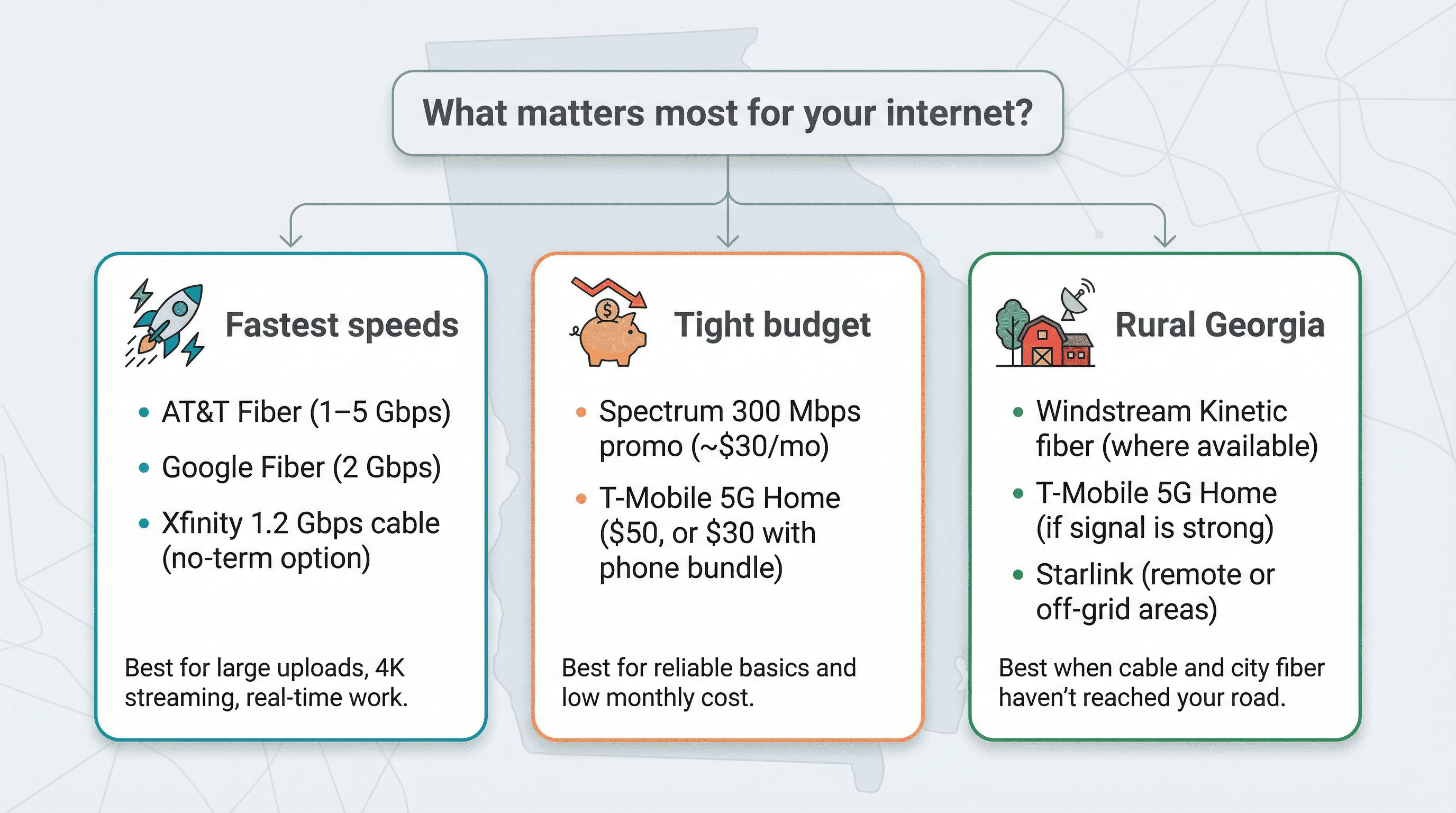
AT&T Fiber leads statewide. Its 1, 2 and 5 Gbps tiers provide symmetrical bandwidth that cable and 5G cannot match, with latency in the teens even during prime time.
Check availability first. Enter your address on AT&T’s site; if “multi-gig” appears, you are set. If not, see whether Google Fiber covers your Atlanta neighborhood. Google’s 2 Gbps plan delivers similar performance, though in fewer ZIP codes.
No fiber? Choose Xfinity’s 1.2 Gbps cable plan with the no-term option. Uploads top out at 35 Mbps, but downloads rival gigabit fiber and a self-install kit gets you online in about an hour.
Key takeaway: fiber takes gold for raw speed, cable takes silver and 5G holds bronze until wireless tech improves.
If you are on a tight budget
Low price no longer equals slow internet. Two providers top the value chart without contracts.
Spectrum’s introductory 300 Mbps package costs about $30 per month with a modem included. Even after the year-one bump you stay under $50 and can cancel or downgrade anytime. Unlimited data prevents surprise overage charges.
T-Mobile Home Internet offers a flat $50 monthly rate covering equipment, taxes and unlimited data statewide. Add a Magenta Max phone line and the bill falls to $30. Typical speeds hover near 100 Mbps, plenty for HD streaming and homework, and the 5G gateway ships free. You can return it within 15 days for a full refund.
Bottom line: pick Spectrum for wired consistency at the lowest price, or T-Mobile for straightforward pricing—especially if you already carry a T-Mobile phone plan.
If you live in rural Georgia
Back-roads bandwidth finally has options. Start by asking whether Windstream or a local electric co-op has installed fiber on your road.
If the answer is yes, sign up. Kinetic’s gigabit fiber offers city-grade speeds with no caps or contracts, and grants often cover the install fee.
If fiber has not reached you, check T-Mobile’s 5G signal at the kitchen window. A solid three-bar reading usually turns into 50–150 Mbps once you plug in the gateway, enough for Netflix and homework for a flat $50.
Still nothing? Order Starlink. The upfront hardware fee is steep, yet month-to-month service turns farms and lake cabins into Zoom-ready offices. Pause billing during the off-season and reactivate when you return; the dish remains yours.
Rural takeaway: sign up for wired fiber when it becomes available, rely on 5G if towers are nearby and keep Starlink as the fallback when neither landline nor cell towers serve your address.
Keep your contract-free connection secure
A month-to-month bill does not shield you from month-to-month threats. Every new router and gateway ships with factory credentials that attackers already know, so your first task after installation is to log in and replace those defaults with a strong, unique passphrase.
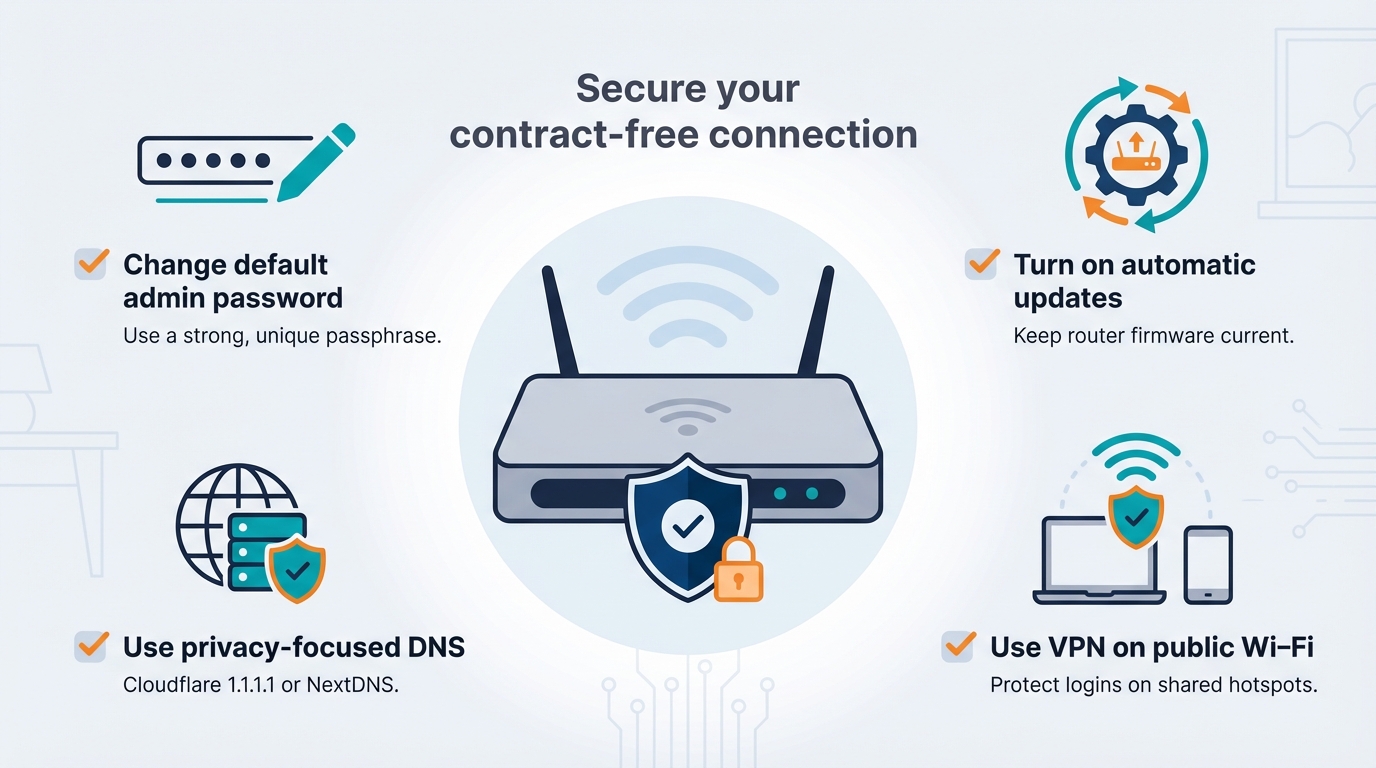
Next, lock down firmware updates. Provider hardware usually patches itself overnight, but only if the auto-update toggle stays on. If you use your own modem or mesh system, open the vendor’s app once a month and install any new version in a single tap.
Privacy matters as well. ISPs can log DNS lookups for marketing. You can limit that data collection by switching your router’s DNS settings to a privacy-focused resolver such as Cloudflare 1.1.1.1 or NextDNS. The change takes about 60 seconds and hides most browsing metadata from your provider.
Finally, approach public Wi-Fi perks with caution. Xfinity and Spectrum broadcast open hotspots from customer hardware. They are convenient, but always launch a reputable VPN before signing in. A no-contract plan means you can leave at any time, yet your data should stay put.
Frequently asked questions
Which internet providers in Georgia skip contracts altogether?
Spectrum, AT&T Fiber, WOW!, Windstream Kinetic, T-Mobile 5G Home, Verizon 5G Home, Google Fiber and Starlink all sell month-to-month service statewide or in select cities. Xfinity also lets you choose a no-term option for most plans, though the sticker price runs about $10 higher.
Does a month-to-month plan always cost more?
Not anymore. Spectrum’s $30 promo and AT&T Fiber’s $55 entry tier both carry zero commitment, proving you can land a deal without signing paperwork. Only a few cable ISPs add a small surcharge when you decline their one-year discount.
Will I hit a data cap on contract-free internet?
It depends on the network, not the contract. Fiber and Spectrum cable are fully unlimited. Xfinity enforces a 1.2-TB ceiling unless you pay extra, and Starlink slows heavy users after roughly 1 TB. Wireless 5G plans remain uncapped but may throttle if towers become congested.
Can I bring my own modem or router?
Yes for cable and DSL. Match the provider’s approved device list to avoid rental fees. Fiber and 5G setups require the ISP’s optical or cellular gateway, yet you can still run your own Wi-Fi mesh behind it for stronger coverage.
How do I switch without losing service?
Overlap service by a few days. Activate the new line first, confirm speeds, then cancel the old plan through your online account. Because neither plan locks you in, you pay only for the partial month and avoid downtime.
Will these providers check my credit?
Most will run a soft pull and waive deposits for good histories. T-Mobile and Verizon offer prepaid options that skip credit entirely, while Starlink requires full hardware payment up front and never asks for a score.
Conclusion
Spend five minutes on these details now, choose the plan that matches your needs and enjoy how smooth a month-to-month internet bill feels.
INTERESTING POSTS
- Top Factors to Consider Before Switching to Cable Internet
- Starlink Secures $17B EchoStar Deal to Power Global Direct-to-Cell Service
- 5G Networks Are Likely to be Hacked: The Unseen Vulnerabilities
- The Impact of 5G Technology on Tablet Connectivity and Performance
- Top 3 D-Link Routers For The Tech-Savvy People
About the Author:

Amaya Paucek is a professional with an MBA and practical experience in SEO and digital marketing. She is based in Philippines and specializes in helping businesses achieve their goals using her digital marketing skills. She is a keen observer of the ever-evolving digital landscape and looks forward to making a mark in the digital space.



