




In this post, I will show you 5 affordable enterprise Internet scalability solutions in South Carolina.
South Carolina’s connectivity boom is here. Armed with $551.5 million in new BEAD funding, fiber crews are wiring Columbia, Charleston, and the Upstate according to the state’s broadband map release.
For the first time, midsize firms can buy enterprise-grade bandwidth without Fortune-100 price tags.
Yet more options mean more confusion. Every carrier touts “gig-speed” service and “99.9 percent” uptime but rarely explains what that means for your backups or rural clinics.
We vetted a dozen networks, rating each on cost, scale, reliability, reach, and security. Five rose to the top.
Next, you’ll see our rubric, provider snapshots, and real-world pricing tactics. Let’s dive in.
Table of Contents
What mid-market enterprises in South Carolina need and how we scored each provider
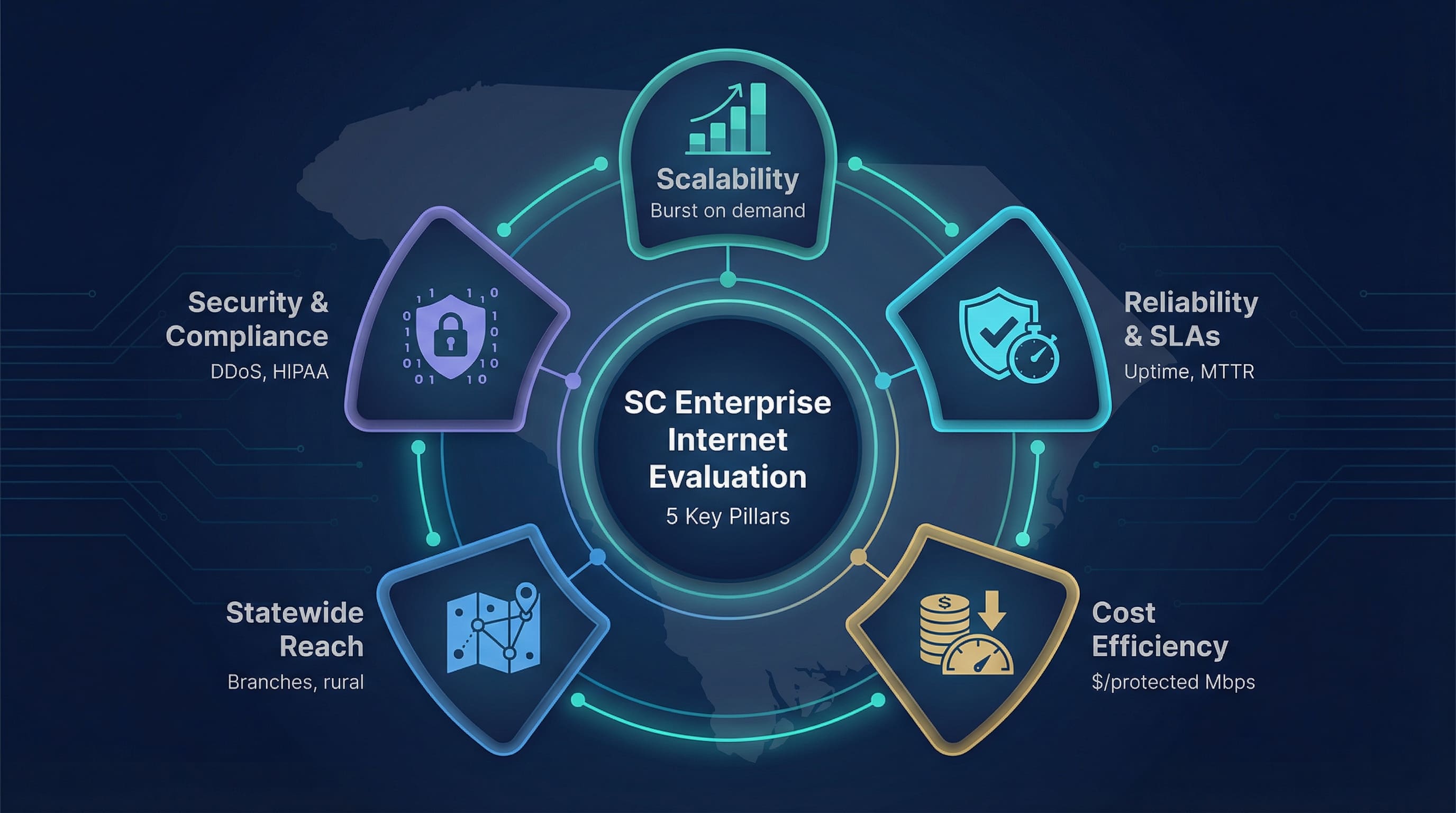
We judged every carrier on five must-haves—scalable bandwidth, reliability, cost efficiency, statewide reach, and baked-in security—so you can see at a glance who really supports growth.
Fast speeds look great on a spec sheet, but they’re meaningless if a cloud call times out during a client demo. We asked a simple question: what keeps a growing South Carolina firm productive when every minute of downtime hurts?
First, bandwidth must scale on demand. Manufacturers along the I-85 corridor already push 4K production video to analytics hubs in Charlotte; tomorrow they’ll stream digital twins in real time. We awarded the most points to networks that let you dial service from a few hundred megabits to multiple gigs without replacing gear.
Reliability came next. Atlantic storms and accidental fiber cuts can wreck project timelines, so we looked for protected rings, diverse routes, and signed SLAs promising at least 99.95 percent uptime plus rapid repair windows. Providers that peer at Columbia’s new Bridge IX—a local exchange keeping traffic in-state—earned bonus credit for lower latency and higher resilience.
Cost still matters. We normalized quotes to “dollars per protected megabit,” checking that promo pricing didn’t jump in year two. Any carrier that hid mandatory router rentals or construction charges lost points.
Coverage rounded out the core criteria. A solution isn’t enterprise-ready if your Charleston HQ hums while the Georgetown warehouse crawls on DSL. Statewide fiber footprints or SD-WAN bundles that blend cable and 5G links scored higher.
Finally, security and compliance broke the ties. Native DDoS scrubbing, HIPAA-aligned contracts, and in-state SOC teams proved decisive for healthcare systems and fintech shops.
Weighting all five factors—scalability, price efficiency, SLA strength, reach, and security—gave us a transparent, repeatable score. Next, you’ll see how those numbers shake out, starting with a newcomer turning heads in the Upstate.
#1 WOW! Business: the fiber challenger redrawing Upstate pricing
Greenville’s skyline isn’t the only thing under construction. WOW! Business has threaded fresh fiber beneath Main Street since 2023 and, by mid-2025, passed 100,000 locations in its greenfield markets—Greenville County tops the list. New plant means lower congestion, cleaner optics, and room to crank speeds without repeat digs.
For enterprise customers, WOW! packages its scalable network solutions for enterprises as dedicated internet from 100 Mbps to 10 Gbps on the same all-IP backbone. Upgrades take a phone call; engineers simply change the profile on your lit strand. Early adopters report a 1 Gbps DIA circuit at about $480 a month on a three-year term, roughly 15 percent below incumbent quotes. Uploads match downloads, so CAD files leave as quickly as backups arrive.
Uptime promises hit 99.99 percent, and the network rides protected rings into Atlanta and Charlotte for diversity. Support runs from a regional NOC, so you speak with someone who can pronounce “Mauldin.” That local touch earns WOW! the top spot in our value-per-megabit scoreboard.
Caveats? Coverage remains spotty outside the Upstate. Charleston and the Grand Strand are on the roadmap, so multi-city firms need a second provider for now. For headquarters north of I-20, though, WOW! delivers premium fiber at budget-friendly pricing—hard to ignore.
#2 AT&T dedicated internet: statewide muscle with rock-solid SLAs
AT&T’s fiber already runs past most South Carolina curbs, from Spartanburg warehouses to Beaufort shipyards. That reach gives the carrier an edge when you want one contract for every branch, not five.
Dedicated internet access starts at 100 Mbps and scales to 10 Gbps on the same port, so you can raise bandwidth without a truck roll. The SLA guarantees 100 percent uptime and a four-hour mean time to repair—welcome numbers when your ERP lives in Azure and Friday is payroll day. Larger sites can add a wireless fail-safe that shifts traffic to AT&T’s 5G network if a backhoe misbehaves.
Pricing sits above newer challengers. Expect a gigabit DIA quote of $650–$800 on a three-year term, though fresh builds often see promotional dips. Many CIOs treat that premium as insurance: you pay for dual-diverse routes, a global backbone, and a support desk that solves fiber cuts before most staff finish a second coffee.
AT&T’s ecosystem runs deep. Need a private on-ramp to AWS or a managed firewall that satisfies a bank examiner? The catalog already covers it, trimming vendor sprawl along with latency.
Trade-offs? Scale can feel impersonal; construction tickets may move slowly, and smaller issues can bounce between tiers. Yet if uptime is non-negotiable and every site must live on the same letterhead, AT&T remains the safe statewide pick.
#3 Spectrum Enterprise: cable convenience, fiber headroom
Charter’s Spectrum network reaches most South Carolina business addresses, so you can light up a circuit fast. A coax drop often goes live in days, not months, giving branch offices an immediate 300 Mbps–1 Gbps downlink while you plan longer-term upgrades. Spectrum also lets you keep coax on a month-to-month plan, so there’s no early-termination fee if you later shift to fiber.
When you need more muscle, the same team can move your headquarters to a dedicated fiber port—anywhere from 100 Mbps to 10 Gbps—with a 100 percent uptime guarantee. We’ve seen 1 Gbps DIA quotes near $500 in Columbia and Charleston, sitting below telco peers yet above a shared coax line. That price buys symmetrical speeds, proactive monitoring, and credits if latency drifts off spec.
Reach remains Spectrum’s biggest draw. If you run shops from Myrtle Beach to Rock Hill, the same backbone likely serves them all, simplifying VPN design and billing. Many companies even keep coax as low-cost failover behind a new fiber primary, a two-circuit tactic few rivals match under one logo.
Trade-offs exist. Coax uploads top out near 35 Mbps, which can slow large cloud backups, and support reviews mix rave notes with tales of ticket ping-pong. Still, for firms that want quick installs, contract flexibility, and a clear path into enterprise fiber, Spectrum offers reliable statewide coverage.
#4 Segra (Cox Business): custom fiber built by Carolinas engineers
Some projects outgrow off-the-rack circuits. When you stitch together a hospital network or a university ring, you need an engineer who speaks routing tables, not a chatbot. That is Segra’s lane. Born from regional telcos and now backed by Cox Business, Segra runs a 100 percent fiber backbone that stretches from Charleston’s port cranes to Spartanburg data labs.
The pitch is simple: explain what you are building, and Segra splices a private wavelength, dark-fiber pair, or Ethernet LAN that acts like one campus no matter how many ZIP codes separate sites. Need 10 Gbps today and 40 Gbps next quarter? Their DWDM gear is already racked. For standard DIA, Segra commits to 99.99 percent uptime, and many customers add a protected ring that lifts that promise to 100 percent inside metro loops.
Latency stays low because Segra peers locally at Columbia’s Bridge IX and multiple carrier hotels, keeping South Carolina traffic in-state rather than hair-pinning through Atlanta. Healthcare IT teams value the saved milliseconds on real-time imaging, and auditors like that Segra’s network never shares paths with residential traffic.
Pricing lands above Spectrum but often undercuts national telcos by double digits once you reach a gigabit. Large deals often include waived construction fees and a named solutions architect on speed dial. The trade-off: small offices chasing a budget 100 Mbps link may find Segra over-qualified and over-budget. For enterprises that treat bandwidth like power and plan aggressive growth, Segra delivers tailored fiber without Manhattan prices.
#5 Windstream Enterprise: SD-WAN glue for multi-site resilience
If your office map spans Columbia, Chester, and the coast, Windstream deserves a close look. Its SD-WAN platform bonds whatever circuits each site can get—Kinetic fiber in Lexington, Spectrum coax in Myrtle Beach, a 5G modem at a lumber mill—and steers traffic around trouble in real time.
Bandwidth starts strong: on-net Kinetic locations see symmetrical gigabit fiber for about $200 a month. Where only copper or cable exists, Windstream still pulls workable speeds and layers LTE failover that clicks in within seconds. The managed portal shows every link on one screen and lets you prioritize voice or production traffic with a few clicks.
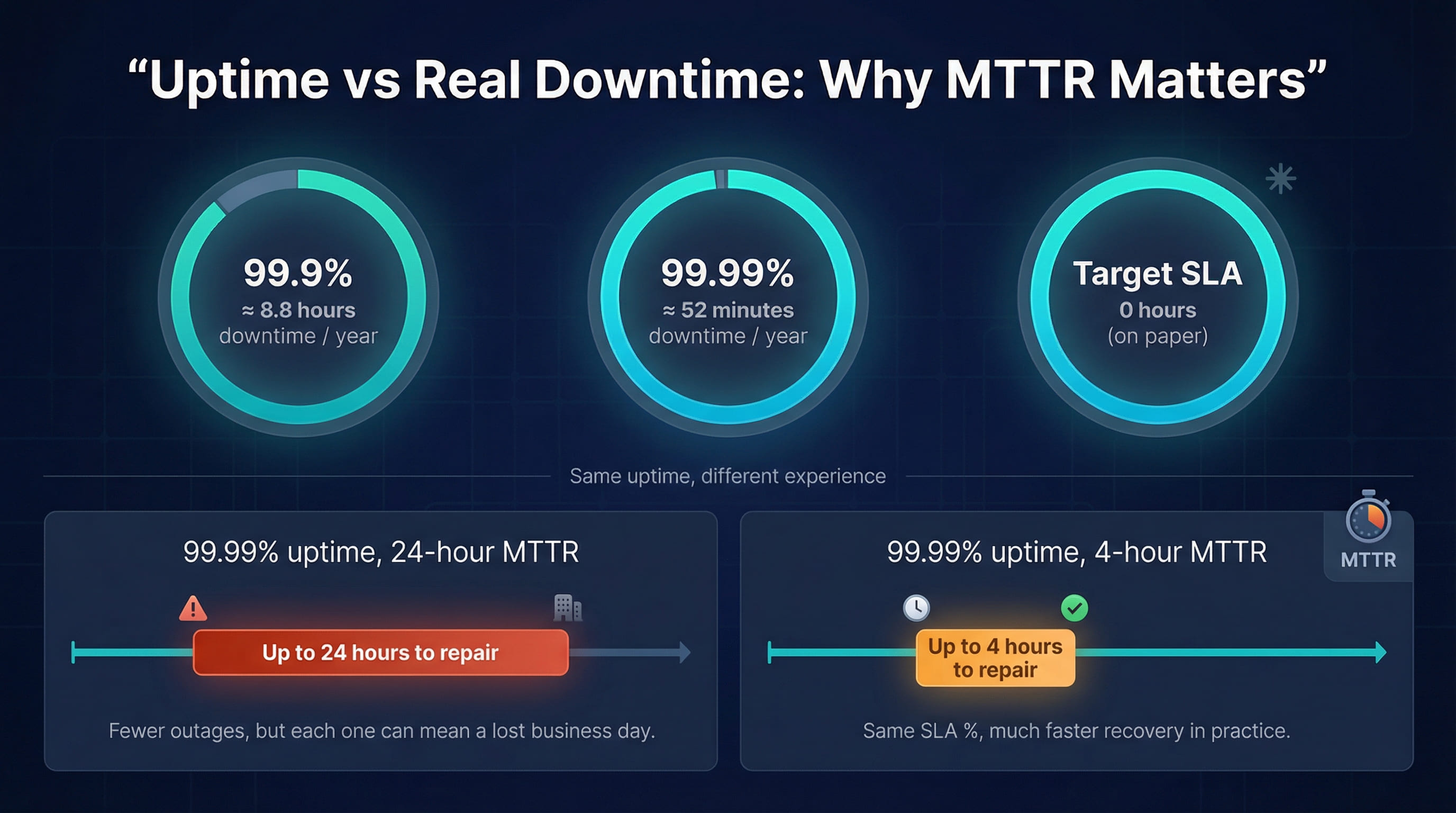
Dual transports under one controller nearly erase the nine hours a year hidden in most 99.9 percent SLAs. Because Windstream owns many rural last-mile exchanges, field techs roll faster than larger carriers that rely on partners.
Pricing stays competitive. Clients pay under $400 per site for dual links, an edge device, and full management—less than they once spent on a single MPLS T1. Lean IT teams appreciate focusing on apps instead of carrier tickets.
Legacy baggage lingers. The 2019 bankruptcy still worries some boards, and support can vary when third-party loops fail. Yet the balance sheet is solid today, and Gartner Peer reviews continue to praise the SD-WAN execution.
If you manage dozens of locations and need consistent uptime without Fortune-500 spend, Windstream’s mix-and-match fabric ties the state together well.
How the five solutions stack up at a glance
| Provider | Scalability path | Typical starting cost* | Published SLA | Contract flexibility | Built-in security | Stand-out strength |
| WOW! Business | 100 Mbps → 10 Gbps on new fiber; coax backup | ≈ $300 for 500 Mbps DIA | 99.99 % uptime, < 5 ms metro | 1, 3, 5-yr; coax month-to-month | Optional DDoS, HIPAA BAA | New fiber at challenger pricing |
| AT&T dedicated internet | 100 Mbps → 10 Gbps statewide fiber | ≈ $650 for 1 Gbps DIA | 100 % uptime, 4 hr MTTR | 1–3 yr; wireless fail-safe add-on | Managed firewall, cloud on-ramps | Reach plus deep service catalog |
| Spectrum Enterprise | Coax 300 Mbps → fiber 10 Gbps | ≈ $500 for 1 Gbps DIA; coax lower | 100 % on fiber, best-effort on coax | Fiber 1–3 yr; coax no term | DDoS on fiber, basic firewall | Quick installs and statewide footprint |
| Segra / Cox Business | DIA 50 Mbps → 100 Gbps, dark fiber, waves | Quote-based; often 10 % under telcos at ≥ 1 Gbps | 99.99 % std; 100 % on protected ring | 3 yr typical; negotiable | Encrypted L2, regional SOC | Custom engineering with low latency |
| Windstream Enterprise | SD-WAN bonds fiber, coax, 5G | ≈ $400 per site for dual links + mgmt | 99.99 % on fiber; SD-WAN path SLA | 1–3 yr coterminous | Cloud firewall, PCI/HIPAA ready | Multi-link resilience on a budget |
*Ballpark monthly rates in South Carolina metros, three-year term unless noted. Construction fees, taxes, and promotions vary.
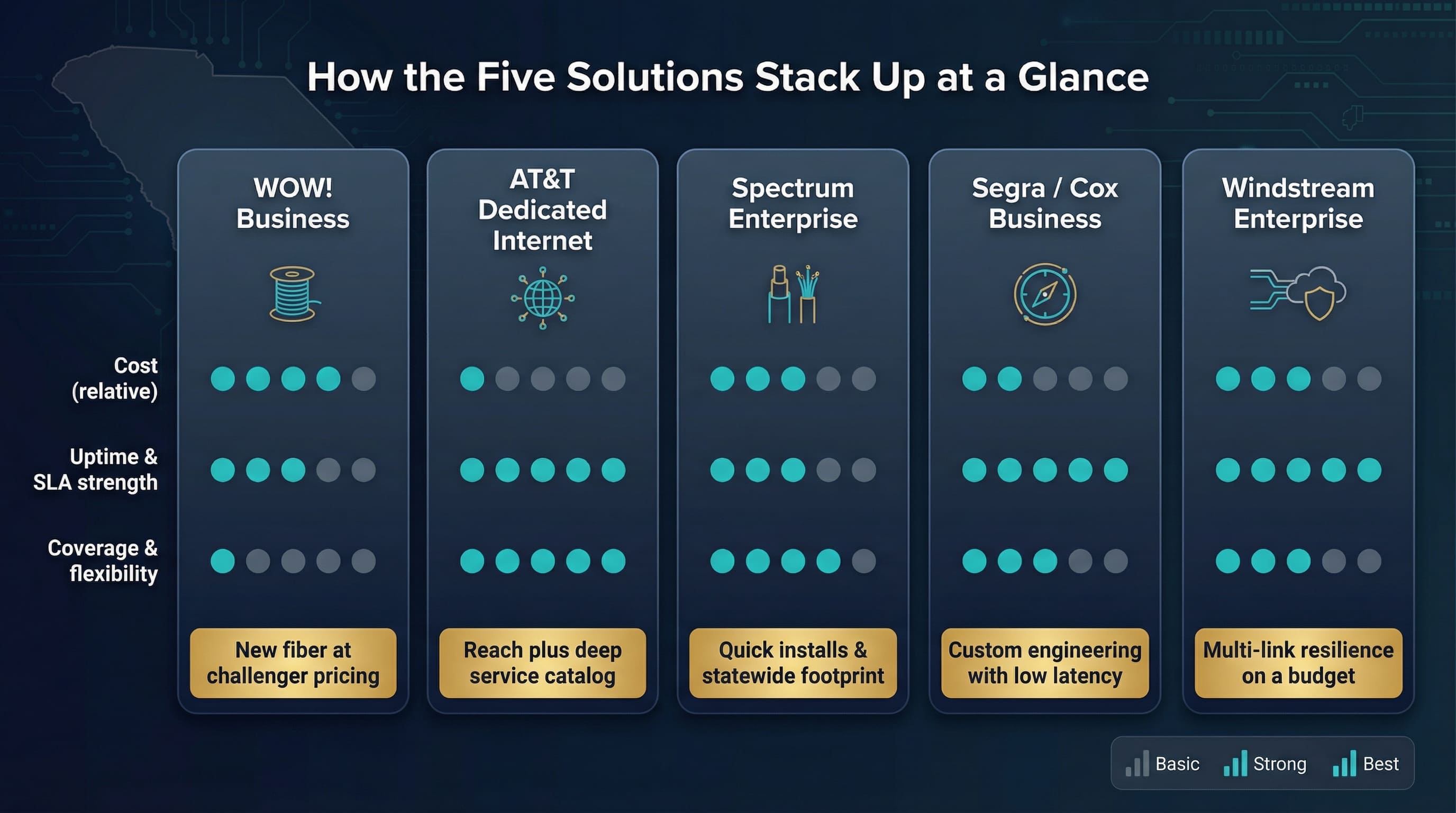
Scan first for your non-negotiable—uptime, cost, or coverage—then short-list two contenders for detailed quoting. Real savings appear only after providers see competitive pressure.
FAQ: picking the right connection without second-guessing
Do I need dedicated internet access?
Yes, if your business runs real-time apps such as VoIP, cloud CAD, or tele-medicine. DIA guarantees symmetrical throughput and stable latency. Shared cable or 5G works for email and browsing, but performance changes with neighborhood traffic. Many firms mix tiers: DIA at data-heavy hubs, business broadband at lighter branches.
What matters most in an SLA?
Focus on mean time to repair. A 99.99 percent uptime promise is hollow if the carrier allows 24 hours to fix an outage. Push for a four-hour MTTR or better and ensure credits apply automatically.
How early should we order service for a new site?
Plan on 60–120 days for fresh fiber, longer if crews must bore under a state highway. Order when you sign the lease and bridge the gap with a month-to-month 5G router. Carriers often waive install fees when you plan ahead.
Is price per megabit the only metric that counts?
No. Cheap bandwidth that fails during hurricane season costs more in downtime. Weigh sticker price against redundancy costs; pairing a low-cost cable line with SD-WAN resilience can beat a single premium circuit on uptime and dollars.
How can I keep my renewal bill from doubling?
Set a reminder 180 days before term end. Collect two competitor quotes and share them with your account manager. Providers prefer a reasonable discount to a churn report, especially in South Carolina’s competitive market.
Conclusion
Still deciding? Pick two providers from the table above, request parallel quotes, and let real numbers—not marketing copy—guide the choice.
INTERESTING POSTS
About the Author:

Chandra Palan is an Indian-born content writer, currently based in Australia with her husband and two kids. She is a passionate writer and has been writing for the past decade, covering topics ranging from technology, cybersecurity, data privacy and more. She currently works as a content writer for SecureBlitz.com, covering the latest cyber threats and trends. With her in-depth knowledge of the industry, she strives to deliver accurate and helpful advice to her readers.


