




In this post, I will show you the 11 best MCP gateways in 2026.
Unlike the AI assistants of just one year ago, AI agents in 2026 don’t just answer questions; they act. AI agents can now connect to your databases, query your internal tools, read and write to your SaaS platforms, and make decisions on behalf of your users and your business.
That shift from AI as assistant to AI as agent changes the security equation entirely. Every tool connection is a potential attack surface. Every action is a potential compliance event. And most organizations have no visibility into any of it.
That’s the security problem Model Context Protocol (MCP) gateways are built to solve. MCP, introduced by Anthropic in late 2024, is the open standard that enables AI agents to discover and interact with external tools at scale. An MCP gateway is the control layer that sits between your agents and those tools, enforcing access controls, detecting threats, and logging everything.
This guide covers the 11 best MCP gateways in 2026, evaluated through a security and governance lens. Whether you’re an IT leader trying to get control of AI sprawl, a security engineer building a compliant AI stack, or a developer choosing infrastructure for production agents, this comparison will help you find the right solution.
Table of Contents
Key Takeaways
- What Does an MCP Gateway Do?
MCP gateways act as the central control plane between your AI agents and your MCP servers, providing:
- Authentication and access control: defining which agents and users can access which tools
- Security enforcement: blocking prompt injection, detecting data exfiltration, enforcing guardrails
- Audit trails: logging every tool call with full context for compliance and forensics
- Observability: real-time dashboards, alerts, and monitoring across your entire MCP ecosystem
- Server management: centrally deploying, provisioning, and governing MCP servers at scale
- How to Evaluate MCP Gateways
Your gateway choice depends heavily on your organization’s profile. A few key dimensions to evaluate:
- Does your industry have compliance requirements that demand audit trails and access controls? Does the primary buyer sit in IT/security or in engineering?
- Do you need a managed cloud service or are you comfortable with self-hosted infrastructure?
- Do you need broad SaaS connectivity out of the box, or are you connecting to a narrow set of internal tools?
Getting clear on these questions before evaluating vendors will save significant time. The right answer for a regulated financial services firm looks very different from the right answer for a fast-moving engineering team.
- The Recommended Choice for IT and Security Teams: For organizations where IT and security teams need centralized visibility and control over AI agent activity, MCP Manager is purpose-built for this use case. It sits as the central control layer between your AI apps and your MCP servers, giving IT teams granular access controls, PII detection, runtime guardrails, and end-to-end audit trails, without blocking the AI adoption their engineering teams are pushing for. It’s the gateway designed specifically for the governance gap most organizations are facing right now.
- Other MCP Gateways for Specific Use Cases
- Best for AWS-native deployments: Amazon Bedrock AgentCore Gateway is the natural choice if you’re running AI workloads on AWS Bedrock and want a fully managed, serverless option.
- Best for developers: Bifrost (Maxim AI) offers sub-3ms latency and excellent developer experience for teams prioritizing speed over governance depth.
- Best for LLM and API gateway teams: Kong and TrueFoundry both offer MCP support as part of broader API and AI infrastructure platforms — a good fit if you’re already managing LLM traffic through either and want to extend that to MCP.
- Best for local and containerized MCP servers: Docker MCP Gateway is the strongest option if you need to sandbox and isolate local MCP servers within a container-native environment.
- Best open-source options: Obot provides an open-source MCP gateway with an integrated agent platform. IBM Context Forge is a strong open-source choice for large enterprises needing federated governance across multiple deployments.
How Do MCP Gateways Improve AI Security?
Without a gateway, your MCP environment is exposed to a range of threats that are invisible at the infrastructure level:
- Prompt injection attacks: malicious instructions embedded in tool responses that hijack agent behavior without the user or system knowing
- MCP rug pull attacks: a tool behaves legitimately during testing but changes its behavior in production to exfiltrate data or perform unauthorized actions
- PII and data leakage: agents handling sensitive data can inadvertently expose Social Security numbers, credit card details, or confidential business information through tool calls
- Shadow IT: employees connecting unauthorized MCP servers to AI clients like Claude or Cursor without IT knowledge, creating ungoverned access to business systems
- Overly privileged agents: without granular access controls, an agent granted access to one tool may pivot to others, accessing data it was never intended to reach
A properly configured MCP gateway addresses all of these. The question is which gateway is right for your organization.
11 Best MCP Gateways in 2026
1. MCP Manager
Best for: Organizations that need governance, control, and security built in from day one
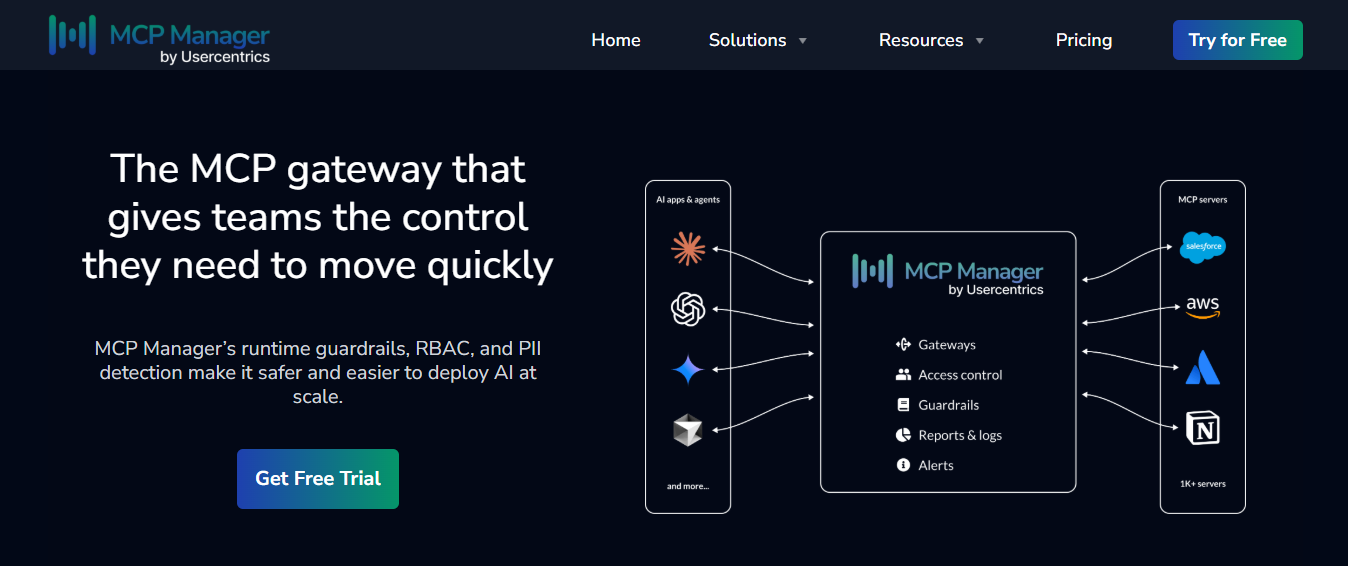
MCP Manager is a purpose-built MCP gateway designed to help AI-forward companies address a governance gap.
MCP Manager sits at the center of your MCP ecosystem as the central control layer between AI apps and agents (Claude, Gemini CLI, Cursor, and others) and your MCP servers (Salesforce, AWS, Atlassian, Notion, etc). Every connection flows through MCP Manager, giving IT and security teams the visibility and control they need without blocking the AI innovation their teams demand.
Key security and governance features:
- Enterprise-grade RBAC: fine-grained role-based access controls at the user, team, and agent level. Define exactly which agents can access which tools, with least-privilege defaults.
- Runtime guardrails and enforcement : set and enforce security policies at the gateway level, not inside individual MCP servers. Block unsafe operations before they reach your tools.
- PII detection: automatically identifies and flags sensitive data (Social Security numbers, credit card numbers, phone numbers, email addresses) flowing through MCP traffic, with configurable blocking and alerting. Uses regex-based filters and a Microsoft Presidio integration.
- MCP attack prevention: real-time monitoring of MCP traffic and tools to prevent common attacks like MCP rug pulls
- End-to-end audit trails: fully traceable, retrievable logs of all MCP traffic including who called what, when, with what parameters, and what was returned. Dashboards and alerts for real-time monitoring.
- SSO and SIEM integration: SSO support for enterprise identity management; OpenTelemetry (OTel) integration for SIEM connectivity, so MCP events flow directly into your existing security operations tooling.
- Private MCP registry: IT can maintain a curated, approved catalog of MCP servers they vetted, preventing shadow IT in the age of AI
- Tool-level permissions: granular control not just at the server level but at the individual tool level within each server.
The tradeoff: MCP Manager is built for organizations, not individual developers. If you’re a solo developer prototyping locally, it offers more than you need. It’s designed for teams where IT, security, and engineering need to work together on AI governance.
Ideal for: Mid-market organizations where IT needs centralized visibility and control over AI agent activity.
2. Amazon Bedrock AgentCore Gateway
Best for: Organizations already invested in the AWS ecosystem
Amazon’s entry into the MCP gateway space is substantial. Bedrock AgentCore Gateway is a fully managed service that provides a unified, secure access point for AI agents to discover and interact with tools via MCP. It launched in 2025 and has been expanded significantly since.
Key security features:
- Zero-code MCP tool creation: works with existing REST APIs and AWS Lambda functions
- OAuth-based inbound authorization: supports Cognito, Okta, Auth0, and custom providers
- IAM-based outbound authorization: achieve secure connections to backend resources
- Semantic tool discovery: agents can find the right tool based on natural language intent
- Full observability: CloudWatch Logs, CloudTrail audit logging, and X-Ray tracing give visibility
- Serverless infrastructure: no gateway infrastructure to manage
- Federation support: one AgentCore Gateway can serve as a target for another, enabling hierarchical tool organization across organizational boundaries
The tradeoff: Deep AWS vendor lock-in. AgentCore Gateway works best for organizations already running on AWS and using Bedrock for AI. Multi-cloud or hybrid environments will face integration friction. It’s also primarily designed for AWS-native tool integration rather than broad SaaS connectivity.
Ideal for: Organizations running AI workloads on AWS Bedrock who want a managed, serverless MCP gateway without standing up their own infrastructure.
3. Kong AI Gateway (Konnect)
Best for: Enterprises already managing APIs and LLM traffic who want to extend governance to MCP
Kong is one of the most established names in API gateway infrastructure, trusted by Fortune 500 companies for API management long before AI agents existed. In 2025 and into 2026, Kong has made a significant push to extend its proven governance patterns to MCP through Kong Konnect, its unified API and AI platform.
The core value proposition is consolidation: if your organization already routes LLM traffic and manages APIs through Kong, adding MCP governance to the same platform is a natural extension rather than a net-new infrastructure decision.
Key governance and security features:
- AI MCP Proxy plugin: protocol bridge translating between MCP and HTTP, allowing MCP clients to call existing APIs or interact with MCP servers through Kong without application changes
- MCP OAuth 2.1 authentication: centralized authentication across all MCP servers with a dedicated OAuth 2.1 plugin, aligning with the official MCP specification
- MCP Registry: launched February 2026, a centralized enterprise directory within Konnect for registering, discovering, and governing approved MCP servers and AI tools. Designed to eliminate shadow AI and provide a system of record for all agent-accessible tools
- MCP ACLs: granular access control lists for MCP tool-level authorization
- Observability: Prometheus metrics extended for MCP-specific monitoring, plus Konnect dashboards for cost optimization and performance tracking
- Unified platform: single control plane for APIs, LLMs, and MCP traffic with consistent security policies across all three
- GDPR, HIPAA, and EU AI Act: Kong explicitly positions MCP Registry as supporting these regulatory requirements through audit trails and visibility
The tradeoff: Kong’s MCP capabilities are built on top of an API gateway platform, which is both its strength and its limitation. Organizations that aren’t already managing APIs through Kong face a significant platform adoption decision, not just a gateway selection. MCP-specific features like PII detection and prompt injection defense are less specialized than purpose-built MCP security products.
Ideal for: Large enterprises already using Kong for API management who want a unified platform covering APIs, LLM traffic, and MCP governance without adding separate vendors to their stack.
4. Bifrost by Maxim AI
Best for: Developer teams prioritizing performance and rapid iteration
Bifrost is a high-performance MCP gateway built in Go, designed for developer velocity. It’s genuinely fast, easy to set up, and has a solid developer experience with built-in observability tooling.
Key features:
- Sub-3ms latency: built in Go for maximum performance
- Agent mode: uses configurable auto-approval for specific tools
- Tool filtering: per-request, per-user, and per-virtual-key
- Built-in dashboard: real-time tool execution monitoring
- Prometheus metrics: OpenTelemetry distributed tracing
- Cost tracking per tool call
The tradeoff: Bifrost is developer-focused, and its governance features reflect that. Enterprise-grade RBAC, PII detection, compliance audit trails, and the kind of controls that satisfy an IT security review are limited compared to purpose-built governance solutions. It’s built for moving fast, not for environments where moving carefully is the priority.
Ideal for: Engineering teams building AI agents who need production-grade performance and observability without complex governance requirements.
5. TrueFoundry MCP Gateway
Best for: Teams wanting a single platform for both AI models and MCP tools
TrueFoundry’s MCP gateway is part of a broader AI infrastructure platform that handles model deployment, fine-tuning, and serving alongside MCP tool management. The core value proposition is avoiding fragmentation across multiple AI infrastructure systems.
Key governance features:
- Unified platform: for LLMs and MCP tools with single dashboard
- Sub-3ms latency: also offers in-memory authentication and rate limiting
- MCP Server Groups: great for logical isolation between teams
- Unification across models and tools: shared security, observability, and performance characteristics:
- Multi-environment support (dev, staging, prod)
The tradeoff: Adopting TrueFoundry’s MCP gateway means adopting TrueFoundry’s broader platform, a significant infrastructure commitment. Security and governance features are solid but not specialized for compliance-heavy environments. Best evaluated as part of a broader AI infrastructure decision rather than a standalone gateway selection.
Ideal for: Organizations already adopting TrueFoundry for AI infrastructure who want unified management of models and tools without a separate gateway product.
6. MintMCP
Best for: Teams wanting enterprise, compliance features with fast deployment
MintMCP is a commercial MCP gateway focused on making enterprise-grade features accessible without the operational complexity of larger platforms. One-click deployment and built-in OAuth/SSO make it particularly attractive for teams that need enterprise features quickly.
Key features:
- One-click deploys: get production infrastructure running fast
- OAuth/SSO support: out of the box
- Security guardrails: real-time policies
- Monitoring and alerting
- Minimal configuration: designed to decrease overhead
The tradeoff: For smaller teams or developers without compliance requirements, MintMCP’s SOC 2 certification and enterprise feature set may be more than you need, which you’ll pay for. Beyond that, MintMCP is optimized for fast deployment over deep customization.
Ideal for: Enterprise teams that need compliance features without the overhead of a full enterprise platform evaluation and deployment.
7. Docker MCP Gateway
Best for: DevOps teams wanting open-source, container-native MCP infrastructure
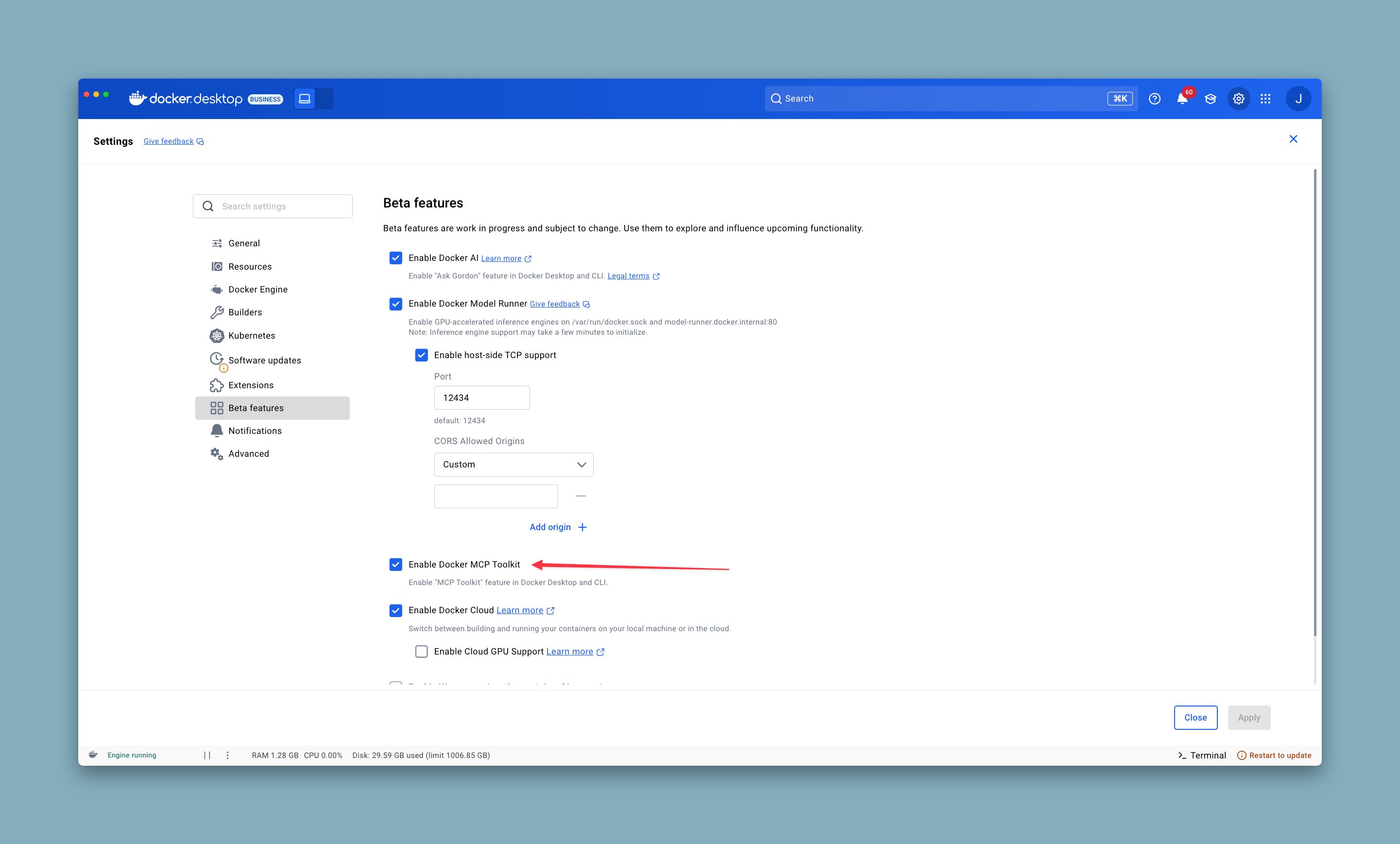
Docker’s open-source MCP gateway treats MCP servers as container workloads, with each server running in its own isolated container with cryptographically signed images and built-in secrets management.
Key features:
- Container isolation per MCP server with CPU and memory limits
- Cryptographically signed images for supply-chain security
- Dynamic server registration and discovery
- Secrets management built in
- Native Docker Desktop integration for developer convenience
- Open-source: full transparency and no vendor lock-in
The tradeoff: Self-hosted means your team owns the maintenance, scaling, and security burden. Centralized governance features (such as RBAC, audit trails, compliance reporting)require you to build or integrate them yourself. Not appropriate for organizations without dedicated platform engineering resources.
Ideal for: Organizations with strong DevOps practices and Kubernetes expertise who want maximum control and transparency over their MCP infrastructure.
8. IBM MCP Context Forge
Best for: Large enterprises requiring federated MCP governance across multiple business units
IBM’s open-source gateway is designed for the complexity of large enterprise environments — multiple business units, multiple MCP deployments, complex multi-tenant governance requirements.
Key features:
- Federation across multiple MCP gateway deployments via mDNS auto-discovery
- Health monitoring and capability merging across federated gateways
- Flexible authentication: JWT bearer tokens, basic auth, custom headers with AES encryption
- Multi-database support: PostgreSQL, MySQL, SQLite
- Virtual servers and retries for resilience
- Optional admin UI
The tradeoff: 100-300ms latency. No official commercial support because you’re relying on the open-source community and internal expertise. Integration is complex and requires significant DevOps capability. Not recommended for organizations without dedicated platform engineering teams comfortable operating unsupported open-source infrastructure.
Ideal for: Large enterprises (10,000+ employees) with sophisticated internal DevOps teams who need federated governance across multiple business units and are comfortable with open-source operational complexity.
9. Obot
Best for: Teams wanting open-source MCP gateway with an integrated AI platform
Obot is an open-source MCP gateway combined with a broader AI agent platform. It sits at the intersection of gateway infrastructure and agent orchestration, making it useful for teams that want to manage both in one place.
Key features:
- Open-source MCP gateway with active community development
- Integrated AI agent platform for building and deploying agents alongside tool management
- Self-hosted deployment for full data control
- Active community and regular development cadence
The tradeoff: As an open-source self-hosted solution, governance and compliance features require more DIY configuration compared to commercial alternatives. Best for technically capable teams comfortable operating open-source infrastructure.
Ideal for: Engineering teams building AI agents who want open-source flexibility and combined gateway and agent platform capabilities.
10. Unified Context Layer (UCL)
Best for: Organizations needing broad SaaS connectivity through a single MCP endpoint
UCL takes a different approach. Rather than focusing primarily on governance, it focuses on breadth of connectivity. It provides a multi-tenant MCP server connecting AI agents to over 1,000 SaaS tools through a single standardized endpoint.
Key features:
- Multi-tenant architecture with organizational scoping
- Single /command endpoint with minimal glue code required
- Standardized interface across all connected tools
The tradeoff: UCL prioritizes connectivity breadth over governance depth. Security and compliance features are less specialized than purpose-built governance gateways. Best evaluated as a connectivity layer rather than a security control layer. Organizations in regulated industries will likely want to combine it with stronger governance tooling.
Ideal for: Organizations that need broad SaaS tool connectivity for AI agents with minimal integration overhead, and whose governance requirements are handled elsewhere in the stack.
11. Zapier
Best for: Non-technical teams wanting to connect AI agents to apps without engineering resources
Note: Zapier is not a dedicated MCP gateway. It’s an automation platform that has added MCP support, allowing AI agents to trigger Zapier workflows and access connected apps through MCP. We’ve included it here because it’s widely used and relevant for certain use cases, but it operates differently from the purpose-built MCP gateways above.
Zapier’s MCP support allows AI clients like Claude to access your Zapier-connected apps — Gmail, Slack, HubSpot, and 7,000+ others — through a single MCP endpoint. For non-technical teams that already use Zapier extensively, this is a practical way to extend AI agent capabilities without engineering involvement.
Key features:
- Access to 7,000+ app integrations through Zapier’s existing ecosystem
- No-code setup for non-technical users
- Builds on existing Zapier automation workflows
The tradeoff: Zapier is not designed as enterprise security infrastructure. Governance features, audit trails, access controls, and security guardrails are minimal compared to purpose-built MCP gateways. It’s a productivity tool, not a security control layer.
Ideal for: Small teams or individual users who want to quickly connect AI agents to everyday apps and don’t have compliance or governance requirements.
Quick MCP Gateway Comparison
| MCP Gateway | Type | Latency | Security Controls | Audit Trails | Best for |
| MCP Manager | Commercial | Fast | Comprehensive | Full end-to-end | Governance-first organizations |
| Amazon Bedrock AgentCore | Commercial | Managed | AWS-Native | Cloud Trail | AWS ecosystem |
| Kong AI Gateway | Commercial | Low | Strong | Good | API-first enterprises |
| Bifrost | Commercial | Sub-3ms | Strong | Standard | Developer velocity |
| TrueFoundry | Commercial | Sub-3ms | Standard | Standard | Unified AI infra |
| MintMCP | Commercial | Fast | Standard | Standard | Fast enterprise deployment |
| Docker MCP Gateway | Open-source | Variable | Container-Based | DIY | DevOps teams |
| IBM Context Forge | Open-source | 100-300ms | Enterprise | Enterprise | Large enterprise federation |
| Obot | Open-source | Variable | Standard | DIY | Open-source agent platform |
| UCL | Commercial | Fast | Standard | Standard | SaaS connectivity |
| Zapier | Automation platform | Variable | Minimal | Minimal | Non-technical teams |
How to Choose the Right MCP Gateway
Start with your security and compliance requirements. If you’re in a regulated industry (such as healthcare, finance, legal, insurance) or any organization where IT needs to demonstrate control over AI agent activity, governance features should drive your decision. Performance is secondary.
If you need centralized governance, PII detection, and compliance-ready audit trails, MCP Manager is purpose-built for this; it’s designed specifically around the IT governance gap, giving security teams the control they need without blocking AI adoption.
If you’re all-in on AWS, Amazon Bedrock AgentCore Gateway offers a managed, serverless option with solid security features that integrates naturally into existing AWS infrastructure.
If developer velocity is your priority and governance requirements are minimal, Bifrost offers the best performance and developer experience.
If you want open-source and full control, Docker MCP Gateway or Obot. But be prepared for the operational overhead.
One thing worth noting: the MCP gateway market is still young and moving fast. Products that launched six months ago look significantly different today. Whatever you choose, verify current feature sets directly with vendors before making a final decision, especially for security and compliance capabilities.
Final Thoughts
The shift from “AI as assistant” to “AI as agent” is the defining security challenge of 2026. When AI can act (not just respond) every connection to your business systems becomes a potential attack surface.
MCP gateways are the control layer that makes AI agents safe to deploy at scale. Choosing the right one means understanding your threat model, your compliance requirements, and where your organization sits on the spectrum from individual developer to regulated enterprise.
For most organizations deploying AI agents in production, the question isn’t whether you need an MCP gateway — it’s which one gives your security and IT teams the visibility and control they need while still enabling the AI innovation your business demands.
INTERESTING POSTS
- LLMs on a Leash: Safely Exposing Scraping Tools via MCP
- How Companies Leverage Decodo’s n8n and MCP Platform: Streamlining Business Intelligence and Operational Automation
- Responsible Web Intelligence at Scale: An MCP-Driven Architecture
- Top Features to Look for in Quality Assurance Software for Your Contact Center
About the Author:

Daniel Segun is the Founder and CEO of SecureBlitz Cybersecurity Media, with a background in Computer Science and Digital Marketing. When not writing, he's probably busy designing graphics or developing websites.



