


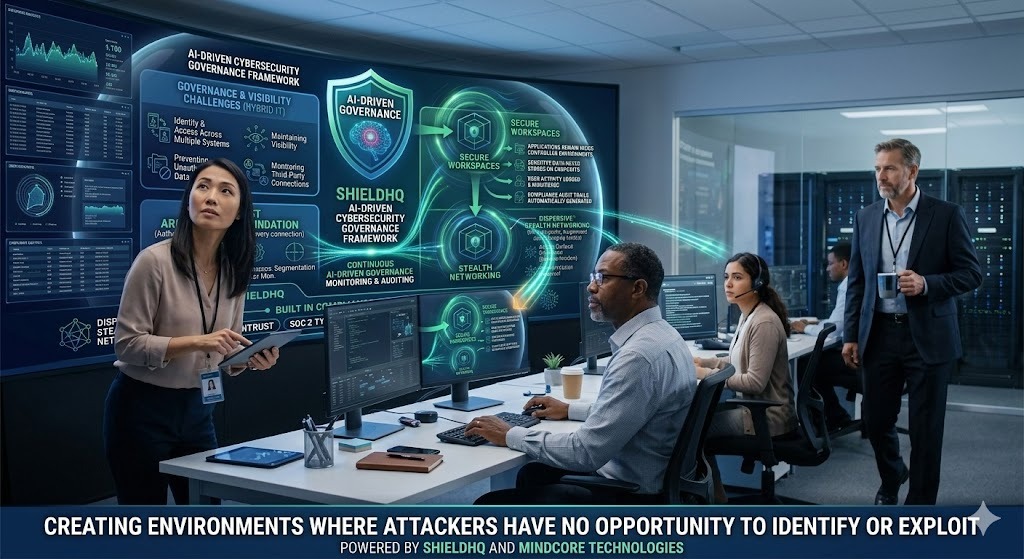

In this post, I will talk about how AI-Driven governance is changing enterprise cybersecurity.
Cybersecurity has traditionally focused on protecting networks from unauthorized access. Organizations deployed firewalls, monitoring tools, and endpoint protection systems to detect threats once attackers attempted to breach infrastructure.
However, modern cyber threats have become far more sophisticated. Attackers now rely on identity compromise, reconnaissance, and infrastructure mapping before launching ransomware or data-exfiltration attacks.
As a result, enterprises are shifting their security strategy toward governance-driven cybersecurity, where infrastructure, access policies, and compliance frameworks are managed through centralized platforms designed to prevent exposure rather than react to threats.
Platforms that combine secure workspaces, Zero Trust access, AI-driven governance, and invisible networking are increasingly becoming the foundation of this new security model.
Table of Contents
The Governance Challenge in Modern IT Environments

Enterprise IT environments have grown significantly more complex in recent years. Organizations now operate across hybrid cloud infrastructure, remote work environments, and distributed teams.
This complexity introduces several governance challenges.
- Managing identity and access across multiple systems
- Maintaining visibility into user activity and data usage
- Ensuring compliance with regulatory frameworks
- Preventing unauthorized data access or exfiltration
- Monitoring vendors and third-party connections
Without centralized governance, security teams often struggle to maintain full visibility and control over these environments.
This is why modern cybersecurity architecture increasingly relies on integrated governance platforms rather than disconnected security tools.
The Role of Secure Workspaces in Governance
Secure workspace environments are becoming an important component of governance-focused cybersecurity strategies.
A secure workspace is a controlled digital environment where users access applications and data without direct network exposure. Instead of connecting directly to internal systems, users interact with applications through secure sessions hosted in protected infrastructure.
This architecture offers several advantages for governance and security.
- Applications remain inside controlled environments
- Sensitive data is never stored on endpoint devices
- Access permissions can be tightly controlled
- User activity can be logged and monitored
- Compliance audit trails are automatically generated
By centralizing how users interact with systems, secure workspace platforms give organizations far greater control over access and activity monitoring.
Zero Trust as the Foundation of Access Control
Secure workspace environments are typically built on Zero Trust security architecture.
Zero Trust operates on the principle that no user or device should be trusted automatically. Every access request must be authenticated and verified before it is granted.
Key components of Zero Trust include:
- Identity verification for every login session
- Role-based access control limiting privileges
- Continuous monitoring of user behavior
- Segmentation of sensitive workloads
- Secure access for remote employees and partners
This approach ensures that access policies are enforced consistently across the organization.
Even if credentials are compromised, attackers cannot easily move laterally through the environment.
Eliminating Attack Surfaces Through Invisible Infrastructure
In addition to controlling access, many organizations are focusing on reducing the visibility of infrastructure itself.
Traditional networks often expose servers, applications, and communication paths to the internet. Attackers can scan these systems to identify vulnerabilities and plan attacks.
Invisible infrastructure removes these exposed entry points.
One technique used to achieve this is stealth networking, which fragments data traffic and disperses it across multiple encrypted paths. This prevents attackers from mapping infrastructure or reconstructing communications.
By hiding network paths and dispersing data across multiple routes, organizations dramatically reduce the number of opportunities attackers have to identify targets.
How ShieldHQ Combines Security, Governance, and Compliance

ShieldHQ integrates several advanced cybersecurity technologies into a single platform designed for enterprise and regulated industries.
The platform combines:
- Secure cloud workspaces
- Zero Trust identity-based access
- AI-driven governance and monitoring
- Compliance automation
- Stealth networking powered by Dispersive®
ShieldHQ’s architecture is designed to make infrastructure effectively invisible to attackers while enforcing strict governance policies across users, applications, and data.
The platform also provides built-in compliance support for frameworks such as:
- HIPAA and HITRUST
- SOC 2 Type II
- NIST and CMMC
- PCI-DSS and GDPR
By integrating compliance monitoring directly into infrastructure, organizations can simplify regulatory reporting while improving security posture.
Leadership Behind the Platform
ShieldHQ was developed by Mindcore Technologies, a cybersecurity and IT solutions provider with more than 30 years of experience helping organizations protect sensitive infrastructure and data.
The platform is led by Matt Rosenthal, CEO of Mindcore Technologies, who designed ShieldHQ to eliminate traditional network attack surfaces and help enterprises operate securely without relying on legacy VPN infrastructure.
This infrastructure-first philosophy reflects a broader industry trend toward proactive cyber defense.
Building the Governance-Driven Security Model
As organizations adopt hybrid work, cloud infrastructure, and distributed systems, governance and visibility will become even more important components of cybersecurity.
Forward-thinking enterprises are increasingly adopting platforms that combine:
- Secure workspace environments
- Zero Trust access controls
- AI-driven governance and monitoring
- Stealth networking technologies
- Compliance-ready security architecture
These technologies work together to create environments where sensitive systems remain protected, users operate within controlled access policies, and organizations maintain full visibility into activity and compliance.
In the evolving cybersecurity landscape, the organizations that succeed will be those that treat security not as a collection of tools, but as an integrated infrastructure designed for resilience and control.
INTERESTING POSTS
About the Author:

Meet Angela Daniel, an esteemed cybersecurity expert and the Associate Editor at SecureBlitz. With a profound understanding of the digital security landscape, Angela is dedicated to sharing her wealth of knowledge with readers. Her insightful articles delve into the intricacies of cybersecurity, offering a beacon of understanding in the ever-evolving realm of online safety.
Angela's expertise is grounded in a passion for staying at the forefront of emerging threats and protective measures. Her commitment to empowering individuals and organizations with the tools and insights to safeguard their digital presence is unwavering.


