


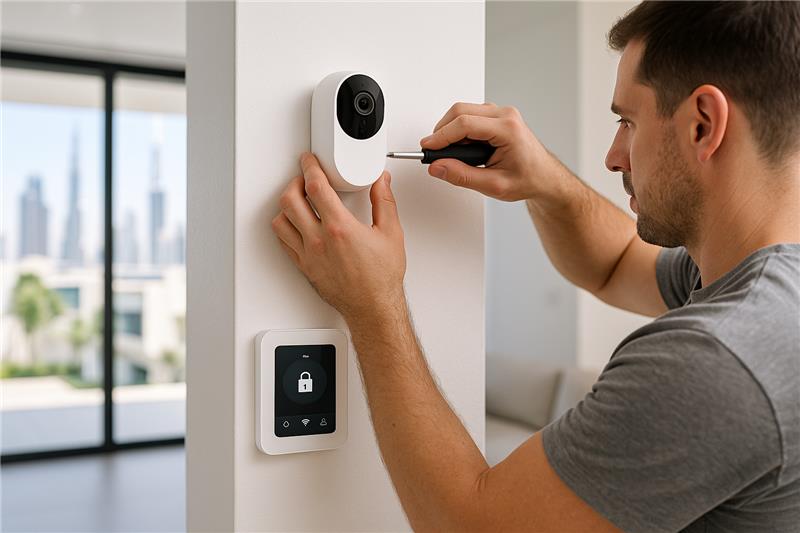

In the latest development, Dubai residential security installations double as prices fall and communities expand.
Dubai, UAE. The residential security market in Dubai reached AED 480 million in 2025. The Dubai Security Industry Association projects that figure will climb to AED 620 million by 2027. That trajectory is not driven by fear alone. It is driven by falling hardware costs, expanding villa communities, and a generation of homeowners who grew up with smartphones and expect to monitor their front door from wherever they happen to be.
Three years ago, a full residential security package in Dubai cost between AED 15,000 and AED 25,000. Today, systems with sharper resolution and cloud storage capability run AED 6,000 to AED 12,000. “That price drop has opened the market to middle-income homeowners who previously considered it out of reach,” said Omar Farouk, Technical Director at European Technical. “Better hardware at lower cost, combined with much higher awareness, explains most of the volume increase.”
The maths are simple. When a complete installation costs less than three months of a typical utility bill, the decision calculus changes.
Table of Contents
What a Standard Residential Security Package Now Includes in Dubai
The baseline specification has shifted considerably. Security system companies in Dubai are now quoting packages built around four to eight IP cameras, a hybrid alarm panel with cellular failover, perimeter motion detection, and remote monitoring through a smartphone application. That remote access has become the primary selling point, often ahead of the hardware specification itself. Homeowners in Dubai’s villa communities want to check a live feed from a business trip to London or verify a delivery at the gate from their office downtown.
The cellular backup deserves particular attention. A growing pattern in residential break-ins involves disrupting power or fibre connectivity before entry. A panel that automatically falls back to a 4G connection when the fixed line goes down addresses that vulnerability directly.
Dubai Police annual crime statistics for 2025 recorded a 12 per cent increase in reported residential burglary attempts. The absolute numbers remain low against global benchmarks, but a separate finding in the same report matters more for homeowners weighing the purchase decision: properties with visible security installations are targeted at rates 70 per cent lower than comparable properties without them. Physical deterrence, it turns out, does a significant portion of the work before any alarm is triggered.
Unfinished Communities Are Driving Demand in Dubai South and DAMAC Hills 2
Several of Dubai’s fastest-growing residential communities share a particular characteristic. Residents take possession of their homes while the surrounding development is still under active construction. Security gates are not yet fully operational. Contractor teams, delivery vehicles, and unfamiliar workers cycle through the neighbourhood daily.
“Residents in these communities often move in while the developer is still building the next phase,” Farouk said. “Construction workers are on-site, delivery vehicles come and go, and the permanent gates have not been fully commissioned. A home camera system is not paranoia in that context. It is common sense.”
Dubai South, DAMAC Hills 2, and Villanova each fit this profile. The same pattern extends into the industrial corridors surrounding these areas. Demand for home security installation in Al Quoz and the adjacent light industrial zones has grown among small business owners seeking remote visibility into warehouses and workshops during and after hours. The residential and commercial use cases have converged on the same hardware, the same price points, and the same installers.
Security Systems and Smart Home Platforms Are Now Sold as One Product
The boundary between a dedicated security installation and a smart home installation has largely dissolved. Modern IP cameras integrate directly with home automation platforms that manage lighting, door locks, and climate control through a single application. European Technical reports that 35 per cent of its security installations in the past twelve months included at least one smart home integration component. In 2023, that figure was 8 per cent.
“Homeowners are not purchasing security systems in isolation anymore,” Farouk said. “They want the cameras to trigger the porch light when motion is detected after 10pm. They want the alarm to arm automatically when the smart lock engages. It is all one system now, and clients expect it to behave that way.”
That integration changes how technicians approach a job from the first visit. Camera placement becomes a lighting trigger decision. Cable routing matters for the automation flow, not only the camera’s field of view. Scoping a security installation now requires understanding how it sits within the broader home technology stack.
Regulatory Gaps in Residential Installations Mean Quality Varies Enormously
The Security Industry Regulatory Agency (SIRA) governs commercial security installations in Dubai, requiring licensed technicians and SIRA-approved equipment. Residential work faces fewer regulatory requirements. That gap has attracted cut-price operators, handyman installs, and DIY systems that pass visual inspection but underperform when actually needed.
“We regularly get called to troubleshoot systems put in by handymen or, in some cases, the homeowner’s driver,” Farouk said. “Cameras positioned at the wrong angle, hard drives overwriting footage every 48 hours, wireless systems with no signal redundancy. A security system is only as reliable as the person who installed it.”
European Technical recommends three minimum standards before any homeowner accepts an installation. First, insist on a site survey before any equipment is specified. Second, specify cameras with at least 4MP resolution; below that threshold, licence plate recognition in the driveway becomes unreliable. Third, confirm at least 30 days of continuous recording storage. Thirty days sounds excessive until you consider that most incidents are reported days or weeks after they occur, well outside the 48-hour window that cheaper systems retain.
AI Video Analytics Is Already in Dubai’s Premium Villas, Mid-Market Will Follow
The hardware price cycle that halved installation costs over three years is giving way to a software-driven upgrade cycle. AI-powered video analytics can distinguish a delivery driver from someone loitering without purpose, flag unrecognised vehicles parked for extended periods near a property, and filter out the false positives that make standard motion alerts largely useless for most homeowners. Residents in Dubai’s premium villa communities are already specifying these capabilities at point of installation.
Broader mid-market adoption is a matter of timing, not direction. As analytics software moves from a premium option to a standard feature, the systems going into communities like Villanova and DAMAC Hills 2 today will be the ones being upgraded within three to four years.
Dubai’s residential footprint continues to expand. Property values continue to rise. The security market reflects both, and the shift toward AI-assisted monitoring means the next upgrade cycle has considerable momentum behind it already.
____________________________________________________________
European Technical is a Dubai-based home maintenance company providing air conditioning, plumbing, electrical, painting, and general maintenance services across Dubai and Abu Dhabi. Licensed by Dubai Municipality, the company serves residential and commercial clients with same-day emergency response capability. For further information, visit europeantechnical.ae or call 800 031 10015.
INTERESTING POSTS
About the Author:

Meet Angela Daniel, an esteemed cybersecurity expert and the Associate Editor at SecureBlitz. With a profound understanding of the digital security landscape, Angela is dedicated to sharing her wealth of knowledge with readers. Her insightful articles delve into the intricacies of cybersecurity, offering a beacon of understanding in the ever-evolving realm of online safety.
Angela's expertise is grounded in a passion for staying at the forefront of emerging threats and protective measures. Her commitment to empowering individuals and organizations with the tools and insights to safeguard their digital presence is unwavering.


